Tuesday, December 16th 2025

NVIDIA Powers Nearly 72% of Cloud Accelerator Locations, AMD at 5.8%
The cloud accelerator market share study was conducted at UBS bank, one of the leading research hubs and close followers of market trends. According to UBS, NVIDIA commands 71.2% of the cloud accelerator location share, which includes GPUs and other types of ASICs. The study also included AMD, and other ASICs. For the AMD front, the situation is entirely different as the data shows AMD only captures 5.8% of the cloud accelerator location share. The remaining portion is split between ASICs designed by the likes of AWS, Meta, Broadcom, MediaTek, and many others, which command 22.3%.
For NVIDIA, the company has managed to penetrate its GPUs in 258 datacenter locations, serving as cloud GPU providers. This is a significant number considering that some of these customers are ordering tens and even hundreds of thousands of GPUs at once, especially as the demand expands. NVIDIA is still the backbone of the entire AI infrastructure, and even its older GPUs, which include A100 and H100, are capturing a significant part of the GPU cloud market share. As "Blackwell" SKUs, designed for a million GPU scale systems, are scaled, and we enter the "Rubin" era, NVIDIA's lead may only expand.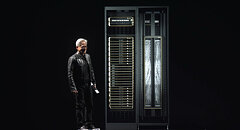
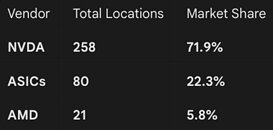 At the same time, AMD sits at 5.8% with its Instinct MI GPUs. These are a little rarer as they are only present at 21 datacenter locations out of the 359 in total. This makes AMD's solutions a rarity in cloud offerings, but that situation is slowly changing as more hyperscalers adopt AMD accelerators. The total addressable market is also expanding, which means that the room for some market share exchange between AMD and NVIDIA is also possible. For custom ASIC designs, the market is massive. UBS estimates that 22.3% of the datacenter locations awe powered by custom designs. This is likely driven by Google's TPUs and AWS Trainium chips, which power today's best AI models.
Source:
Ben Bajarin on X
For NVIDIA, the company has managed to penetrate its GPUs in 258 datacenter locations, serving as cloud GPU providers. This is a significant number considering that some of these customers are ordering tens and even hundreds of thousands of GPUs at once, especially as the demand expands. NVIDIA is still the backbone of the entire AI infrastructure, and even its older GPUs, which include A100 and H100, are capturing a significant part of the GPU cloud market share. As "Blackwell" SKUs, designed for a million GPU scale systems, are scaled, and we enter the "Rubin" era, NVIDIA's lead may only expand.


7 Comments on NVIDIA Powers Nearly 72% of Cloud Accelerator Locations, AMD at 5.8%
As for Nvidia, 70% of a trillion dollars market are enough to buy a country or a US state.
In the real free market, AMD has about 10-15%.
I personally don't think Google's internal devices are being accounted for, just the ones meant for GCP (their public cloud offering), which includes both Nvidia, AMD and TPUs.
In the real free market, AMD is rarely seen in public clouds. GCP has no AMD GPU instances available anymore, from what I remember, AWS only has a couple Radeon Pro instances for VDI, and no high-performing options (but it still has Gaudi, Qcom and even Xilinx FPGA options).
Azure has a grand total of 3 AMD GPU options, 2 Radeon Pros for VDI, and a single one with the aging MI25.
Those 3 vendors alone are the great majority of the public cloud market already.