News Posts matching #Asus

Return to Keyword Browsing

ASUS Intros the VG245Q Value Gaming Monitor

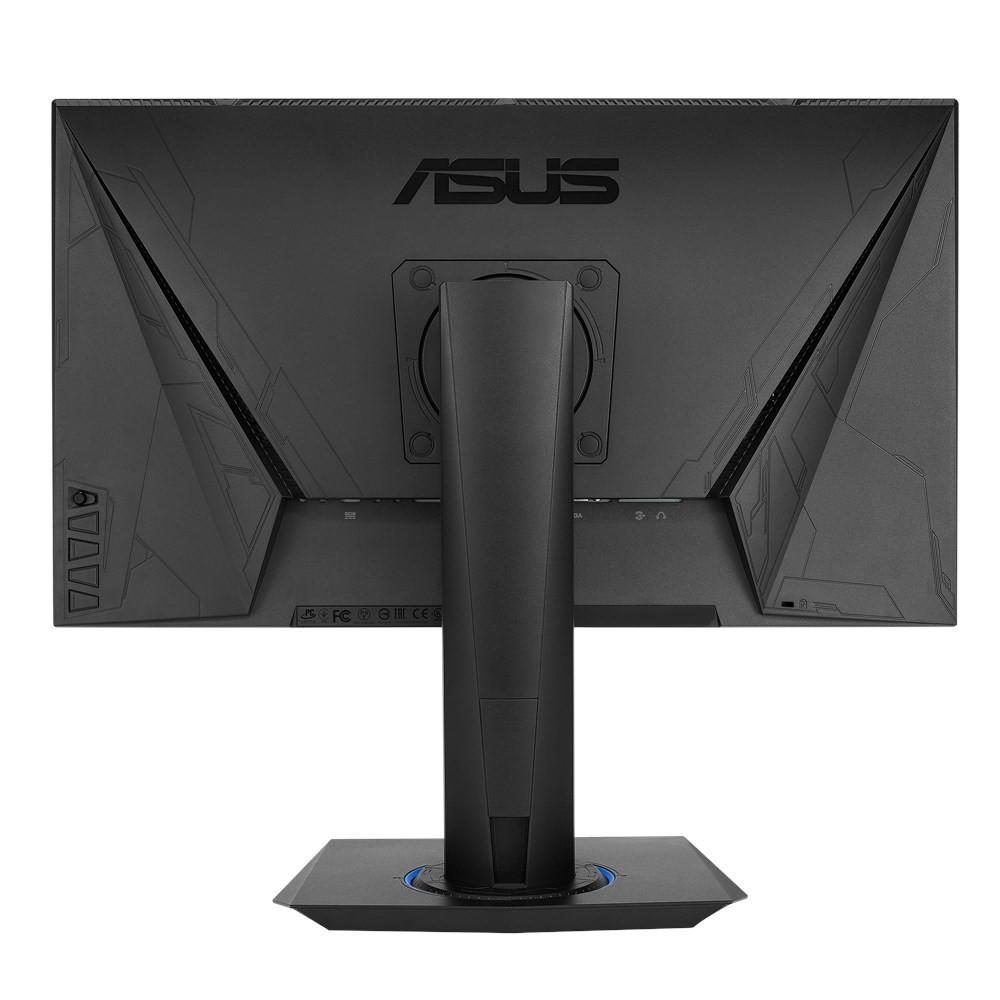
ASUS introduced the VG245Q, a 24-inch gaming-grade monitor targeting a sub-$250 price point. This monitor comes with 1 ms response time (GTG), and support for AMD FreeSync technology. Under the hood is a TN-film panel with Full HD (1920 x 1080 pixels) resolution, 250 cd/m² maximum brightness, 170°/160° viewing angles (H/V), and flicker-free LED brightness adjustment. The monitor comes with display presets optimized for the various genres of gaming (racing sims, RTS, RPG, FPS, etc). Inputs include one DisplayPort 1.2a (required for FreeSync), two HDMI 1.4a, and one D-Sub.

ASUS Announces the STRIX GD30 Gaming Desktop

ASUS Republic of Gamers (ROG) today announced Strix GD30, a powerful gaming desktop featuring a sleek black-and-white design, with interchangeable front panels that allow gamers to customize the system to suit their unique style. Equipped with up to the latest 7th Generation Intel Core i7 processors and NVIDIA GeForce GTX 1080 graphics, ROG Strix GD30 delivers unrivaled performance for incredible gaming and multimedia experiences.

An advanced thermal system - featuring large air vents at the front and underside plus an isolated power supply chamber - provides improved airflow for better cooling and greater system efficiency. Exclusive ASUS Aegis III software enhances gaming experiences by allowing gamers to track CPU and memory usage, monitor networking status, and control fan speeds and ASUS Aura RGB lighting effects.

ASUS GeForce GTX 1080 Ti STRIX Specifications Surface

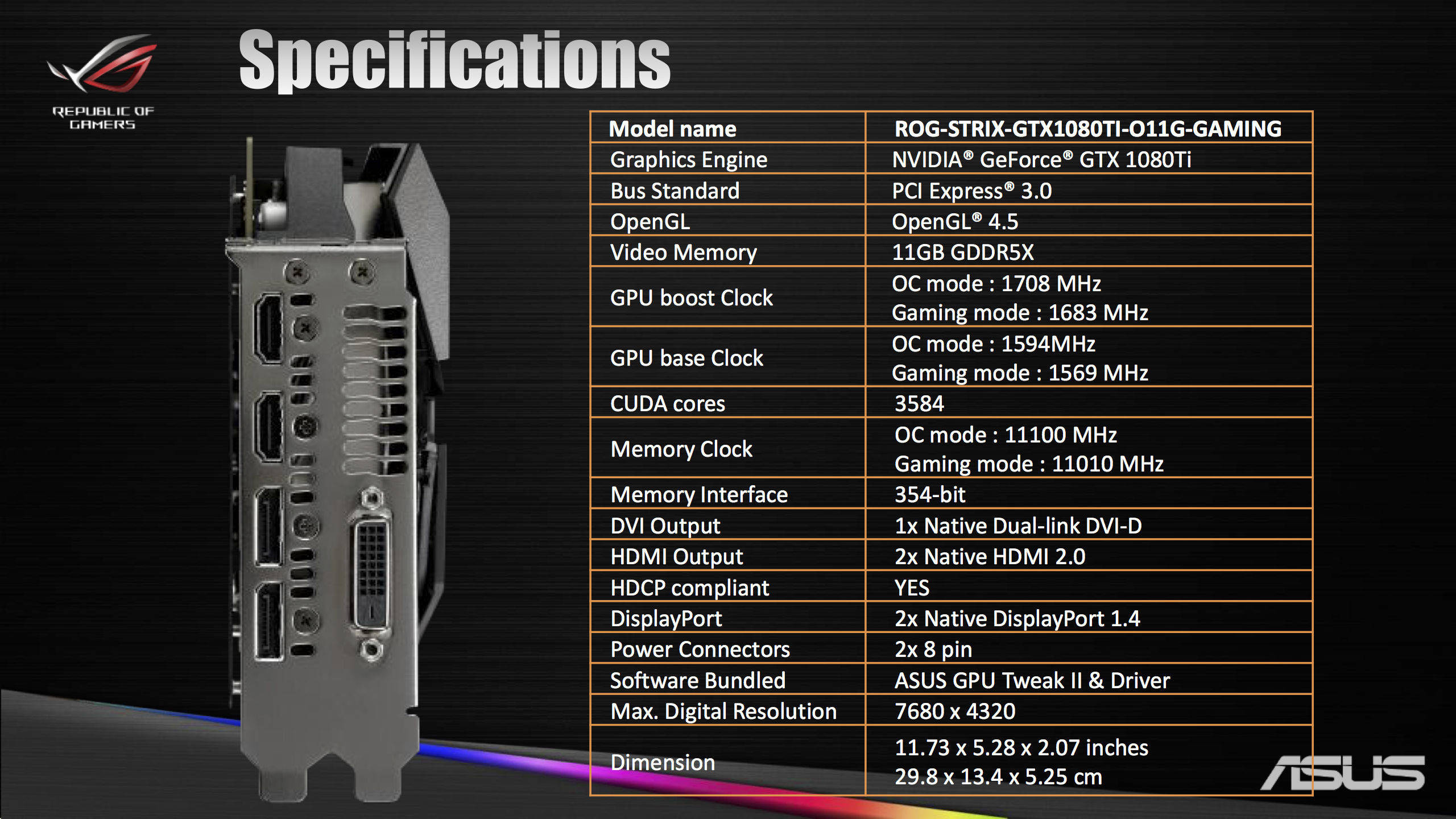
Ahead of its launch, specifications of the GeForce GTX 1080 Ti STRIX graphics card by ASUS, appeared on the web thanks to a leaked press-deck. The one spec on most people's minds is the factory-overclock. Out of the box, in the so-called "gaming mode," the card is clocked at 1569 MHz core, 1683 MHz GPU Boost, and an untouched 11 GHz (GDDR5X-effective) memory. The "OC Mode," a clock-speed preset that you activate with the included GPUTweak II software, runs the card at 1594 MHz core, 1708 MHz GPU Boost, and 11.1 GHz memory.

It turns out that the DirectCU III cooler deployed on the GTX 1080 Ti STRIX is indeed beefier than the one found on the GTX 1080 and GTX 1070 STRIX cards; with ASUS claiming up to 30% lower temperatures, thanks to a 40% increase in surface area of the heatsink. ASUS took advantage of the heavier heatsink to lower fan-noise, which it claims to be significantly lower than the reference-design card. The company is also using a newer thermal interface material (TIM) called "MaxContact," which due to its particle density, can get up to 10 times flatter than conventional TIMs, for lower thermal resistance posed by the TIM, and higher conductivity. Display outputs of this card include two each of HDMI 2.0b and DisplayPort 1.4 ports.

EK Releases EK-FB ASUS Z270E Strix RGB Monoblock for ASUS Z270 Motherboards

EK Water Blocks, the world leading premium liquid cooling manufacturer, is proud to release a monoblock liquid cooling solution for several ASUS Z270 motherboards. EK-FB ASUS Z270E Strix RGB Monoblock is compatible with ASUS Aura Sync, thus offering a full lighting customization experience!

Designed and engineered in cooperation with ASUS, this monoblock uses the award-winning EK-Supremacy EVO cooling engine to ensure best possible CPU cooling performance. This water block directly cools Intel LGA-1151 socket type CPU and power regulation (MOSFET) module as water flows directly over all critical areas. It is a very high flow water block that can be easily used with the system using weaker water pumps.

ASUS GeForce GTX 1080 Ti ROG STRIX and Turbo Pictured

Besides the NVIDIA reference-design $699-ish GeForce GTX 1080 Ti, which doesn't come with a $100 Founders Edition sucker-tax, ASUS is giving final touches to at least two custom-design models, the GTX 1080 Ti ROG STRIX, and the GTX 1080 Ti Turbo, pictured in a leaked press image, below. The GTX 1080 Ti Turbo is positioned to be the more affordable of the two, and it won't surprise us if ASUS prices it cheaper than even its reference-design SKU. The card features a lateral-flow cooling solution strapped onto a PCB that closely resembles the reference-design.

Next up, is the company's Republic of Gamers (ROG) STRIX card, which could likely come in two variants, an OC variant with factory-overclocked speeds, and a standard variant that either ticks at reference speeds, or close-to-reference speeds. These cards feature a beefier variant of the DirectCU III cooling solution the company launched with its GTX 1080 STRIX cards, which comes with ASUS Aura Sync RGB LED lighting. The cooler will be mated to a custom-design PCB with a strong VRM, multiple case fan-headers (yes, case fan headers), and preparation for front-panel VR HMD connectivity.

ASUS Unveils the TinkerBoard to Rival Raspberry Pi and Intel Edison

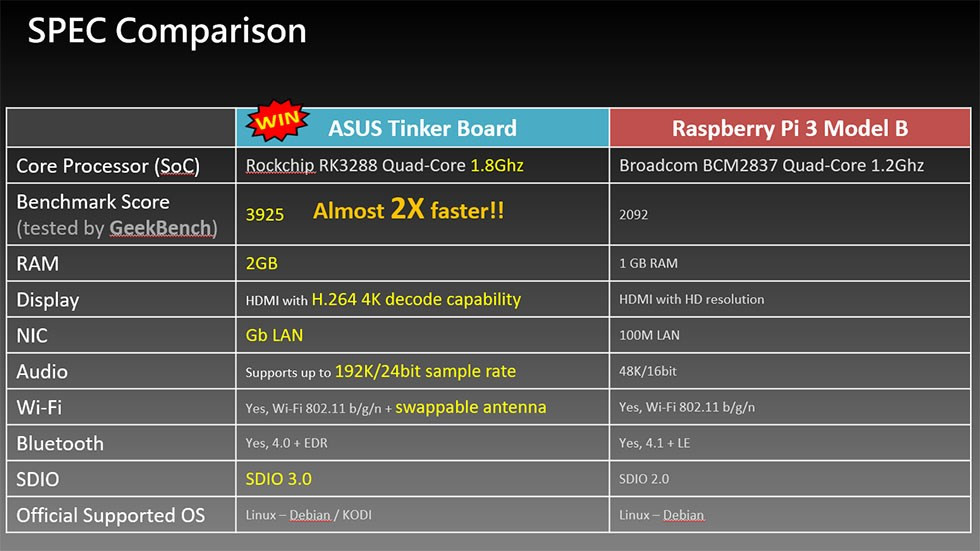
As the world's number one PC motherboard manufacturer by volume, it would be a shame if ASUS didn't pander to the budding engineers and electronics hobbyists among you with a product that rivals the Raspberry Pi and Intel Edison. That product is the TinkerBoard, a card-sized single-board computer with a ton of I/O, including support for 4K Ultra HD displays. At the heart of this board is a Rockchip RK3288 SoC, which embeds a 32-bit quad-core ARM Cortex-A17 CPU, and a Mali T764 GPU. This chip is topped off by 2 GB of dual-channel memory. The most prominent Raspberry Pi competitor to this board is the Pi 3 Model B, with its 64-bit Broadcom BCM2837 chip, and a starting price of just $35.

Other features of the TinkerBoard include a GPIO that rivals Raspberry Pi, 4K Ultra HD H.264 video decode capability, gigabit Ethernet, SDIO 3.0, 24-bit/192 kHz HD audio, and a swappable antenna for its 802.11 b/g/n WLAN. While the specifications check out well in favor of the TinkerBoard, it all comes down to pricing. Hobbyists working on robotics projects, for example, purchase Raspberries Pi by the dozens thanks to their low price. ASUS should do well to keep that in mind when pricing this board.

ASUS Announces Availability of the Designo Curve MX34VQ With Qi Charging

After announcing it on mid-2016, ASUS is finally coming through with its announcement of a unique take on the widescreen monitor department. Dubbed the Designo Curve, the MX34QV stays true to the design implied in its name, presenting an interesting mix of straight lines and a nicely curved, organic base, which incidentally supports wireless Qi charging. I find the aesthetics on this monitor pleasing and subdued, even though some liberties have been taken with that exquisite Qi charging base, which lights up in a cool blue lighting.

EK Releases Monoblock for ASUS Maximus IX Hero

EK Water Blocks, the world renowned premium liquid cooling manufacturer, is proud to release their monoblock liquid cooling solution for the ASUS ROG Maximus IX Hero motherboard. The EK-FB ASUS M9H is first in the line of monoblocks for socket 1151 ASUS Z270 chipset motherboards. EK-FB ASUS M9H Monoblock is a complete all-in-one (CPU and motherboard) liquid cooling solution for the new Intel Z270 Express Chipset LGA1151 ASUS ROG Maximus IX motherboard that supports the latest 7th generation and 6th generation Intel Core Processors as well.

Designed and engineered in cooperation with ASUS, this monoblock uses award-winning EK-Supremacy EVO cooling engine to ensure best possible CPU cooling. This water block directly cools Intel LGA-1151 socket type CPU, as well as the power regulation (MOSFET) module. Liquid flows directly over all critical areas, providing the enthusiasts with a great solution for high and stable overclocks. Like with every EK monoblock, EK-FB ASUS M9H features high flow design and this monoblock can be easily used with the system using a weaker water pump as well.

Team Group Announces the T-FORCE DARK Series Memory Asus ROG Certified

Team Group, the world's leading memory brand, today officially announces the launch of the popular ASUS ROG certified memory product, the T-FORCE DARK memory. ROG (Republic Of Gamers) is a gaming brand established in 2006. It represents the ultimate performance and top quality that gamers around the world keep pursuing. Team Group's T-FORCE DARK memory is rigorously tested and certified by ASUS officials to obtain the ROG certification. Together with ASUS motherboards, the consumers can have all the top gaming hardware at once to fully enjoy an extreme gaming and entertainment experience.

T-FORCE DARK is both unique and eye catching thanks to its unique feature of being the first and only to utilize a four-piece heat-spreader in the industry. In addition to advancing from previous two-piece heat spreaders, it also adds a combination of two more arched fins to increase radiating area and provide up to 8% better dissipation performance than traditional heat spreaders. Besides ROG certification and performance improvements, its killer look of a dark knight's armor is combined with ROG's unique elements such as the ROG abstract patterns together with the mighty ROG log. Consumers can freely choose from the eye catching colors of black and red, or the calming colors of black and grey to build up the perfect gaming memory.

ASUS Also Announces the DSL-AC88U Gaming Grade Modem Router

ASUS today announced DSL-AC88U, an ultra-fast AC3100 dual-band Wi-Fi modem router that supports the latest high-speed G.fast DSL standard as well as all existing ADSL, ADSL2/2+ and VDSL2 standards. DSL-AC88U is our fastest ever modem router, featuring cutting-edge Broadcom NitroQAM technology that delivers 1.25X-faster Wi-Fi speeds than standard four-stream (4x4) routers. This enables data rates of up to 2167Mbps on the 5GHz band and 1000Mbps on the 2.4GHz band - or a combined concurrent bandwidth of up to 3167 Mbps.

DSL-AC88U has family-friendly parental controls that allow users to monitor and filter internet activity, which can help to protect the online safety of younger family members. In addition to its wide compatibility with G.fast and existing DSL broadband services, DSL-AC88U can also connect to the internet via an Ethernet connection, such as those provided by fiber- or cable-modem-based ISPs. These outstanding connectivity options make DSL-AC88U a supremely flexible and future-proof choice for any home user.

ASUS Announces the ROG Strix Impact Gaming Mouse

ASUS Republic of Gamers (ROG) today announced Strix Impact, a wired optical gaming mouse with a lightweight and ergonomic ambidextrous design optimized for multiplayer online battle arena (MOBA) games. Built with the essential qualities of lightness, speed, comfort, and durability that MOBA gamers need to triumph and have fun during marathon sessions, ROG Strix Impact is a reliable and effective gaming weapon.

Flexible customization options available in the intuitive ROG Armoury software let gamers change different aspects of the operation of ROG Strix Impact, and ASUS Aura Sync RGB lighting lets them express their personal style and synchronize lighting with other Aura-enabled products. ROG Strix Impact is built to last with durable Omron switches that are rated to 50 million clicks. Thoughtful design details include a DPI switch and indicator to adjust tracking speed on the fly, and a low-friction, drag-free cable for fast, easy movement.

ASUS Intros Z270-WS Workstation Motherboard

ASUS today unveiled the Z270-WS socket LGA1151 motherboard targeted at DIY workstation builds. Based on the Intel Z270 Express chipset, the board supports 7th generation Core "Kaby Lake" processors. What sets this board apart from most of the company's Z270 motherboard lineup is its PLX PEX8747 PCI-Express 3.0 x48 bridge chip. The board features a 12-phase CPU VRM with server-grade electrical components. The CPU socket is wired to four DDR4 DIMM slots, and three PCI-Express 3.0 x16 slots over the bridge chip (x16/NC/x16 or x16/x8/x8). The fourth x16 slot is electrical x4 and wired to the PCH. An open-ended PCI-Express 3.0 x4 completes the expansion area. The board draws power from a combination of 24-pin ATX, 8-pin EPS, and 6-pin PCIe power connectors.

Storage connectivity on the Z270-WS includes six SATA 6 Gb/s, two 32 Gb/s M.2, and two 32 Gb/s U.2 ports. The board supports Intel Optane (3D X-point SSD) technology. Network connectivity includes two gigabit Ethernet interfaces, one driven by an Intel I210-AT controller, and another by Intel I210-LM. USB connectivity includes six USB 3.0 and four USB 3.1 ports (including one type-C port). The board offers 8-channel HD audio driven by a 115 dBA SNR CODEC. The company didn't reveal pricing.

ASUS ROG Crosshair VI Hero Flagship Motherboard Detailed

Crosshair is the brand that kicked off ASUS' coveted Republic of Gamers (ROG) series. The NVIDIA nForce chipset based ROG Crosshair socket AM2 motherboard was the board to have, in AMD's hayday as the leader in CPU performance. Over the years, the Crosshair brand received lesser love from ASUS, as AMD's chipset releases became infrequent, due to the company's slower CPU product development cycle than Intel. With the new socket AM4 platform and its companion AMD X370 chipset for the high-end segment, ASUS is back with a Crosshair branded motherboard, the ROG Crosshair VI Hero. It's interesting that ASUS chose not to give it the "Formula," "Extreme" or "Apex" extensions, and instead with the "Hero" extension it reserves for the $200-230 ROG branded boards.

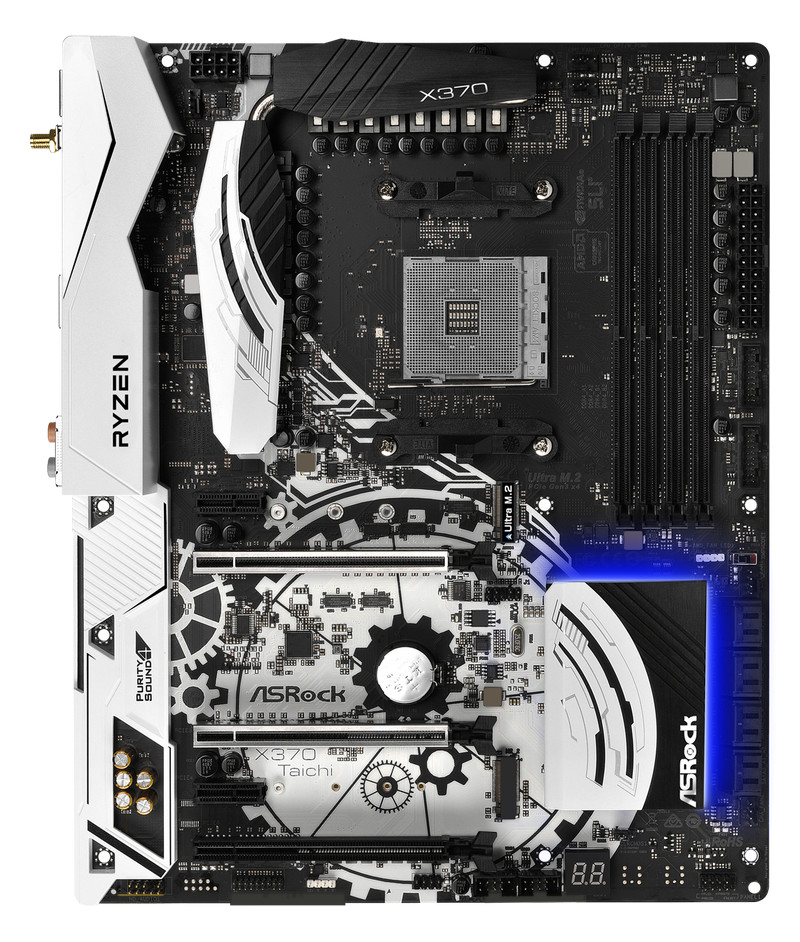
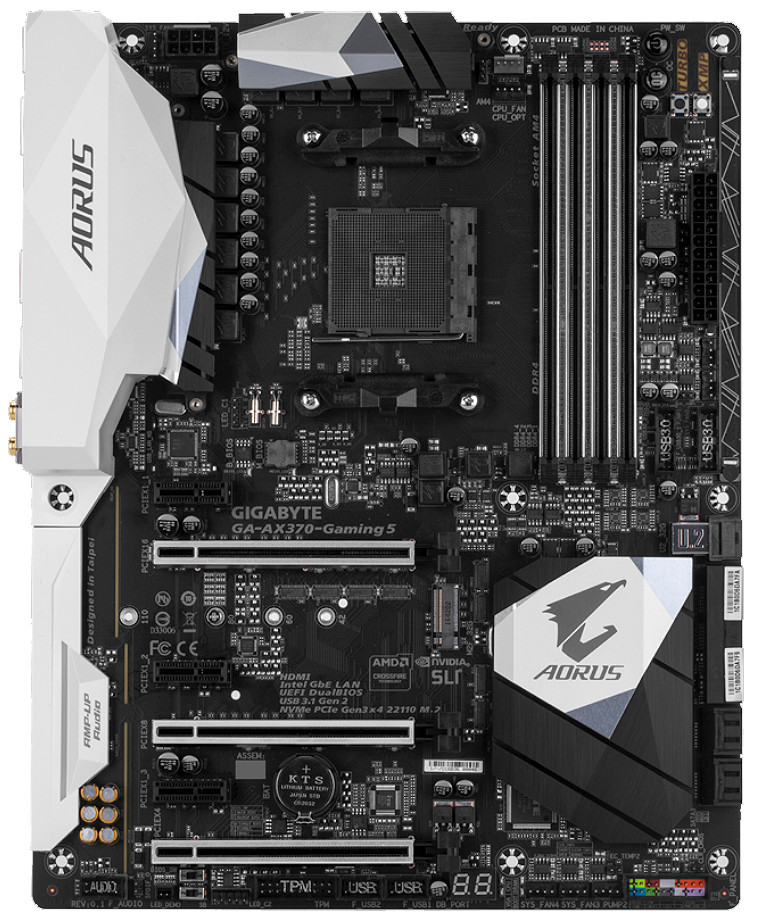
Nevertheless, the ROG Crosshair VI Hero looks to be one of the most elaborately designed socket AM4 motherboards, and will compete with the likes of the Aorus AX370 Gaming 5 and the MSI X370 XPower Gaming Titanium. Built in the ATX form-factor, the Crosshair VI Hero draws power from a combination of 24-pin ATX, 8-pin EPS, and 4-pin ATX power connectors, and conditions it for the CPU with a 12-phase VRM. The board features a "monochromatic design," so you can deck it up with your own LED lighting. It does feature RGB LED headers, with support for ASUS Aura Sync platform. The board has its own diagnostic LEDs that guide you through the POST sequence. Besides the ROG stylized chipset and CPU VRM heatsinks, the board features plastic I/O shield covers that run the length of the board.

ASUS Intros the B150M Expedition Motherboard

ASUS' new line of PC hardware targeted at gaming iCafes under the Expedition brand grows, with its first motherboard, the B150M Expedition (model: EX-B150M-V5 D3). These products are designed to be durable enough for the rigors of gaming iCafes, at affordable prices, though not as apocalypse-survivalist as the company's coveted TUF series. The B150M Expedition is a socket LGA1151 motherboard with DDR3 memory support. It features two memory slots that support up to 16 GB of dual-channel DDR3-1866 memory. The memory slots have an anti-theft feature that lets you screw-in the modules to the slots.

The narrow micro-ATX board draws power from a combination of 24-pin ATX and 8-pin EPS power connectors, and conditions it for the CPU with a 7-phase VRM. Expansion slots include one PCI-Express 3.0 x16, and two PCI-Express 3.0 x1. Storage connectivity includes four SATA 6 Gbps ports. USB connectivity includes eight USB 3.0 ports (six on the rear panel, two via headers). Networking is care of a single gigabit Ethernet interface driven by a Realtek RTL8111GR controller. ASUS deployed the gaming-grade Crystal Audio 2 onboard audio solution, with a Realtek ALC887 6-channel HD audio CODEC, ground-layer isolation, audio-grade capacitors, and a headphones amp. The board also features a PS/2 port for legacy input devices. ASUS didn't disclose pricing.

ASUS Intros the GeForce GTX 1070 Expedition Graphics Card

ASUS announced the GeForce GTX 1070 Expedition series graphics card. Based on the company's new Expedition line of durable graphics cards, which made its debut this CES, with the GTX 1050 Ti Expedition, this card is designed with a focus on durability and longevity. Each card on the production line has been stress-tested against the elements for longer than the other cards. This includes 144 hours of continuous stress, 2-hour reboot test (continuous reboots), and 15 hours of 3DMark stress. The idea here is to make the cards fit for the rigors of gaming iCafes, which are popular in some parts of Asia.

The GTX 1070 Expedition comes with a factory OC of 1607 MHz core, 1797 MHz GPU Boost, and an untouched 8.00 GHz (GDDR5-effective) memory, against reference clocks of 1506/1683 MHz. It features a dense aluminium fin-stack heatsink with a single fin array to which heat drawn directly from the GPU is conveyed by a pair of 8 mm-thick nickel-plated copper heat pipes. The card draws power from a single 8-pin PCIe power connector. Display outputs include three DisplayPorts, and one each of HDMI and DVI. The company didn't reveal pricing or availability information, although it's likely that this card could see a release limited to certain east Asian markets.

Nanoxia Announces its Rigid LED Strips and ASUS Aura Compliant LED Controller

Nanoxia is very happy to announce that none other than ASUS was so impressed by the RGB Rigid LED that they certified them with the AURA SYNC label. Meaning, they are perfectly suited to be connected to the 4-Pin RGB-Header of the latest ASUS motherboards, like the Z270E GAMING, the X99 GAMING or the MAXIMUS IX FORMULA. The ASUS AURA SYNC software is perfect to control the RGB LEDs.

The 30 cm long RGB Rigid LED is equipped with 27 ultra-bright SMD5050 LED. Up to 16.7 million different colors can be chosen from, if you use the appropriate software with our RGB Rigid LED bar - like the outstanding ASUS AURA SYNC. It's also easily possible to use various lighting modes, for example strobe-effects, color circles or breathing-pulses.

ASUS DIMM.2 is an M.2 Riser Card

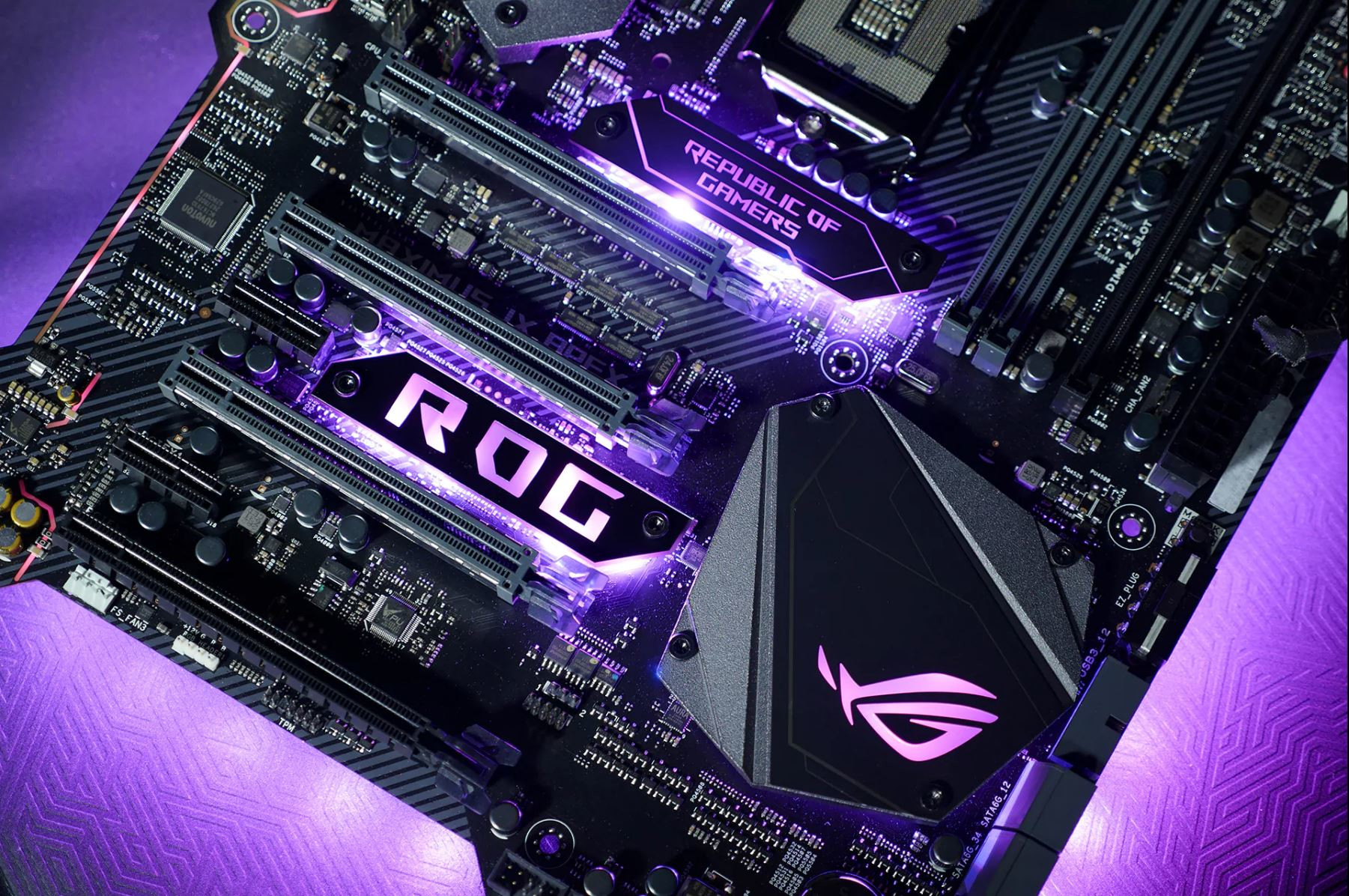
Here's a close-up view of the DIMM.2 accessory being included with ASUS Maximus IX Apex motherboard. The DIMM.2 card is a riser designed to decongest the crowded motherboard that has no room for M.2 slots. The DIMM.2 accessory is a PCB with two 32 Gb/s M.2 slots, and a riser interface that's similar to a DDR3 DIMM (so inserting DDR3 DIMMs this slot won't work).

ASUS ProArt PA32U is a Beautiful 4K-HDR Monitor

ASUS ProArt series of monitors are designed to look good on a corporate hotshot's desk, and the PA32U is no exception. This 32-inch monitor features a Quantum Dot display panel, which can reproduce 99.5% of the Adobe RGB color-space, 85% of REC.2020, 95% of DCI-P3, and 100% of sRGB. The star attraction here is 4K-HDR support, which is achieved using a full 384-zone direct-LED backlight matrix. The LED driver electronics operate at 1 ms, for more realistic HDR in videos. The monitor takes input from Thunderbolt, in addition to DisplayPort.

ASUS Also Unveils the ROG GR8 II Gaming Desktop

ASUS launched its smaller yet more powerful gaming desktop than the VivoPC X, it also unveiled this CES. The Republic of Gamers (ROG) GR8 II is the second generation GR8 compact gaming desktop. It's roughly the size of a PlayStation 4 console, but packs a wallop - Intel Core i7-7700 "Kaby Lake" processor, and NVIDIA GeForce GTX 1060 6 GB graphics. Also featured is up to 32 GB of dual-channel DDR4 memory, M.2 PCIe SSD, and an additional 2.5-inch SATA HDD. The chassis features RGB LED lighting elements, which can be controlled using the ASUS Aura Sync software.

ASUS Shows Off its VR-Ready VivoPC X

ASUS, at its 2017 International CES booth, showed off its VR-Ready gaming desktop for the living room, the VivoPC X. Roughly the size of a PlayStation 4 Pro game console, this desktop meets Oculus Rift premium requirements. Under the hood is a custom-design motherboard that lacks display connectors of its own, so you don't confuse them with those of the graphics card.

Driving the VivoPC X is an Intel Core i5-7500 "Kaby Lake" processor, 16 GB of dual-channel DDR4 memory, NVIDIA GeForce GTX 1060 graphics, and storage options that include M.2 SSDs, and SATA SSDs. The desktop features 802.11ac WLAN, Bluetooth 4.0, gigabit Ethernet (Intel controller), 6-channel HD audio, and USB 3.0 ports that include a type-C port.

NZXT & ASUS Stand Together with Noctis 450 ROG

NZXT announces today the Noctis 450 ROG, a Special Edition case aimed at dedicated PC Gamers. This ATX mid-tower case is ROG-certified, displays an exclusive Gun Gray finish and features Aura Sync RGB-lighting technology.

"The original Noctis 450 highlighted NZXT's return to bold and daring designs. As we joined forces with Republic of Gamers (ROG) to develop a dedicated case for high-end gaming systems, it felt like the perfect tailored fit to build a Special Edition case. With exclusive aesthetics, ROG certification and Aura sync compatibility leading to new features, Noctis 450 ROG focuses on users aiming at building powerful systems that leverages the Republic of Gamers ecosystem," says Johnny Hou, NZXT's founder and CEO.

NVIDIA Announces the G-SYNC HDR Technology

NVIDIA today announced the G-SYNC HDR technology. An evolution of the company's proprietary adaptive display sync technology, which keeps the display's refresh-rates dynamically in-sync with the graphics card's frame-rates, G-SYNC HDR, as its name suggests, adds support for HDR (high dynamic range) displays. NVIDIA's partner display manufacturers such as Acer, and ASUS have each announced displays with this technology, which will will be available later this year.

NVIDIA worked with display panel maker AUOptronics to develop G-SYNC HDR. It leverages full 384-zone LED backlights, and a quantum-dot technology. The monitors rely on wide color gamuts, with 10-bit (1.07 billion color palettes) to bring HDR to life. G-SYNC HDR monitors come with support for the HDR10 standard. The year's most anticipated game, "Mass Effect: Andromeda," will come with support for G-SYNC HDR.

AMD Announces X370 Motherboards: Ryzen Approaches

At CES 2017, AMD made a statement on their new AM4's platform readiness to market, revealing some of the upcoming AM4 motherboard designs coming to end users for their Ryzen CPUs and Bristol Ridge. All in all, there were sixteen boards being displayed from the major manufacturers, including overclocking and gaming-oriented models. These boards will be the base for system integrator PC designs to come, with at least seventeen SIs coming on board for today's announcement.

ASUS Announces its 200-series Chipset Motherboard Family

ASUS today announced its complete 2017 lineup of Z270 motherboards designed to maximize the potential of 7th Generation Intel Core processors. The new range includes the highly-anticipated next-generation Republic of Gamers (ROG) Maximus IX gaming motherboards - with Maximus IX Apex having already secured its place in history by claiming eight world records and 13 global first places in some of the world's toughest benchmarks.

Also included in the lineup are the latest ROG Strix gaming motherboards for style-conscious enthusiast, the all-new ASUS Prime series for everyday customization and tuning, and the latest ASUS TUF boards with 24/7 stability and newly-added overclocking abilities. The ASUS workstation motherboard series has also been updated for the Z270 revolution - and all boards are loaded with exclusive technologies to enable users to extract every ounce of performance from Intel's latest CPUs.

ASUS Intros Four Z270 STRIX Series Motherboards

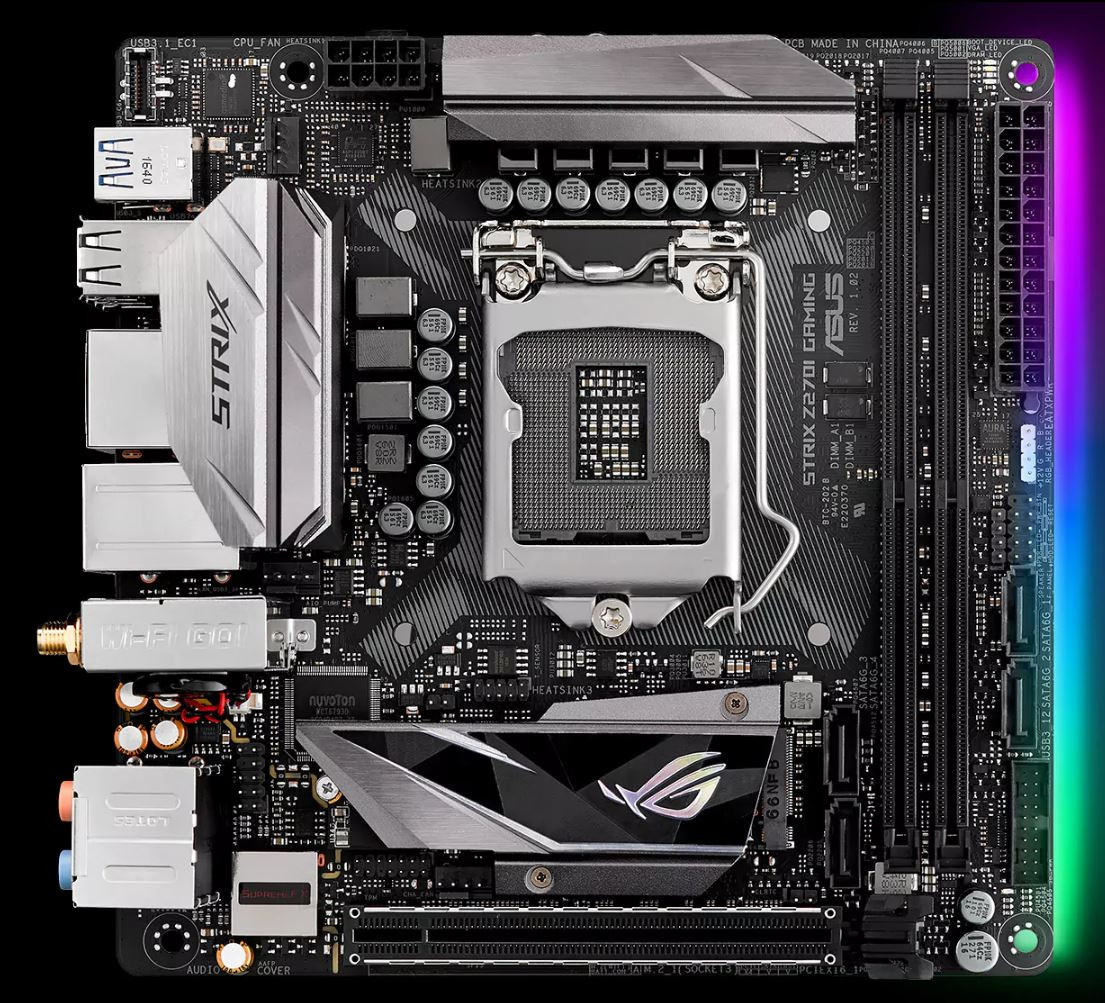
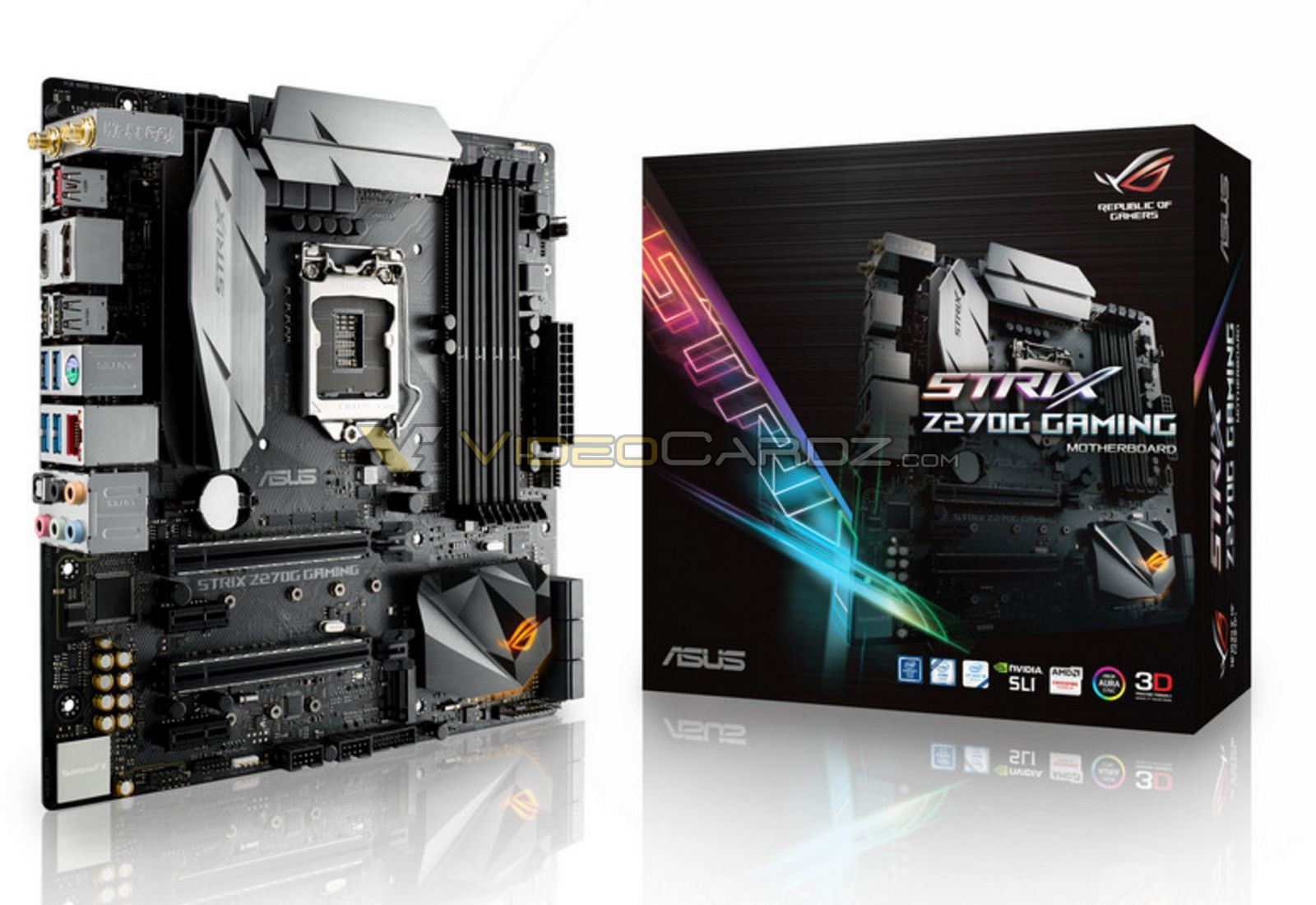
The STRIX series of motherboards for ASUS are characterized by their multi-color (RGB) LED flair over practical mid-segment motherboards. These boards come with headers that simplify RGB LED case lighting using the ASUS Aura software. The company is ready with four such boards, the STRIX Z270H-Gaming and STRIX Z270E-Gaming in the ATX form-factor; the STRIX Z270G-Gaming in the micro-ATX form-factor; and the STRIX Z270I-Gaming, in the mini-ITX form-factor. The Z270H-Gaming is the lighter of the two ATX boards in terms of features, although you still get a 6-phase VRM, two PCI-Express 3.0 x16 slots with SLI support, two M.2 slots, 8-channel gaming-grade audio, and two USB 3.1 ports. The PCH heatsink has a groovy RGB LED ornament. The Z270E-Gaming leads the series, with a 10-phase VRM, 802.11ac WLAN, reinforced PCIe x16 slots, and RGB LED elements located in a large I/O area shroud that extends into the VRM heatsinks.

The Z270G-Gaming is the micro-ATX offering from this lineup. It has more features than the Z270H-Gaming, but fewer slots than the Z270E-Gaming. You get the same 10-phase VRM, and connectivity that includes gaming-grade audio, USB 3.1 ports, two M.2 slots, but no I/O shroud, and the RGB LED element is located in the PCH heatsink. The Z270I-Gaming is brimming with features, including concealed M.2 slot, a reinforced PCIe slot, 8-channel HD audio, 802.11ac WLAN, four SATA 6 Gb/s ports. RGB LED lighting is care of an LED strip located in the reverse side of the PCB, along the right edge of the PCB.

Return to Keyword Browsing
Nov 26th, 2026 01:45 CST change timezone

New Forum Posts

Popular Reviews

TPU on YouTube

Controversial News Posts