News Posts matching #Data Center

Return to Keyword Browsing

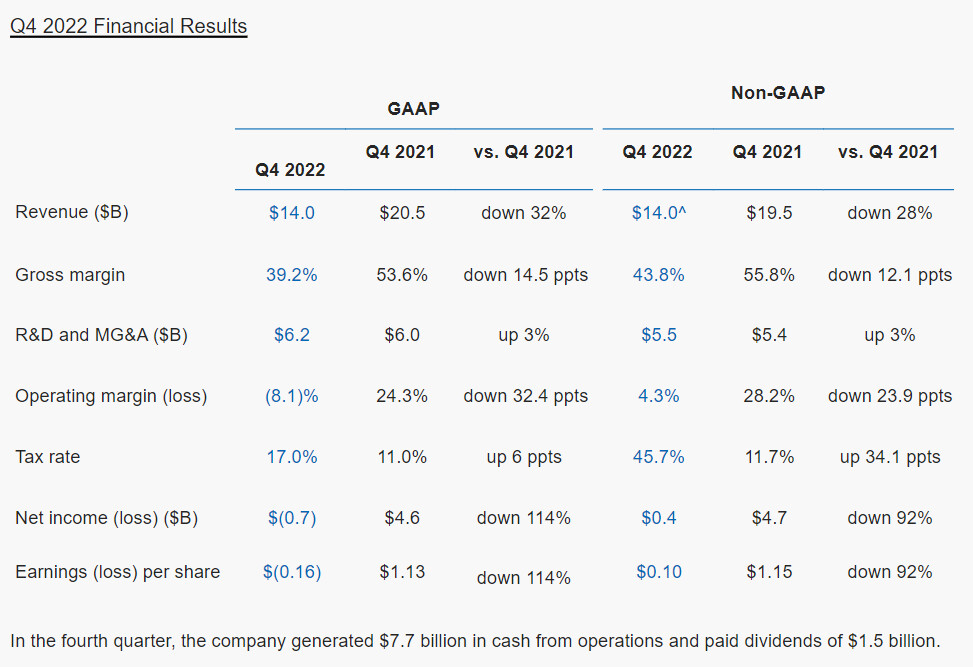
Intel Reports Fourth-Quarter and Full-Year 2022 Financial Results, Largest Loss in Years

Intel Corporation today reported fourth-quarter and full-year 2022 financial results. The company also announced that its board of directors has declared a quarterly dividend of $0.365 per share on the company's common stock, which will be payable on March 1, 2023, to shareholders of record as of February 7, 2023.

"Despite the economic and market headwinds, we continued to make good progress on our strategic transformation in Q4, including advancing our product roadmap and improving our operational structure and processes to drive efficiencies while delivering at the low-end of our guided range," said Pat Gelsinger, Intel CEO. "In 2023, we will continue to navigate the short-term challenges while striving to meet our long-term commitments, including delivering leadership products anchored on open and secure platforms, powered by at-scale manufacturing and supercharged by our incredible team."

Lenovo Unveils Next Generation of Intel-Based Smart Infrastructure Solutions to Accelerate IT Modernization

Today, Lenovo unveiled 25 new ThinkSystem and ThinkAgile server and hyperconverged solutions powered by Intel's 4th Generation Xeon Scalable Processors as part of its recently announced Infrastructure Solutions V3 portfolio. Designed to help accelerate global IT modernization for organizations of all sizes, the integrated solutions deliver advanced performance, efficiency and management capabilities specifically optimized for complex workloads, including mission-critical, AI, HPC and containerized applications.

"In today's competitive business climate, modern infrastructure solutions that generate faster insights and more efficiently enable complex workloads from the edge to the cloud are critical across every major industry," said Kamran Amini, Vice President and General Manager of Server & Storage, Lenovo Infrastructure Solutions Group. "With the performance and management improvements of the Intel-based ThinkSystem V3 portfolio, customers can reduce their IT footprint by up to three times to achieve greater ROI and more easily transform their infrastructure with one seamless platform designed for today's AI, virtualization, multi-cloud and sustainable computing demands."
Intel Launches 4th Gen Xeon Scalable Processors, Max Series CPUs and GPUs

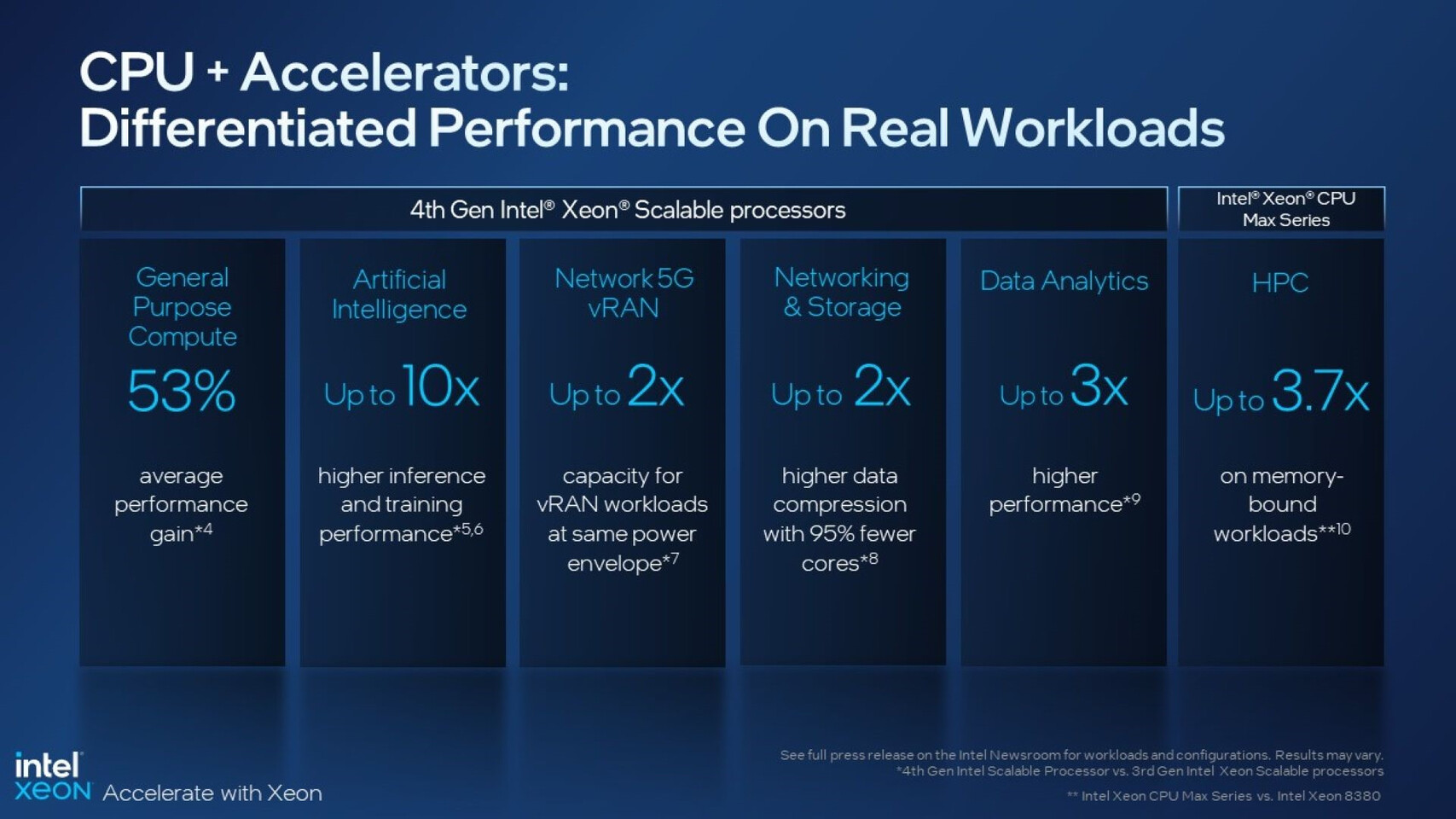
Intel today marked one of the most important product launches in company history with the unveiling of 4th Gen Intel Xeon Scalable processors (code-named Sapphire Rapids), the Intel Xeon CPU Max Series (code-named Sapphire Rapids HBM) and the Intel Data Center GPU Max Series (code-named Ponte Vecchio), delivering for its customers a leap in data center performance, efficiency, security and new capabilities for AI, the cloud, the network and edge, and the world's most powerful supercomputers.

Working alongside its customers and partners with 4th Gen Xeon, Intel is delivering differentiated solutions and systems at scale to tackle their biggest computing challenges. Intel's unique approach to providing purpose-built, workload-first acceleration and highly optimized software tuned for specific workloads enables the company to deliver the right performance at the right power for optimal overall total cost of ownership. Additionally, as Intel's most sustainable data center processors, 4th Gen Xeon processors deliver customers a range of features for managing power and performance, making the optimal use of CPU resources to help achieve their sustainability goals.

Microsoft Announces Acquisition of Fungible to Accelerate Data Center Innovation

Today, Microsoft is announcing the acquisition of Fungible Inc., a provider of composable infrastructure aimed at accelerating networking and storage performance in datacenters with high-efficiency, low-power data processing units (DPUs). Fungible's technologies help enable high-performance, scalable, disaggregated, scaled-out datacenter infrastructure with reliability and security.

The Fungible team will join Microsoft's datacenter infrastructure engineering teams and will focus on delivering multiple DPU solutions, network innovation and hardware systems advancements.

Intel to Host 4th Gen Xeon Scalable and Max Series Launch on the 10th of January

On Jan. 10, Intel will officially welcome to market the 4th Gen Intel Xeon Scalable processors and the Intel Xeon CPU Max Series, as well as the Intel Data Center GPU Max Series for high performance computing (HPC) and AI. Hosted by Sandra Rivera, executive vice president and general manager of the Datacenter and AI Group at Intel, and Lisa Spelman, corporate vice president and general manager of Intel Xeon Products, the event will highlight the value of 4th Gen Intel Xeon Scalable processors and the Intel Max Series product family, while showcasing customer, partner and ecosystem support.

The event will demonstrate how Intel is addressing critical needs in the marketplace with a focus on a workload-first approach, performance leadership in key areas such as AI, networking and HPC, the benefits of security and sustainability, and how the company is delivering significant outcomes for its customers and the industry.

New Intel oneAPI 2023 Tools Maximize Value of Upcoming Intel Hardware

Today, Intel announced the 2023 release of the Intel oneAPI tools - available in the Intel Developer Cloud and rolling out through regular distribution channels. The new oneAPI 2023 tools support the upcoming 4th Gen Intel Xeon Scalable processors, Intel Xeon CPU Max Series and Intel Data Center GPUs, including Flex Series and the new Max Series. The tools deliver performance and productivity enhancements, and also add support for new Codeplay plug-ins that make it easier than ever for developers to write SYCL code for non-Intel GPU architectures. These standards-based tools deliver choice in hardware and ease in developing high-performance applications that run on multiarchitecture systems.

"We're seeing encouraging early application performance results on our development systems using Intel Max Series GPU accelerators - applications built with Intel's oneAPI compilers and libraries. For leadership-class computational science, we value the benefits of code portability from multivendor, multiarchitecture programming standards such as SYCL and Python AI frameworks such as PyTorch, accelerated by Intel libraries. We look forward to the first exascale scientific discoveries from these technologies on the Aurora system next year."
-Timothy Williams, deputy director, Argonne Computational Science Division

Ventana Introduces Veyron, World's First Data Center Class RISC-V CPU Product Family

Ventana Micro Systems Inc. today announced its Veyron family of high performance RISC-V processors. The Veyron V1 is the first member of the family, and the highest performance RISC-V processor available today. It will be offered in the form of high performance chiplets and IP. Ventana Founder and CEO Balaji Baktha will make the public announcement during his RISC-V Summit keynote today.

The Veyron V1 is the first RISC-V processor to provide single thread performance that is competitive with the latest incumbent processors for Data Center, Automotive, 5G, AI, and Client applications. The Veyron V1 efficient microarchitecture also enables the highest single socket performance among competing architectures.

SiPearl and AMD Join Forces to Develop European Exascale Systems

SiPearl, the company designing the highperformance, low-power microprocessor for European supercomputers, has entered into a business collaboration agreement with AMD to provide a joint offering for exascale supercomputing systems, combining SiPearl's HPC microprocessor, Rhea, with AMD Instinct accelerators.

Initially, AMD and SiPearl will jointly assess the interoperability of the AMD ROCm open software with the SiPearl Rhea microprocessor and build an optimized software solution that would strengthen the capabilities of a SiPearl microprocessor combined with an AMD Instinct accelerator. This joint work targets porting and optimization activities of the AMD HIP backend, openMP compilers and libraries, will enable scientific applications to benefit from both technologies.

Intel Introduces the Max Series Product Family: Ponte Vecchio and Sapphire Rapids

In advance of Supercomputing '22 in Dallas, Intel Corporation has introduced the Intel Max Series product family with two leading-edge products for high performance computing (HPC) and artificial intelligence (AI): Intel Xeon CPU Max Series (code-named Sapphire Rapids HBM) and Intel Data Center GPU Max Series (code-named Ponte Vecchio). The new products will power the upcoming Aurora supercomputer at Argonne National Laboratory, with updates on its deployment shared today.

The Xeon Max CPU is the first and only x86-based processor with high bandwidth memory, accelerating many HPC workloads without the need for code changes. The Max Series GPU is Intel's highest density processor, packing over 100 billion transistors into a 47-tile package with up to 128 gigabytes (GB) of high bandwidth memory. The oneAPI open software ecosystem provides a single programming environment for both new processors. Intel's 2023 oneAPI and AI tools will deliver capabilities to enable the Intel Max Series products' advanced features.

Kyocera's New "On-Board Optics Module" Achieves World-Record Bandwidth, Reduces Power Consumption for Data Centers

Kyocera Corporation today announced it has developed an On-Board Optics Module that achieves world-record bandwidth of 512 Gbps. The module is expected to support high-speed network applications, such as data centers. Additionally, by converting electrical signals into optical signals, the module uses much less power than conventional alternatives and will also help decrease power consumption and promote sustainability.

Kyocera's prototype module is miniaturized for installation on a printed circuit board near the processor, allowing electronic data to be converted into optical signals instantaneously. In addition, the product is designed to create unprecedented improvements in signal-to-noise ratio, virtually eliminating the signal loss caused by conventional electrical conductors. As a result of these technological advances, Kyocera's On-Board Optics Module has achieved world-record bandwidth of 512 gigabits per second (Gbps) and is expected to help data centers and supercomputers save power while increasing bandwidth and data transfer rates.

Intel 4th Gen Xeon Scalable "Sapphire Rapids" Server Processors Launch in January

Intel just finalized the launch date of its 4th Gen Xeon Scalable "Sapphire Rapids" server processors. The company plans to launch them on January 10, 2023. The new processors will be launched at a special event dedicated to the company's various new Data Center (group) innovations, which cover server processors, new networking innovations, possible launches from Intel's ecosystem partners, and more.

A lot is riding on the success of "Sapphire Rapids," as they see the introduction of Intel's new high-performance CPU core on in the enterprise segment at core-counts of up to 60-core/120-thread per socket; along with cutting-edge new I/O that includes DDR5 memory, PCI-Express Gen 5, next-gen CXL, and on-package HBM memory on certain variants.

Intel Reports Third-Quarter 2022 Financial Results

Intel Corporation today reported third-quarter 2022 financial results. "Despite the worsening economic conditions, we delivered solid results and made significant progress with our product and process execution during the quarter," said Pat Gelsinger, Intel CEO. "To position ourselves for this business cycle, we are aggressively addressing costs and driving efficiencies across the business to accelerate our IDM 2.0 flywheel for the digital future."

"As we usher in the next phase of IDM 2.0, we are focused on embracing an internal foundry model to allow our manufacturing group and business units to be more agile, make better decisions and establish a leadership cost structure," said David Zinsner, Intel CFO. "We remain committed to the strategy and long-term financial model communicated at our Investor Meeting."

Meta's Grand Teton Brings NVIDIA Hopper to Its Data Centers

Meta today announced its next-generation AI platform, Grand Teton, including NVIDIA's collaboration on design. Compared to the company's previous generation Zion EX platform, the Grand Teton system packs in more memory, network bandwidth and compute capacity, said Alexis Bjorlin, vice president of Meta Infrastructure Hardware, at the 2022 OCP Global Summit, an Open Compute Project conference.

AI models are used extensively across Facebook for services such as news feed, content recommendations and hate-speech identification, among many other applications. "We're excited to showcase this newest family member here at the summit," Bjorlin said in prepared remarks for the conference, adding her thanks to NVIDIA for its deep collaboration on Grand Teton's design and continued support of OCP.

KIOXIA Announces Next-Generation EDSFF E1.S SSDs for Hyperscale Data Centers

Furthering its mission to address future enterprise infrastructure requirements, KIOXIA America, Inc. today announced that it has expanded its broad portfolio of client, enterprise and data center SSDs with the addition of the XD7P Series. Designed for hyperscale and general server applications in the new Enterprise and Data Center Standard Form Factor (EDSFF) E1.S form factor, XD7P drives are the second generation of E1.S SSDs with Open Compute Project (OCP) Data Center NVMe SSD 2.0 specification support from KIOXIA, following its XD6 series. KIOXIA XD7P drives are now sampling to select data center customers.

"Hyperscale needs of density, power, performance and serviceability are driving PCIe 5.0, E1.S, as a form factor, and the OCP Data Center NVMe SSD specification V2.0 for the data center," said Ross Stenfort, hardware storage engineer, Meta. "The KIOXIA XD7P Series SSD supports these storage technologies to enable the next generation of hyperscale needs."

AMD Trims Q3 Forecast, $1 Billion Missing, Client Processor Revenue down 40%, Halved Quarter-over-Quarter

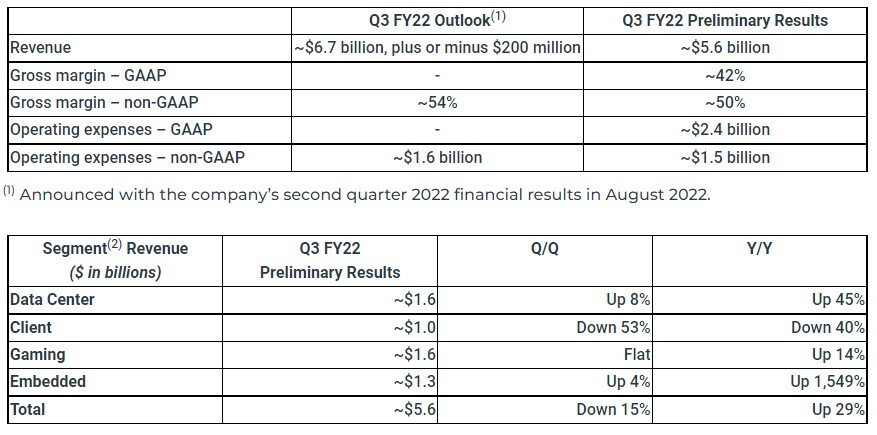
AMD (NASDAQ:AMD) today announced selected preliminary financial results for the third quarter of 2022. Third quarter revenue is expected to be approximately $5.6 billion, an increase of 29% year-over-year. AMD previously expected revenue to increase approximately 55% year-over-year at the mid-point of guidance. Preliminary results reflect lower than expected Client segment revenue resulting from reduced processor shipments due to a weaker than expected PC market and significant inventory correction actions across the PC supply chain.

Revenue for the Data Center, Gaming, and Embedded segments each increased significantly year-over-year in-line with the company's expectations. Gross margin is expected to be approximately 42% and non-GAAP(*) gross margin is expected to be approximately 50%. AMD previously expected non-GAAP gross margin to be approximately 54%. The gross margin shortfall to expectations was primarily due to lower revenue driven by lower Client processor unit shipments and average selling price (ASP). In addition, the third quarter results are expected to include approximately $160 million of charges primarily for inventory, pricing, and related reserves in the graphics and client businesses.

Neo Forza Server DRAM Available to DELL Data Center Customers

Goldkey Technology Corporation (TPEx : 3135), aka "Neo Forza", offers products and solutions marketed under the label Neo Forza successfully completed qualification of its server modules with Dell PowerEdge R650 and R750 series servers, which DELL loaned to Neo Forza. Following successful qualification, Neo Forza announces commercial and industrial channel partner availability of Neo Forza DDR4 RDIMM server memory in adherence to industry qualifications, ranging from DDR4 2133MT/s to 3200MT/s.

"Data center staff need to maximize platform performance and extend platform longevity. Neo Forza's qualified DDR4 server memory assures these factors are met cost-effectively," said Jess Kung, vice president of sales. "Goldkey Technology Corporation has been on the forefront of the memory industry and is an integrated-circuit (I/C) specialist with technical acumen of more than 15 years. The successful qualification program amplifies our intrinsic value to our global customers."

AMD Pensando Distributed Services Card to Support VMware vSphere 8

AMD announced that the AMD Pensando Distributed Services Card, powered by the industry's most advanced data processing unit (DPU)1, will be one of the first DPU solutions to support VMware vSphere 8 available from leading server vendors including Dell Technologies, HPE and Lenovo.

As data center applications grow in scale and sophistication, the resulting workloads increase the demand on infrastructure services as well as crucial CPU resources. VMware vSphere 8 aims to reimagine IT infrastructure as a composable architecture with a goal of offloading infrastructure workloads such as networking, storage, and security from the CPU by leveraging the new vSphere Distributed Services Engine, freeing up valuable CPU cycles to be used for business functions and revenue generating applications.

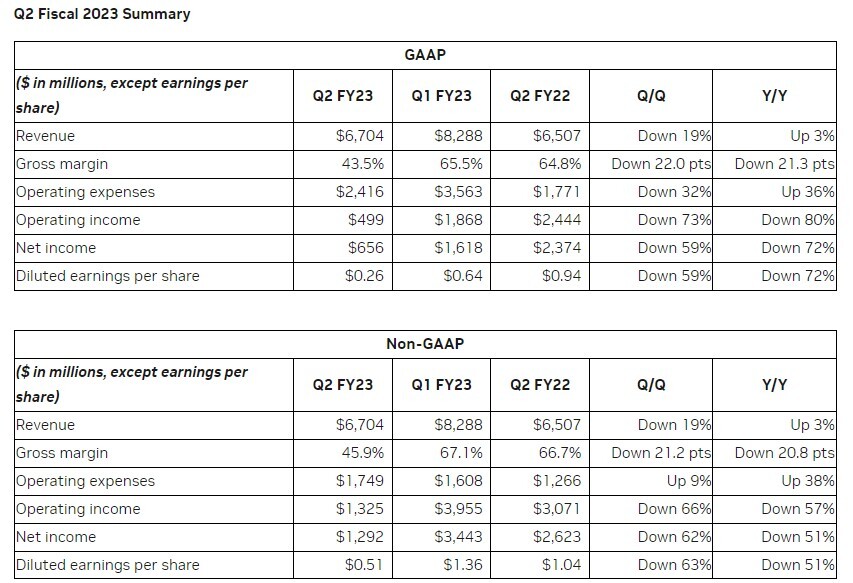
NVIDIA Announces Financial Results for Second Quarter Fiscal 2023: Gaming Revenues Slashed by a Third

NVIDIA (NASDAQ: NVDA) today reported revenue for the second quarter ended July 31, 2022, of $6.70 billion, up 3% from a year ago and down 19% from the previous quarter. GAAP earnings per diluted share for the quarter were $0.26, down 72% from a year ago and down 59% from the previous quarter. Non-GAAP earnings per diluted share were $0.51, down 51% from a year ago and down 63% from the previous quarter.

"We are navigating our supply chain transitions in a challenging macro environment and we will get through this," said Jensen Huang, founder and CEO of NVIDIA. "Accelerated computing and AI, the pioneering work of our company, are transforming industries. Automotive is becoming a tech industry and is on track to be our next billion-dollar business. Advances in AI are driving our Data Center business while accelerating breakthroughs in fields from drug discovery to climate science to robotics.

Ansys and AMD Collaborate to Speed Simulation of Large Structural Mechanical Models Up to 6x Faster

Ansys announced that Ansys Mechanical is one of the first commercial finite element analysis (FEA) programs supporting AMD Instinct accelerators, the newest data center GPUs from AMD. The AMD Instinct accelerators are designed to provide exceptional performance for data centers and supercomputers to help solve the world's most complex problems. To support the AMD Instinct accelerators, Ansys developed APDL code in Ansys Mechanical to interface with AMD ROCm libraries on Linux, which will support performance and scaling on the AMD accelerators.

Ansys' latest collaboration with AMD resulted in a solution that, according to Ansys' tests, significantly speeds up simulation of large structural mechanical models—between three and six times faster for Ansys Mechanical applications using the sparse direct solver. Adding support for AMD Instinct accelerators in Ansys Mechanical gives customers greater flexibility in their choice of high-performance computing (HPC) hardware.

Intel Data-Center GPU Flex Series "Arctic Sound-M" Launched: Visual Processing, Media, and Inference top Applications

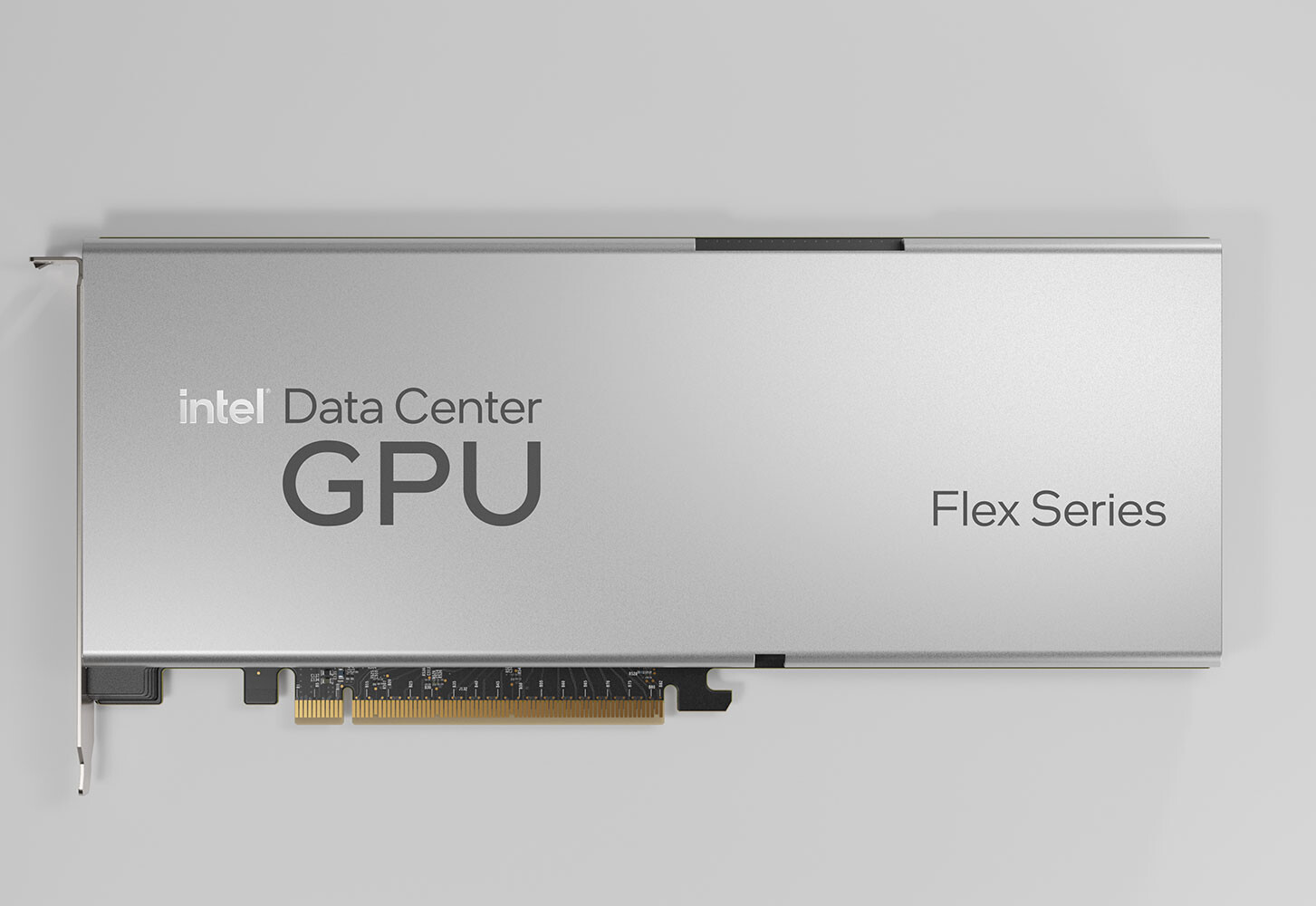
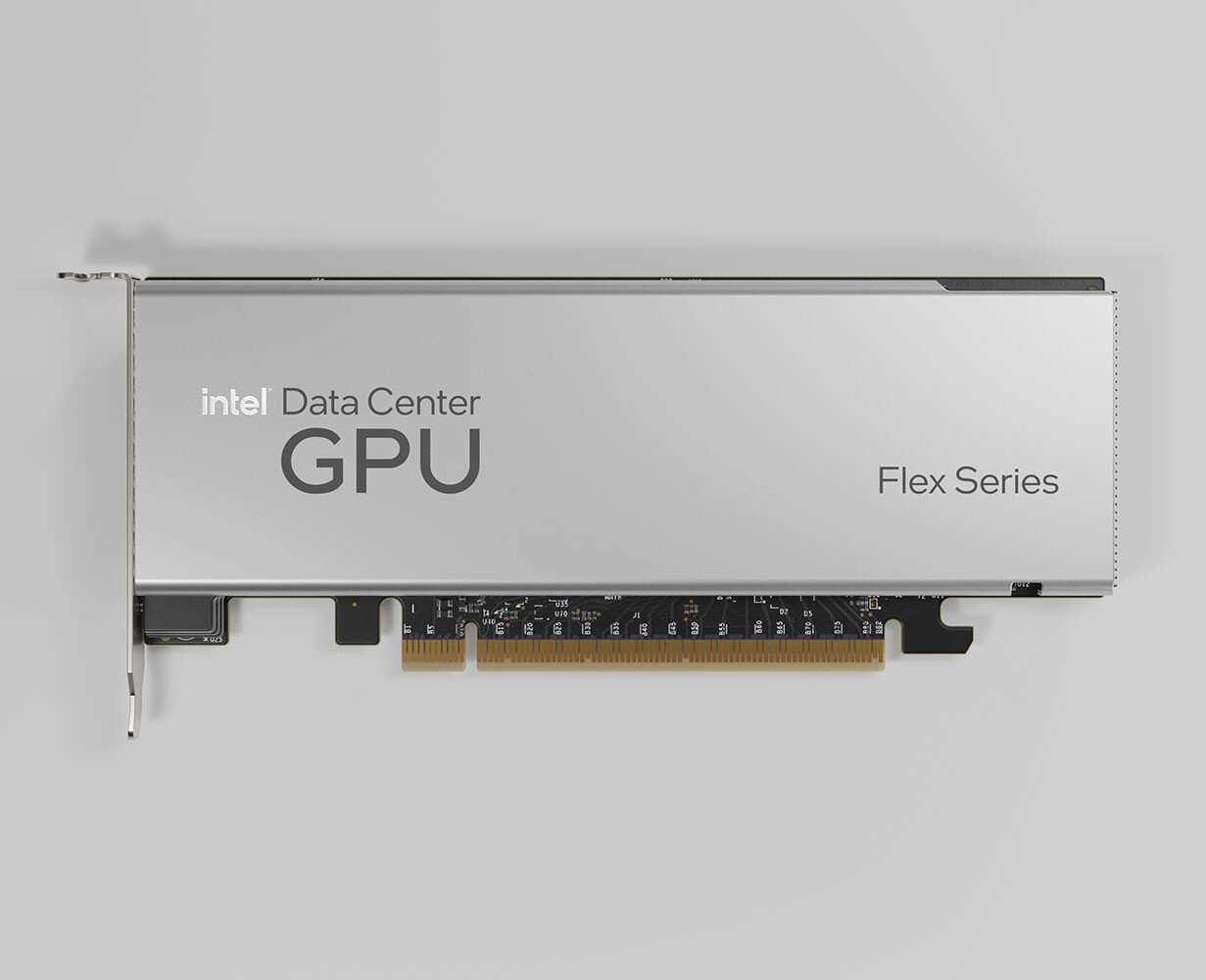
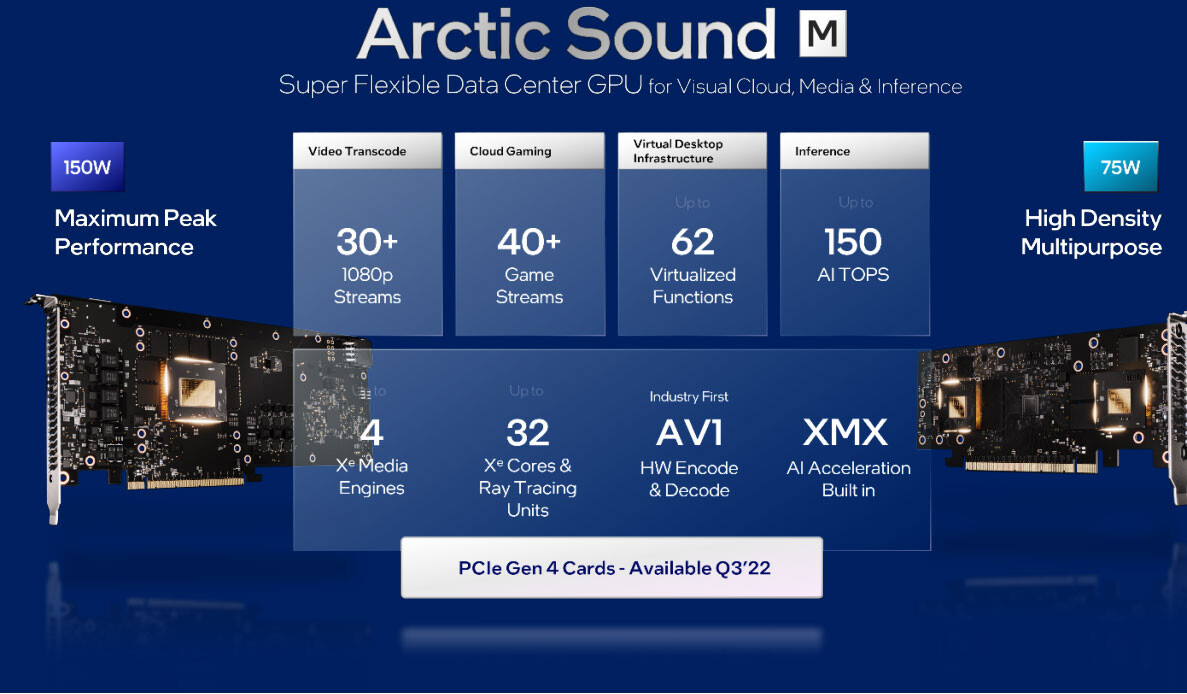
Intel today launched its Arctic Sound M line of data-center GPUs. These are not positioned as HPC processors like the "Ponte Vecchio," but GPUs targeting cloud-compute providers, with their main applications being in the realm of visual processing, media, and AI inferencing. Their most interesting aspect has to be the silicon, which are the same 6 nm "ACM-G11" and "ACM-G10" chips powering the Arc "Alchemist" client graphics cards, based on the Xe-HPG architecture. Even more interesting is their typical board power values, ranging between 75 W to 150 W. The cards are built in the PCI-Express add-on card form-factor, with their cooling solutions optimized for rack airflow.

The marketing name for these cards is simply Intel Data Center GPU Flex, with two models being offered: The Data Center GPU Flex-140, and Flex-170. The Flex-170 is a full-sized add-on card based on the larger ACM-G10 silicon, which has 32 Xe Cores (4,096 unified shaders), whereas the Flex-140, interestingly, is a low-profile dual-GPU card with two smaller ACM-G11 chips that each has 8 Xe Cores (1,024 unified shaders). The two chips appear to be sharing a PCIe bridge chip in the renders. Both models come with four Xe Media Engines that pack AV1 encode hardware-acceleration, XMX AI acceleration, real-time ray tracing, and GDDR6 memory.

Silicon Motion's Gen 5 SSD Controller is Called MonTitan, Reaches 14 GB/s, But Enterprise Only

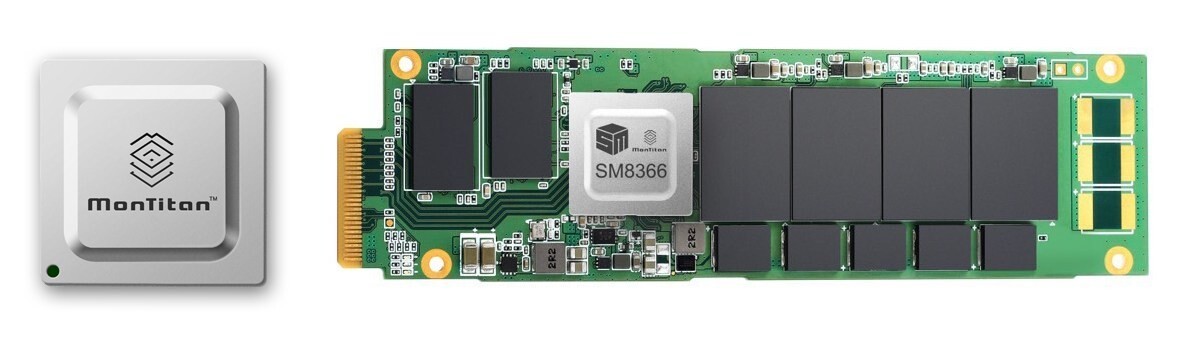
Silicon Motion Technology Corporation ("Silicon Motion"), a global leader in designing and marketing NAND flash controllers and solid-state storage devices today announces MonTitan, a PCIe Gen5 SSD solution platform perfectly suited for the most challenging Datacenter and Enterprise applications. Silicon Motion's new MonTitan platform features an entirely new, purpose-built ASIC and FW architecture, optimized for performance and QoS. Its unique Layered FW stack enables the development of customer differentiated solutions with a high degree of flexibility and accelerated time to market, all while reducing engineering cost.

"SSD storage solutions are evolving to address new challenges in data centers which demand changes in storage platforms and operating models," said Nelson Duann, Silicon Motion's Senior Vice President of Marketing and R&D. "Our MonTitan SSD solution is an innovative PCIe Gen5 SSD platform designed to satisfy the unique demands of datacenters today while providing flexibility and programmability to meet future evolving standards."

Supermicro Launches Multi-GPU Cloud Gaming Solutions Based on Intel Arctic Sound-M

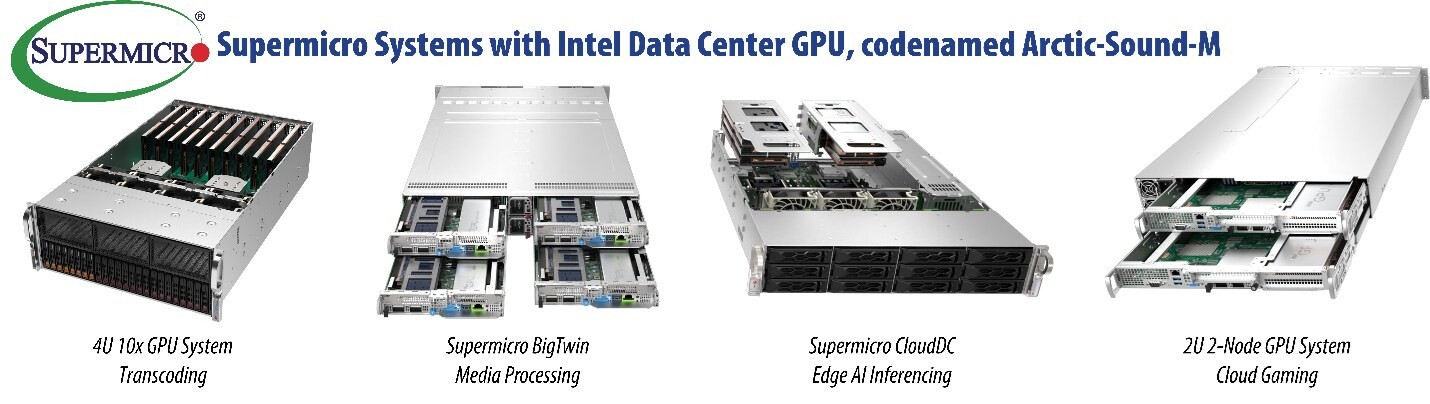
Super Micro Computer, Inc., a global leader in enterprise computing, storage, networking, and green computing technology, is announcing future Total IT Solutions for availability with Android Cloud Gaming and Media Processing & Delivery. These new solutions will incorporate the Intel Data Center GPU, codenamed Arctic Sound-M, and will be supported on several Supermicro servers. Supermicro solutions that will contain the Intel Data Center GPUs codenamed Arctic Sound-M, include the 4U 10x GPU server for transcoding and media delivery, the Supermicro BigTwin system with up to eight Intel Data Center GPUs, codenamed Arctic Sound-M in 2U for media processing applications, the Supermicro CloudDC server for edge AI inferencing, and the Supermicro 2U 2-Node server with three Intel Data Center GPUs, codenamed Arctic Sound-M per node, optimized for cloud gaming. Additional systems will be made available later this year.

"Supermicro will extend our media processing solutions by incorporating the Intel Data Center GPU," said Charles Liang, President, and CEO, Supermicro. "The new solutions will increase video stream rates and enable lower latency Android cloud gaming. As a result, Android cloud gaming performance and interactivity will increase dramatically with the Supermicro BigTwin systems, while media delivery and transcoding will show dramatic improvements with the new Intel Data Center GPUs. The solutions will expand our market-leading accelerated computing offerings, including everything from Media Processing & Delivery to Collaboration, and HPC."

Western Digital is Shipping its 22 TB WD Gold, Red Pro and Purple Pro Hard Disk Drives

When it comes to data, everything is growing - quantity, size, format, resolution, use cases, applications, value and more. As people and businesses look for solutions to effectively and efficiently store their data in the zettabyte era, Western Digital HDDs continue to play a critical role in delivering massive capacity, performance and reliability.

Extending its innovation and technology leadership across its portfolio, Western Digital today announced that it is now shipping new 22 TB HDDs targeting three key segments: WD Gold HDDs for IT/data center channel customers; WD Red Pro for network attached storage (NAS); and WD Purple Pro for smart video/surveillance. As highlighted in its What's Next Western Digital Event, these new drives are loaded with industry-firsts, including OptiNAND technology, energy-assisted PMR (ePMR), triple-stage actuator (TSA) and HelioSeal to deliver the industry's highest areal density at 2.2 TB per platter, delivering 22 TB CMR HDDs for its customers.

Iceotope collaborates with Intel and HPE to accelerate sustainability and cut power for Edge and Data Center compute requirements by up to 30 Percent

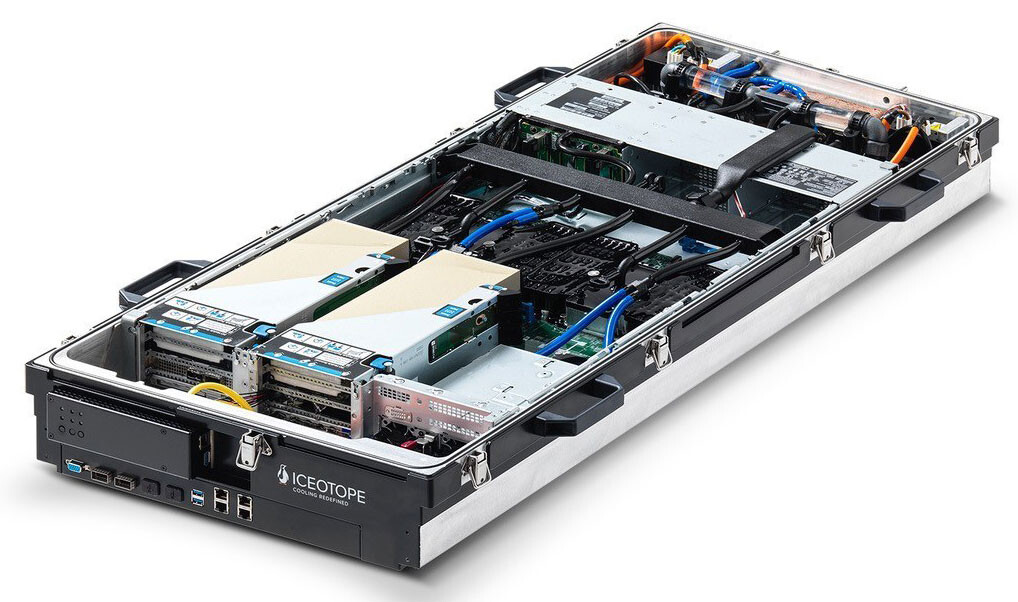
Iceotope, the global leader in Precision Immersion Cooling, has announced that its chassis-level cooling system is being demonstrated in the Intel Booth at HPE Discover 2022, the prestigious "Edge-to-cloud Conference". Ku:l Data Center is the product of a close collaboration between Iceotope, Intel and HPE and promises a faster path to net zero operations by reducing edge and data center energy use by nearly a third. Once the sole preserve of arcane, high performance computing applications, liquid cooling is increasingly seen as essential technology for reliable and efficient operations of any IT load in any location. There is a pressing concern about sustainability impacts as distributed edge computing environments proliferate to meet the demand for data processing nearer the point of use, as well as growing facility power and cooling consumption driven by AI augmentation and hotter chips.

Working together with Intel and HPE, Iceotope benchmarked the power consumption of a sample IT installation being cooled respectively using air and precision immersion liquid cooling. The results show a substantial advantage in favour of liquid cooling, reducing overall power use across IT and cooling infrastructure.

PCI-SIG Announces PCI Express 7.0 Specification to Reach 128 GT/s

PCI-SIG today announced that the PCI Express (PCIe ) 7.0 specification will double the data rate to 128 GT/s and is targeted for release to members in 2025. "For 30 years the guiding principle of PCI-SIG has been, 'If we build it, they will come,'" observed Nathan Brookwood, Research Fellow at Insight 64. "Early parallel versions of PCI technology accommodated speeds of hundreds of megabytes/second, well matched to the graphics, storage and networking demands of the 1990s.

In 2003, PCI-SIG evolved to a serial design that supported speeds of gigabytes/second to accommodate faster solid-state disks and 100MbE Ethernet. Almost like clockwork, PCI-SIG has doubled PCIe specification bandwidth every three years to meet the challenges of emerging applications and markets. Today's announcement of PCI-SIG's plan to double the channel's speed to 512 GB/s (bi-directionally) puts it on track to double PCIe specification performance for another 3-year cycle."
Return to Keyword Browsing
Nov 23rd, 2026 01:22 CST change timezone

New Forum Posts

Popular Reviews

TPU on YouTube

Controversial News Posts