News Posts matching #Data Center

Return to Keyword Browsing

Phison Announces Customizable PCIe Gen4x4 Enterprise SSDs in M.2 2280 and 22110 Form Factors Powered by E18DC PCIe Gen4x4 NVMe Controller

Phison Electronics Corp., a global leader in NAND flash controller and storage solutions, today unveiled two new PCIe Gen4x4 Enterprise Class SSDs: the EPR3750 in M.2 2280 form factor and the EPR3760 in M.2 22110 form factor. The EPR3750 and EPR3760 SSDs are backward compatible in PCIe Gen3 M.2 slots at even faster speeds while offering significant performance enhancements when matched with PCIe Gen4 chipsets. Also, the EPR3750 and EPR3760 SSDs provide a faster quality of service (QoS) command execution with Enterprise SSD firmware. Workstation and Server boot applications require consistent and predictable performance from storage. Phison's new SSDs are ideal to use as boot drives in workstations, servers, and in Network Attached Storage (NAS) and RAID environments.


Ayar Labs Partners with NVIDIA to Deliver Light-Based Interconnect for AI Architectures

Ayar Labs, the leader in chip-to-chip optical connectivity, is developing with NVIDIA groundbreaking artificial intelligence (AI) infrastructure based on optical I/O technology to meet future demands of AI and high performance computing (HPC) workloads. The collaboration will focus on integrating Ayar Labs' technology to develop scale-out architectures enabled by high-bandwidth, low-latency and ultra-low-power optical-based interconnects for future NVIDIA products. Together, the companies plan to accelerate the development and adoption of optical I/O technology to support the explosive growth of AI and machine learning (ML) applications and data volumes.

Optical I/O uniquely changes the performance and power trajectories of system designs by enabling compute, memory and networking ASICs to communicate with dramatically increased bandwidth, at lower latency, over longer distances and at a fraction of the power of existing electrical I/O solutions. The technology is also foundational to enabling emerging heterogeneous compute systems, disaggregated/pooled designs, and unified memory architectures that are critical to accelerating future data center innovation.

Solidigm introduces the industry's most advanced PCIe 4.0 SSD family, optimized for cloud and enterprise workloads

Today Solidigm is expanding its performance-optimized D7 Product Series with new solid-state storage drives (SSDs)—the D7-P5520 and the D7-P5620—for data center and enterprise use. These drives are optimized for real-world compute and storage server workloads and are available in an extended range of form factors and capacities. They offer accelerated performance and reduced total cost of ownership (TCO) by enabling a smaller storage footprint and lower power consumption. The D7-P5520 (designed for read-intensive and light mixed workloads), and the D7-P5620 (designed for mixed workloads), are the first family of products being introduced by Solidigm, which launched as a standalone company in December 2021.

The D7 Series comprises the industry's most advanced PCIe 4.0 SSD family of products given their capacity offerings, breadth of form factors and optimized performance capabilities. These SSDs are optimized for real-world workloads and reflect insights gained from deep technical engagements with leading cloud service providers, OEMs, and storage innovators. Designed and tested with zero tolerance for data errors, consistently durable IOPS and QoS, and with near-zero lifetime performance degradation, they can be deployed with the utmost confidence.

Intel "Arctic Sound M" Enterprise Accelerator Shown Encoding AV1 Video

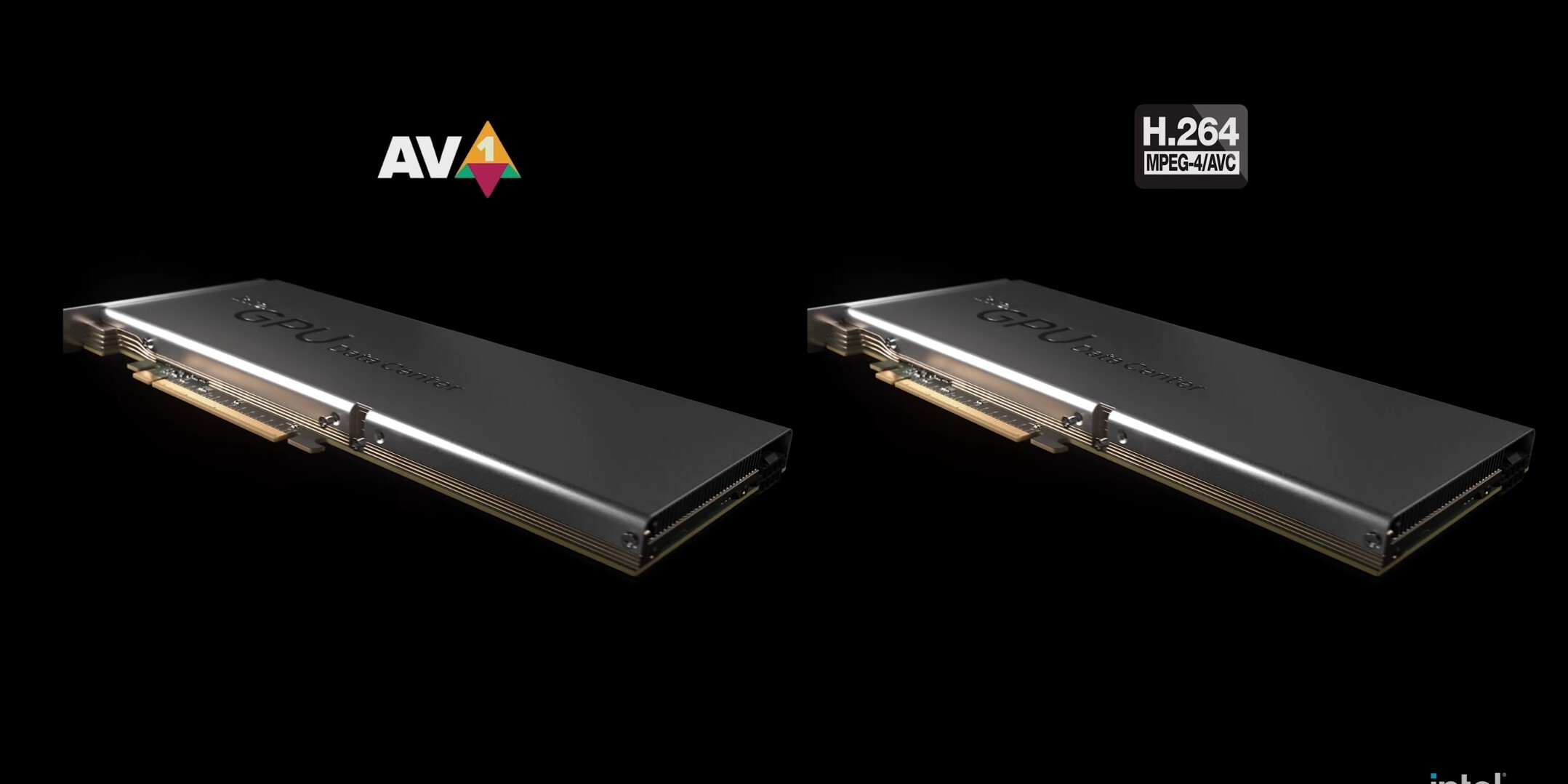
Intel showed off the video encode acceleration capabilities of its upcoming Data Center GPU codenamed "Arctic Sound M," which features AV1 video encode hardware-acceleration. Intel has been pushing for AV1 to be adopted as the streaming video standard for some years now, as it offers comparable bitrate savings and quality to H.265, but is royalty free, resulting in tens of millions of Dollars of royalty savings for streaming content providers such as Netflix, as well as consumer electronics manufacturers, particularly smart TV makers.

Intel's accelerator is a single-slot, full-height add-on card with a PCI-Express x16 interface. It relies on rack airflow for cooling, and features a metal-channel heatsink. Power is drawn from a single 8-pin PCIe power connector. There are no encoding performance numbers put out, except the 30% bitrate savings AV1 offers compared to the current industry standard, H.264. This 30% saving adds up in a big way for a streaming content provider.
Intel's video presentation follows.

Announcing Fungible GPU-Connect - Connect Any GPU to Any Server Over Ethernet

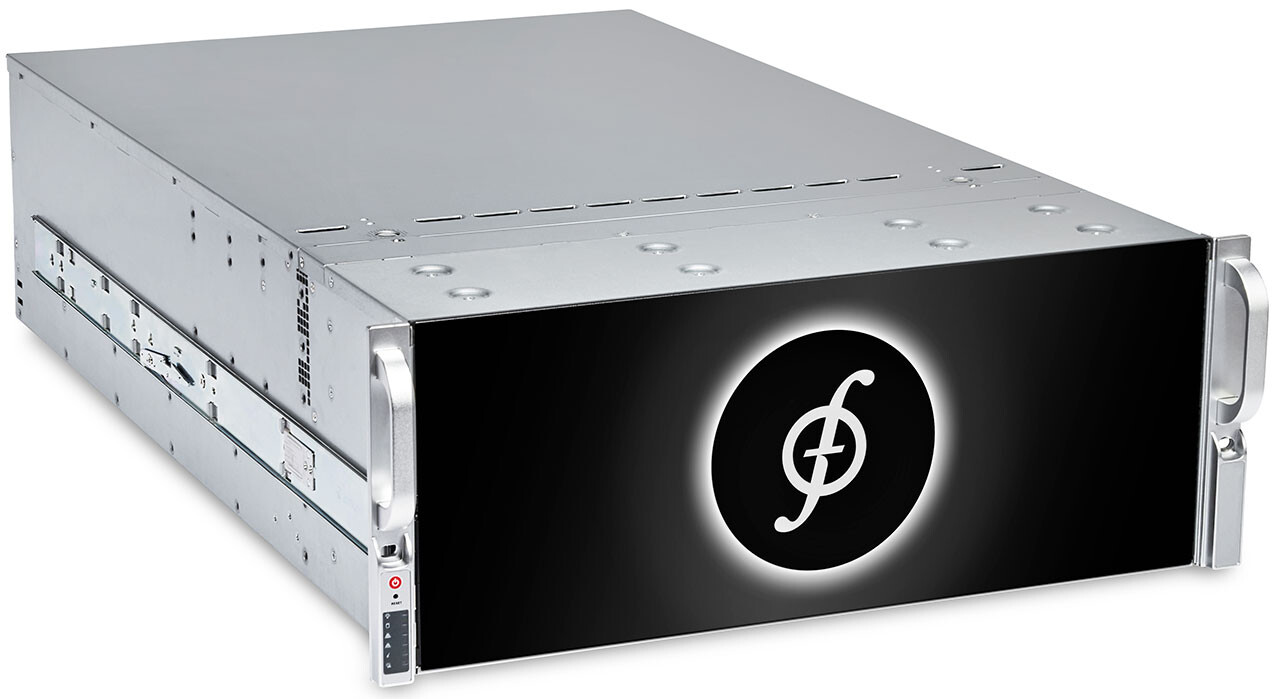
Fungible, Inc., the composable infrastructure company, today announced a new product offering, Fungible GPU-Connect (FGC ), an innovative solution engineered to revolutionize how data processing power is accessed in enterprise and service provider infrastructures. Fungible GPU-Connect solves the challenges caused by the growing demand for AI/ML, especially in Edge Data Centers with stranded and underutilized GPUs. FGC leverages the Fungible DPU to dynamically compose GPU and CPU resources across an Ethernet network. This provides significant economic benefits and agility to organizations that provision, allocate, and manage expensive GPU resources. For the first time, organizations can create a GPU-powered infrastructure free from the physical limitations of PCIe.

FGC allows data centers to centralize their existing GPU assets into a single resource pool to be attached to servers on demand. Instead of dedicated GPUs sitting idle most of the time, data centers can provide new users with access to the GPU pool, making greater use of existing assets. This disaggregated solution also removes the constraints of having GPUs and CPUs physically co-located. They can be located anywhere within the same data center, eliminating the stranding of expensive GPU resources. The Fungible DPU creates a secure, virtual PCIe connection between the GPU and the server that is transparent to the server and to applications - no special software or drivers are needed. This connection is managed in hardware by the DPU, ensuring a high-performance and low latency connection. This transparency means FGC can be easily retrofitted into existing environments, and can scale with growing demand, ensuring GPUs are always available when they are needed.

AMD Expands Data Center Solutions Capabilities with Acquisition of Pensando

AMD today announced a definitive agreement to acquire Pensando for approximately $1.9 billion before working capital and other adjustments. Pensando's distributed services platform includes a high-performance, fully programmable packet processor and comprehensive software stack that accelerate networking, security, storage and other services for cloud, enterprise and edge applications.

"To build a leading-edge data center with the best performance, security, flexibility and lowest total cost of ownership requires a wide range of compute engines," said Dr. Lisa Su, AMD chair and CEO. "All major cloud and OEM customers have adopted EPYC processors to power their data center offerings. Today, with our acquisition of Pensando, we add a leading distributed services platform to our high-performance CPU, GPU, FPGA and adaptive SoC portfolio. The Pensando team brings world-class expertise and a proven track record of innovation at the chip, software and platform level which expands our ability to offer leadership solutions for our cloud, enterprise and edge customers."

GIGABYTE Announces Data Center Liquid Immersion Cooling

GIGABYTE Technology, today announced participation in KDDI's one-phase immersion cooling proof of concept that demonstrates how alternative cooling solutions in data centers are needed and should be environmentally minded. Through this joint venture it is possible to sustain high-performance, improve the environmental impact, and reduce costs; all while doing so in a self-contained portable container. KDDI approached technology partners, such as GIGABYTE, to explore ways to bridge various disciplines to achieve the goal of an environmentally sustainable data center. GIGABYTE was keen to assist and had been monitoring and developing immersion cooling systems over the last decade.

Staring data centers in the face is one of their great challenges, and that is how to rectify the increasing power density in traditional data centers and deploy edge computing solutions. Companies are increasing reliant on cloud services and consumers expect fast streaming media and real-time results, but all of this adds work in the data center. Even if the power density reaches an acceptable balance with performance and cooling, can it be implemented in data centers with a higher consideration for the environment and operate more efficiently? That is the crux of the matter as more novel solutions must come out or the problem will only be compounded. Using liquid immersion cooling it is possible to achieve a PUE (power usage effectiveness) of 1.2-1.3, which is far better than the PUE of 1.7 found in air-cooled data centers today. PUE is an important metric to use as it determines the energy efficiency of a data center. If a data center is able to reach a PUE of 1.2-1.3 then it can reduce power consumption by 30-50%.

ARM-based Server Penetration Rate to Reach 22% by 2025 with Cloud Data Centers Leading the Way, Says TrendForce

According to TrendForce research, corporate demand for digital transformation including artificial intelligence and high-performance computing has accelerated in recent years, which has led to increasing adoption of cloud computing. In order to improve service flexibility, the world's major cloud service providers have gradually introduced ARM-based servers. The penetration rate of ARM architecture in data center servers is expected to reach 22% by 2025.

In the past few years, ARM architecture processors have matured in the fields of mobile terminals and Internet of Things but progress in the server field has been relatively slow. However, companies have diversified cloud workloads in recent years and the market has begun to pay attention to the benefits ARM architecture processing can provide to data centers. TrendForce believes that ARM-based processors have three major advantages. First, they can support diverse and rapidly changing workloads and are more scalability and cost-effective. Second, ARM-based processors provide higher customization for different niche markets with a more flexible ecosystem. Third, physical footprint is relatively small which meets the needs of today's micro data centers.

NVIDIA Announces Spectrum Data Center Networking Platform

NVIDIA today announced NVIDIA Spectrum -4, the next generation of its Ethernet platform which enables the extreme networking performance and robust security needed for data center infrastructure at scale. The world's first 400 Gbps end-to-end networking platform, NVIDIA Spectrum-4 provides 4x higher switching throughput than previous generations, with 51.2 terabits per second. It consists of the NVIDIA Spectrum-4 switch family, NVIDIA ConnectX -7 SmartNIC, NVIDIA BlueField -3 DPU and the DOCA data center infrastructure software to supercharge cloud-native applications at scale.

Built for AI, NVIDIA Spectrum-4 arrives as data centers are growing exponentially and demanding extreme performance, advanced security and powerful features to enable high-performance, advanced virtualization and simulation at scale. The Spectrum-4 Ethernet platform includes key features needed for the uncompromising requirements of these technologies.

AMD Introduces Instinct MI210 Data Center Accelerator for Exascale-class HPC and AI in a PCIe Form-Factor

AMD today announced a new addition to the Instinct MI200 family of accelerators. Officially titled Instinct MI210 accelerator, AMD tries to bring exascale-class technologies to mainstream HPC and AI customers with this model. Based on CDNA2 compute architecture built for heavy HPC and AI workloads, the card features 104 compute units (CUs), totaling 6656 Streaming Processors (SPs). With a peak engine clock of 1700 MHz, the card can output 181 TeraFLOPs of FP16 half-precision peak compute, 22.6 TeraFLOPs peak FP32 single-precision, and 22.6 TFLOPs peak FP62 double-precision compute. For single-precision matrix (FP32) compute, the card can deliver a peak of 45.3 TFLOPs. The INT4/INT8 precision settings provide 181 TOPs, while MI210 can compute the bfloat16 precision format with 181 TeraFLOPs at peak.

The card uses a 4096-bit memory interface connecting 64 GBs of HMB2e to the compute silicon. The total memory bandwidth is 1638.4 GB/s, while memory modules run at a 1.6 GHz frequency. It is important to note that the ECC is supported on the entire chip. AMD provides an Instinct MI210 accelerator as a PCIe solution, based on a PCIe 4.0 standard. The card is rated for a TDP of 300 Watts and is cooled passively. There are three infinity fabric links enabled, and the maximum bandwidth of the infinity fabric link is 100 GB/s. Pricing is unknown; however, availability is March 22nd, which is the immediate launch date.

AMD places this card directly aiming at NVIDIA A100 80 GB accelerator as far as the targeted segment, with emphasis on half-precision and INT4/INT8 heavy applications.

KIOXIA Introduces 2nd Generation SSDs for Enterprise and Hyperscale Data Centers Designed with PCIe 5.0 Technology

KIOXIA America, Inc., today announced that it is sampling its 2nd generation PCIe 5.0 SSD for enterprise and data center customers. After being the first vendor to offer a drive using the PCIe 5.0 interface, KIOXIA has now introduced the new CD8 Series data center NVMe SSD family. CD8 SSDs double the bandwidth per lane over PCIe 4.0 SSDs from 16 gigatransfers per second (GT/s) to 32GT/s and are optimized for hyperscale data center and enterprise server-attached workloads.

"Today, PCIe 4.0 SSDs are considered at the forefront in terms of delivering the highest levels of drive performance," commented Greg Wong, founder and principal analyst, Forward Insights. "Next generation PCIe 5.0 SSDs provide twice the level of performance, and will continue to propel the PCIe/NVMe SSD market - which is expected to grow at a CAGR of over 20% out to 2026."

TYAN Drives Innovation in the Data Center with 3rd Gen AMD EPYC Processors with AMD 3D V-Cache Technology

TYAN, an industry-leading server platform design manufacturer and a MiTAC Computing Technology Corporation subsidiary, today announced availability of high-performance server platforms supporting new 3rd Gen AMD EPYC Processors with AMD 3D V-Cache technology for the modern data center. "The modern data center requires a powerful foundation to balance compute, storage, memory and IO that can efficiently manage growing volumes in the digital transformation trend," said Danny Hsu, Vice President of MiTAC Computing Technology Corporation's Server Infrastructure Business Unit. "TYAN's industry-leading server platforms powered by 3rd Gen AMD EPYC processors with AMD 3D V-Cache technology give our customers better energy efficiency and increased performance for a current and future of highly complex workloads."

"3rd Gen AMD EPYC processors with AMD 3D V-Cache technology continue to drive a new standard for the modern data center with breakthrough performance for technical computing workloads due to 768 MB of L3 cache, enabling faster time-to-results on targeted workloads. Fully socket compatible with our 3rd Gen AMD EPYC platforms, customers can adopt these processors to transform their data center operations to achieve faster product development along with exceptional energy savings," said Ram Peddibhotla, corporate vice president, EPYC product management, AMD.

Marvell Introduces Industry's First 800G Multimode Electro-Optics Platform for Cloud Data Centers

Marvell (NASDAQ: MRVL) today announced the industry's first 800 Gbps or 8x 100 Gbps multimode platform solution, that enables data center infrastructure to achieve dramatically higher speeds for short-reach optical modules and Active Optical Cable (AOC) applications. As artificial intelligence (AI), machine learning (ML) and high-performance computing (HPC) applications continue to drive greater bandwidth requirements, cloud-optimized solutions are needed that can bring lower power, latency and cost to short-range data center interconnections. The new 800G platform, which includes Marvell's PAM4 DSP with a multimode transimpedance amplifier (TIA) and Driver, enables faster data center speeds scaling to 800 Gbps, using conventional cost-effective vertical-cavity surface-emitting laser (VCSEL) technology while accelerating time-to-market with plug-and-play deployment.

Today's data centers are packed with equipment utilizing optical modules or AOCs connected by multimode optical fiber optimized for communication over short distances within data centers. This 100G per lane multimode fiber provides cost-effective, low-power, short-reach connectivity. To support multi-gigabit transmissions, multimode architectures often use VCSEL transmitters, which offer the cost benefits of reliability, power efficiency and easy deployment.

IBM Announces the Cyber Vault Flash Storage System Resilient to Ransomware and other Cyber Attacks

IBM today unveiled IBM FlashSystem Cyber Vault to help companies better detect and recover quickly from ransomware and other cyberattacks. The company also announced new FlashSystem storage models, based on IBM Spectrum Virtualize to provide a single and consistent operating environment, that are designed to increase cyber resilience and application performance within a hybrid cloud environment.

According to the IBM Cyber Resilient Organization study, 46 percent of respondents surveyed reported experiencing a ransomware attack over the past two years. With cyberattacks continuing to grow, and with average recovery time lasting days or even weeks, business and reputational risks are unprecedented. Even with prevention and detection tactics in place, organizations also must be ready to recover their operations quickly to minimize loss of business and other costs.

Server Shipments Forecast to Increase 4~5% YoY in 2022 Driven by North American Data Center Demand, Says TrendForce

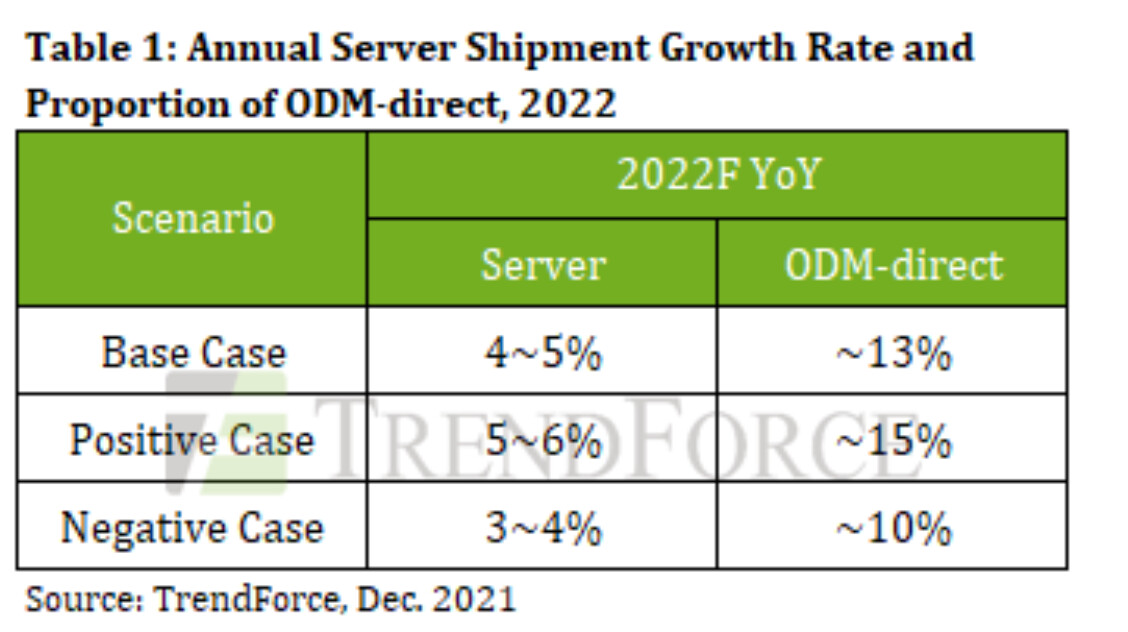
The new normal ushered in by the pandemic will not only become the driving force of digital transformation but will also continue to drive the server market in 2022, according to TrendForce's investigations. It is worth noting that potential unmet demand in 2021 and the risk of future server component shortages will become medium and long-term variables that influence the market. Analyzing the shipment volume of completed servers, a growth rate of approximately 4-5% in completed server shipments is expected next year with primary shipment dynamics remaining concentrated in North American data centers with an annual growth rate of approximately 13-14%. From the supply chain perspective, the ODM Direct business model has gradually replaced the business model of the traditional server market, giving cloud service providers the ability to respond quickly to market changes. However, based on the unpredictability of the market, TrendForce assumes two forecasts for server growth trends. One, the supply situation of key components is effectively improved. Two, the supply situation of key components is exacerbated.

Intel Launches Integrated Photonics Research Center

Intel Labs recently opened the Intel Research Center for Integrated Photonics for Data Center Interconnects. The center's mission is to accelerate optical input/output (I/O) technology innovation in performance scaling and integration with a specific focus on photonics technology and devices, CMOS circuits and link architecture, and package integration and fiber coupling.

"At Intel Labs, we're strong believers that no one organization can successfully turn all the requisite innovations into research reality. By collaborating with some of the top scientific minds from across the United States, Intel is opening the doors for the advancement of integrated photonics for the next generation of compute interconnect. We look forward to working closely with these researchers to explore how we can overcome impending performance barriers," said James Jaussi, senior principal engineer and director of the PHY Research Lab in Intel Labs.

NAND Flash Revenue Rises by 15% QoQ for 3Q21 Thanks to Demand from Smartphone and Data Center Markets, Says TrendForce

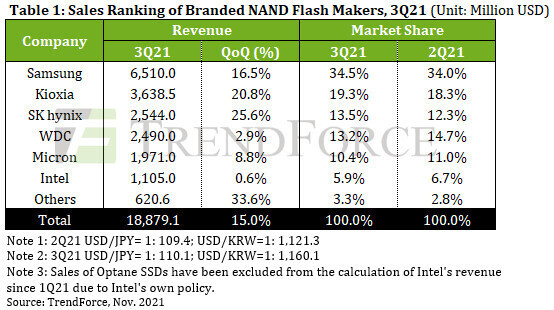
The growth of the NAND Flash market in 3Q21 was primarily driven by strong demand from the data center and smartphone industries, according to TrendForce's latest investigations. More specifically, NAND Flash suppliers' hyperscaler and enterprise clients kept up their procurement activities that began in 2Q21 in order to deploy products based on new processor platforms. Major smartphone brands, on the other hand, likewise expanded their NAND Flash procurement activities during the quarter as they prepared to release their new flagship models. As such, clients in both server and smartphone industries made significant contributions to the revenue growth of the NAND Flash industry for 3Q21. At the same time, however, suppliers also warned that orders from PC OEMs began showing signs of decline. On the whole, the industry's quarterly total NAND Flash bit shipment increased by nearly 11% QoQ for 3Q21, and the overall NAND Flash ASP rose by nearly 4% QoQ for the same quarter. Thanks to rising prices and expanding shipments, the quarterly total NAND Flash revenue increased by 15% QoQ to a new record high of US$18.8 billion in 3Q21.

AMD Details Instinct MI200 Series Compute Accelerator Lineup

AMD today announced the new AMD Instinct MI200 series accelerators, the first exascale-class GPU accelerators. AMD Instinct MI200 series accelerators includes the world's fastest high performance computing (HPC) and artificial intelligence (AI) accelerator,1 the AMD Instinct MI250X.

Built on AMD CDNA 2 architecture, AMD Instinct MI200 series accelerators deliver leading application performance for a broad set of HPC workloads. The AMD Instinct MI250X accelerator provides up to 4.9X better performance than competitive accelerators for double precision (FP64) HPC applications and surpasses 380 teraflops of peak theoretical half-precision (FP16) for AI workloads to enable disruptive approaches in further accelerating data-driven research.

AMD Radeon PRO V620 GPU Delivers Powerful, Multi-Purpose Data Center Visual Performance for Today's Demanding Cloud Workloads

AMD announced the AMD Radeon PRO V620 GPU, built with the latest AMD RDNA 2 architecture which delivers high-performance GPU acceleration for today's demanding cloud workloads including immersive AAA game experiences, intensive 3D workloads and modern office productivity applications at scale in the cloud.

With its innovative GPU-partitioning capabilities, multi-stream hardware accelerated encoders and 32 GB GDDR6 memory, the AMD Radeon PRO V620 offers dedicated GPU resources that scale to multiple graphics users, helping ensure cost-effective graphics acceleration for a range of workloads. Built using the same GPU architecture that powers the latest generation game consoles and PC game experiences, the AMD Radeon PRO V620 GPU is also designed to develop and deliver immersive AAA game experiences.

FSP Group Releases CRPS 2000W Power Supply for Datacenter Application

FSP Group, a global leading power supply manufacturer, unveiled a new family of CRPS product line with 80 Plus titanium level efficiency. The first market pioneer is FSP2000-20HM, which is designed to meet latest trend of for server, storage and networking applications. The new CRPS 2000 W broadens product portfolio of FSP Group and meets data center requirements for telecommunications, data communications, cloud infrastructure and enterprise IT customers.

With existing CRPS power ratings from 550 W up to 2400 W, FSP provides makers a full series of power solution for server, networking devices for cloud and hyperscale environments. The series can address the market from entry level systems to power-hungry, high performance servers with space constraints. FSP2000-20HM is housed in standard CRPS enclosure measuring just 2.89 x 7.28 x 1.57 inches (73.5 x 185.0 x 40 mm), achieved by digital power topology and latest component packaging techniques.


Synopsys Accelerates Multi-Die Designs with Industry's First Complete HBM3 IP and Verification Solutions

Synopsys, Inc. today announced the industry's first complete HBM3 IP solution, including controller, PHY, and verification IP for 2.5D multi-die package systems. HBM3 technology helps designers meet essential high-bandwidth and low-power memory requirements for system-on-chip (SoC) designs targeting high-performance computing, AI and graphics applications. Synopsys' DesignWare HBM3 Controller and PHY IP, built on silicon-proven HBM2E IP, leverage Synopsys' interposer expertise to provide a low-risk solution that enables high memory bandwidth at up to 921 GB/s.
The Synopsys verification solution, including Verification IP with built-in coverage and verification plans, off-the-shelf HBM3 memory models for ZeBu emulation, and HAPS prototyping system, accelerates verification from HBM3 IP to SoCs. To accelerate development of HBM3 system designs, Synopsys' 3DIC Compiler multi-die design platform provides a fully integrated architectural exploration, implementation and system-level analysis solution.

Micron Announces 7400 PCIe 4.0 NVMe Enterprise SSD Portfolio

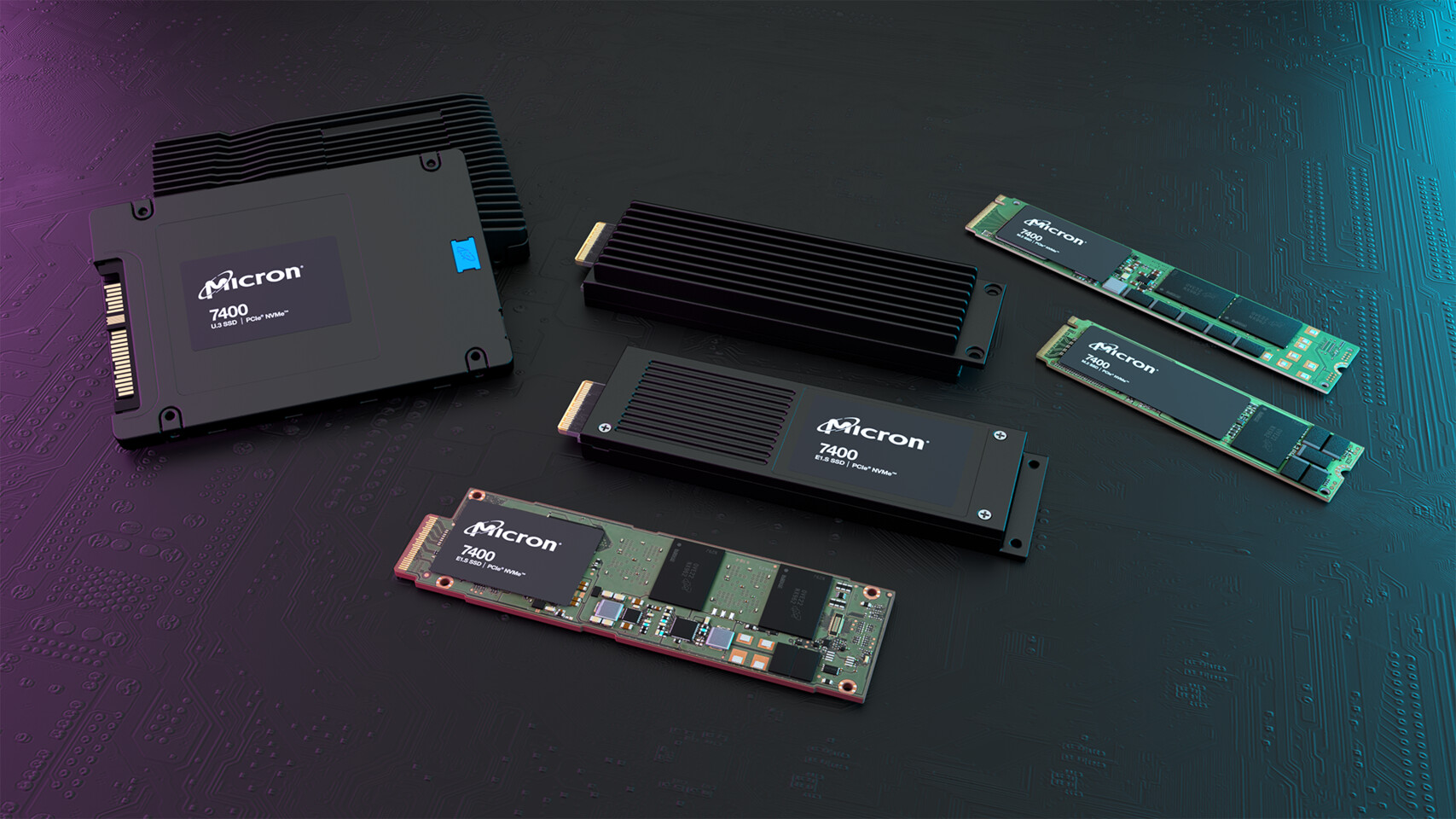
Micron Technology, today announced availability of the Micron 7400 SSD with NVMe, delivering industry-leading form factor flexibility, PCIe Gen4 performance, and leading-edge security to meet the storage needs of demanding data center workloads. With this portfolio, Micron is providing the broadest selection of mainstream data center SSDs available. Featuring seven form factors, the Micron 7400 SSD enables the transition to next-generation server architectures. Data centers continue to evolve thanks to the rapid growth of data and proliferation of applications that demand high performance. The need to process, analyze and secure data that provides valuable insights is fueling the modernization of the data center, requiring new levels of storage innovation.

Phison is Enabling Custom PCIe Gen 5 SSDs to Ship in 2022, New E26-series Processor

Phison Electronics Corp., a global leader in NAND flash controller integrated circuits and storage solutions, today announced its technology development of PCIe Gen 5 customizable SSD solutions for Enterprise and Client SSDs. Phison customers from Hyperscale Cloud Data Centers to PC Gaming demand the fastest performance motherboards and SSD storage devices. Their business models require that they transition to the newest technologies when they first become available, usually well before the rest of the software and hardware ecosystem has been established.

Phison is enabling our valued customers with PCIe Gen 5 SSD platforms that may be customized to perform optimally in their applications. Customers who are early adopters of PCIe Gen 5 SSDs will benefit from superior specifications and first to market leadership revenue. The data rate specification for PCIe Gen 5 at 32 Gb/s is twice the lane speed of PCIe Gen 4 at 16 Gb/s, enabling either double the overall performance, or offering similar performance, but using half as many lanes as PCIe Gen 4.

NAND Flash Revenue for 2Q21 Rises by 10.8% QoQ Due to Strong Notebook Demand and Procurements for Data Centers, Says TrendForce

NAND Flash suppliers' Clients in the data center segment were gradually stepping up enterprise SSD procurement after finishing inventory adjustments, according to TrendForce's latest investigations. Moreover, the adoption rate of 4/8 TB products in the enterprise SSD market increased substantially on account of the releases and adoption of the new server processor platforms from Intel and AMD. Although the recent wave of COVID-19 outbreaks that struck Southeast Asia weakened smartphone sales in 2Q21, the quarterly total NAND Flash bit shipments rose by nearly 9% QoQ, as PC OEMs still had plenty of component orders in 2Q21 due to the fairly robust notebook demand during the period. On the other hand, the shortage of controller ICs became more severe during the period, and the winter storm that battered Texas this February affected the operation of Samsung's foundry fab Line S2 in Austin. As demand for NAND Flash products rose, the overall ASP also rose by nearly 7% QoQ, and the quarterly total NAND Flash revenue rose by 10.8% QoQ to US$16.4 billion in 2Q21.

NVIDIA Announces Financial Results for Second Quarter Fiscal 2022

NVIDIA (NASDAQ: NVDA) today reported record revenue for the second quarter ended August 1, 2021, of $6.51 billion, up 68 percent from a year earlier and up 15 percent from the previous quarter, with record revenue from the company's Gaming, Data Center and Professional Visualization platforms. GAAP earnings per diluted share for the quarter were $0.94, up 276 percent from a year ago and up 24 percent from the previous quarter. Non-GAAP earnings per diluted share were $1.04, up 89 percent from a year ago and up 14 percent from the previous quarter.

"NVIDIA's pioneering work in accelerated computing continues to advance graphics, scientific computing and AI," said Jensen Huang, founder and CEO of NVIDIA. "Enabled by the NVIDIA platform, developers are creating the most impactful technologies of our time - from natural language understanding and recommender systems, to autonomous vehicles and logistic centers, to digital biology and climate science, to metaverse worlds that obey the laws of physics.
Return to Keyword Browsing
Nov 23rd, 2026 01:22 CST change timezone

New Forum Posts

Popular Reviews

TPU on YouTube

Controversial News Posts