News Posts matching #Data Center

Return to Keyword Browsing

AMD's "We Love Gamers" Post Clashes With Its Own CEO's Comments

AMD Japan took to X today to say "AMD loves gamers," while also claiming that the company values its interactions with gamers above all else. The post was a quote tweet to coverage of CEO Dr. Lisa Su attending the opening of Micro Center's new Austin store. AMD handed out 300 swag bags and also raffled off a Radeon RX 9070 XT signed by Dr. Su at that event. However, that gesture was certainly not enough to undo Dr. Lisa Su's comments less than two weeks ago, where she called AMD a "data center first" company. The replies, and later a community note, were quick to remind AMD Japan of that contradiction.

In addition to its own CEO's comments, AMD's latest earnings also don't agree with its X post today. AMD posted record Q3 2026 revenue of $13.4 billion, up 45% year over year, and the Data Center segment did most of the heavy lifting. It brought in a record $8.5 billion, 64% of the total revenue, which was up 97% year over year. By comparison, the Client and Gaming segment fell 8% to $3.7 billion. This is the part that caters to gamers, and what's more interesting is that the Client revenue actually grew 7%, which means that the damage sits almost entirely in gaming. The latter dropped 40% to $773 million, under 6% of AMD's total revenue now. Not to mention, AMD expects data center sales to grow roughly 50% from Q3 to Q4, while there's nothing officially on the horizon for gamers except a CES 2027 teaser.



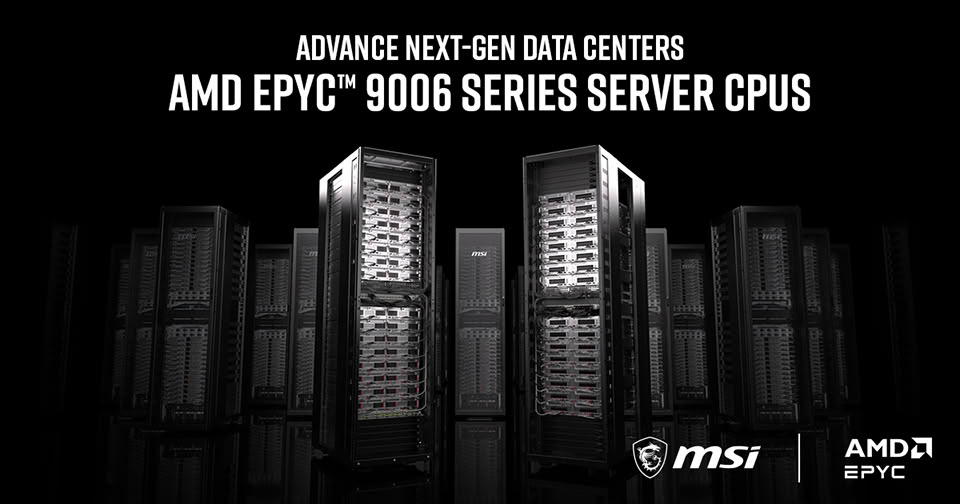
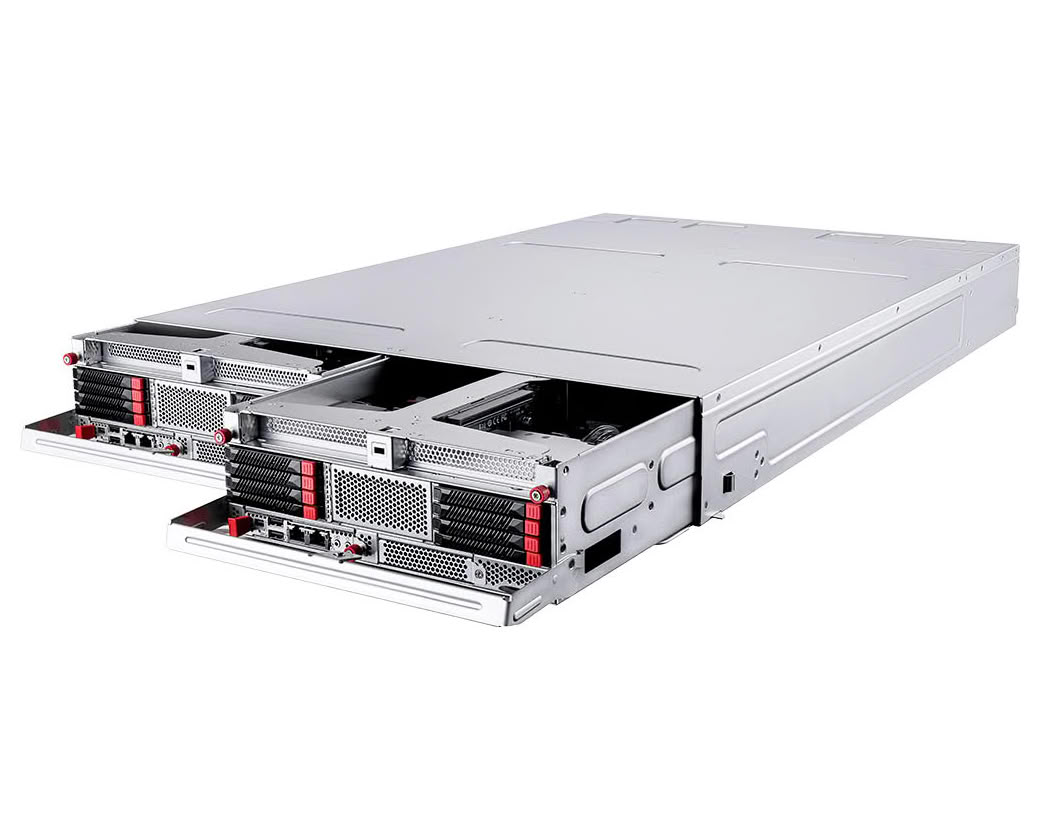
MSI Advances Next-Gen Data Center Infrastructure with AMD EPYC 9006 Series Server CPUs

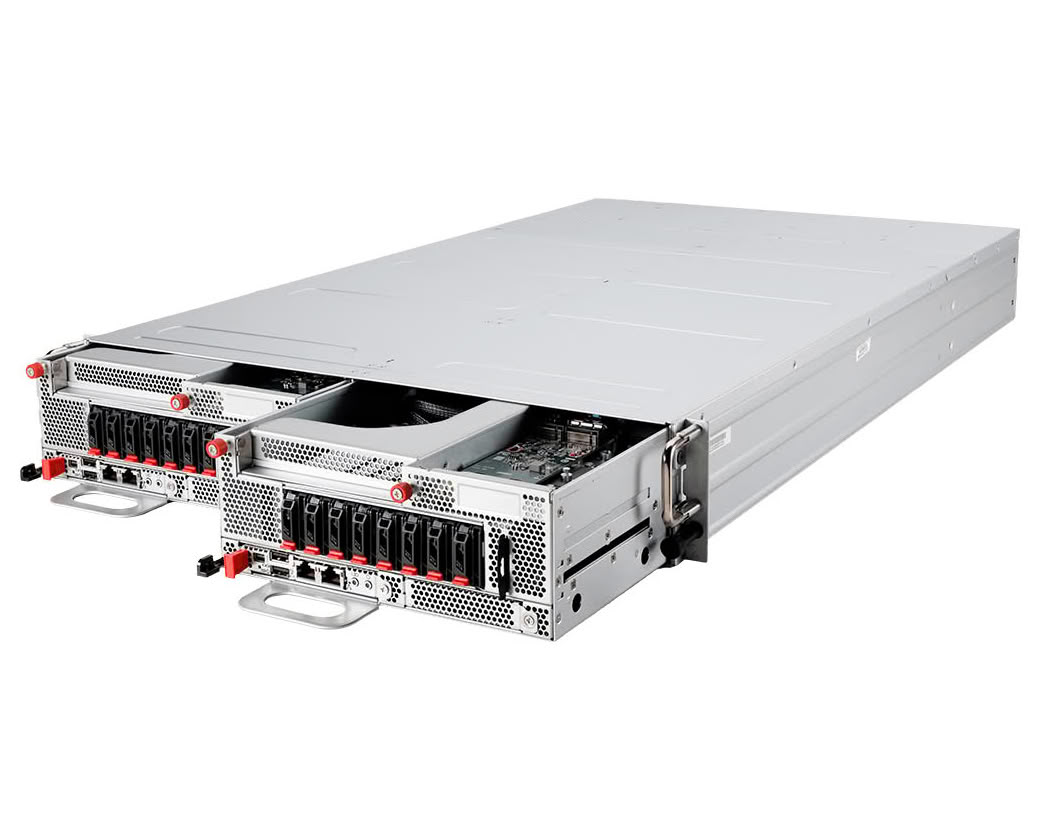
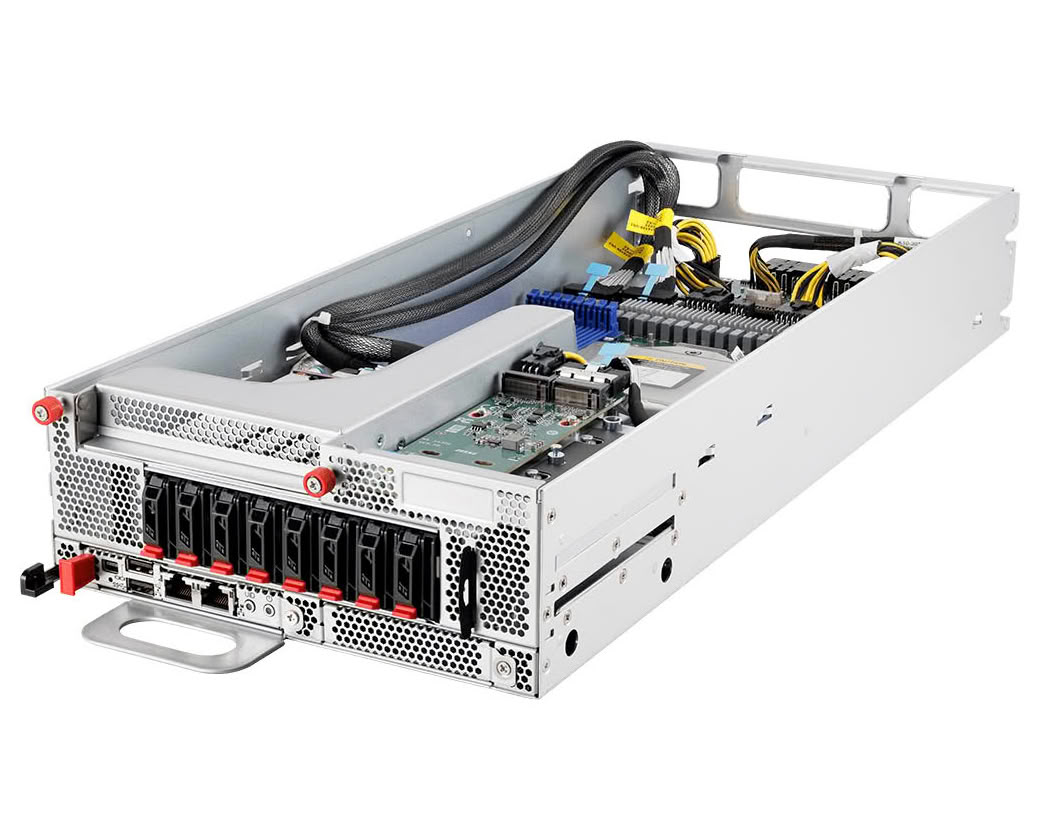
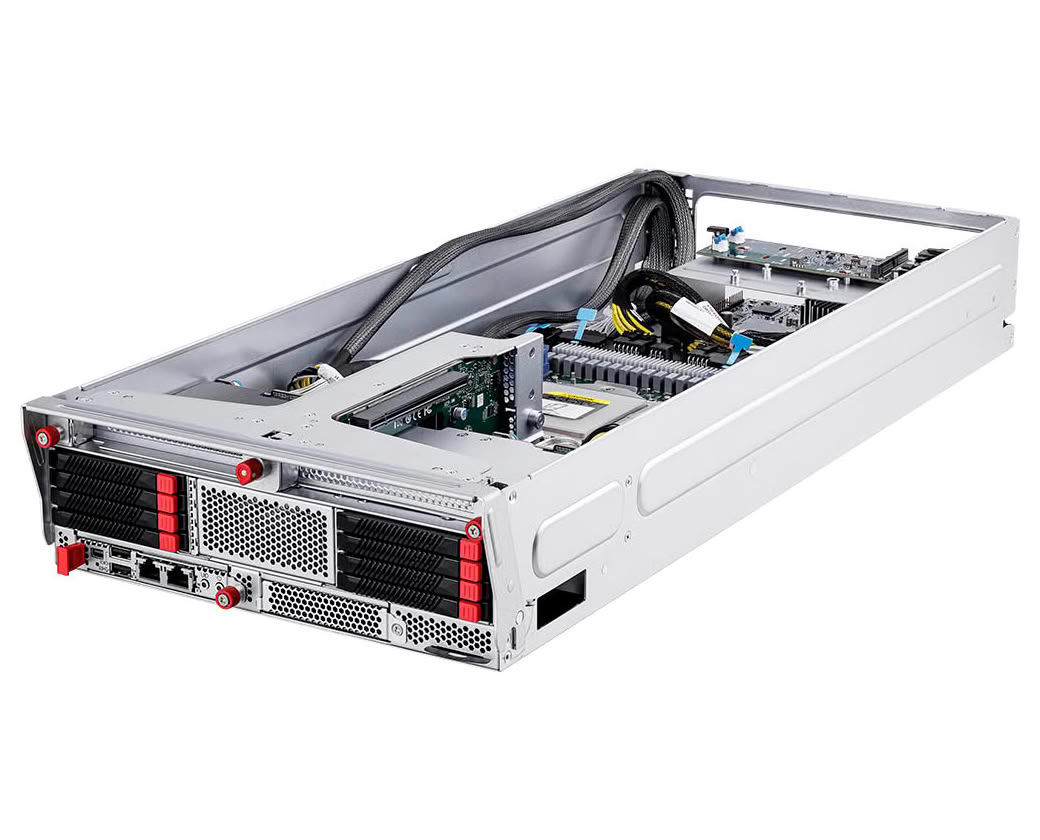
As agentic AI drives new demands for compute density, memory bandwidth, and data movement, MSI is advancing next-generation data center infrastructure with server platforms powered by AMD EPYC 9006 Series SP7 Server CPUs. With SP7 systems entering the shipping phase in Q4 2026 and SP8 platforms planned for the first half of 2027, MSI's portfolio spans liquid-cooled GPU servers, 19" DC-MHS and 21" ORv3 multi-node platforms, and enterprise servers, supporting AI, cloud, HPC, virtualization, and business-critical workloads.

Built on the Zen 6 architecture, AMD EPYC 9006 Series Server CPUs deliver up to 256 cores and 512 threads per socket for high-density computing and AI agent execution. With up to 1.6 TB/s of memory bandwidth and PCIe Gen 6 connectivity, they support data-intensive workloads and high-speed I/O for GPUs, networking, and storage.

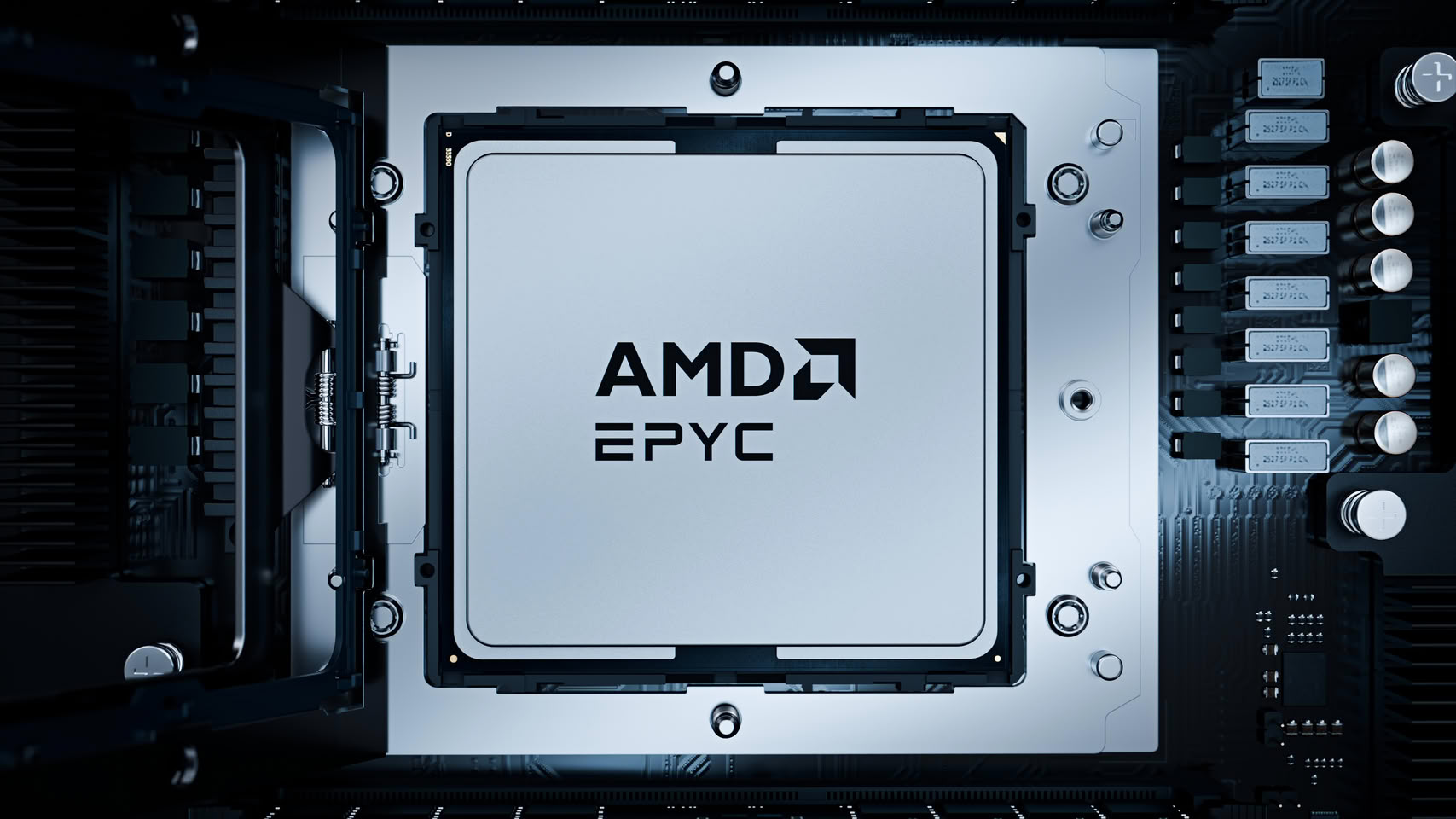
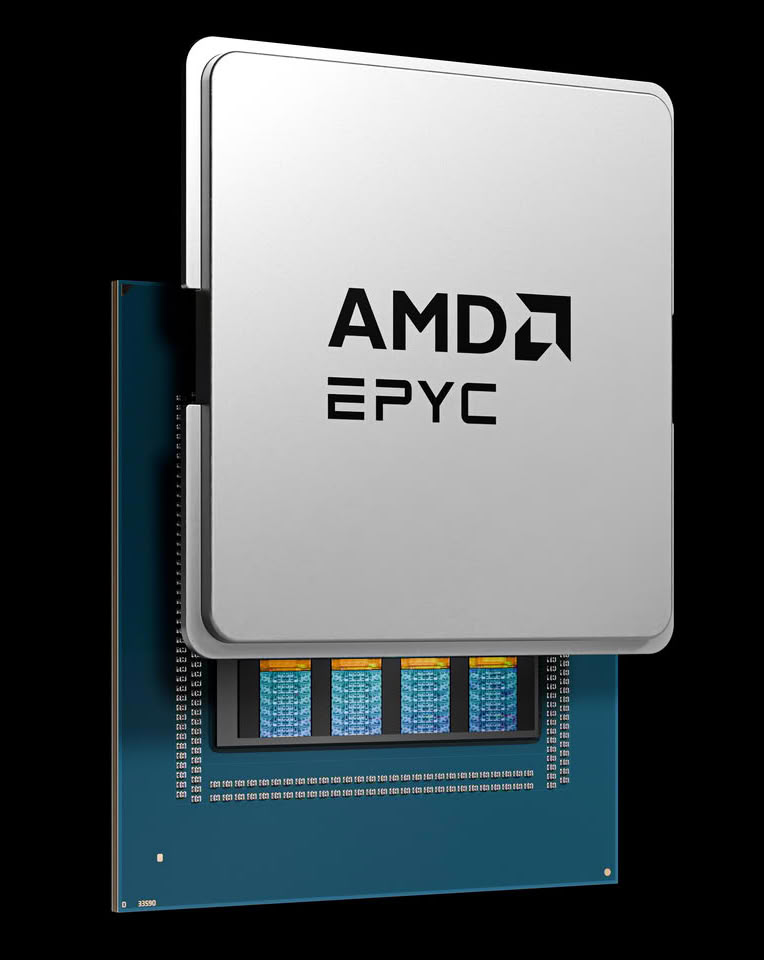
AMD Showcases 6th Gen EPYC Server SP7 Processors Based on the New Zen 6 Architecture

AMD (NASDAQ: AMD) today announced the general availability of the 6th Gen AMD EPYC server SP7 processors, based on the new "Zen 6" architecture, extending its historical server CPU performance leadership as AI creates new demands across the data center. Systems powered by the new CPUs are shipping from all leading server vendors, and cloud instances from Microsoft Azure and OCI are coming soon.

Across five generations, AMD EPYC processors have repeatedly raised the standard for server CPU performance, energy efficiency and platform choice, culminating in 5th Gen AMD EPYC processors becoming the fastest-ramping and highest-volume EPYC generation in AMD history. Now, 6th Gen AMD EPYC server CPUs extend AMD CPU leadership, running AI agents, accelerated infrastructure and critical enterprise applications, helping customers expand computing capacity that runs their businesses.

[Editor's note: You can read our AMD Zen 6 Technical Deep Dive here]

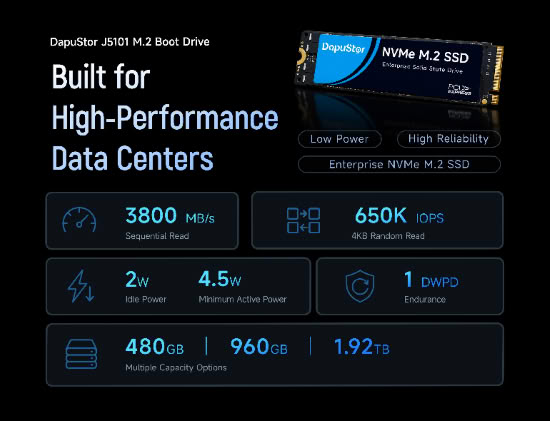
DapuStor Launches Enterprise NVMe M.2 Boot Drive for High-Performance Data Centers

The DapuStor J5101, an enterprise NVMe M.2 boot drive, built with the PCIe Gen 4 interface and a compact M.2 form factor, delivers fast, reliable server boot with low power consumption and flexible capacity options. These capabilities improve operational efficiency and lower total cost of ownership (TCO) in virtualization, AI, HPC, and cloud environments.

As AI infrastructure and data centers scale, server configurations are becoming denser and more complex, with higher costs per node. M.2 boot drives have become a critical component in server reliability and cluster operating costs, with evolving requirements in three key areas:

AMD Goes "Data Center First" While Gaming Revenue Drops 40%

AMD CEO Lisa Su now calls AMD a "data center first" company, two days after AMD reported a 40% drop in gaming revenue. Speaking to Yahoo Finance's Brian Sozzi on November 5, Su said AMD's data center business should grow 50% sequentially from Q3 to Q4, and suggested it could more than double next year. Here's how she put it:
Dr. Lisa Su, AMD CEOWe are a data center first company, that is our profile, and you know, people need more computing to power all these applications.
Data Center brought in a record $8.5 billion in Q3, up 97%, and now makes up 64% of AMD's $13.4 billion total, up from 47% a year ago. Gaming fell to $773 million, or under 6% of revenue. AMD blames it mostly on lower semi-custom sales, meaning the console chips it makes for Sony and Microsoft, along with weaker graphics demand. Gaming was flat against Q2, though, and last year's Q3 was boosted by a 181% console-driven jump to $1.3 billion. Su used the same "data center first" line back in 2024, when data center was just over half of revenue.

AMD Guidance Points to Its First Quarter Ever With More Revenue Than Intel

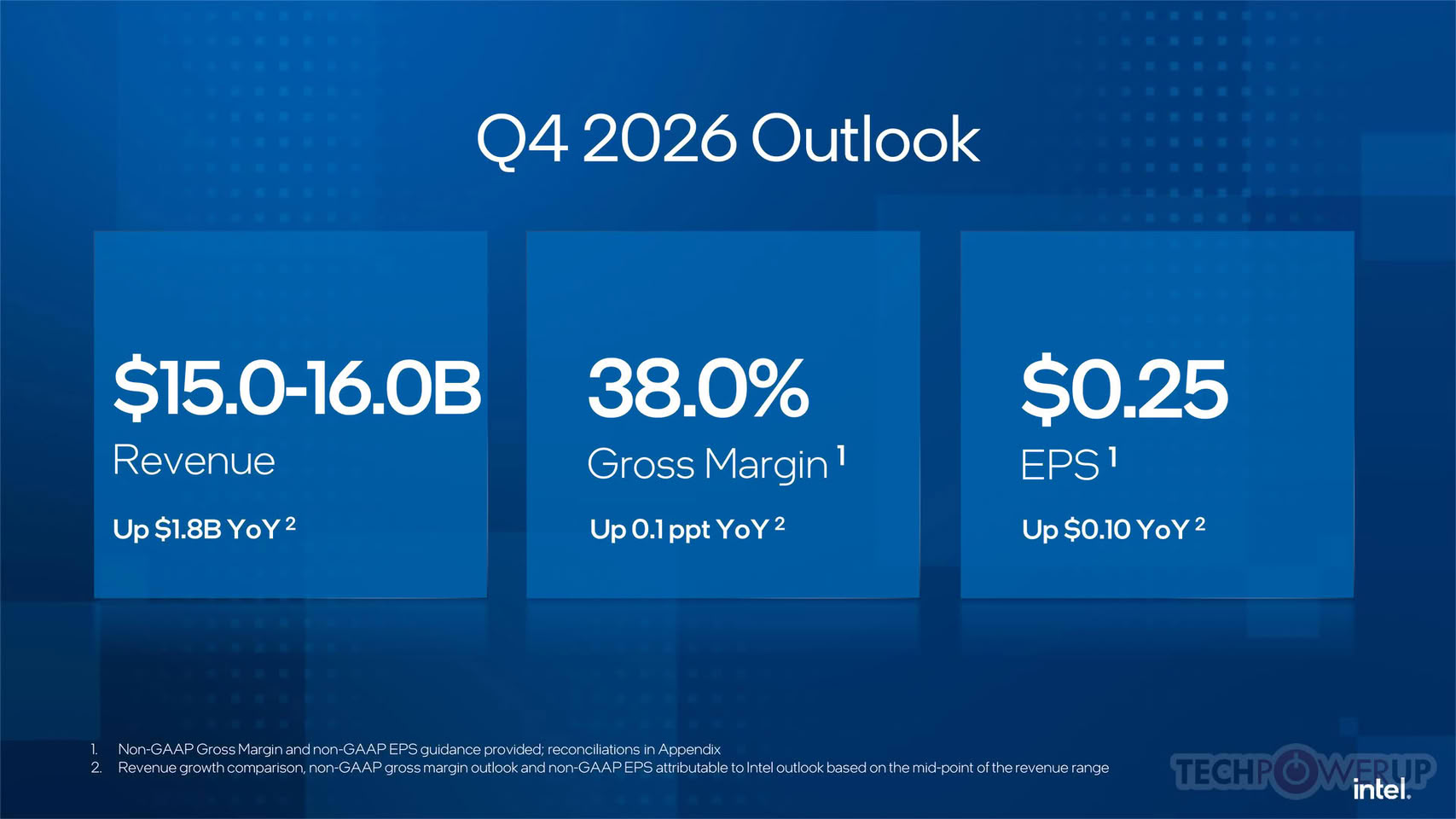
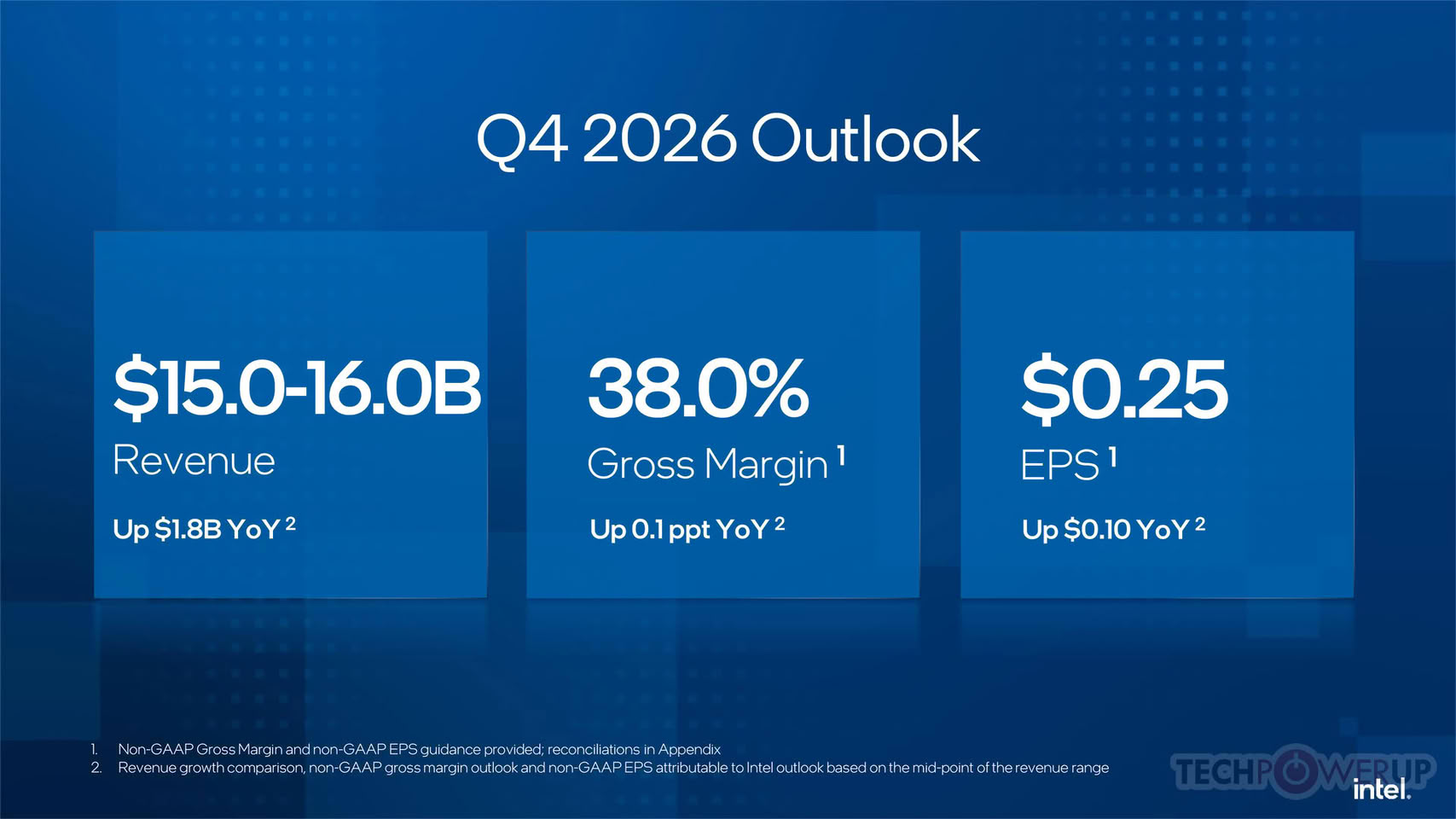
AMD looks set to bring in more quarterly revenue than Intel for what appears to be the first time ever. Alongside its record Q3 2026 results, AMD guided Q4 revenue to approximately $17 billion, plus or minus 3%, or roughly $16.5 billion to $17.5 billion. Intel, on the other hand, expects Q4 revenue between $15 billion and $16 billion. Even the bottom of AMD's range sits above the top of Intel's, so unless either company misses its guidance badly, the flip is pretty much locked in.

Most of AMD's growth comes from the data center. AMD's Data Center segment hit a record $8.5 billion in Q3, up 97% year over year, on strong EPYC demand and the launch of the Instinct MI450 Series GPUs inside its Helios racks. AMD expects the segment to grow about 50% sequentially in Q4, while Client and Gaming is expected to drop by more than 20%. Intel's Q4 outlook, meanwhile, came in well below expectations, partly due to a two-week shutdown at Fab 28 in Israel that Intel says will cost about $300 million in Q4 revenue.

OpenAI CEO Argues Home PCs Waste the World's Limited DRAM Supply

OpenAI CEO Sam Altman thinks the DRAM sitting inside personal computers would be better used in data centers. He made the comments on the Cheeky Pint podcast, hosted by Stripe co-founder John Collison, in an episode released on October 29. The two were discussing the memory supply chain when the topic turned to local inference, meaning running AI models on your own hardware instead of the cloud. Here's what Altman said, at roughly the 29-minute mark:
Sam Altman, OpenAI CEOA lot of people want local inference. And somehow, they assume that the problem is solved now. Because, we are going to have open-source models. We're going to be able to run them on our computers. And so we're not going to need all the stuff in the data center. But from a global allocation perspective, actually, it's quite terrible to have everybody have a bunch of the world's limited supply of DRAM sitting in their own computer. And, being used 5% of the time. You want maximum utilization in the cloud if you're trying to deal with this very supply constrained environment. And somehow everyone's... many people's intuition is the opposite of that.

Intel Data Center Revenue Jumps 78%, but Weak Q4 Guidance Drags Stock Down 30%

Intel shares fell roughly 29% on Friday to $65.76 after the company's fourth-quarter outlook came in well below Wall Street expectations. According to CNBC, it was the stock's worst day since the 1970s. Intel had closed at $92.07 on Thursday, right before it posted its third-quarter 2026 results. Oddly enough, the quarter itself was a good one. Revenue came in at $16.5 billion, up 21% year over year, and adjusted EPS of $0.52 easily beat the roughly $0.40 analysts were expecting. Data Center and AI revenue jumped 78% to $7.3 billion, while the Client Computing Group slipped 5% to $8.1 billion.

Investors, however, were looking at Q4. Intel expects revenue between $15 billion and $16 billion, against a consensus of around $17 billion, with adjusted EPS of just $0.25. Non-GAAP gross margin is also expected to fall to about 38% from 44% in Q3. Part of the shortfall comes from a plant shutdown in Israel. CFO David Zinsner said Intel sees "the PC slowdown continuing at least through the first half of next year." On the earnings call, the company said it expects the PC market to shrink by about 12% in units this year, and it reportedly sees another 10% decline in 2027.

d-Matrix Announces Squadron Compute Clusters for AI Inference at Data Center Scale

d-Matrix today announced d-Matrix Squadron, a fleet of multi-rack systems offering megawatts of highly efficient inference compute for running AI models with extreme speed and energy efficiency at data center scale. Benefiting from d-Matrix's unique memory-centric compute architecture, Squadron clusters are ideal for AI labs, enterprises, and sovereign organizations with latency-sensitive AI applications including coding, personal agents, cybersecurity, and high-frequency trading.

Developed in partnership with Arista, Broadcom, and Supermicro, Squadron has already been deployed by d-Matrix in its Arizona data center for internal research and development and is now shipping to priority customers for deployment in their own data centers. Additionally, Squadron's building blocks—d-Matrix Corsair servers and d-Matrix Corsair SquadRacks—are now generally available.

Marvell Unveils Second-generation Structera X, Industry-first Six-channel CXL 3.2 Memory Expanders for AI Inference

Marvell Technology, Inc. , a leader in data infrastructure semiconductor solutions, today announced the second-generation Marvell Structera X 3406 and Marvell Structera X 3506 CXL memory expanders, designed to help cloud, enterprise and AI infrastructure providers build more efficient, scalable and higher-performance systems for the next era of AI and computing. Designed to address the evolving needs of leading hyperscale datacenters, Structera X addresses the most demanding data center workload requirements.

AI and ML workloads are rewriting the rules of data center design. Growing LLM sizes, expanding context windows and growing KV-cache requirements are driving unprecedented memory demands that traditional server architectures simply cannot meet. Memory is a critical constraint of AI performance and infrastructure efficiency.

Supermicro Now Shipping NVIDIA Vera Rubin NVL72 Racks

Super Micro Computer, Inc. (NASDAQ: SMCI), an AI, Enterprise, Storage, and 5G/Edge IT Total Solution Provider, is now shipping NVIDIA Vera Rubin NVL72 racks integrated with Supermicro's Data Center Building Block Solutions (DCBBS) and its direct liquid cooling stack (DLC-2).
Charles Liang, president and CEO, Supermicro"We have spent years building the liquid-cooling stack, the manufacturing capacity, and the deployment teams for exactly this moment. Our customers can now order a Scalable Unit and receive production-ready systems with end-to-end integration, because we design and build every layer between the cold plate and the cooling tower. Our development of DLC-2 technology is what sets Supermicro apart and allows us to deliver the most complete solution for the NVIDIA Vera Rubin platform."

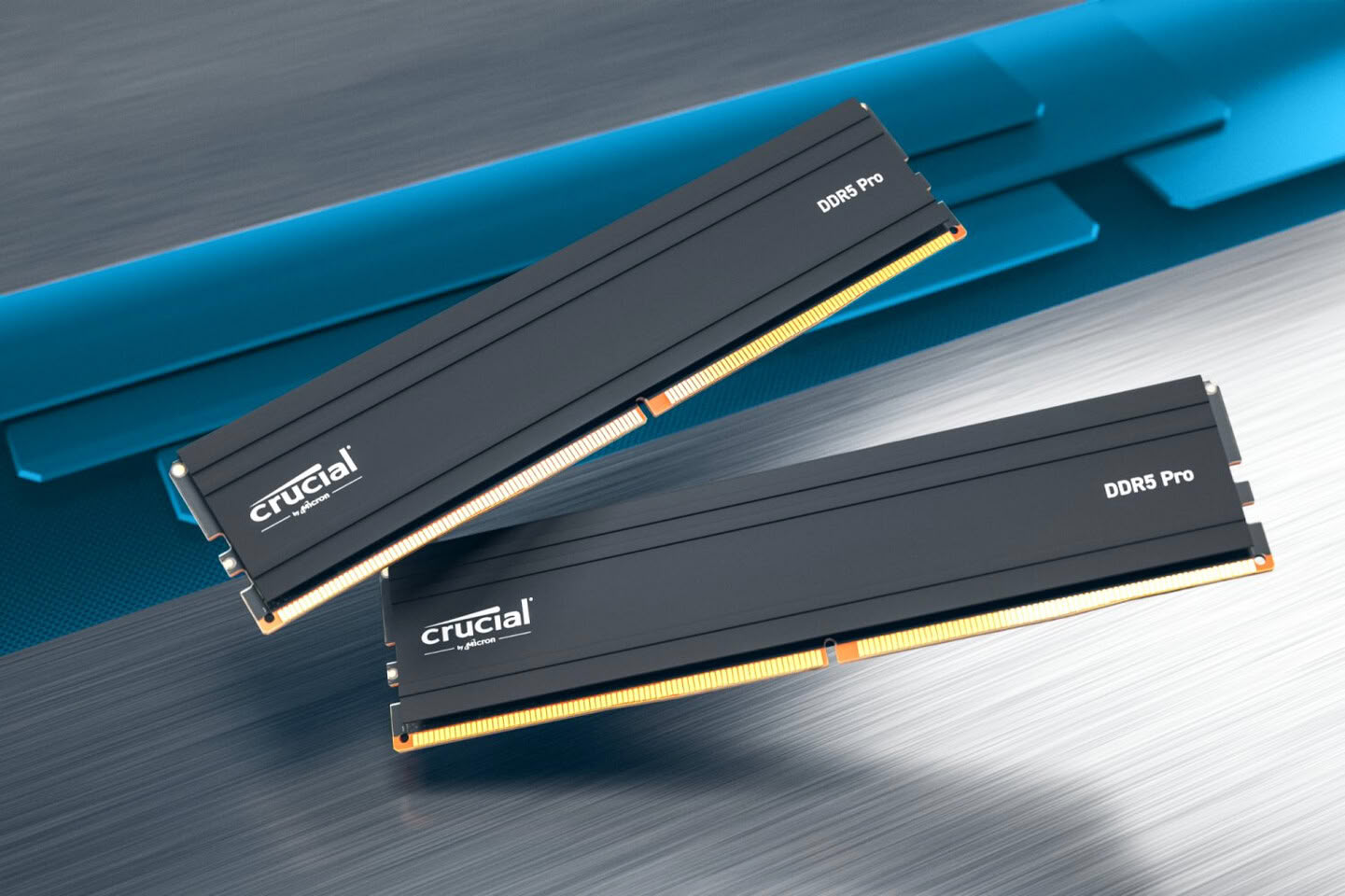
Micron Develops 512 GB DDR5 RDIMM Server Memory Reaching 9200 MT/s

Micron Technology, Inc. (Nasdaq: MU), today announced a major milestone in memory innovation with the successful demonstration of the world's first 512 GB DDR5 module on multiple server platforms. The achievement reinforces Micron's leadership in high-performance, high-capacity server memory and provides enterprise data center and cloud customers with a path to support large and demanding AI, analytics, in-memory database and simulation-heavy workloads with greater efficiency. Leading semiconductor enablers, AMD and Intel, are both actively validating the module, which will deliver speeds up to 9,200 MT/s.

The module's high capacity is possible due to Micron's advanced vertical interconnect packaging innovations. This product vertically stacks DRAM dies interconnected by through-silicon vias (TSVs) to maximize density within individual DRAM packages while preserving the performance modern data center architectures demand. The module enables up to 12 TB of DDR5 DRAM in a single 24-slot dual-socket server.

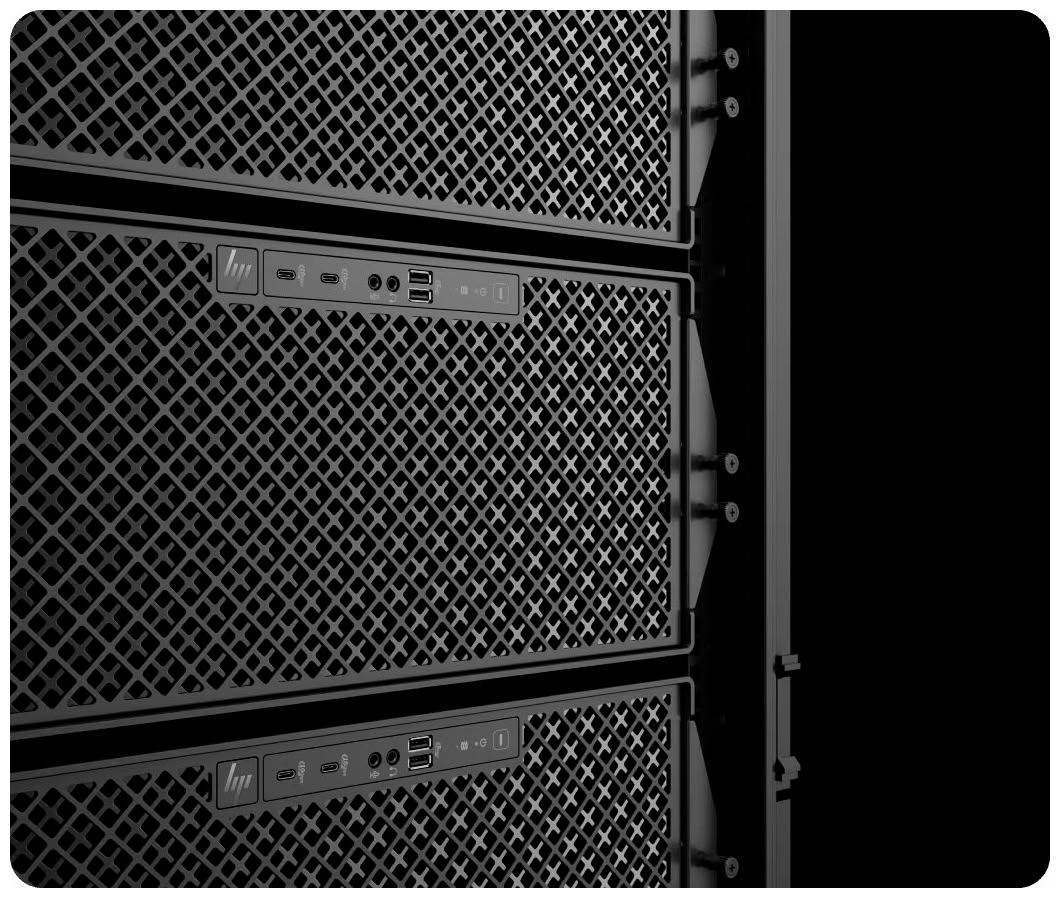
HP Launches ZGX Fury AI Station Powered by NVIDIA GB300 Grace Blackwell and Red Hat

HP Inc. today announced a collaboration with Red Hat, the world's leading provider of open-source solutions, to give organizations more choice in where AI workloads run, whether locally, in the cloud or across both environments. In collaboration with Red Hat, HP is developing an open, enterprise-grade AI platform to deliver purpose-built AI infrastructure powered by Red Hat AI Factory with NVIDIA.

HP's open enterprise-grade AI platform aims to help companies maximize local AI inference throughput with up to 20 PFLOPS FP4 AI performance, reduce environment setup time and deployment risk, and improve GPU utilization through optimized CUDA libraries, scheduling, and multi-GPU workload orchestration. Red Hat AI Factory with NVIDIA is an integrated AI platform, built on the industry-leading infrastructure of Red Hat Enterprise Linux and Red Hat OpenShift, for deploying and managing AI models, agents and applications across the hybrid cloud.

Intel Set to Raise CPU Prices by Another 10% in October

Intel is reportedly planning another 10% price increase on PC CPUs in October, according to DIGITIMES. This would be the latest in a string of price hikes made in stages over the past year. The report doesn't specify whether this price increase will affect only desktop CPUs or whether mobile CPUs will also be included. Industry sources cited by the outlet say the goal is to improve gross margin rather than growing market share. That would be especially important, since global PC shipments are expected to dip slightly from 260 million to about 250 million units in 2027, even as prices continue to climb. If Intel can push CPU shipments back up toward 200 million units, DIGITIMES estimates its market share could recover to roughly 78%.

The report also claims Intel is considering ending its low-margin Small Core product line entirely, which could open the door for Qualcomm and MediaTek to expand further into the industrial PC and IoT chip markets that Intel currently leads. On staffing, sources suggest another 5% to 10% of the workforce could be cut, following Intel's trim of its Data Center and AI group in July. Headcount reportedly sits around 75,000 now, though the same sources say Intel plans to keep hiring alongside any cuts, and that its current size is already reasonable.

AMD Gains Ground as Intel x86 Market Share Goes Back to 1995 Levels

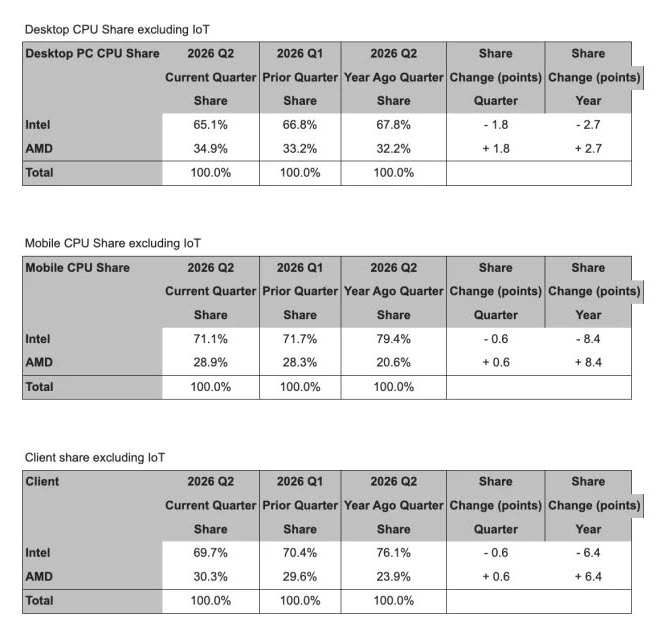
According to Mercury Research, Intel's x86 CPU market share has dropped below 70% for the first time since 1995, hitting 69.3% in Q2 2026, a 6.5-point drop year over year. AMD was there to pick up the difference, reaching 30.7%, a new record for the company. Mercury Research president Dean McCarron confirmed the 31-year low to CRN following the release of his second-quarter CPU market share report. Those figures cover PC and server CPU shipments only. When semi-custom, embedded, and IoT products are included, the Intel market share falls to 65.9% vs. AMD's 34.1%, with the latter getting a boost from a stronger than expected gaming console SoC shipments, a segment Intel doesn't compete in, if we skip the Arc G3 CPU family dedicated to handhelds.

Breaking it down by segment, AMD's desktop share reached 34.9%, up 2.7 points year over year against Intel's 65.1%, despite Intel CPUs returning to Amazon's CPU Top 10 sales ranking yesterday. In the server CPU market, AMD managed to grow by 7.3 points year over year, reaching 34.5% against Intel's 65.5%. The competition is fierce in this segment, AMD has launched the 6th Gen EPYC "Venice" server processors powered by the "Zen 6" CPU microarchitecture, while Intel just announced its upcoming Xeon 7 "Diamond Rapids" CPUs and the "Crescent Island" graphics card for data centers and workstations. The laptop market is where AMD moved the most, climbing to 28.9%, up 8.4 points year over year, while Intel stays at 71.1%. Overall PC market share for AMD hit a record 30.3%, up 6.4 points year over year.

Silicon Motion Showcases Next-Generation Storage Solutions for Agentic AI Applications at FMS 2026

Silicon Motion Technology Corporation ("Silicon Motion"), a global leader in designing and marketing NAND flash controllers for solid-state storage devices, today announced it will showcase its latest storage innovations for AI Factory, Edge AI, and Physical AI applications at Future of Memory and Storage (FMS) 2026, taking place August 4 to 6 in Santa Clara, California, at Booth #315.

As AI evolves beyond large language model training toward Agentic AI, real-time inference has become increasingly dependent on fast, predictable data access. Emerging storage requirements for KV cache and Agentic AI applications demand storage solutions that maximize acceleration while maintaining low latency and consistent performance. Silicon Motion will showcase five major product lines addressing the evolving storage requirements across the three AI segments, supporting enterprise infrastructure, edge computing, embedded devices, and automotive platforms:

Microchip Partners with Micron to Showcase High-Performance PCIe Gen 6 Storage Architecture

Microchip Technology (Nasdaq: MCHP) today announced a demonstration showcasing an end-to-end PCIe Gen 6 storage architecture, combining Microchip's Switchtec PCIe Gen 6 switches with high-performance Micron 9650 NVMe solid state drives (SSDs). The demonstration highlights the role of next-generation PCIe technology in enabling higher data throughput, reduced latency and scalable connectivity for AI, high-performance computing (HPC) and cloud data center workloads.

At the 2026 Future of Memory and Storage (FMS) Conference, the demonstration features a Microchip Switchtec Gen 6 PCIe fanout switch acting as a high-bandwidth, low-latency interconnect between host processors and multiple Micron 9650 SSDs enabling the drives to operate at the full potential of Gen 6 speed. The architecture supports composable and disaggregated system designs, allowing data center architects to scale storage resources efficiently while maintaining predictable performance.

Kioxia Announces NX1 Data Center NVMe E1.S SSDs

KIOXIA America, Inc. today announced the KIOXIA NX1 Series of solid-state drives (SSDs), a new generation of E1.S PCIe 5.0 NVMe data center SSDs, and Kioxia's first SSD with direct liquid cooling support. The KIOXIA NX1 Series features Kioxia's next-generation, in-house developed controller architecture enabling unique capabilities today while providing a foundation for future features. The new drives are engineered to deliver high-performance, power-efficient storage for GPU-enabled servers and hyperscale data center environments.

The KIOXIA NX1 Series is the successor model of the XD series, and leverages PCIe 5.0 performance to help cloud providers and hyperscale operators optimize infrastructure while maintaining operational efficiency. Compared to the previous generation, KIOXIA NX1 SSDs deliver up to 38% higher sequential write performance and up to 20% higher random write performance.

NVIDIA and OpenAI Reportedly Discuss $250 Billion Deal for 10-Gigawatt Ohio Data Center

NVIDIA is in talks to provide roughly $250 billion in financing guarantees for OpenAI's planned data center campus in southern Ohio, according to the Wall Street Journal, cited by Reuters. The project is being developed by SB Energy, a SoftBank subsidiary and is a 10-gigawatt facility sited on a decommissioned uranium-enrichment site about 50 miles south of Columbus, Ohio. The total cost, including chips, could exceed $500 billion making it the largest data center project announced to date. The financing structure would have NVIDIA backstop a set of lending instruments to reassure investors, which is necessary partly because OpenAI hasn't turned a profit and can't qualify for investment-grade credit on its own. The $250 billion commitment covers the lease and construction financing but not the chips. For those it seems that NVIDIA is also in talks to help fund OpenAI's chip purchases, a figure the WSJ puts at up to $350 billion. Remember that last year, OpenAI and NVIDIA teamed up on a huge project to set up 10 gigawatts of NVIDIA systems, the latter planning (at that time) to invest up to $100 billion into OpenAI.

For OpenAI the deal would be its first directly leased data center, reducing dependence on Microsoft, Amazon, and Oracle for cloud infrastructure. The company has since raised its projected computing spend to around $750 billion through 2030. For NVIDIA, backing the project effectively locks in chip demand for years. Power for the site is controlled by the U.S. government and funded separately through a recent trade deal with Japan, which agreed to invest $33 billion in a natural gas plant on the federal land in exchange for lower tariffs. Power allocation is controlled by US Commerce Secretary Howard Lutnick, OpenAI, Anthropic, Microsoft, and Google have all been in contact with him about the site. The first phase is expected to be completed in 2028 at around 800 megawatts. However, the terms of the deal are not final, and it could be scrapped.

AMD Advancing AI 2026: Pensando "Salina" DPU and "Vulcano" AI NIC Power Helios Networking

Networking is the third pillar of AMD's Advancing AI 2026 rack-scale strategy, and today the company detailed the AMD Pensando silicon and fabric technology that connects the Helios rack. As Helios is AMD's first rack-scale design, the company encountered challenges in interconnecting many GPUs, memories, and data movement speeds within a single system, both for scaling up and scaling out for multi-rack connections inside the data center. Current AI infrastructure must closely follow model development as AI model sizes have grown exponentially, from the original 65-million-parameter Transformer in 2017 to trillion-parameter GPT-4-class systems and now 10-trillion-plus parameter agentic and reasoning models. To run a model with more than 10 trillion parameters, you need to connect dozens of GPUs with high-speed VRAM, as well as a high-speed interconnect to split model weights effectively so latency isn't an issue. The modern interconnect of choice is again the plain-old Ethernet, not proprietary interconnects, which have become the standard for AI networking.

AMD's solution spans three layers: a third-generation Pensando "Salina" DPU on the front end, a first-generation UALink-over-Ethernet (UALoE) scale-up fabric inside the rack, and a second-generation Pensando "Vulcano" AI NIC for scale-out. All of this is managed by AMD's Helios management software and Fabric Manager. AMD outlined challenges that bandwidth needs are doubling in less than two years driven by massive AI models growing at a rapid pace, and that the hardware iteration cycles need to account for intelligence in the data fabric layer, not only compute layer.

AMD Instinct MI400 Series and Helios Rack Debut: CDNA 5 Goes 2 nm, Plus ROCm.ai and "Gorgon Halo"

AMD used its Advancing AI 2026 keynote today to launch the Instinct MI400 Series, its next-generation data-center GPU family, alongside the Helios rack-scale solution and the CDNA 5 architecture that underpins both. CDNA 5 is AMD's first GPU architecture to reach the 2 nm node, with the flagship Instinct MI455X carrying 320 billion transistors across a multi-chiplet package and 432 GB of HBM4. This is a data-center compute architecture, not a Radeon gaming architecture, though some of the design choices in CDNA 5 point to where AMD's future unified gaming/compute architecture could be headed.

The MI400 Series splits into two parts: the Instinct MI455X for frontier AI and AI-factory deployments, and the Instinct MI430X for sovereign AI and HPC. Together with the Helios rack, 6th Gen EPYC "Venice" CPUs and AMD Pensando networking, they form AMD's open answer to NVIDIA's Vera Rubin NVL72. This post also covers the new ROCm.ai software stack and AMD's "Gorgon Halo" client teaser.

IBM Launches Compact z17 and LinuxONE Systems

IBM (NYSE: IBM) today announces new IBM z17 and IBM LinuxONE 5 configurations, marking the first time IBM is offering rack mount alongside single frame systems across its full Z and LinuxONE portfolio. The expanded IBM z17 and LinuxONE 5 portfolios now offer a wide range of deployment options, engineered with the same flagship performance, security, and ecosystem standards. New single frame and rack mount options provide additional ways for organizations to position their infrastructure where it fits best for their business needs, helping support flexibility and operational efficiency.

Organizations processing highly sensitive workloads at scale are facing record-low data center vacancy and rental rates exceeding $400 per kW/month, according to CBRE's 2026 Global Data Center Trend Report. At the same time, they need infrastructure that can optimize their data center footprint while prioritizing the resilience required for their core applications. Enterprises can use IBM z17 and LinuxONE 5 rack mount and single frame systems to address these challenges, optimizing their data center real estate to meet today's realities.

Qualcomm and Meta Announce Strategic Multi-Generation Agreement on Data Center CPUs

Qualcomm Technologies, Inc. and Meta today announced a strategic multi-generation collaboration for Qualcomm Technologies to be a supplier for data center CPUs for Meta. Qualcomm Technologies' data center CPU, the Qualcomm Dragonfly C1000, is planned to power Meta's next-generation server fleet, underscoring the growing importance of high-performance, power-efficient compute in large-scale scale-out environments.

Qualcomm Technologies' solutions will be in production starting in the second half of 2028 and future data center capacity expansions. Qualcomm Technologies' platform approach, spanning advanced compute, high-performance connectivity, and system-level optimization, is designed to deliver substantial performance per watt and help reduce total cost of ownership at scale.

Qualcomm Unveils Data Center Roadmap with New Dragonfly Portfolio

Qualcomm Technologies, Inc. (NASDAQ: QCOM) today announced at its Investor Day, new data center solutions, including the Qualcomm Dragonfly C1000 CPU, Qualcomm High Bandwidth Compute (HBC), Qualcomm Dragonfly AI300 inference accelerator, and connectivity products, together with custom silicon solutions, all engineered to maximize performance per watt and token throughput at lower total cost of ownership. The new platforms highlight Qualcomm Technologies' growing role in building full-stack data center infrastructure optimized for AI, spanning agentic and data-center-class CPUs, AI inference accelerators, high-performance connectivity, and at scale custom silicon solutions. The Qualcomm Dragonfly AI300 joins the previously announced Qualcomm Dragonfly AI200 and AI250 in its data center solutions portfolio with an annual cadence AI accelerator roadmap.

"Agentic AI is driving a significant increase in demand for AI inference in the data center. As these become the dominant workloads, infrastructure has to deliver much higher performance at lower power and cost," said Cristiano Amon, President and CEO, Qualcomm Incorporated. "That plays directly to Qualcomm's strengths, and we're well positioned for this shift. With Qualcomm Dragonfly, we're bringing our high-performance, low-power computing into the data center, with multi-year, multi-generation agreements with leading customers."
Supermicro Launches New Server Solutions with Intel Xeon 6+ Processors

Super Micro Computer, Inc (NASDAQ: SMCI), an AI, Enterprise, Storage, 5G/Edge total solution provider featuring Data Center Building Block Solutions (DCBBS), today announced the launch of 12 new server platforms optimized for new Intel Xeon 6+ processors. Featuring up to 288 efficiency cores per socket and delivering improved performance-per-watt, the new systems are designed for high-density cloud, virtualization, 5G analytics, and other throughput-intensive workloads.

"By working closely with Intel, we have optimized our DCBBS with the new Xeon 6+ processors to deliver breakthrough core density and efficiency," said Charles Liang, president and CEO of Supermicro. "These new X14 platforms, with up to 576 E-cores per server, dramatically improve performance-per-watt and help customers shorten time-to-deployment while lowering TCO and energy consumption in large-scale cloud and enterprise data centers."
Return to Keyword Browsing
Nov 23rd, 2026 01:10 CST change timezone

New Forum Posts

Popular Reviews

TPU on YouTube

Controversial News Posts