News Posts matching #GB300

Return to Keyword Browsing

NVIDIA "Vera Rubin" NVL144 Servers Set for 2026 Volume Production

Foxconn has begun engineering validation for NVIDIA's "Vera Rubin" NVL144 MGX liquid-cooled racks, with plans for mass production in the latter half of 2026, according to internal supply-chain documents obtained by Taiwan Economics Daily. Each NVL144 unit features 144 Rubin GPUs with HBM4, updated 88-core Vera CPUs, and ConnectX-9 NICs and NVLink 6 interconnect for CPU-to-GPU and GPU-to-GPU communication, effectively doubling the compute density of the current NVL72 platform. The Taiwanese contractor Foxconn currently handles about 60% of NVIDIA's AI server output and is expanding its immersion-cooling and copper-plating lines at its Wisconsin and Houston facilities to meet new domestic manufacturing requirements.

The gap between GB300 peak shipments and Rubin's first silicon will be six to eight months, the shortest generational gap in NVIDIA's history. Despite the accelerated roadmap, Blackwell Ultra remains NVIDIA's main revenue source through mid-2026. Procurement data shows that cloud providers have reserved around 400,000 GB300 nodes for delivery in late 2025 and early 2026, indicating strong near-term demand. At the same time, OpenAI has placed a large preorder for Vera Rubin silicon, securing initial production volumes and supporting Foxconn's capacity investments. The rapid transition from Hopper to Blackwell and then to Rubin within 30 months marks the fastest acceleration of datacenter equipment cycles, leading hyperscale operators to speed up depreciation schedules.
ASRock Rack Unveils NVIDIA HGX B300 Servers with Waterless Liquid Cooling Solution

ASRock Rack Inc., a leading innovative server company, today announced the launch of the 4U16X-GNR2/ZC, which uniquely integrates NVIDIA HGX B300 platform with ZutaCore HyperCool waterless direct liquid cooling (DLC). The breakthrough platform will be showcased at the Open Compute Project (OCP) Global Summit 2025, taking place October 14-16 at the San Jose Convention Center, Booth C31.

The rapid growth of AI is driving demand for powerful, efficient infrastructure across industries. To support this expansion, liquid cooling is becoming essential for managing heat in high-performance AI factories. By maximizing efficiency and reducing operational costs, liquid-cooled AI factories are key to accelerating AI adoption and powering the next wave of innovation.

ASUS Unveils AI Factory and Next-Gen Servers with NVIDIA HGX B300 systems at OCP 2025

ASUS today announced its participation in the 2025 OCP Global Summit, being held from October 13-16 at the San Jose Convention Center, booth #C15. At the event, ASUS unveiled its XA NB3I-E12 series AI servers, based on NVIDIA HGX B300 system integrated with NVIDIA ConnectX-8 InfiniBand SuperNICs, 5 PCIe expansion slots, 32 DIMM and 10 NVMe. Designed for enterprises and cloud service providers (CSPs) managing intensive AI workloads, these servers deliver outstanding performance and stability, unlocking the full potential of AI.

Starting this September, ASUS AI POD built on NVIDIA GB300 NVL72 and XA NB3I-E12 servers based on NVIDIA HGX B300 have begun shipping, giving enterprises and cloud service providers early access to cutting-edge AI performance and reliability.

Giga Computing Joins OCP Global Summit and Debuts New OCP-based GIGABYTE Server

Giga Computing, a subsidiary of GIGABYTE and an industry leader in enterprise hardware and advanced cooling solutions, today announced its participation in the OCP Global Summit and the launch of its new GIGABYTE TO86-SD1 based on the NVIDIA HGX B200 platform. Built on the OCP ORv3 standard, the system combines breakthrough performance with an energy-efficient design to meet the demands of large-scale AI training, inference, and HPC workloads. With support for the powerful NVIDIA Blackwell GPU, this next-generation platform empowers enterprises and research organizations to accelerate innovation, scale seamlessly, and unlock new possibilities in AI.

What to Expect at GIGABYTE Booth #A57
The 2025 OCP Global Summit (Oct. 13-16) is the first opportunity to display and introduce this new OCP-based GPU server. The new GIGABYTE TO86 Series is designed to support 8-GPU OAM baseboards that are ideal for their performance and scalability and are used by hyperscalers, sovereign data centers, and specialized AI cloud providers. Also featured at the GIGABYTE booth is the NVIDIA GB300 NVL72 platform, a liquid-cooled, rack-scale design with dense performance in a platform optimized for test-time scaling inference. Alongside this platform for AI factories is the GIGABYTE XL44-SX2, an NVIDIA RTX PRO Server featuring NVIDIA ConnectX-8 SuperNICs. These products are a testament to the breadth of accelerated computing solutions using standardized designs, including ones inspired by OCP.

Microsoft Azure Unveils World's First NVIDIA GB300 NVL72 Supercomputing Cluster for OpenAI

Microsoft Azure today announced the new NDv6 GB300 VM series, delivering the industry's first supercomputing-scale production cluster of NVIDIA GB300 NVL72 systems, purpose-built for OpenAI's most demanding AI inference workloads. This supercomputer-scale cluster features over 4,600 NVIDIA Blackwell Ultra GPUs connected via the NVIDIA Quantum-X800 InfiniBand networking platform. Microsoft's unique systems approach applied radical engineering to memory and networking to provide the massive scale of compute required to achieve high inference and training throughput for reasoning models and agentic AI systems.

Today's achievement is the result of years of deep partnership between NVIDIA and Microsoft purpose-building AI infrastructure for the world's most demanding AI workloads and to deliver infrastructure for the next frontier of AI. It marks another leadership moment, ensuring that leading-edge AI drives innovation in the United States.

Giga Computing Showcases AI-Centric Server Solutions at GITEX Global 2025

Giga Computing, a subsidiary of GIGABYTE and a global leader in AI servers and advanced cooling technologies, announced its participation in GITEX Global 2025, featuring nVent and Iceotope at GIGABYTE booth H10-18. As a trusted partner in the AIDC Infra ecosystem, Giga Computing designs and delivers high-performance AI servers. nVent is a leader in high density liquid cooling, rear-door heat exchangers (RDHx), IT server racks and cabinets, manifolds and iPDUs. Iceotope liquid cooling solutions offer enterprises and cloud service providers a unique combination of peak thermal efficiency and deployment flexibility. Working together, they underscore a collaborative ecosystem supported by a joint commitment to energy-efficient and sustainable AI infrastructure.

Driving Growth and Innovation in the Middle East
Participation in GITEX reflects Giga Computing's commitment to building a strong presence in the Middle East market, a region experiencing a rapid digital transformation and AI adoption. As one of the world's top-tier AI server suppliers, Giga Computing is bringing its complete AI data center solutions to the Middle East, providing enterprises, hyperscalers, and emerging AI innovators with scalable infrastructure designed for cutting-edge workloads.

Microsoft Unveils World's Biggest AI Datacenter, Housing Hundreds of Thousands of GPUs

Microsoft announced today that it will bring Fairwater, a purpose-built AI datacenter in Mount Pleasant, Wisconsin, online in early 2026. The new site is designed as the most powerful datacenter on the planet, serving as a hub for next-generation model training and inference. The campus covers 315 acres with roughly 1.2 million square feet across three buildings and will house hundreds of thousands of NVIDIA GB200 and GB300 GPUs linked by fiber, which can reportedly circle the globe 4.5 times. While we don't have information on the exact GPU count, Microsoft claims the installation will deliver about 10x the performance of today's fastest supercomputers for frontier AI workloads. With the fastest already deployed cluster being xAI's Colossus 1, this means that this system could have over half a million "Blackwell" and "Blackwell Ultra" GPUs.

Over 90% of compute capacity will use a closed-loop liquid cooling system that is filled during construction and continuously recirculated, backed by what the company describes as the planet's second-largest water-cooled chiller plant. Around 10% of servers will rely on outside air and switch to water cooling only on the hottest days. Storage and I/O are scaled for exabyte-class datasets, and the buildout involved 46.6 miles of deep foundation piles, 26.5 million pounds of structural steel, 120 miles of medium-voltage underground cable, 72.6 miles of mechanical piping, and an external cooling array that includes 172 20-foot fans.

China Blocks Tech Firms from Buying NVIDIA AI Accelerators

China has reportedly banned its domestic technology firms from purchasing NVIDIA AI accelerators to promote the adoption of domestic AI accelerators. According to sources close to the Financial Times, the Cyberspace Administration of China (CAC) instructed several technology giants, including Alibaba, Baidu, and Tencent, to stop their independent evaluation and procurement of NVIDIA's export-modified AI accelerators. This includes chips like the RTX PRO 6000D, a variant of the RTX PRO 6000 designed for the Chinese market. There is no mention of the modified "Blackwell Ultra" single-die B30A accelerators, which were intended as a China-specific alternative to the GB300, offering half the compute power.

This directive from Beijing indicates that, despite Chinese tech giants' interest in NVIDIA-supplied AI accelerators due to their superior software and computing capabilities, regulators aim to promote domestic AI accelerators from companies like Huawei and Cambricon. These domestic chips are built on older technology nodes, primarily because of China's limited access to cutting-edge manufacturing and the absence of modern EUV tools for its domestic fabs. An insider told the Financial Times that "the top-level consensus now is there's going to be enough domestic supply to meet demand without having to buy NVIDIA chips." This suggests that the current ambitions of Chinese AI labs could be fully met with domestic chips. However, training and running frontier-level models on non-NVIDIA hardware remains a persistent challenge.

NVIDIA Moves to SOCAMM2, Phases Out Initial SOCAMM Design

NVIDIA has reportedly discontinued its first-generation Small Outline Compression Attached Memory Modules, known as SOCAMM. According to ET News, NVIDIA is shifting focus to the second-generation SOCAMM2 standard, which is being revamped for higher memory speeds, resulting in significantly improved bandwidth and performance. The first-generation SOCAMM was developed independently by NVIDIA, outside of any official memory consortium like JEDEC. It featured a detachable module design, offering superior specifications compared to existing solutions, with 694 I/O ports (compared to LPCAMM's 644 and traditional DRAM's 260), direct LPDDR5X memory substrate integration, and a more compact form factor.

NVIDIA aims for SOCAMM2 to become a faster, more widely adopted standard, potentially with JEDEC's assistance to standardize the format. SOCAMM2 is expected to maintain the same 649 I/O ports exposed to the motherboard but will integrate faster LPDDR5X running at 9600 MT/s, compared to the first-generation SOCAMM's 8533 MT/s. The new SOCAMM2 might also use LPDDR6 and source it from multiple suppliers. NVIDIA currently ships SOCAMM in its "Blackwell Ultra" GB300 NVL72 system, providing 18 TB of LPDDR5X memory at 14.3 TB/s bandwidth. An upgrade to SOCAMM2 could increase that to 16 TB/s bandwidth as a simple drop-in replacement, stemming from 9600 MT/s LPDDR5X. Additionally, NVIDIA may be diversifying its supplier strategy. The first-gen SOCAMM was supplied by Micron, but now Samsung and SK Hynix might join, although no specific details or timeline are available.

NVIDIA Blackwell Ultra Sets the Bar in New MLPerf Inference Benchmark

Inference performance is critical, as it directly influences the economics of an AI factory. The higher the throughput of AI factory infrastructure, the more tokens it can produce at a high speed - increasing revenue, driving down total cost of ownership (TCO) and enhancing the system's overall productivity. Less than half a year since its debut at NVIDIA GTC, the NVIDIA GB300 NVL72 rack-scale system - powered by the NVIDIA Blackwell Ultra architecture - set records on the new reasoning inference benchmark in MLPerf Inference v5.1, delivering up to 1.4x more DeepSeek-R1 inference throughput compared with NVIDIA Blackwell-based GB200 NVL72 systems.

Blackwell Ultra builds on the success of the Blackwell architecture, with the Blackwell Ultra architecture featuring 1.5x more NVFP4 AI compute and 2x more attention-layer acceleration than Blackwell, as well as up to 288 GB of HBM3e memory per GPU. The NVIDIA platform also set performance records on all new data center benchmarks added to the MLPerf Inference v5.1 suite - including DeepSeek-R1, Llama 3.1 405B Interactive, Llama 3.1 8B and Whisper - while continuing to hold per-GPU records on every MLPerf data center benchmark.

NVIDIA Unveils "Rubin CPX" GPU: Single-Die, 30 PetaFLOPS, and 128 GB of GDDR7 Memory

During the AI Infra Summit, NVIDIA announced the "Rubin CPX" GPU, a specialized accelerator derived from the upcoming "Rubin" family, specifically made for massive-context AI models. The chip delivers 30 PetaFLOPS of NVFP4 compute performance on a monolithic die, accompanied by 128 GB of GDDR7 memory. The monolithic die configuration represents a departure from the dual-GPU packages characteristic of NVIDIA's current Blackwell and Blackwell Ultra architectures, as well as the design path that the rest of the Rubin family will follow. The Rubin CPX addresses computational bottlenecks in extended-context scenarios where AI models process millions of tokens simultaneously. This capability proves critical for applications including comprehensive software codebase analysis and hour-long video content processing, which can require up to one million tokens.

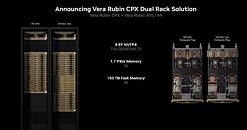
The processor integrates four NVENC and four NVDEC video encoders directly on-chip, enabling streamlined multimedia workflows without external processing dependencies. Performance metrics suggest that the Rubin CPX is delivering three times the attention processing speed of NVIDIA's current best GB300 Blackwell Ultra accelerator systems. The architecture employs a cost-optimized single-die approach, rather than multi-chip modules, which potentially reduces manufacturing complexity while maintaining computational density. Memory bandwidth specifications remain undisclosed, though a 512-bit interface could yield approximately 1.8 TB/s throughput when using 30 Gbps GDDR7 memory chips. NVIDIA plans integration of Rubin CPX processors within the Vera Rubin NVL144 CPX platform, which combines traditional Rubin GPUs with the specialized CPX variants. This hybrid configuration targets 8 ExaFLOPS of aggregate compute performance, with 1.7 PB/s of memory bandwidth, across a complete rack deployment. The "Kyber" rack will include ConnectX-9 network adapters capable of 1600G networking, Spectrum6 doing 102.4T switching, as well as co-packaged optics. NVIDIA plans this to arrive in late 2026, after the regular Rubin GPU launch in early 2026.

NVIDIA "Blackwell Ultra" Brings PCIe Gen 6 and 1.5x NVFP4 Performance Boost

NVIDIA's long-anticipated "Blackwell Ultra" is the final form of the Blackwell family before the transition to "Rubin." However, this silicon doesn't seem to share much resemblance with its predecessors, especially in terms of I/O and performance. On its blog, NVIDIA detailed the silicon design of its latest creation and all the accompanying features like enhanced software support and optimizations. One of the most striking aspects of the Blackwell Ultra, designed for AI servers, is its use of PCIe Gen 6, whereas the consumer Blackwell and regular server Blackwell use PCIe Gen 5. Made using the TSMC 4NP node, the massive Ultra chip features 208 billion transistors, which is 2.6 times more than the last generation Hopper, based solely on raw transistor count. This comes with a 1,400 W TDP, which means a massive cooling system is a must.

When it comes to performance, Blackwell Ultra delivers approximately 1.5 times denser NVFP4 compute compared to Blackwell, resulting in higher tokens-per-second on inference and improved throughput for large-batch training. The chip pairs 160 SMs across two reticle dies via NVIDIA's NV-HBI link, bringing a 10 TB/s die-to-die fabric, 288 GB of HBM3E at up to 8 TB/s bandwidth, and fifth-generation Tensor Cores tuned for NVFP4. Attention-layer throughput benefits from the doubled performance of special function units (SFUs) for transcendental operations, reducing softmax latency and enhancing reasoning responsiveness.
Blackwell Ultra Blackwell Ultra Blackwell Ultra

Giga Computing Joins SIGGRAPH 2025 with NVIDIA-based Systems Scaling from Mini PCs to Workstations to Enterprise-grade Servers

Giga Computing, a subsidiary of GIGABYTE and an industry leader in generative AI servers and advanced cooling technologies, today announced its GIGABYTE booth at SIGGRAPH 2025 to showcase innovative products accelerated by NVIDIA Blackwell architecture that allows designers and researchers to manipulate or engage with digital content in real-time. At SIGGRAPH, Giga Computing is presenting a comprehensive range of AI computing solutions, beginning with a compact system, advancing to a high-performance workstation, and culminating in a powerful server. Each system is fully optimized and seamlessly integrated with the NVIDIA AI software stack to deliver exceptional performance across a broad spectrum of applications, including video processing, AI research, and more.

A GIGABYTE GPU Server to Maximize Design and Visualization
Then new GIGABYTE XL44-SX2 at SIGGRAPH shows off the best in enterprise computing by pairing a future-proof, modularized server design with the ultimate data center GPU for AI and visual computing—NVIDIA RTX PRO 6000 Blackwell Server Edition. This GPU accelerates demanding enterprise workloads, including AI, scientific computing, graphics, and video applications. Up to eight GPUs can be configured in the GIGABYTE server with an integrated NVIDIA MGX PCIe switch board with NVIDIA ConnectX-8 SuperNIC with 800G networking for each GPU to deliver high throughput and better scale-out capabilities.

ASUS Packs NVIDIA GB300 "Blackwell Ultra" in a Desktop PC

What if NVIDIA's most powerful symbiosis of CPU and GPU design, originally intended for server infrastructure, is put inside a desktop form factor? That is exactly the question ASUS asked and decided to do. In its ExpertCenter Pro ET900N G3, ASUS utilized the NVIDIA GB300 Grace Blackwell Ultra desktop superchip, delivering 20 PetaFLOPS of FP4 precision compute, alongside 784 GB of unified cache-coherent memory, 288 GB of which are attributed to HBM3E on the GPU itself, and the remaining 496 GB to LPDDR5X embedded around the Grace CPU. With the GB300 "Blackwell Ultra," NVIDIA allows OEM partners to utilize its DGX blueprint and design their own desktops, so ASUS is undertaking a custom implementation here. To connect the monstrous compute to the outside world, ASUS embeds ConnectX-8 SuperNIC, which runs at 800 Gb/s, and installs NVIDIA's DGX OS, a Ubuntu fork with NVIDIA-specific kernel tweaks, optimizations, and additional drivers.

The motherboard powering the system is designed for serious expandability, offering three full-length PCIe x16 slots that allow you to stack multiple GPUs or specialized accelerators, including extra RTX cards for maximum compute performance, and three M.2 expansion slots for high-speed SSDs. Power delivery is interesting as it includes the standard ATX and EPS12V connectors for the CPU and system, plus three dedicated 12V-2×6 GPU power connectors capable of supplying up to 1,800 Watts. Pricing and availability are unknown, but expect to pay $30,000+ for a system of this caliber, which is specifically aimed at AI researchers running these boxes as part of their larger infrastructure.

Humanoid Robots to Assemble NVIDIA's GB300 NVL72 "Blackwell Ultra"

NVIDIA's upcoming GB300 NVL72 "Blackwell Ultra" rack-scale systems are reportedly going to get a humanoid robot assembly, according to sources close to Reuters. As readers are aware, most of the traditional manufacturing processes in silicon manufacturing, PCB manufacturing, and server manufacturing are automated, requiring little to no human intervention. However, rack-scale systems required humans for final assembly up until now. It appears that Foxconn and NVIDIA have made plans to open up the first AI-powered humanoid robot assembly plant in Houston, Texas. The central plan is that, in the coming months as the plant is completed, humanoid robots will take over the final assembly process entirely removing humans from the manufacturing loop.

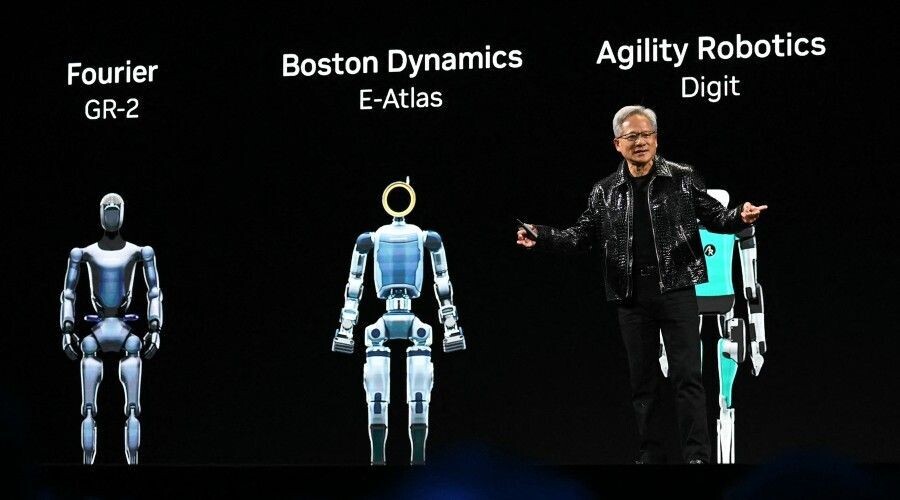
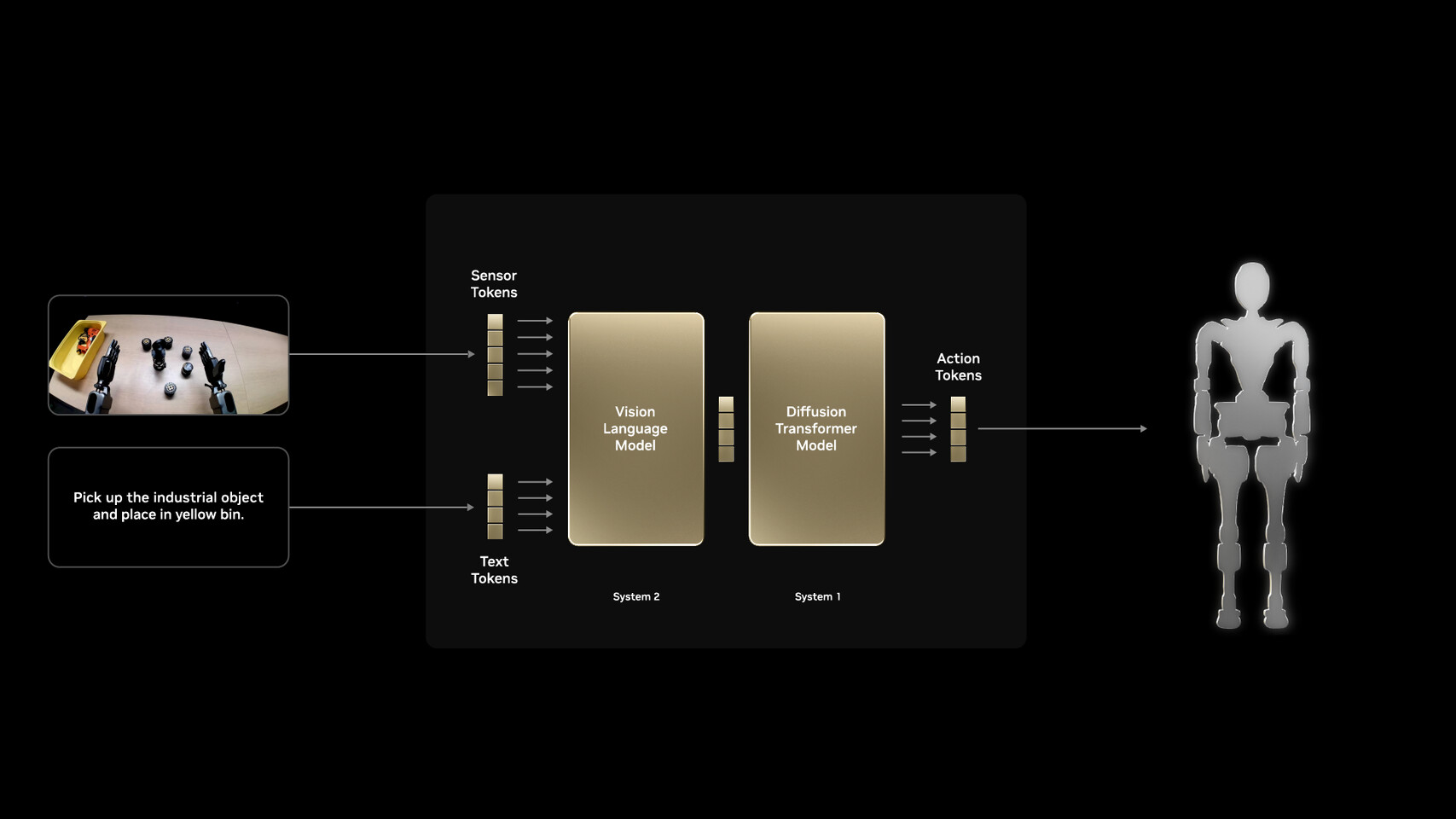
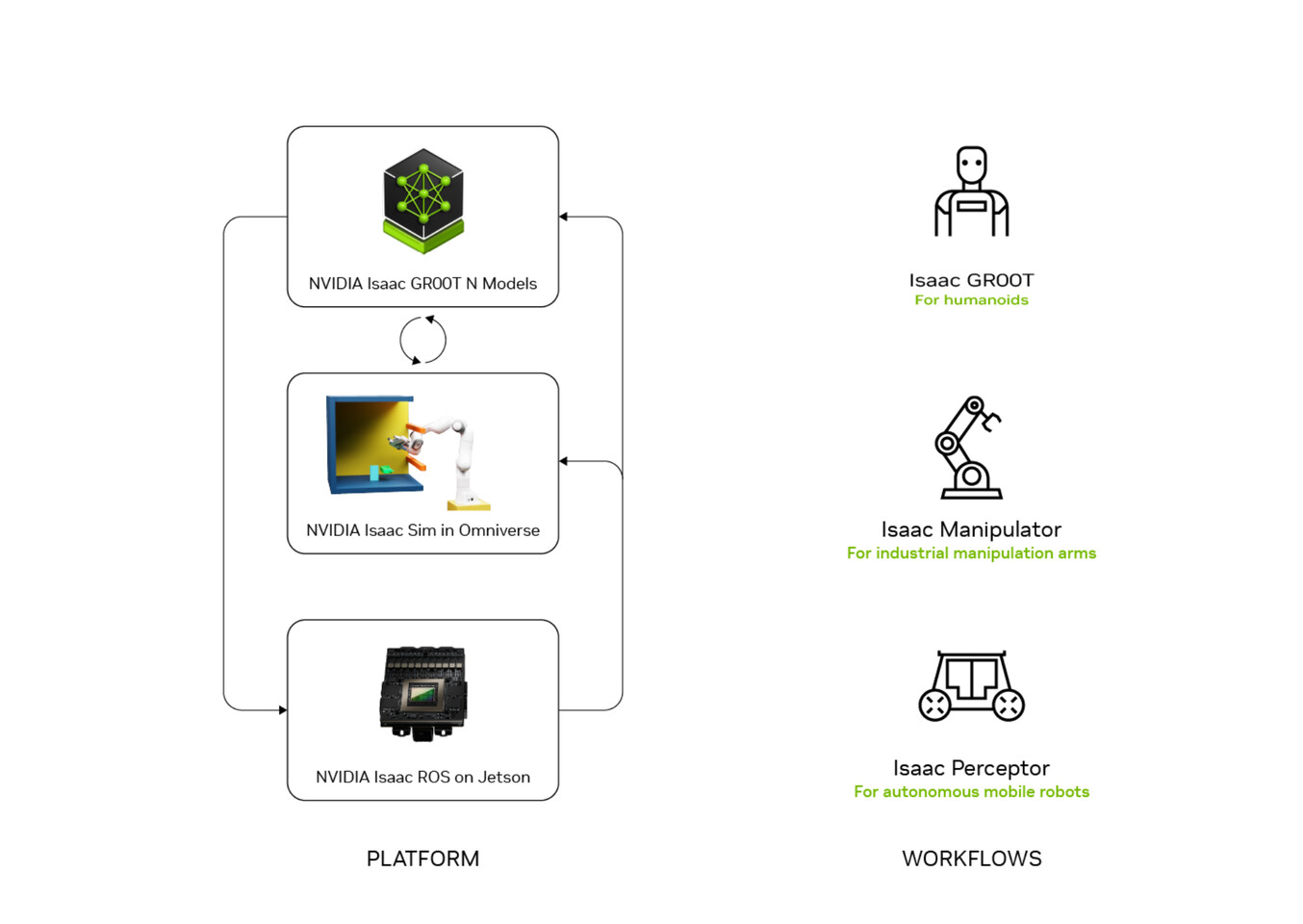
And this is not a bad thing. Since server assembly typically requires lifting heavy server racks throughout the day, the humanoid robot system will aid humans by doing the hard work, thereby saving workers from excessive labor. Initially, humans will oversee these robots in their operations, with fully autonomous factories expected later on. The human element here will primarily involve inspecting the work. NVIDIA has been laying the groundwork for humanoid robots for some time, as the company has developed NVIDIA Isaac, a comprehensive CUDA-accelerated platform designed for humanoid robots. As models from Agility Robotics, Boston Dynamics, Fourier, Foxlink, Galbot, Mentee Robotics, NEURA Robotics, General Robotics, Skild AI, and XPENG require models that are aware of their surroundings, NVIDIA created Isaac GR00T N1, the world's first open humanoid robot foundation model, available for anyone to use and finetune.

Pegatron Unveils AI-Optimized Server Innovations at GTC Paris 2025

PEGATRON, a globally recognized Design, Manufacturing, and Service (DMS) provider, is showcasing its latest AI server solutions at GTC Paris 2025. Built on NVIDIA Blackwell architecture, PEGATRON's cutting-edge systems are tailored for AI training, reasoning, and enterprise-scale deployment.

NVIDIA GB300 NVL72
At the forefront is the RA4802-72N2, built on the NVIDIA GB300 NVL72 rack system, featuring 72 NVIDIA Blackwell Ultra GPUs and 36 NVIDIA Grace CPUs. Designed for AI factories, it boosts output by up to 50X. PEGATRON's in-house developed Coolant Distribution Unit (CDU) delivers 310 kW of cooling capacity with redundant hot-swappable pumps, ensuring performance and reliability for mission-critical workloads.

Supermicro Unveils Industry's Broadest Enterprise AI Solution Portfolio for NVIDIA Blackwell Architecture

Supermicro, Inc., a Total IT Solution Provider for AI, Cloud, Storage, and 5G/Edge, is announcing an expansion of the industry's broadest portfolio of solutions designed for NVIDIA Blackwell Architecture to the European market. The introduction of more than 30 solutions reinforces Supermicro's industry leadership by providing the most comprehensive and efficient solution stack for NVIDIA HGX B200, GB200 NVL72, and RTX PRO 6000 Blackwell Server Edition deployments, enabling rapid time-to-online for European enterprise AI factories across any environment. Through close collaboration with NVIDIA, Supermicro's solution stack enables the deployment of NVIDIA Enterprise AI Factory validated design and supports the upcoming introduction of NVIDIA Blackwell Ultra solutions later this year, including NVIDIA GB300 NVL72 and HGX B300.

"With our first-to-market advantage and broad portfolio of NVIDIA Blackwell solutions, Supermicro is uniquely positioned to meet the accelerating demand for enterprise AI infrastructure across Europe," said Charles Liang, president and CEO of Supermicro. "Our collaboration with NVIDIA, combined with our global manufacturing capabilities and advanced liquid cooling technologies, enables European organizations to deploy AI factories with significantly improved efficiency and reduced implementation timelines. We're committed to providing the complete solution stack enterprises need to successfully scale their AI initiatives."

ASUS Announces Key Milestone with Nebius and Showcases NVIDIA GB300 NVL72 System at GTC Paris 2025

ASUS today joined GTC Paris at VivaTech 2025 as a Gold Sponsor, highlighting its latest portfolio of AI infrastructure solutions and reinforcing its commitment to advancing the AI Factory vision with a full range of NVIDIA Blackwell Ultra solutions, delivering breakthrough performance from large-scale datacenter to personal desktop.

ASUS is also excited to announce a transformative partnership milestone in its partnership with Nebius. Together, the two companies are enabling a new era of AI innovation built on NVIDIA's advanced platforms. Building on the success of the NVIDIA GB200 NVL72 platform deployment, ASUS and Nebius are now moving forward with strategic collaborations featuring the next-generation NVIDIA GB300 NVL72 platform. This ongoing initiative underscores ASUS's role as a key enabler in AI infrastructure, committed to delivering scalable, high-performance solutions that help enterprises accelerate AI adoption and innovation.

NVIDIA Plans 800 V Power Infrastructure to Drive 1 MW AI Racks

AI infrastructure buildout is pushing data center desings beyond the limits of conventional power delivery. Traditional in-rack 54 V DC distribution was designed for racks drawing tens of kilowatts and cannot scale to the megawatt requirements for next-generation AI facilities. At GTC and Computex 2025, NVIDIA introduced a comprehensive solution: an end-to-end 800-volt high-voltage DC (HVDC) infrastructure that will support 1-megawatt AI racks and beyond, with deployments planned to begin in 2027. Cooling and cabling already place immense strain on rack designs. NVIDIA's current GB200 and GB300 NVL72 systems can draw up to 132 kW per rack—significantly more than the 50 to 80 kW that most data halls were built to handle. If rack power rises to the 700 kW to 1 MW range under a 54 V distribution, it would require roughly 64 U of chassis space devoted solely to copper busbars, which is almost the entire rack, and about 200 kg of copper per rack. For a 1 GW installation, that adds up to nearly half a million metric tons of copper.

NVIDIA's 800 V HVDC architecture eliminates multiple AC-to-DC and DC-to-DC conversion stages by consolidating them into a single grid-edge rectifier. From a 13.8 kV AC feed, power is converted directly to 800 V DC and then routed through row-level busways to each rack. Compact DC-DC modules in the rack step down the voltage for the GPUs. Fewer power supply units mean fewer fans, lower heat output, and a simpler electrical footprint. Beyond scalability, 800 V HVDC offers up to 5 percent gains in end-to-end efficiency and a 45 percent reduction in copper usage. This results in lower electricity costs and reduced infrastructure buildout costs. To drive industry adoption, NVIDIA has partnered with leaders across the power ecosystem. Silicon and power-electronics specialists such as Infineon, MPS, Navitas, ROHM, STMicroelectronics, and Texas Instruments are contributing components. System integrators, including Delta, Flex Power, Lead Wealth, LiteOn, and Megmeet, are developing power shelves. Data-center infrastructure companies Eaton, Schneider Electric, and Vert iv are standardizing protective devices at every boundary from the power room to the rack. Below you can compare the traditional rack system in the top to the newly proposed variation in the middle and the bottom part of the image. Thanks to HardwareLuxx, we can even see how it looks in reality.

NVIDIA Reportedly Postpones SOCAMM Rollout; Could Debut with Next-gen "Rubin" AI GPUs

Around mid-February, South Korean sources alleged that NVIDIA was in the process of developing an innovative new memory form factor. The System on Chip Advanced Memory Module (SOCAMM) design is reportedly a collaborative effort. Team Green's usual set of memory partners—SK Hynix, Samsung, and Micron—were mentioned in early 2025 news articles. Just over a month later, official press material revealed a key forthcoming deployment—Micron stated: "(our) SOCAMM (product), a modular LPDDR5X memory solution, was developed in collaboration with NVIDIA to support the NVIDIA GB300 Grace Blackwell Ultra Superchip. In a (rumored) blow to all involved parties, ZDNet Korea posits that Team Green has postponed the commercialization of their "next-generation low-power DRAM module" IP. According to industry moles, the SOCAMM standard will not debut with this generation of enterprise-focused "Grace-Blackwell" chips. Instead, fresher theories indicate a postponement into next-gen territories—possibly rescheduled to arrive alongside the firm's "Rubin" GPU architecture.

NVIDIA has reportedly sent out notices to major memory partners—(alleged) May 14 updates were received by Samsung Electronics and SK Hynix (in South Korea) and Micron (USA). As a result, SOCAMM supply timelines are (apparently) adjusted. A newer "Cordelia" board design—acting as a substrate for GB300 chips, and compatible with SOCAMM—was in the picture. The latest whispers suggest a return to an existing "Bianca" board configuration, that supports current-gen LPDDR memory modules. ZDNet believes that company engineers have run into several obstacles: "Blackwell chips have been continuously experiencing difficulties in securing design and packaging yields. In fact, the 'Cordelia' board is known to have reliability issues, such as data loss, and SOCAMM has reliability issues, such as heat dissipation characteristics." NVIDIA briefly previewed its futuristic "Rubin Ultra" AI GPU design during GTC 2025—on-stage, a "second half of 2027" release window was teased.

Kingdom of Saudi Arabia & NVIDIA Announce Building of AI Factories in the Region

NVIDIA and the Kingdom of Saudi Arabia (KSA) have announced partnerships to transform the country into a global powerhouse in AI, cloud and enterprise computing, digital twins and robotics. During a state visit today with U.S. President Donald Trump and His Royal Highness Prince Mohammed bin Salman bin Abdulaziz Al Saud, Crown Prince and Prime Minister of Saudi Arabia, NVIDIA founder and CEO Jensen Huang said that the effort will harness sovereign AI infrastructure and expertise to propel Saudi Arabia to the ranks of global hyperscale AI leaders. "AI, like electricity and internet, is essential infrastructure for every nation," Huang said. "Together with HUMAIN, we are building AI infrastructure for the people and companies of Saudi Arabia to realize the bold vision of the Kingdom."

"Our partnership with NVIDIA is a bold step forward in realizing the Kingdom's ambitions to lead in AI and advanced digital infrastructure," said Tareq Amin, CEO of HUMAIN. "Together, we are building the capacity, capability and a new globally enabled community to shape a future powered by intelligent technology and empowered people."

ASUS Introduces a New Class of NVIDIA-powered Desktop AI Supercomputers

They say that the most difficult part of transportation planning is last-mile delivery. A network of warehouses and trucks can bring products within a mile of almost all customers, but logistical challenges and costs add up quickly in the process of delivering those goods to the right doors at the right time. There's a similar pattern in the AI space. Massive data center installations have empowered astonishing cloud-based AI services, but many researchers, developers, and data scientists need the power of an AI supercomputer to travel that last mile. They need machines that offer the convenience and space-saving design of a desktop PC, but go well above and beyond the capabilities of consumer-grade hardware, especially when it comes to available GPU memory.

Enter a new class of AI desktop supercomputers, powered by ASUS and NVIDIA. The upcoming ASUS AI supercomputer lineup, spearheaded by the ASUS ExpertCenter Pro ET900N G3 desktop PC and ASUS Ascent GX10 mini-PC, wield the latest NVIDIA Grace Blackwell superchips to deliver astounding performance in AI workflows. For those who need local, private supercomputing resources, but for whom a data center or rack server installation isn't feasible, these systems provide a transformative opportunity to seize the capabilities of AI.

GIGABYTE to Present End-to-End AI Portfolio at COMPUTEX 2025

GIGABYTE Technology, a global leader in computing innovation, will return to COMPUTEX 2025 from May 20 to 23 under the theme "Omnipresence of Computing: AI Forward." Demonstrating how GIGABYTE's complete spectrum of solutions spanning the AI lifecycle, from data center training to edge deployment and end-user applications reshapes the infrastructure to meet the next-gen AI demands.

As generative AI continues to evolve, so do the demands for handling massive token volumes, real-time data streaming, and high-throughput compute environments. GIGABYTE's end-to-end portfolio - ranging from rack-scale infrastructure to servers, cooling systems, embedded platforms, and personal computing—forms the foundation to accelerate AI breakthroughs across industries.

NVIDIA Blackwell Platform Boosts Water Efficiency by Over 300x - "Chill Factor" for AI Infrastructure

Traditionally, data centers have relied on air cooling—where mechanical chillers circulate chilled air to absorb heat from servers, helping them maintain optimal conditions. But as AI models increase in size, and the use of AI reasoning models rises, maintaining those optimal conditions is not only getting harder and more expensive—but more energy-intensive. While data centers once operated at 20 kW per rack, today's hyperscale facilities can support over 135 kW per rack, making it an order of magnitude harder to dissipate the heat generated by high-density racks. To keep AI servers running at peak performance, a new approach is needed for efficiency and scalability.

One key solution is liquid cooling—by reducing dependence on chillers and enabling more efficient heat rejection, liquid cooling is driving the next generation of high-performance, energy-efficient AI infrastructure. The NVIDIA GB200 NVL72 and the NVIDIA GB300 NVL72 are rack-scale, liquid-cooled systems designed to handle the demanding tasks of trillion-parameter large language model inference. Their architecture is also specifically optimized for test-time scaling accuracy and performance, making it an ideal choice for running AI reasoning models while efficiently managing energy costs and heat.

Supermicro Adds Portfolio for Next Wave of AI with NVIDIA Blackwell Ultra Solutions

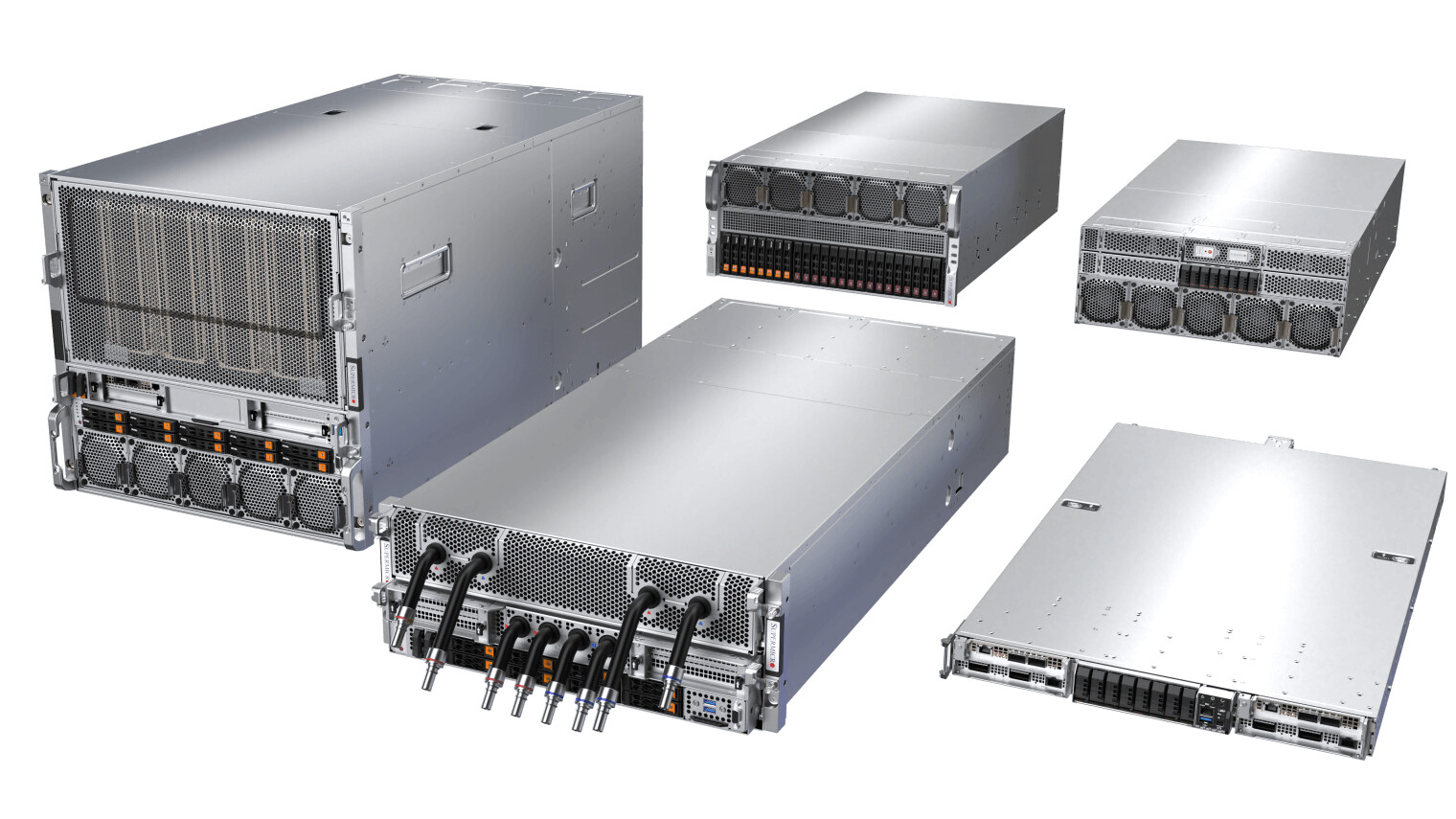
Supermicro, Inc., a Total IT Solution Provider for AI, Cloud, Storage, and 5G/Edge, is announcing new systems and rack solutions powered by the NVIDIA's Blackwell Ultra platform, featuring the NVIDIA HGX B300 NVL16 and NVIDIA GB300 NVL72 platforms. Supermicro and NVIDIA's new AI solutions strengthen leadership in AI by delivering breakthrough performance for the most compute-intensive AI workloads, including AI reasoning, agentic AI, and video inference applications.

"At Supermicro, we are excited to continue our long-standing partnership with NVIDIA to bring the latest AI technology to market with the NVIDIA Blackwell Ultra Platforms," said Charles Liang, president and CEO, Supermicro. "Our Data Center Building Block Solutions approach has streamlined the development of new air and liquid-cooled systems, optimized to the thermals and internal topology of the NVIDIA HGX B300 NVL16 and GB300 NVL72. Our advanced liquid-cooling solution delivers exceptional thermal efficiency, operating with 40℃ warm water in our 8-node rack configuration, or 35℃ warm water in double-density 16-node rack configuration, leveraging our latest CDUs. This innovative solution reduces power consumption by up to 40% while conserving water resources, providing both environmental and operational cost benefits for enterprise data centers."
Return to Keyword Browsing
Nov 13th, 2026 23:02 CST change timezone

New Forum Posts

Popular Reviews

TPU on YouTube

Controversial News Posts