Thursday, September 18th 2025

Microsoft Unveils World's Biggest AI Datacenter, Housing Hundreds of Thousands of GPUs
Microsoft announced today that it will bring Fairwater, a purpose-built AI datacenter in Mount Pleasant, Wisconsin, online in early 2026. The new site is designed as the most powerful datacenter on the planet, serving as a hub for next-generation model training and inference. The campus covers 315 acres with roughly 1.2 million square feet across three buildings and will house hundreds of thousands of NVIDIA GB200 and GB300 GPUs linked by fiber, which can reportedly circle the globe 4.5 times. While we don't have information on the exact GPU count, Microsoft claims the installation will deliver about 10x the performance of today's fastest supercomputers for frontier AI workloads. With the fastest already deployed cluster being xAI's Colossus 1, this means that this system could have over half a million "Blackwell" and "Blackwell Ultra" GPUs.
Over 90% of compute capacity will use a closed-loop liquid cooling system that is filled during construction and continuously recirculated, backed by what the company describes as the planet's second-largest water-cooled chiller plant. Around 10% of servers will rely on outside air and switch to water cooling only on the hottest days. Storage and I/O are scaled for exabyte-class datasets, and the buildout involved 46.6 miles of deep foundation piles, 26.5 million pounds of structural steel, 120 miles of medium-voltage underground cable, 72.6 miles of mechanical piping, and an external cooling array that includes 172 20-foot fans.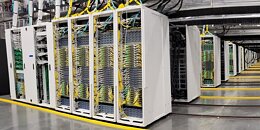


 Beyond raw hardware, Microsoft frames Fairwater as both an engineering milestone and a community investment. The initial price tag is $3.3 billion, with an additional $4 billion committed toward a second, similar site. Several identical Fairwater-class centers are also under construction elsewhere in the U.S. The company also states that it will pre-pay energy and infrastructure costs to prevent increasing local electricity prices and will offset fossil-fuel kilowatt-hours with carbon-free energy additions, including a 250 MW solar project.
Source:
Microsoft
Over 90% of compute capacity will use a closed-loop liquid cooling system that is filled during construction and continuously recirculated, backed by what the company describes as the planet's second-largest water-cooled chiller plant. Around 10% of servers will rely on outside air and switch to water cooling only on the hottest days. Storage and I/O are scaled for exabyte-class datasets, and the buildout involved 46.6 miles of deep foundation piles, 26.5 million pounds of structural steel, 120 miles of medium-voltage underground cable, 72.6 miles of mechanical piping, and an external cooling array that includes 172 20-foot fans.


46 Comments on Microsoft Unveils World's Biggest AI Datacenter, Housing Hundreds of Thousands of GPUs
Microsoft does not. Same with Google. Samsung. HP, Dell, Lenovo, Nothing Phone, OPPO, Huawei. Same with pretty much everyone else.
Even when Apple was using CPUs from Intel, GPUs from AMD, network chips from Broadcom, cellular chips from Qualcomm, they often were able to spec out their requirements. And of course, Apple only needs to support a very limited number of hardware combinations. They know the exact specs of their notebook computer displays, the batteries, the front facing cameras in their iPhones.
And as Apple develops more of their own silicon (C1, C1X, N1, H1 chips) they increase this advantage because they don't sell their chips to competitors. They don't have to design mass-market chips with a bunch of extra features to appeal to a wide spectrum of OEMs and chip customers, like FM radio compatibility.
Microsoft basically has no idea what hardware is in whatever contraption running Windows apart from their Surface line. And Microsoft is still using someone else's components, they don't really do any chip design for their consumer offerings. So Microsoft has to write Windows for their own hardware AND (nearly) everyone else's.
When Microsoft shut down their smartphone efforts, they basically conceded they had lost in the consumer technology (apart from Xbox). And they also gave up the easiest pathway to scalable semiconductor development. It's not feasible for them to design SoCs for notebook PCs that barely have a ripple in the market.
Google's Pixel phone family is sorta like Microsoft's Surface family. But at least as a smartphone, Google has an inkling of a chance for volume sales. The PC market is stagnant. And a lot of people here are still in denial that the consumer Windows PC market has shifted overwhelmingly to notebook models.
Personal computers don't drive consumer technology innovation anymore, they haven't for 10+ years. The smartphone is the driver for pretty much all consumer technology innovation, even if it's not a hardware spec on the latest phone. Joe & Jill Consumer LOVE being addicted to their phones.
The old paradigm of sitting in front of that fatass computer display with that fatass mini-tower desktop PC at your feet keeping your toes warm and thinking that you are where the cutting edge of technology is dead. DEAD, DEAD, DEAD.
Sure, you can still rack up the high score on benchmarks with your 9950X3D and RTX 5090 but my dumb little iPhone (last year's vintage) will crush your $4000 PC in performance-per-watt metrics.
No, the majority of the world does not obsess about flagship GPUs from Nvidia. Or undervolting CPUs. Or which PSU they should buy for ____ GPU. Or how to flash the BIOS on their ex-miner card so they can play Doom on Linux.
I don't think that TPU even represents 0.001% of the PC using planet. That would be like 8 million people, right? (assuming 8 billion humans right now).
Hell, there are people here who can't even grasp the idea that there are more notebook PCs than DIY desktop PCs and that corporate buyers from organizations like General Electric, the Munich City Government, or the General Accounting Office have far more say and far more buying power than Mr. TPU Dorkwad.
But don't worry. Here in Cali we have plenty of environmentalists. As soon as they find out, they'll grab their pitchforks and head to city council chambers to yell at their elected officials to stop the madness. Just don't expect them to post here saying they're gonna do so.
TPU's discussion form is not X/Twitter. I don't know if I should laugh or cry that I had to explain this.
You've seen the old satire video of "Tech Support in Medieval Ages", the one with books, yes?
Even the ex-CEO of Google Eric Schmidt said to just let AI expand and then use it to figure out how to fix climate change. That was a couple of years ago. Because even if we shut down every single AI datacenter on this planet right now, the environment is still headed the wrong direction. Far more changes need to happen and so far the finest climate scientists haven't figure out how to do that yet.
Remember that not AI datacenters are just going to be used for AI chatbots or to host virtual girlfriends.
The sooner the "Ai" bubble bursts the better for humanity.
I wouldn't be surprised that this is going to be used to do Even more gcide targeting
If you were to put black solar panels on top of the roof you would create heat islands the cooling for your servers is going to have to deal with.
Upping the energy cost for cooling.
putting the solar farm elsewhere is the right move.
Planting a forest around the datacentre would be a good move as trees cool down the environment.
Anywho, they need to build more nuclear plants and do it yesterday.
For example, in this survey of French population's concerns, as of June 2025 it ranks only 7th after :
I also wonder if the old adage of "manners cost you nothing" holds true in the "age of ai"
futurism.com/altman-please-thanks-chatgpt
Not with a bang but a please and thank you