Tuesday, September 9th 2025

NVIDIA Unveils "Rubin CPX" GPU: Single-Die, 30 PetaFLOPS, and 128 GB of GDDR7 Memory
During the AI Infra Summit, NVIDIA announced the "Rubin CPX" GPU, a specialized accelerator derived from the upcoming "Rubin" family, specifically made for massive-context AI models. The chip delivers 30 PetaFLOPS of NVFP4 compute performance on a monolithic die, accompanied by 128 GB of GDDR7 memory. The monolithic die configuration represents a departure from the dual-GPU packages characteristic of NVIDIA's current Blackwell and Blackwell Ultra architectures, as well as the design path that the rest of the Rubin family will follow. The Rubin CPX addresses computational bottlenecks in extended-context scenarios where AI models process millions of tokens simultaneously. This capability proves critical for applications including comprehensive software codebase analysis and hour-long video content processing, which can require up to one million tokens.
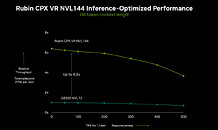
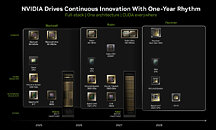
The processor integrates four NVENC and four NVDEC video encoders directly on-chip, enabling streamlined multimedia workflows without external processing dependencies. Performance metrics suggest that the Rubin CPX is delivering three times the attention processing speed of NVIDIA's current best GB300 Blackwell Ultra accelerator systems. The architecture employs a cost-optimized single-die approach, rather than multi-chip modules, which potentially reduces manufacturing complexity while maintaining computational density. Memory bandwidth specifications remain undisclosed, though a 512-bit interface could yield approximately 1.8 TB/s throughput when using 30 Gbps GDDR7 memory chips. NVIDIA plans integration of Rubin CPX processors within the Vera Rubin NVL144 CPX platform, which combines traditional Rubin GPUs with the specialized CPX variants. This hybrid configuration targets 8 ExaFLOPS of aggregate compute performance, with 1.7 PB/s of memory bandwidth, across a complete rack deployment. The "Kyber" rack will include ConnectX-9 network adapters capable of 1600G networking, Spectrum6 doing 102.4T switching, as well as co-packaged optics. NVIDIA plans this to arrive in late 2026, after the regular Rubin GPU launch in early 2026.


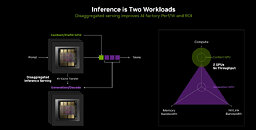
 NVIDIA pushes Rubin CPX as a one-off in the Rubin family to address the complexity of inferencing a test-time scaling AI system. As models evolve beyond simple text generation toward sophisticated reasoning systems, inference operations increasingly split between computationally intensive context processing and memory-bandwidth-dependent token generation phases. The CPX design optimizes for these dual requirements through its dedicated architecture, handling context prefill operations that can span enterprise chatbot sessions with 256,000 tokens or comprehensive code analysis exceeding 100,000 lines. This specialization becomes critical as AI systems transition from basic language models to multistep reasoning agents that maintain persistent memory across extended interactions. Hence, all of that needs to be enabled by hardware, and NVIDIA wants to make it a seamless experience for developers.
Sources:
NVIDIA, via Cambrian AI
The processor integrates four NVENC and four NVDEC video encoders directly on-chip, enabling streamlined multimedia workflows without external processing dependencies. Performance metrics suggest that the Rubin CPX is delivering three times the attention processing speed of NVIDIA's current best GB300 Blackwell Ultra accelerator systems. The architecture employs a cost-optimized single-die approach, rather than multi-chip modules, which potentially reduces manufacturing complexity while maintaining computational density. Memory bandwidth specifications remain undisclosed, though a 512-bit interface could yield approximately 1.8 TB/s throughput when using 30 Gbps GDDR7 memory chips. NVIDIA plans integration of Rubin CPX processors within the Vera Rubin NVL144 CPX platform, which combines traditional Rubin GPUs with the specialized CPX variants. This hybrid configuration targets 8 ExaFLOPS of aggregate compute performance, with 1.7 PB/s of memory bandwidth, across a complete rack deployment. The "Kyber" rack will include ConnectX-9 network adapters capable of 1600G networking, Spectrum6 doing 102.4T switching, as well as co-packaged optics. NVIDIA plans this to arrive in late 2026, after the regular Rubin GPU launch in early 2026.


11 Comments on NVIDIA Unveils "Rubin CPX" GPU: Single-Die, 30 PetaFLOPS, and 128 GB of GDDR7 Memory
It would enable a real ramping up of local AI (both LLM and image/video processing) by consumers and enthusiast.
But no. It has to be with their platform and it's gonna cost an outrageous amount of money, limiting it to corps.
Oh well, I'll keep on waiting with my trusted 3090, I guess.
I expect Rubin CPX to arrive as a PCIe card as well, but it's still going to be very expensive since NVIDIA is basically a monopoly and it targets an innovative segment of AI.
There's also opportunity cost. TSMC capacity is limited. Every bit of silicon that goes to consumers is silicon that doesn't go to corps that are also buying Nvidia networking and support for 50x total revenue of a consumer.
When this current AI Plague is over, does the Ruby have any sensible use for scientific computation?
Doesn't provide anything that could be really useful for inference... Sure it has 128GB but it's very slow DDR5, can't run any medium/large models, and the more the context gets filled the slower it becomes. This when it comes to pure LLMs. A Mac with M3 Ultra is faster. And with MoE any PC with a 24GB GPU to offload active params and context is gonna be faster.
When we talk about video processing (or anything else, really) the situation becomes worse since the DGX is limited by the OS at that point, forced to be the one provided by nVidia.
As for user adoption being low, I agree but only partially. People who would know how to use those are limited and will keep on being limited if there's nothing to adopt in the first place.
Let me be clear, I'm not saying it should be released at 500$ or similar. But a PCIe card not limited to their platform for pure enthusiasts or custom workstations, at 5K$+... I don't see why not.
Just like they made the RTX 6000 Pro this year. Capacity is there and customers too... for the right price.
Why would they announce it a year ahead of launch?