News Posts matching #Processors
Return to Keyword Browsing

In a hilarious and somewhat cruel twist of fate, market research has proven that AMD sells more when Intel really lays down the advertising. Stephen DiFranco, vice president of worldwide sales and marketing at AMD, had this to say in regards to Intel's advertising.
I wish they would advertise more. I beg them publicly, please advertise more. Create more demand. Some weeks in the United States there are more AMD desktops and notebooks sold than Intel.
Granted, DiFranco later admitted that most consumers hardly know the difference between AMD and Intel. However, going from a 5% retail market share to a 50% retail market share without spending any money on advertising is pretty hard to explain any other way.

IBM was never known for making anything small. From some of the very first computers to the PlayStation 3 processor, IBM is one of the largest influences of the tech industry. As if to add to this success, IBM wants to be a host: to the entire internet. The thought is, at first, silly, and then unfathomable. How can one computer, let alone one company, run the entire internet? IBM claims they can pull it off with a heavily modified Blue Gene computer, which they have codenamed "Kittyhawk". The processing power of Kittyhawk would be immense. The software is too complex to explain, and will be left at "Kittyhawk will run the internet as a single application". As far as hardware is concerned, current estimates say that Kittyhawk will need 67.1 million cores and 32PB of memory.

Yesterday, we brought you the tragic news that Dell recently stopped selling computers based on AMD processors on their website. Today, Dell made a statement to attempt to clarify the situation. Dell explained that there is a delicate balancing act that must be done between retail, phone, and internet sales channels. Dell also assured that there will be ample supply of AMD-based computers coming through retail channels, and that Dell hasn't quite stopped selling AMD computers on their website just yet (Inspiron 531 is still available). Dell also clarified that Dell is still selling plenty of AMD-based computers online, just so long as the customers are business. To sum it up, Dell said this:
We are committed to the AMD product lines as a long-term partner to provide the maximum choice for our customers.
For years, users wanted Dell to include AMD processors in Dell builds. In May 2006, Dell was happy to announce that they were bringing AMD on board. Everything seemed to be working out, until now. Dell recently announced that they're discontinuing almost all AMD-based Dell computers. The few ones that are left cannot be purchased online, and are only found in stores like Best Buy and Circuit City. This is likely to be a huge blow for AMD, and could not have come at a worse time. AMD recently posted abysmal revenue/loss figures for Q4 2007, and is running a company (ATI) that is worth 30% less than it was at the time of initial purchase. Hopefully, AMD will find more people to sell their processors.
As most of us know, AMD was hoping to shove the triple core Phenom series (8x00) out their factory doors by next month. However, it would seem as though things have changed over at AMD. The Phenom 8400 (2.1GHz) and 8600 (2.3GHz) will both be launched at CeBIT 2008 (which will be hosted in early March). However, AMD may ditch the 8700 in favor of a B3 stepping 8750, accompanied by an 8450 and 8550 from the same stepping.
Any processor from the B3 stepping should fix up the hated TLB issue that early Phenom processors suffer. This B3 stepping will also show up in quad core parts. The Phenom 9700 (2.4GHz) and 9900 (2.6GHz) will be replaced by the B3 based 9750 and 9950, respectively.
AMD CEO Dirk Meyer had something to say to the press today, and it was something along the lines of bungling (I love that word) the Barcelona launch. As The Inquirer so eloquently puts it, Barcelona "was hyped as the best thing since nylon stockings. In the end it was launched six months late, failed to work then, and is now adrift on high seas, apparently following its arch-competitor's Itanic on a trip to Laughing Stock Island." As far as an official statement goes, Dirk Meyer had this to say regarding Barcelona:
We haven't delivered our quad core product according to plan. We'll make good on our promise to deliver hundreds of thousands of quad core processors, but we're disappointed. We blew it, and we're very humbled by it. And we learned from it, and we're not going to do it again.
If AMD's financial records continue their abysmal performance, and the stock continues sinking below the four-year low it currently is at, AMD may not have too many more chances to redeem their reputation.
When AMD released the K10 micro-architecture, which included Phenom and Barcelona, they unfortunately neglected to mention that they had also released an entirely new way to benchmark power consumption and thermal output. AMD's Average CPU Power system, or "ACU" for short, is a new way to measure the amount of power a CPU really requires, and consequently, the heat it puts out. AMD, when asked, claimed that their way of measuring things was comparable to the TDP system. However, independent results reveal otherwise.
AMD's great quad-core Phenom-based Opteron got a reasonable 75W power consumption rating using AMD's system. However, when put under the traditional TDP test, the Opteron quickly heated up to requiring 95W. Stunned, the testers tried again, and the same CPU got a remarkable 115W TDP load. The full version of the chart is available at the source link. For comparison, Intel's biggest and baddest quad-core CPU uses 120W TDP full load.
AMD feels that the K8 architecture still has a little life in it. While Intel is working hard on 45-nm and Quad Core platforms that will cost quite a pretty penny, AMD is working on cost-effective and energy efficient solutions for the dudes that don't need or can't afford 1.21 gigawatts of processing power. To create said solutions, AMD is going to revert to an old favorite: the tried-and-true K8 architecture. After putting the K8 series through a die shrink, AMD plans to bring 11 65nm K8 CPUs to market, under the code-name Brisbane. The new 65nm variants of the K8 architecture will more likely than not require very little power to run, and will even more likely be clocked at high speeds. AMD is putting a large focus on energy efficiency, as the majority of current confirmed CPU models are flagged "Energy Efficient". All of the new 65nm K8 chips will be socket AM2, and will work in an AM2+ motherboard.

Underscoring strong momentum and industry support, Intel Corporation today unveiled Dual-Core Intel Itanium Processor 9100 series processors. Built for managing high-end applications and armed with advanced features that improve reliability and reduce power consumption, the 9100 series accentuates the ongoing shift from proprietary RISC products to the choice offered by Itanium-based servers. The 9100 series represents the sixth generation of Itanium chips, with three future generations under development.
Regardless of theoretical performance, the upcoming AMD RD790 and Athlon 64 Black Edition line of processors certainly are overclockable and feature-laden. On nothing but air cooling, MSI testers were able to get an RD790 chipset to a remarkable 510MHz FSB speed. Once the RD790 is released with PCI Express 2, CrossFire X, and support for goodies such as Phenom, we will see one seriously good platform.
AMD recently admitted that it was not quite prepared when they launched quad-core processors earlier this year. Even after the delays, there simply were not enough AMD quad core offerings to go around. And so, to make up for that, they've announced that they're going to make a lot more quad core processors this quarter. The official statement by AMD:
While our initial production ramp of quad-core Opterons has been slower than anticipated, we expect quad-core Opteron will be widely available by the middle of this quarter; and, we expect to ship hundreds of thousands of quad-core processors this quarter into the server and desktop segments.
Intel took on the mindset of "out with the old and in with the new", and their choice is reflected in their roadmaps. Starting in Q1 2008, Intel will remove their single-core offerings from the market by replacing them with superior dual-core models. The upcoming Celeron E1000 series will be the first entry-level dual-core processor to hit the market. The first dual-core Celeron, the E1200, is clocked at 1.6GHz, has an 800MHz FSB, a 512KB L2 cache, and will cost a mere $51 USD (in thousand-unit quantities). All of the E1000 series will be based on the Core 2 Duo micro-architecture, and will be 45nm parts.
Part of AMD's marketing plan is to make creative, enticing names for their products. For one of their low-energy models, AMD's marketing department did a fine job creating a very memorable CPU core code-name: Sparta. For the low price of $46 shipped, you can have your very own Spartan computer part. This product offers more than an awesome name, however. The value-oriented part is built on a 65nm micro-architecture, requires only an impressive 45W of energy to run, runs at 1.9GHz with an FSB speed of 800MHz, has an L1 cache of 64KB+64KB, and an L2 cache of 256KB. Anyone hoping to own an AMD Sempron LE-1100 should follow the source link.
.
Fortunately for anybody considering an upgrade to AMD AM2 processors, AMD will be slashing prices on their Athlon 64 processors. Just some examples of price cuts we'll be seeing...
The Athlon 64 X2 5000+ currently costs
$119, and will soon cost $109USD.
The Athlon 64 X2 5200+ currently costs
$124, and will soon cost $119USD
The Athlon 64 X2 5600+ currently costs
$149, and will soon cost $139USD.
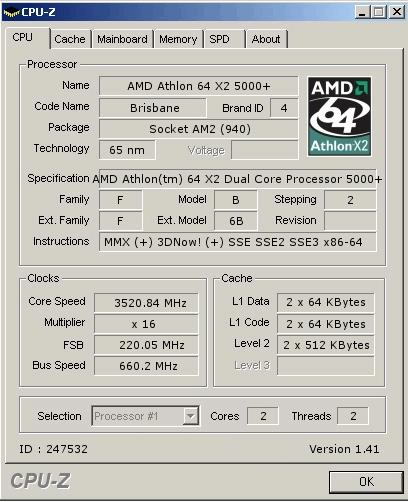
When AMD first released the 5000+ version of the Black Edition series of processors, it seemed pretty unimpressive. However, the Black Edition processors are a lot like the old FX processors: they come with an unlocked multiplier, and are hand-picked for overclocking. And so, while the Black Edition processors may not be the best at stock clocks, they certainly are good at overclocking. Just as an example, a Chinese overclocker was able to push his 5000+ Black Edition to a respectable 3.5GHz on stock cooling.
While Intel is preparing to move on to a 45nm micro-architecture, AMD is preparing true quad-core processors, and working on a quad-graphics card solution. The technology that will allow for four graphics cards to be stuck in one system will be called "QuadFire", and there are no major details out at this time, other than the name and pictures of supporting motherboards. The chipset supporting "QuadFire" is AMD's own RD790, which is pictured below in MSI's K9A2 motherboard. The RD790 is designed to work with a Phenom processor, has six SATA ports, and two E-SATA ports.
Pictures courtesy of
OCWorkbench.

Via is well known for low power CPUs, so it comes as no big surprise that the company will be offering a new Eden processor with a power consumtion of a mere Watt. The new CPU adopts the typical VIA V4 bus and 21mm × 21mm nanoBGA2 packaging as other Eden models, but sets itself apart offering a 500MHz core frequency at a power consumption of only 1W. It is meant for network applicances or embedded boards.
Intel's next big thing is 45 nanometer architecture, which it has applied to their new Penryn micro-architecture. On November 11, Intel will release seven Xeon processors containing the new micro architecture. Among the seven processors are the 2.00GHz E5405, the 2.33GHz E5410, the 2.50GHz E5420, the 2.66GHz E5430, the 2.83GHz E5440, the 3.00GHz E5450 and the 3.16GHz X5460. All seven chips operate on a 1333MHz frontside bus. No official prices are available at this time, and we will see more Penryn processors in Q1 2008.
AMD isn't the only one making new CPUs: Intel plans to announce a new Core 2 Duo CPU and make some hefty price cuts on September 2nd. The Core 2 Duo T7800 is a laptop chip, will be clocked at 2.6GHz, run on a 800MHz bus, and have 4MB of L2 cache. Intel will also launch the Core 2 Duo T7250, which is clocked at 2GHz, with a bus speed of 800MHz and 2MB of L2 cache. For budget customers, Intel has the new 2.0GHz Celeron M 550. There is no word on how much these new processors will cost, but the current Core 2 Duo prices will definitely get cut on September 2nd.
While every hardcore AMD fan awaits the Barcelona and Phenom series of CPUs, AMD is busy making the best out of what it has already. In a Japanese presentation, AMD showed off the Athlon 64 6400+ "Black Edition". This CPU should hit retail markets on August 20th, and should cost anywhere between $220 and $240 USD. The CPU runs on a 90nm process, and is clocked at 3.2GHz.
At the same presentation, AMD demoed a Phenom X4 system at 3GHz in an AMD RD790 motherboard. AMD somehow managed to present this without anyone getting good performance numbers.
With the passable launch date of September 10 there seems two be a couple of problems with the chip and compatibility. It seems that the Dual Dynamic Power Management will not work without a BIOS update, and with a supported motherboard. This is something to be expected from knowing that some features will not be supported on former socket types.
"It seems the CPU itself is capable of engaging in CoolCore operations, but not Dual Dynamic Power Management (formerly "Split Plane," which allowed each core to operate independently with different voltages and clock speeds). It won't be able to handle these power saving and performance enhancing aspects of operations from the core alone. The motherboard must be brought into the mix in an active way to help reduce power consumption and save energy when the many cores are not in high use."
The other issue while not truly being an issue is the 128-bit floating point. There simply isn't any software on the market to take advantage of it. Hearing something like this isn't new to the PC market at all. The 64Bit CPUs are just now starting to see the light after a few years of their release, and Dual core CPUs are also just now starting to be implemented into applications. It's safe to say that the 128-bit floating point technology may take some time before developers start using it.
According to AMD's most recent roadmap, 2 Phenom FX series will see the light of day: Phenom FX-80 and Phenom FX-90. The FX-80 will be designed as single-core CPU's while the FX-90 will be designed as 4x4 dual CPU's.
The plan is to launch the Phenom FX-90 CPU's by Q1 2008 and the FX-80's a little earlier during the November-December interval.
AMD has recently denied the rumor that
Phenom would be delayed. AMD says that they will have Phenom released during Q4 2007, despite motherboard manufacturers saying otherwise.
However, any Phenom launch before Q1 2008, according to AMD, will be a mere paper launch, not unlike the HD 2x00 series. Motherboard manufacturers claim that this delay is give AMD enough time to make enough Phenom processors for a heavy AMD fanbase. This is also a move designed to make Phenom more competitive with Penryn.
Intel (or "Chipzilla", as The Inquirer lovingly refers to them), according to Intel spokesperson Danny Cheung, has sold one million quad-core Xeon 5300 processors. "Clovertown" was unleashed just last November, and thanks to great performance and competitive pricing, is solely responsible for re-claiming the Server market for Intel. The entire Clovertown line is priced between $455 and $1,172 USD, according to Intel's
price list.
AMD announced today that Quad-Core AMD Opteron processors, code-named "Barcelona," are planned for shipment in both standard and low power versions at launch later this summer. This would be the first time AMD has made both standard and low power parts immediately available as part of a new processor launch.
During this first launch, processor speeds are expected to be available up to 2.0 GHz.
Return to Keyword Browsing