News Posts matching #ROCm

Return to Keyword Browsing

AMD Completes Acquisition of Taalas to Advance AI Inference Innovation

AMD today announced the completion of its acquisition of Taalas, a pioneer in specialized AI inference silicon, further strengthening the company's full-stack AI portfolio and long-term inference roadmap. As demand for AI inference accelerates, Taalas brings differentiated technology and world-class engineering expertise designed to deliver breakthrough performance and efficiency for increasingly specialized AI workloads.

"AI inference is evolving rapidly, and customers need a broad range of compute solutions optimized for their workloads," said Vamsi Boppana, senior vice president of the Artificial Intelligence Group at AMD. "With Taalas now part of AMD, we're expanding our ability to deliver differentiated inference performance and efficiency, while strengthening our full-stack AI platform."


Ubuntu 26.10 "Stonking Stingray" Launches With GNOME 51, Linux 7.3 and Optional Speech-to-Text Feature

Canonical has released Ubuntu 26.10 "Stonking Stingray," shipping with GNOME 51, Linux kernel 7.3, and a new optional speech-to-text feature called Myna. Following its official release in September, GNOME 51 lands in Ubuntu 26.10 and promises a more responsive desktop experience and improved accessibility. Linux kernel 7.3 brings hardware support for Intel Xe3P (Nova Lake), AMD Zen 6, and NVIDIA 615.x Linux drivers, along with improved DRM, power management hooks and out-of-the-box Lustre filesystem support. However, the headline that could easily get unnoticed is the Myna, an opt-in speech-to-text agent that runs entirely on-device using local LLMs. Canonical says it is positioning it as the first step toward a more natural AI-assisted desktop, with accessibility as the stated priority for the initial rollout. Jon Seager, VP of Ubuntu Engineering at Canonical, says "Stonking Stingray delivers the first milestone through the integration of Myna: a speech-to-text agent that utilizes on-device LLMs. We've led Ubuntu's first AI integration with accessibility to ensure that cutting-edge features are available to all users from day one."

Security and enterprise features got expanded with a full migration to Rust-based uutils coreutils, post-quantum package signing, and broader TPM-backed full-disk encryption support. Microsoft Entra ID integration brings support for password-plus-MFA and passwordless authentication flows. Ubuntu 26.10 also upgrades ROCm to version 10.0, adding support for newer AMD GPU architectures and frameworks including vLLM and SGLang. Going back to Ubuntu's new AI Myna feature, Canonical also says that it will not go away, rather it will continue to evolve and will be included by default with new Ubuntu releases.

AMD Introduces Its Next Ryzen AI Halo Developer Platform With Ryzen AI Max+ PRO 495

Today, AMD is introducing the next AMD Ryzen AI Halo Developer Platform, powered by the AMD Ryzen AI Max+ PRO 495 processor.

With up to 192 GB of unified memory, support for 300-billion-parameter and larger models, and a curated software experience, the new platform gives developers and creators the freedom to build, experiment, and run more AI locally. Choose your models, frameworks, operating system, and workflows, then put them to work on your terms.

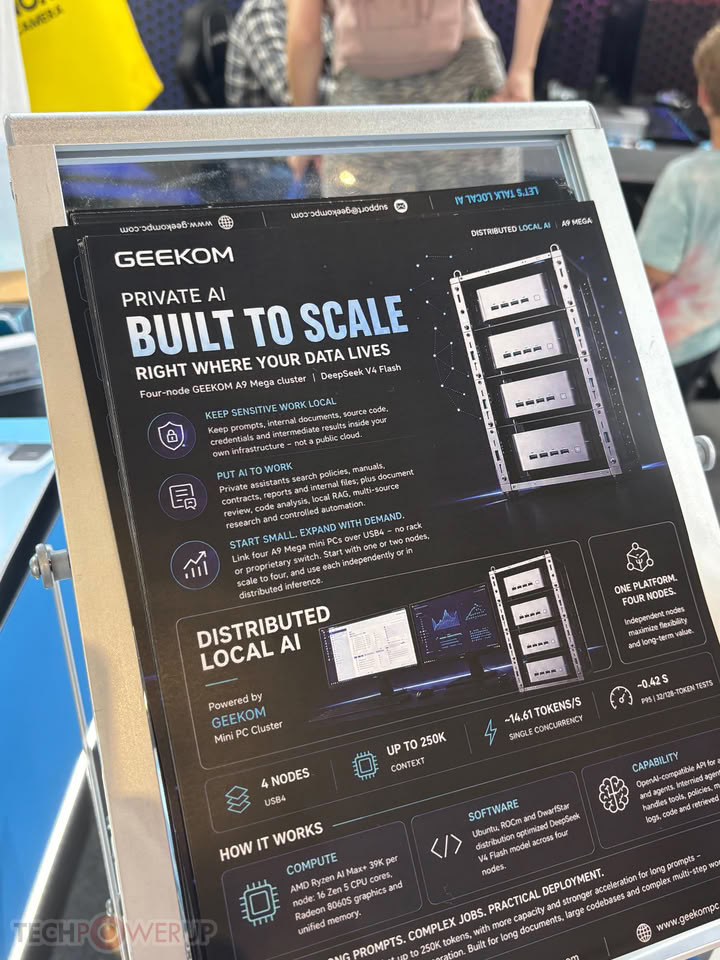
GEEKOM's A9 Mega Mini PCs Form Local Inference Cluster at IFA 2026

At IFA 2026, GEEKOM revealed that the company has successfully interconnected multiple miniature PCs into a single local supercomputer capable of running inference with ease. At the company booth, GEEKOM demonstrated how it linked four of its A9 Mega mini PCs into a local inference cluster. The GEEKOM Private AI setup uses USB4 to connect these four mini PCs directly, eliminating the need for a dedicated rack or proprietary networking hardware. The result is essentially a miniature supercomputer that can sit on a desk, keeping AI workloads and data entirely local.

Each node is based on AMD's Ryzen AI Max+ 395, featuring 16 "Zen 5" CPU cores with integrated Radeon 8060S graphics and up to 128 GB of unified LPDDR5X memory running at 8,000 MT/s. Storage is provided by two PCIe 4.0 x4 M.2 slots, supporting drives up to 4 TB. The compact 171 x 171.1 x 70.1 mm system also includes dual 2.5 GbE, Wi-Fi 7, Bluetooth 5.4, USB4, and HDMI 2.1 connectivity. The processor has a 140 W TDP and an NPU rated at up to 50 TOPS, which means the total mini rack system will draw less than 1,000 W at peak load, making this setup extremely power efficient.

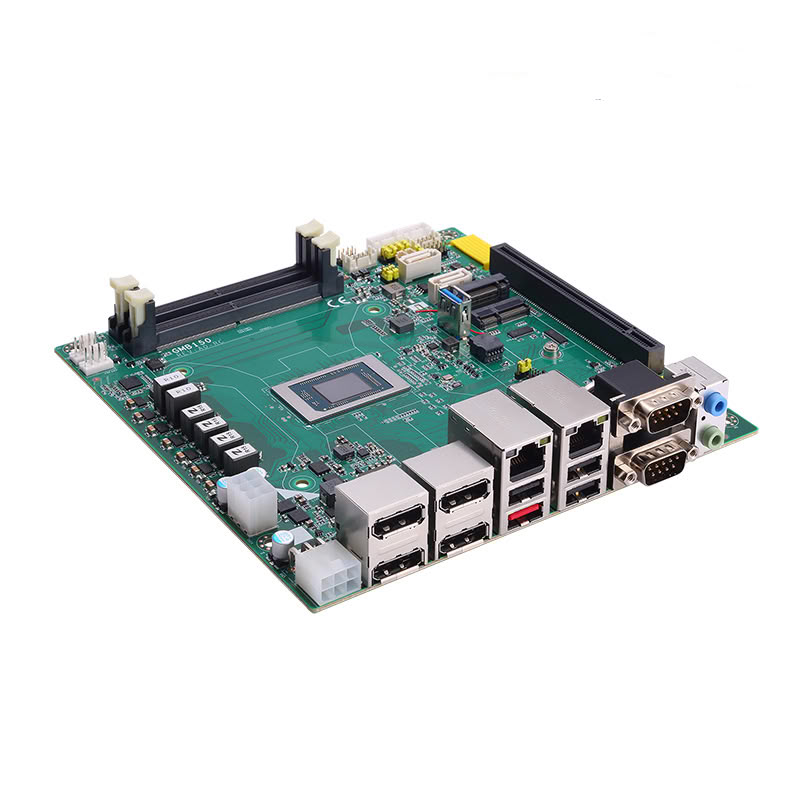
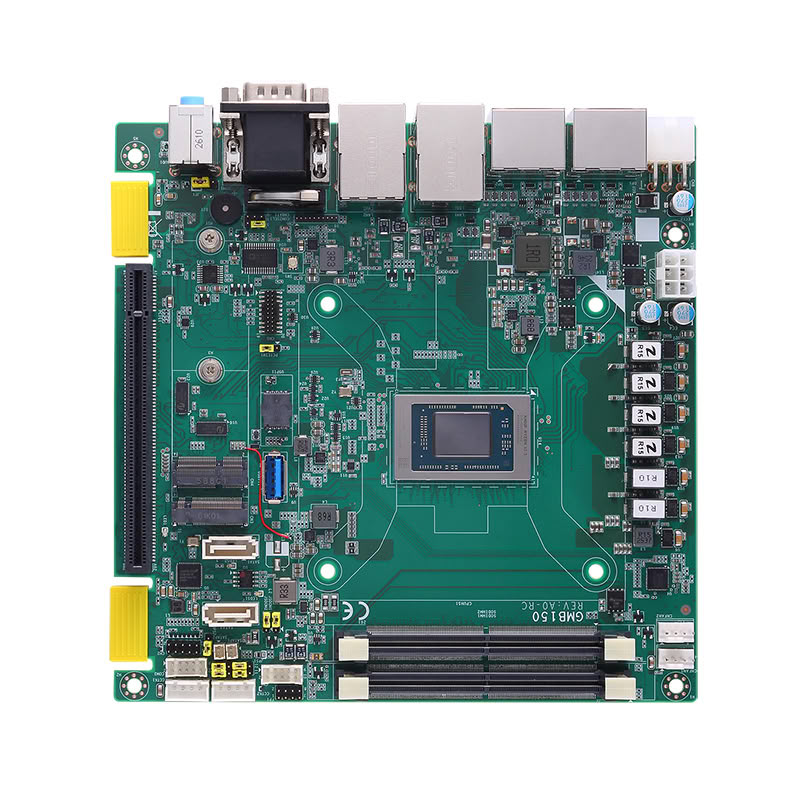
Axiomtek Launches GMB150 Mini-ITX Board Powered by AMD Ryzen Embedded P100 Series Processors

Axiomtek, a world-renowned leader relentlessly devoted to the research, development, and manufacture of innovative, highly efficient, and reliable industrial computer products, proudly introduces the GMB150, a next-generation Mini-ITX gaming motherboard powered by the latest AMD Ryzen Embedded P100 Series processors. As one of the first Mini-ITX gaming motherboards built on this new platform, the GMB150 combines advanced AMD "Zen 5" architecture, RDNA 3.5 graphics, and the AMD XDNA 2 AI engine into a single SoC, delivering up to 80 TOPS of heterogeneous AI computing performance.

Designed to meet the evolving needs of AI-powered electronic gaming machines, the GMB150 combines AI computing, gaming-specific peripheral integration, and hardware-level security in a compact Mini-ITX platform while maintaining the flexibility to support a wide range of intelligent edge applications. Leveraging the latest AMD Ryzen Embedded P100 Series platform, the GMB150 enables gaming OEMs to build more intelligent, secure, and future-ready electronic gaming machines through AI acceleration, advanced graphics, and trusted security.

GEEKOM Pushes the Boundaries of Mini PC Innovation with Four-Node A9 Mega AI Cluster

GEEKOM, a leading innovator in high-performance Mini PCs, has deployed DeepSeek V4 Flash across four GEEKOM A9 Mega systems. The achievement shows how GEEKOM is extending its compact-computing expertise into practical enterprise AI. Rather than relying on a data-center server, the cluster connects four A9 Mega mini PCs through USB4 as one distributed platform. Each A9 Mega is powered by the AMD Ryzen AI Max+ 395, combining 16 Zen 5 CPU cores, Radeon 8060S graphics, and unified memory in a compact chassis.

Ubuntu, ROCm, and DwarfStar distribute an optimized DeepSeek V4 Flash model across the machines. An OpenAI-compatible API connects applications and AI agents, while USB4 eliminates the need for a proprietary high-speed switch or server rack.

SAPPHIRE Technology Unveils EDGE+ Apex Robotics Platform

SAPPHIRE Technology today unveiled the EDGE+ Apex SOM/Carrier Robotics Platform, a production-ready hardware platform powered by AMD Ryzen AI Embedded X100 Series processors and designed to accelerate the development and deployment of physical AI in autonomous robotics. The platform has been showcased at AMD Advancing AI 2026 in San Francisco.

Built for rugged, always-on robotics deployments, the EDGE+ Apex platform pairs a COM-HPC module based on AMD Ryzen AI Embedded X100 Series processors with up to 128 GB of LPDDR5x memory and SAPPHIRE's purpose-built robotics carrier board to deliver the perception, planning and control performance autonomous machines require at the edge.

AMD Instinct MI400 Series and Helios Rack Debut: CDNA 5 Goes 2 nm, Plus ROCm.ai and "Gorgon Halo"

AMD used its Advancing AI 2026 keynote today to launch the Instinct MI400 Series, its next-generation data-center GPU family, alongside the Helios rack-scale solution and the CDNA 5 architecture that underpins both. CDNA 5 is AMD's first GPU architecture to reach the 2 nm node, with the flagship Instinct MI455X carrying 320 billion transistors across a multi-chiplet package and 432 GB of HBM4. This is a data-center compute architecture, not a Radeon gaming architecture, though some of the design choices in CDNA 5 point to where AMD's future unified gaming/compute architecture could be headed.

The MI400 Series splits into two parts: the Instinct MI455X for frontier AI and AI-factory deployments, and the Instinct MI430X for sovereign AI and HPC. Together with the Helios rack, 6th Gen EPYC "Venice" CPUs and AMD Pensando networking, they form AMD's open answer to NVIDIA's Vera Rubin NVL72. This post also covers the new ROCm.ai software stack and AMD's "Gorgon Halo" client teaser.

AMD and Anthropic Announce Strategic Partnership to Deploy 2 GW of Instinct MI450 Chips

AMD and Anthropic today announced a strategic partnership to deploy up to 2 gigawatts of AMD Instinct MI450 Series GPUs in AMD Helios rackscale solutions, with deployment of the first gigawatt beginning in the first half of 2027. The extraordinary pace of AI adoption is driving rapid growth in demand for training and inference capacity. Anthropic is scaling its compute infrastructure to serve strong and growing demand for Claude, and its adoption of AMD Helios at gigawatt scale represents a major expansion of AMD's position at the center of the global AI infrastructure buildout.

Anthropic will deploy AMD Helios rackscale solutions featuring AMD Instinct MI455X GPUs, part of the AMD Instinct MI450 Series, together with AMD EPYC "Venice" CPUs, AMD Pensando networking and AMD ROCm software. Purpose-built for next-generation AI training and inference, Helios delivers the performance, efficiency and scale required for the most demanding AI workloads. This deployment builds on Anthropic's existing use of AMD Instinct MI355X GPUs.

Microsoft to Deploy Next-Gen AMD Instinct and AMD EPYC Processors

AMD today announced an expanded strategic partnership spanning AMD GPUs, CPUs, networking and software on Microsoft Azure. At the center of this expansion, Microsoft will deploy the AMD Helios Rackscale Solution, to power frontier model AI inference for Microsoft, its AI customers and support Azure AI services. Azure will also add two new AMD EPYC CPU-powered VM series and broaden its deployment of Pensando DPUs to support Azure networking services. AMD will begin shipping Helios to customers, including Microsoft, in the second half of 2026.

AMD Helios combines AMD Instinct MI455X GPUs, AMD EPYC "Venice" CPUs, Pensando networking and ROCm software in an open, integrated rackscale platform built for large-scale AI training and inference. The Azure deployment will use Helios for inference workloads spanning frontier models, Azure AI services and customer applications.

AMD Explains FSR 4.1 Upscaling for RDNA 3, Promises Quality Parity with RDNA 4

At Computex 2026, we had the opportunity to interview AMD's Chief Software Officer, Andrej Zdravkovic, and Terry Makedon, Senior Director of Software at AMD, to discuss various developments happening in AMD's labs. One of our questions focused on the FSR 4.1 Upscaling algorithm, which is currently exclusive to the RDNA 4 generation with the Radeon RX 9000 series of graphics cards. However, it is expected to be available this July for RDNA 3-based Radeon RX 7000 series GPUs. We were curious whether the FSR 4.1 Upscaling model that currently runs on RDNA 4 would be the same one used on RDNA 3. AMD explained that the underlying model is slightly different, but the end result will be of the same quality. This is reassuring news for millions of RDNA 3 and RDNA 2 gamers worldwide, especially during a time when upgrading PC hardware is more challenging than it has been in years.

For example, we know there are some fundamental differences in the RDNA generations regarding microarchitecture. For RDNA 3, this means there is no 8-bit floating point support in older generations, as only the latest RDNA 4 uses FP8. To run the FSR 4.1 Upscaling model on RDNA 3, AMD must convert this to 8-bit integer data, since RDNA 3 hardware uses INT8 data types without FP8 support. Generally, integer math is sufficient to optimize these models, but the conversion work is necessary, hence the delay between RDNA 4 and RDNA 3 support. This difference requires AMD to completely modify the FSR 4.1 model for the new data type and ensure there is no quality loss in the final visual output. AMD's software officials have confirmed that the company has been working hard on this issue, and more information will be released next month, in July, as the launch approaches.

AMD Announces More Than $10 Billion in Taiwan Ecosystem Investments to Accelerate AI Infrastructure

To meet the growing demand for AI infrastructure, AMD (NASDAQ: AMD) today announced more than $10 billion in investments across the Taiwan ecosystem to expand strategic partnerships and scale advanced packaging manufacturing for next-generation AI infrastructure. Working with strategic partners in Taiwan and globally, AMD is advancing leading-edge silicon, packaging and manufacturing technologies that enable higher performance, greater efficiency and faster deployment of AI systems. These efforts build on AMD's deep ecosystem partnerships and long-standing leadership in chiplet architectures, high-bandwidth memory integration, 3D hybrid bonding and rack-scale system design for next-generation AI infrastructure.

"As AI adoption accelerates, our global customers are rapidly scaling AI infrastructure to meet growing compute demand," said Dr. Lisa Su, Chair and CEO, AMD. "By combining AMD leadership in high-performance computing with the Taiwan ecosystem and our strategic global partners, we are enabling integrated, rack-scale AI infrastructure that helps customers accelerate deployment of next-generation AI systems."

AMD Announces Ryzen AI Halo, the Compact DGX Spark and Mac Mini Rival

AMD today released Ryzen AI Halo, a compact AI development computer designed by AMD to serve as a nearly full-stack machine for AI development, inferencing, and generative AI content creation. Ryzen AI Halo is designed to strike a unique balance of price, performance, and capabilities that rival Apple Mac Mini and NVIDIA DGX Spark. It is a compact computer that can be used as a standalone PC, or in small clusters talking to your workstation. An advantage it offers over DGX Spark and Mac Mini is that it's based on x86-64, and fully supports Windows. AMD is pricing the Ryzen AI Halo at $3,999. Pre-orders open in June 2026.

At the heart of the Ryzen AI Halo is the Ryzen AI Max+ 395 "Strix Halo" processor that combines 16 "Zen 5" CPU cores with an oversized iGPU powered by the RDNA 3.5 graphics architecture, featuring compute capabilities. There's also a nimble 50 TOPS NPU. Perhaps the most interesting aspect that brings this whole device together, is memory. The processor features a quad-channel (256-bit wide) LPDDR5x memory interface, and AMD has crammed 128 GB of memory into this box. Also helping things is a spacious 2 TB NVMe SSD. The large memory size, helps the processor run AI models with up to 200B parameters, with the right quantization. For reference, the current Mac Mini can only be configured with up to 64 GB of memory. Hardware is less than half the story, the bulk of AMD's engineering effort with the Ryzen AI Halo is on the software side. The company innovated a comprehensive software platform compatible with both Windows and Linux, which helps developers quickly deploy one or more Ryzen AI Halo boxes faster than it takes to set up DGX Spark, AMD says.

AMD Radeon GPU Drivers 26.5.1 Break Blender Cycles Path-Tracing Engine

AMD's latest Adrenalin Edition 26.5.1 WHQL Drivers are causing problems for Blender users, according to the latest Blender issue tracker. Blender 5.1.1 is crashing with these drivers, particularly when using the Cycles path-tracing render engine. The issue appears to be a ROCm runtime mismatch. Blender 5.1.1 uses ROCm 6 runtimes, but the latest AMD driver 26.5.1 only includes ROCm 7, leading to compatibility issues that prevent the application from running smoothly. Multiple users have reported crashes, and we now understand the background.

Developer involved in AMD evosystem Sahar A. Kashi confirmed that when a factory reset is performed and the system is installed from scratch, the amdhip64_6.dll file is removed, causing Blender Cycles to attempt loading ROCm 7 kernels. However, since Blender version 5.1.1 is compiled only for ROCm 6, this runtime mismatch results in application crashes. To resolve this issue on AMD GPU systems, users should install the older 26.3.1 drivers and use them until Blender version 5.2 is released, and the Cycles path-tracing render engine achieves full ROCm 7 compatibility.

Ubuntu 26.04 "Resolute Raccoon" Launches With Gnome 50 and Linux 7.0

Canonical has today released Ubuntu 26.04 LTS as the company's latest update to the mainstream Linux distro. As we reported previously, Canonical has upgraded the minimum system requirements to 6 GB of RAM, but that change comes alongside a number of upgrades to the distro itself, some of which will be immediately noticeable, while others will silently improve the user experience in the background. Ubuntu users can download Ubuntu 26.04 directly from Canonical, or users of previous Ubuntu versions can simply run "do-release-upgrade -p" in their terminal.

The biggest user-facing change is the move to Gnome 50, which now mandates Wayland and has improved, non-experimental support for both VRR and fractional scaling. Gnome 50 also implements a new feature that allows the cursor to render at the monitor's full refresh rate, even if the foreground app is running at a lower frame rate. The Gnome 50 update also sees the Yaru theme get some nifty visual tweaks that bring it closer to the standard Gnome theme and a new icon pack. Resolute Raccoon also moves Ubuntu up to the Linux kernel 7.0, adding better memory management, removing the "experimental" tag from Rust, and updating various drivers and services, like ZFS, and adding security features, like TPM-backed full-disk encryption. Ubuntu 26.04 is also the first Ubuntu version to ship NVIDIA CUDA out of the box, and AMD's ROCm platform is available in the Ubuntu repos for those looking to run local AI.

AMD Instinct MI355X GPUs Surpass 1M Tokens/Sec in MLPerf 6.0

In its MLPerf Inference 6.0 submission, AMD did not simply revisit familiar benchmarks with a faster GPU. It expanded into first-time workloads, crossed the 1-million-tokens-per-second threshold at multinode scale and showed that partners can reproduce the results across a broader ecosystem. That combination matters because our customers no longer evaluate inference platforms on one metric alone. They want competitive single-node performance, efficient scale-out, faster bring-up on new models, reproducible results across partner systems and confidence that the software stack can keep pace. MLPerf Inference 6.0 let us show all of that in one submission.

Just as important, we showed that these results are not isolated. A broad partner ecosystem submitted across four AMD Instinct GPU types that closely reproduced numbers submitted by AMD and the first three-GPU heterogeneous MLPerf submission demonstrated that AMD hardware and AMD ROCm software can orchestrate meaningful inference throughput even across systems in different geographies.

AMD and Nutanix Announce Strategic Partnership to Advance an Open and Scalable Platform for Enterprise AI

AMD and Nutanix today announced a multi-year strategic partnership to jointly develop an open, full-stack AI infrastructure platform designed to power agentic AI applications everywhere. This agreement aligns to both companies' commitment to an open ecosystem for AI, providing customers with choice and easy-to-deploy, production ready, high-performance and efficient solutions that are optimized for Agentic AI, at the edge, inside enterprises, and across the cloud.

The partnership aligns silicon innovation, open runtime software and enterprise cloud orchestration technologies for AI to deliver scalable, production-ready agentic AI platforms across data centers, hybrid and edge environments. By optimizing the Nutanix Cloud and Nutanix Kubernetes Platforms on AMD EPYC CPUs and AMD Instinct GPUs and integrating the AMD ROCm software ecosystem and the AMD Enterprise AI platform into Nutanix AI full-stack solutions, the companies are developing an open solution for Agentic AI platforms using high-performance infrastructure and supported by a broad set of OEM partners.

AMD and Meta Announce Expanded Strategic Partnership to Deploy 6 Gigawatts of AMD GPUs

AMD and Meta today announced a 6-gigawatt agreement to power Meta's next generation of AI infrastructure across multiple generations of AMD Instinct GPUs. This agreement expands on the companies' existing strategic partnership and aligns roadmaps across silicon, systems and software to deliver AI platforms purpose-built for Meta's workloads. The first deployment will use a custom AMD Instinct GPU based on the MI450 architecture to deliver AI platforms that are optimized for Meta's workloads at gigawatt-scale. Shipments supporting the first gigawatt deployment are scheduled to begin in the second half of 2026 powered by the custom AMD Instinct MI450-based GPU and 6th Gen AMD EPYC CPUs, codenamed "Venice," running ROCm software and built on the AMD Helios rack-scale architecture. AMD Helios was developed jointly by AMD and Meta through the Open Compute Project to enable scalable, rack-level AI infrastructure.

"We are proud to expand our strategic partnership with Meta as they push the boundaries of AI at unprecedented scale," said Dr. Lisa Su, chair and CEO, AMD. "This multi-year, multi-generation collaboration across Instinct GPUs, EPYC CPUs and rack-scale AI systems aligns our roadmaps to deliver high-performance, energy-efficient infrastructure optimized for Meta's workloads, accelerating one of the industry's largest AI deployments and placing AMD at the center of the global AI buildout."

AMD Announces Day 0 Support for Qwen 3.5 LLM on Instinct GPUs

AMD is excited to announce Day 0 support for Alibaba's latest generation of Large Language Models, Qwen 3.5, on AMD Instinct MI300X, MI325X, and MI355X GPU accelerators, in close collaboration with Alibaba Qwen team. Leveraging the optimized ROCm software stack, SGLang and vLLM inference serving framework, developers can immediately deploy these state-of-the-art models.

The Strategic Value of Qwen 3.5 on AMD Instinct
Empowering Next-Generation AI Agents—This Day 0 enablement is designed for AI developers, system architects, and DevOps professionals building the next wave of AI agents and enterprise platforms. While previous models required trade-offs between parameter depth and reasoning speed, the Qwen 3.5 family on AMD Instinct GPUs allows teams to deploy massive 256K context windows and complex multimodal workflows with unprecedented efficiency.

AMD's State-of-the-Art "Helios" Rack-scale AI Architecture Heading to India

AMD, a leader in high-performance and AI computing, and Tata Consultancy Services, a global leader in IT services, consulting, and business solutions, have expanded their strategic collaboration. TCS, through its subsidiary HyperVault AI Data Center Limited (HyperVault), and AMD will codevelop a rack-scale AI infrastructure design based on the AMD "Helios" platform in support of India's national AI initiatives.

Powered by GPUs, next-generation AMD EPYC "Venice" CPUs, AMD Pensando Vulcano NICs and the open ROCm software ecosystem, "Helios" is purpose-built to deliver a rack-scale AI platform supporting sovereign AI factories. "Helios," combined with TCS' enterprise expertise and scale, will accelerate deployment and enhance operational efficiencies for enterprises. As part of this strategic collaboration, both companies will offer an AI-ready data center blueprint supporting up to 200 MW of capacity and will work with hyperscalers and AI companies to accelerate data center build-outs in India.

AMD Intros ROCm v7.2 - Smarter, Faster, & More Scalable for Modern AI Workloads

Modern AI workloads demand more than raw compute—they require a tightly integrated software stack that can extract maximum performance, scale efficiently across systems, and operate reliably in production environments. With the latest ROCm 7.2 release, we're delivering a broad set of optimizations and software enhancements designed to improve developer productivity, runtime performance, and enterprise readiness.

In this blog, we highlight the latest ROCm 7.2 enhancements for AMD Instinct GPUs, designed to boost AI and HPC performance. Learn how hipBLASLt and GEMM optimizations, FP8/FP4 support in rocMLIR and MIGraphX, and topology-aware communication with GDA and RCCL deliver higher throughput and lower latency. We also cover AI model tuning for AMD Instinct MI300X and MI350 GPUs and Node Power Management (NPM) for efficient multi-GPU operation—together enabling faster, more scalable, and reliable AI workloads.

SolidRun Launches Bedrock RAI300 Fanless Edge PC with AMD Ryzen AI 9 HX 370

SolidRun has announced the first industrial PC based on the AMD Ryzen AI 9 HX 370 with support for the latest AMD ROCm 7 stack. The combination of high-performance Zen 5 cores, Radeon iGPU, XDNA NPU and high memory capacity in a compact and ruggedized x86 device provides secure and robust edge AI processing capabilities.

AMD Ryzen AI 9 HX 370 processor contains a 12C/24T Zen 5 CPU (up to 5.1 GHz), Radeon 890M GPU with 16 graphics cores and a 50 TOPS NPU. Up to 128 GB of DDR5 capacity allows for the local execution of large AI models.

AMD Announces Ryzen AI 400 Series "Gorgon Point" Mobile Processors

AMD at the 2026 International CES announced the new Ryzen AI 400 series "Gorgon Point" mobile processors powering the company's client processor lineup through 2026. These chips are based on the new 4 nm "Gorgon Point" silicon that is a refresh of the current "Strix Point" monolithic processor supporting higher clock speeds across its various compute components, and updates to its power management. The processor implements the "Zen 5" microarchitecture, and uses a dual-CCX CPU with four full-sized "Zen 5" cores sharing a 16 MB L3 cache, and eight compact "Zen 5c" cores sharing an 8 MB L3 cache. The "Zen 5" cores boost up to 5.20 GHz, while the iGPU goes up to 3.10 GHz engine clock. The chip features an iGPU based on the RDNA 3.5 graphics architecture with 16 compute units (CU). Both the CPU and iGPU feature improved boost residency over "Strix Point."

Besides the CPU and iGPU, the integrated NPU also gets a performance uplift, with increased NPU clock speeds enabling a peak throughput of 60 TOPS, up from 55 TOPS on Ryzen AI 300 series processors. AMD has also given the processor a feature-packed ROCm software stack, so client AI software can leverage this 60 TOPS NPU and the AI acceleration capabilities of the iGPU and CPU. Lastly, AMD has updated the integrated memory controllers, giving them native support for LPDDR5X 8533 MT/s memory speeds, an increase from the 8000 MT/s that "Strix Point" natively supports. Despite these improvements, "Gorgon Point" remains mostly similar to "Strix Point" at a physical level, and so AMD took the opportunity to refresh the way the various Ryzen AI 400 series processor models are segmented from this silicon, giving each SKU an improvement over its Ryzen AI 300 series predecessor. This could be anything from CPU clock speeds, to CPU core-count, to iGPU CU count, and NPU throughput.

Canonical Prepares Native AMD ROCm Support for Ubuntu

Canonical is pleased to announce an expanded collaboration with AMD to package and maintain AMD ROCm software directly in Ubuntu. AMD ROCm is an open software ecosystem to enable hardware-accelerated AI/ML and HPC workloads on AMD Instinct and AMD Radeon GPUs, simplifying the deployment of AI infrastructure with long term support from Canonical.

Canonical has formed a dedicated team of engineers to package the AMD ROCm software libraries to streamline installation, support, and long-term maintenance on Ubuntu. Canonical will also submit these packages for consideration on Debian.

AMD and HPE Expand Collaboration to Advance Open Rack-Scale AI Infrastructure

Today, AMD announced an expanded collaboration with HPE to accelerate the next generation of open, scalable AI infrastructure built on AMD leadership compute technologies. HPE will become one of the first system providers to adopt the AMD "Helios" rack-scale AI architecture, which will integrate a purpose-built HPE Juniper Networking scale-up switch - in collaboration with Broadcom - and software for seamless, high-bandwidth connectivity over Ethernet. "Helios" combines AMD EPYC CPUs, AMD Instinct GPUs, AMD Pensando advanced networking and the AMD ROCm open software stack to deliver a cohesive platform optimized for performance, efficiency, and scalability. The system is engineered to simplify deployment of large-scale AI clusters, enabling faster time to solution and greater infrastructure flexibility across research, cloud, and enterprise environments.

"HPE has been an exceptional long-term partner to AMD, working with us to redefine what is possible in high-performance computing," said Dr. Lisa Su, Chair and CEO, AMD. "With 'Helios', we're taking that collaboration further, bringing together the full stack of AMD compute technologies and HPE's system innovation to deliver an open, rack-scale AI platform that drives new levels of efficiency, scalability, and breakthrough performance for our customers in the AI era."
Return to Keyword Browsing
Nov 25th, 2026 17:40 CST change timezone

New Forum Posts

Popular Reviews

TPU on YouTube

Controversial News Posts