Tuesday, February 17th 2026

AMD Announces Day 0 Support for Qwen 3.5 LLM on Instinct GPUs
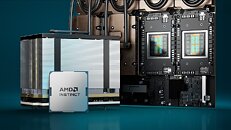
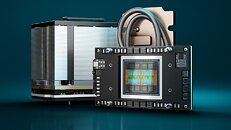
AMD is excited to announce Day 0 support for Alibaba's latest generation of Large Language Models, Qwen 3.5, on AMD Instinct MI300X, MI325X, and MI355X GPU accelerators, in close collaboration with Alibaba Qwen team. Leveraging the optimized ROCm software stack, SGLang and vLLM inference serving framework, developers can immediately deploy these state-of-the-art models.
The Strategic Value of Qwen 3.5 on AMD Instinct
Empowering Next-Generation AI Agents—This Day 0 enablement is designed for AI developers, system architects, and DevOps professionals building the next wave of AI agents and enterprise platforms. While previous models required trade-offs between parameter depth and reasoning speed, the Qwen 3.5 family on AMD Instinct GPUs allows teams to deploy massive 256K context windows and complex multimodal workflows with unprecedented efficiency.
 Breaking the Long-Context Bottleneck
Traditional Transformer architectures suffer from quadratic complexity; as sequence length increases, memory and compute requirements grow exponentially. Qwen 3.5 solves this via its Hybrid Attention architecture:
For enterprises, this integration provides a path to high-performance AI without vendor lock-in:
To ensure high performance on day zero, AMD has worked to provide optimized kernel support for the unique components of Qwen 3.5.
1. Hybrid Attention Architecture
Unlike Qwen 3's reliance on Sliding Window Attention, Qwen 3.5 utilizes a Hybrid Attention strategy:
Qwen 3.5 is "multimodal by design," featuring a DeepStack Vision Transformer:
The Qwen 3.5 MoE model evolves the standard sparse architecture by introducing a Shared Expert mechanism:
Conclusion
With the release of Qwen 3.5, Alibaba continues to push the boundaries of open-weight models. By providing Day 0 support on AMD Instinct GPUs with both SGLang and vLLM, we ensure that developers have the compute power and optimized software stack needed to run these massive, high-context models at production scale.
Source:
AMD Developer Resources
The Strategic Value of Qwen 3.5 on AMD Instinct
Empowering Next-Generation AI Agents—This Day 0 enablement is designed for AI developers, system architects, and DevOps professionals building the next wave of AI agents and enterprise platforms. While previous models required trade-offs between parameter depth and reasoning speed, the Qwen 3.5 family on AMD Instinct GPUs allows teams to deploy massive 256K context windows and complex multimodal workflows with unprecedented efficiency.


Traditional Transformer architectures suffer from quadratic complexity; as sequence length increases, memory and compute requirements grow exponentially. Qwen 3.5 solves this via its Hybrid Attention architecture:
- Linear Scaling: By utilizing Gated Delta Networks, the model achieves linear complexity, allowing it to maintain performance across massive contexts that would crash standard dense models.
- Inference Speed: In contexts exceeding 32K tokens, Qwen 3.5 delivers significantly higher throughput compared to its predecessors due to the reduced computational overhead.
For enterprises, this integration provides a path to high-performance AI without vendor lock-in:
- Massive Cost Savings: The Ultra-Sparse MoE design activates only a fraction of its total parameters during inference. This allows it to outperform larger dense models while using significantly less compute.
- Native Multimodality: With DeepStack and 3D Convolutions, the model can natively operate as a "Visual Agent"—identifying objects in complex environments for industrial or support use cases.
- Maximized ROI: By leveraging the massive HBM capacity of the AMD Instinct GPUs developers can serve full-scale models and massive contexts on a single GPU or single node, reducing the hardware footprint needed for production-grade agents.
To ensure high performance on day zero, AMD has worked to provide optimized kernel support for the unique components of Qwen 3.5.
- Linear Attention via Triton: The Gated Delta Networks in Qwen 3.5 are supported in vLLM via Triton-based kernels (fused_recurrent_gated_delta_rule). Since SGLang and vLLM supports Triton on ROCm, these kernels work out-of-the-box on AMD GPU.
- Shared Expert MoE: The Shared Expert path leverages highly optimized hipBLASLt GEMM kernels, while the routed experts continue to use optimized AITER FusedMoE implementations.
- Vision Kernels: Multimodal Rotary Positional Embeddings (mRoPE) and Conv3d operations are fully supported via standard MIOpen and PyTorch kernels on AMD GPU.
1. Hybrid Attention Architecture
Unlike Qwen 3's reliance on Sliding Window Attention, Qwen 3.5 utilizes a Hybrid Attention strategy:
- Full Attention: Standard multi-head attention layers are used at set intervals (defaulting to every 4th layer) to maintain high associative recall.
- Linear Attention (Gated Delta Networks): Qwen 3.5 implements Gated Delta Networks (Qwen3_5GatedDeltaNet) which offer linear complexity relative to sequence length. This allows the model to handle massive contexts with significantly reduced computational overhead.
Qwen 3.5 is "multimodal by design," featuring a DeepStack Vision Transformer:
- Convolutions: It treats video as a third dimension, using Conv3d for patch embeddings to capture temporal dynamics natively.
- DeepStack Mechanism: It merges features from multiple layers of the visual encoder rather than just the last layer, capturing both fine-grained and high-level visual details.
The Qwen 3.5 MoE model evolves the standard sparse architecture by introducing a Shared Expert mechanism:
- Shared Expert: A dedicated dense MLP processes every token to capture universal features, improving training stability and overall model performance.
- Routed Experts: Tokens are simultaneously routed to a subset of specialized experts (e.g., top-8 active out of 64) via a Top-K Router.
Conclusion
With the release of Qwen 3.5, Alibaba continues to push the boundaries of open-weight models. By providing Day 0 support on AMD Instinct GPUs with both SGLang and vLLM, we ensure that developers have the compute power and optimized software stack needed to run these massive, high-context models at production scale.
Comments on AMD Announces Day 0 Support for Qwen 3.5 LLM on Instinct GPUs
There are no comments yet.