News Posts matching #RTX 5070 Ti

Return to Keyword Browsing

MSI Reportedly Plans RTX 5080 Price Hikes of up to $1,200 in China

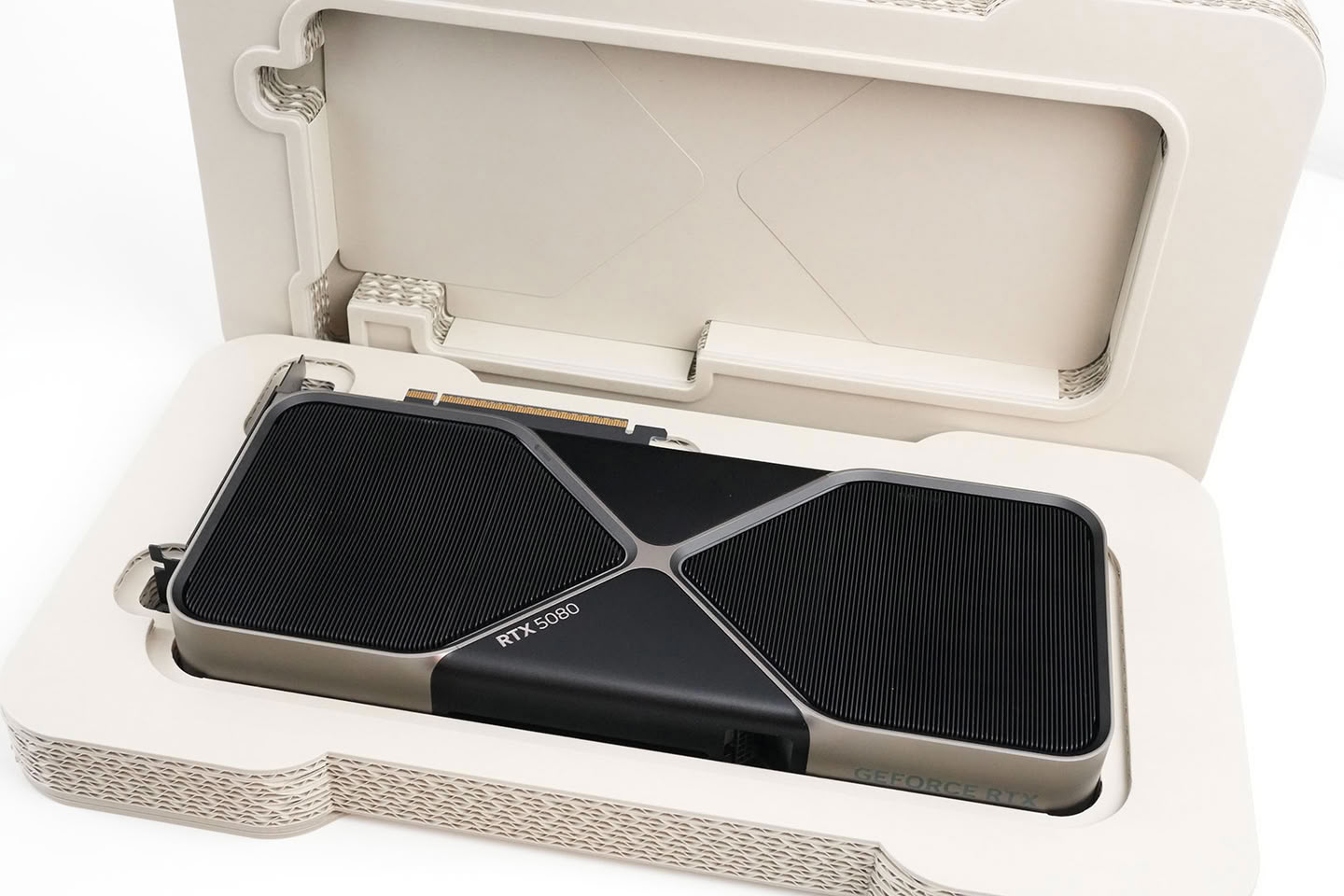
MSI's GeForce RTX 5080 cards could cost up to 8,000 yuan (about $1,200) more in China this month, according to a ChannelGate post shared on X by harukaze5719. The post outlines MSI's November distributor pricing compared to October, with RTX 5080 models going up by 1,300 to 8,000 yuan depending on the card. That's roughly $195 at the low end, while the top figure alone is more than the RTX 5080's entire $999 launch MSRP. Yes, that's apparently a $1,200 increase planned for the RTX 5080 at the top end.

The rest of the RTX 50 stack goes up too. RTX 5070 Ti models rise by 800 to 4,000 yuan (about $120 to $600), and the RTX 5070 by 500 to 1,000 yuan (75 to $150). The RTX 5060 Ti 16 GB picks up 400 yuan, its 8 GB sibling 200 yuan, and the RTX 5060 between 200 and 500 yuan. Even the RTX 3050 gets a 100 yuan bump. These are distributor prices in China, not new MSRPs, and the post doesn't say which RTX 5080 models sit at the top of that range. Colorful and Galax reportedly started sharing similar hikes with their partners earlier this month, so MSI seems to be following the same path. We can certainly expect other AIB partners to follow suit soon.

NVIDIA RTX 5070 Ti Climbs $160 in Eight Days, Now 79% Over MSRP

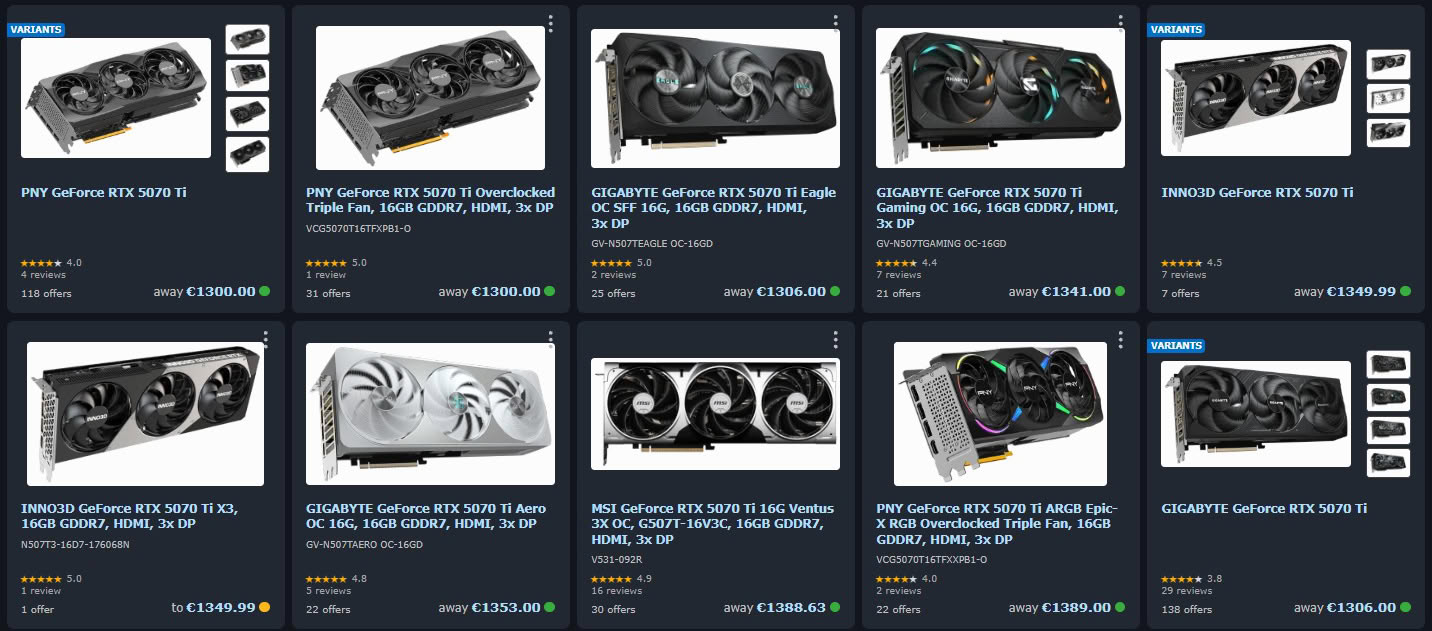
NVIDIA's GeForce RTX 5070 Ti is now close to double its $749 MSRP in the US. According to price tracking by VideoCardz, the cheapest RTX 5070 Ti at major US retailers was $1,339.99 on November 6, about 79% above MSRP, up from $1,179.99 on October 29. That's a $160 jump in just eight days. Some models have already crossed the 2x mark, like the ASUS TUF Gaming OC at $1,499.99 on B&H. Prices are also moving fast. At the time of writing, the cheapest RTX 5070 Ti sold by Newegg itself is an MSI SHADOW RTX 5070 Ti at $1,409.99. Things aren't much better in Germany, where the cheapest listing on Geizhals sits at €1,300 for a PNY model, roughly 48% above the €879 MSRP.

Things are probably going to get worse, too. NVIDIA's board partners in China are reportedly raising RTX 5070 Ti prices by around 1,000 RMB (about $150) this week, with retail prices expected to follow within a week or two. Unlike the RTX 5090 and 5080 16 GB, which have reportedly been discontinued, the RTX 5070 Ti is still officially in production. After reports of an end of production in January early this year, NVIDIA said it was still shipping all GeForce SKUs, and ASUS denied the card was end-of-life, while admitting that memory supply was hurting production and restocking. The card is still listed at major retailers, unlike the RTX 5080, which vanished from NVIDIA's US Marketplace two weeks after the RTX 5090 did the same. Anyone shopping for an RTX 5070 Ti should probably expect these prices to keep rising for a while.

NVIDIA GeForce RTX 50-Series Scheduled for up to $500 Price Hike This Week

NVIDIA's GeForce RTX 50-Series "Blackwell" gaming graphics cards are expected to see significant price adjustments this week. According to Chinese ChannelGate, add-in card (AIC) partners have confirmed that price hikes are scheduled due to the ongoing demand for these GPUs outstripping supply. Some major AIC partners, like Colorful and Galax, have reportedly already started sharing information about these price increases. The most significant example is expected to be for SKUs based on NVIDIA's GeForce RTX 5090 DV2, which will see an increase of up to 3,300 RMB, translating to nearly $500. Even entry-level GPUs are not exempt, as the GeForce RTX 5060 is expected to see around a $30 price increase on existing models. These changes are anticipated to be implemented this week for retail partners, meaning that consumer prices might take a week or two to reflect the new listing prices.
Below is the list of price hikes in China, expected to be the norm.

RTX 5080 Vanishes From NVIDIA's US Marketplace Two Weeks After the RTX 5090

NVIDIA's US Marketplace no longer lists the GeForce RTX 5080. The GPU filter on the store's graphics card page now tops out at the RTX 5070 Ti, followed by the RTX 5070, RTX 5060 Ti, RTX 5060, and RTX 5050, with partner RTX 5080 models gone as well. The same thing happened to the RTX 5090 about two weeks ago and, barring a brief cameo at $5,599, the card still hasn't returned. NVIDIA has since denied that the RTX 5090 is discontinued, though it hasn't said anything about the RTX 5080 yet. Oddly enough, its RTX 5080 product page still says "Starting at $999."

The removal seems limited to the US for now. NVIDIA's UK Marketplace still has 13 RTX 5080 listings and two RTX 5090 cards. Of course, a missing listing could simply mean there's no stock left, since the RTX 5080 already costs close to $2,000 at US retailers, roughly double its MSRP. That leaves the RTX 5070 Ti as the fastest card on NVIDIA's US store, and it isn't cheap either. The seven listings there range from $1,269.99 to $1,499.99, well above its $749 launch price.

ASUS and Gigabyte Bump RTX 5080 Prices in China, RTX 5070 Ti Also Sees Wholesale Increase

Rumors of the RTX 5080 16 GB being discontinued are picking up steam, and the effects are starting to show. RTX 5080 16 GB wholesale prices in China have jumped by around 2,000 yuan (roughly $300), according to new information from Board Channels. The card previously traded at 12,700 to 13,500 yuan (~$1,900 to $2,020) and now sits at 14,500 to 15,000 yuan (~$2,170 to $2,240). Board Channels blames tighter upstream supply and the reported discontinuation of the 16 GB model. A leaker recently claimed that NVIDIA has set January discontinuation dates for the card, though NVIDIA hasn't confirmed anything.

Along with the RTX 5080 16 GB, the RTX 5070 Ti, which uses the same 16 GB of GDDR7, is also facing price hikes. It is now going for 9,650 to 9,850 yuan (~$1,440 to $1,470), compared to 9,000 to 9,150 yuan (~$1,350 to $1,370) before, a roughly $100 bump. Board partners are adjusting too. ASUS has reportedly added 1,000 yuan (~$150) to all of its RTX 5080 16 GB models and 200 yuan (~$30) to the RTX 5070 Ti, RTX 5070, and RTX 5060 Ti 16 GB cards. Gigabyte went further, with 1,200 yuan (~$180) on its RTX 5080 cards and 200 yuan (~$30) on the RTX 5070 Ti and RTX 5070. Cheaper RTX 5060-class cards from both brands saw smaller bumps of 200 yuan (~$30) or less, and ASUS reportedly raised prices on its Radeon cards as well, between $15 and $50.

AMD Radeon Owners Can Now Run Nearly Every DLSS Feature Through Fan-Made Mod

Daniel Blanco's DLSS-NR on AMD project has grown well past its original scope. The mod first got NVIDIA's DLSS 5 Neural Rendering running on Radeon cards back in September, and later pulled off a 74% performance jump in a single day. The new Alpha 0.8.0 release, published on October 17, now brings almost the whole DLSS stack to AMD GPUs. That includes DLSS 4.5 Super Resolution (Models M and L), Ray Reconstruction (Model F), and Frame Generation with up to 4x multi-frame generation (MFG) in games that expose DLSS FG inputs. FSR 4.1.1 is also bundled, so it no longer depends on the driver, and a new NeuralHub mod manager handles game detection and installation.

According to the developer, this is a ground-up reimplementation of the DLSS runtimes using custom HIP kernels rather than a translation layer, and users have to supply their own NVIDIA DLLs. RDNA 4 and RDNA 3 cards get the full feature set, while RDNA 2 support is still experimental and limited to Neural Rendering. The developer says DLSS 5 Neural Rendering now runs at roughly 90 to 100 FPS at 1080p on an RX 9070 XT, and the goal is to match an RTX 5070 Ti. Early results with Ray Reconstruction are mixed, however. One Reddit user reported no performance loss in Cyberpunk 2077 with path tracing at 1440p on an RX 9070 XT, while others saw drops of up to 25%. The mod only works in DirectX 12 games on Windows 11, and anti-cheat software blocks it, so readers are advised to stick to single-player titles.

PS4 Exclusive Driveclub Now Runs Natively on PC Through New Recomp

Driveclub, Evolution Studios' 2014 PS4 racer, now runs natively on Windows through DriveClub Recomp, a fan project released on GitHub by OverkillLabs3. While PlayStation emulation has been progressing rapidly, this one doesn't use CPU emulation. The game's own x86-64 code runs directly on the PC's processor, while the PS4 system libraries are reimplemented and GPU commands are translated to Vulkan. The port supports resolutions from 720p to 8K, ultrawide displays, and an unlocked frame rate that doesn't speed up the game. It also replaces the original anti-aliasing with NVIDIA DLAA on RTX cards or AMD FSR 3.1 on any GPU, both at native resolution, and RTX owners can swap between the two in-game with F10.

The developer says the game holds about 60 FPS at 4K in its heaviest scenes on an RTX 5070 Ti paired with a Ryzen 7 5800X3D, and the v0.2.3 update pushed one 4K test race from roughly 62 to 71 FPS. It is still rough around the edges, however. Some reflections look too bright, shaders compile during the first few minutes, slower CPUs drop frames in busy scenes, and online features don't work. It has also only been tested on NVIDIA hardware so far. A second project, DCport by qnfn, takes a similar route with FSR 3.1 and FSR 4 support. Both need the player's own dump of version 1.28. It's in the same vein as how modders recently got Gran Turismo Sport running on PC. These recomps arrive a couple of months after a ShadPS4 patch let Driveclub run at up to 8K, quite the jump for a game that shipped at 1080p and 30 FPS.

Redditor Orders One MSI RTX 5070 Ti From Walmart for $1,099, Gets Four

Orders that get mixed up often tend to leave buyers with the short end of the stick. For instance, in 2025, a Micro Center customer found backpacks inside a Zotac GeForce RTX 5090 box, and another Best Buy customer reportedly got rocks instead of an ASUS TUF RTX 5080 and was initially denied a refund. This time, apparently, the order error went the other way. Reddit user deadmanwonderland_23 says they ordered a single MSI GeForce RTX 5070 Ti 16 GB from Walmart for $1,099 and received four identical cards. The card looks like MSI's Frieren Edition, which comes with a bundled blanket, and currently goes for $1,259 on MSI's website. It was already a relatively good deal at $1,099, but getting four cards really sounds too good to be true. At the price paid, the four cards add up to roughly $4,400, and there's no word on whether the buyer has told Walmart about the extras.

One plausible explanation is that someone in a Walmart warehouse mistook a carton of four cards for a single special edition package. That seems like a possibility, but the actual reason is not currently known. As of now, Walmart hasn't commented on this incident, and the only account comes from a Reddit post, so take it with a grain of salt. Retailers have often let customers keep extra units in the past, though that is usually decided case by case. Walmart has been generous with mistakes before, like when a customer managed to pick up an RTX 5070 for just $129 due to a labeling error. Either way, it's something we don't often see in a GPU market where prices just keep climbing.

Mod Pushes NVIDIA RTX 5090 Laptop GPU to 225 W

Gaming laptop GPUs are generally power limited, which often results in significant performance losses compared to their desktop contemporaries, especially for higher-powered GPUs. However, a new mod called NvpwrControl aims to increase performance of NVIDIA's latest RTX 50-series gaming laptops by increasing their power targets using baked-in power policies not available to consumers.

The developer, who found the workaround by reverse-engineering NVIDIA's power management path, says that the mod supports the RTX 5070 Ti, 5080, and 5090 GPUs, with 140 W TGP 5070 Ti GPUs getting power targets all the way to 180 W. The 5070 Ti is the GPU with the most robust support so far, with the developer explicitly stating that RTX 5080 and 5090 support is experimental. Purportedly, the RTX 5080 and 5090 should be able to reach as high as 225 W with NvpwrControl, although that doesn't come without risks and caveats.

XMG Refreshes APEX 16 and PRO 16 VE Laptops With RTX 5070 12GB and Better Cooling

XMG is introducing 2026 refreshes of its 16-inch laptops from the APEX and PRO model series with the XMG APEX 16 and XMG PRO 16 VE. Unlike the 2025 APEX 16 MAX and PRO 16 VE models, the new versions feature an NVIDIA GeForce RTX 5070 with 12 GB of VRAM. Both models also receive minor adjustments to their cooling systems and bottom ventilation.

XMG APEX 16: Ryzen 9 9955HX or 8945HX and RTX 5070 with 12 GB VRAM
Following in the footsteps of the XMG APEX 16 MAX (M25), the new XMG APEX 16 (M26) offers a choice between the AMD Ryzen 9 9955HX from the Fire Range and the Ryzen 9 8945HX from the Dragon Range refresh generation. Both processors feature 16 cores and 32 threads. For graphics, the laptop uses the updated NVIDIA GeForce RTX 5070 with 12 GB of VRAM and a maximum graphics power of 115 watts, including Dynamic Boost. By contrast, the 2025 XMG APEX 16 MAX (M25) is equipped with the GeForce RTX 5070 Ti and therefore remains available as the higher-end MAX version of the 16-inch laptop.

NVIDIA Reportedly Preparing GeForce RTX 5070 Variant With Bigger GB203 Die

NVIDIA appears to be preparing a new variant of the RTX 5070, this time built on the bigger GB203 die instead of the GB205 chip the card has shipped with since launch. The information comes from leaker hongxing2020, who also mentioned a new driver arriving on September 9, though it's not clear if that's tied to this specific SKU. This wouldn't be the first time NVIDIA has done this. The GeForce RTX 5060 normally runs on the GB206 die, but some retail units turned up with GB205 silicon instead, cut down to match the same specs. The jump to GB203 is a much bigger one for the RTX 5070, though. It's the same chip used in the RTX 5070 Ti and RTX 5080, measuring 378 mm² against the GB205's 263 mm².

To match the RTX 5070's 6,144 CUDA cores and 12 GB of GDDR7 on a 192-bit bus, NVIDIA would need to disable nearly 43% of the GB203's cores and shut off two of its eight memory channels. The likely explanation for this change is binning. GB203 dies that fall short of RTX 5070 Ti or RTX 5080 requirements probably still work fine at RTX 5070 specs, so NVIDIA gets to use them instead of scrapping them. There's no indication the GB203 variant will actually perform any better than the current GB205-based RTX 5070, since the specs are expected to stay the same either way. Board partners haven't said anything yet, so it's still worth treating this as a rumor until a retail card or driver listing actually confirms it.

ASUS and Galax Raise GeForce RTX 50-Series Prices by Up to $74

ASUS and Galax have become the latest NVIDIA board partners to raise prices on RTX 50-series cards, with increases landing September 1. According to a report from Channel Gate, ASUS is bumping RTX 5070 prices by 150 to 300 Yuan, or roughly $22 to $44, while Galax is applying a 200 Yuan (about $30) hike to the same card. Galax's RTX 5070 Ti is going up 300 Yuan (around $44), and its RTX 5080 sees the steepest jump at 500 Yuan (about $74). Budget cards like the RTX 5060 and RTX 5050, along with the flagship RTX 5090, are apparently untouched this time. The increases here are smaller in dollar terms than some earlier hikes, but they add up, and mid-range buyers eyeing the RTX 5070 family are in the crosshairs this time.

This is likely the third or fourth 2026 price hike for NVIDIA's board partners, and it results from the GDDR7 cost pressure we have tracked for months. NVIDIA reportedly raised the price of its GPU-memory kits for partners back in July, and that increase still seems to be trickling down one vendor at a time. NVIDIA had already raised prices on the RTX 5090 specifically in May for the same reason. With ASUS and Galax moving this week, other partners like MSI, Gigabyte, and Colorful will probably follow with adjustments of their own soon, since that's been the pattern all year. Right now, there seems to be no plausible end in sight either.

Windows 11 Deletes ASUS GPU Drivers After Extended Eco Mode Usage

As was recently discovered by an ASUS ROG Zephyrus G14 owner on Reddit, there is apparently a conflict between Windows 11's built-in driver management tools and ASUS's proprietary power profiles. After leaving their Zephyrus G14 laptop, with an NVIDIA GeForce RTX 5070 Ti dGPU, in Eco Mode for a number of weeks, Reddit user u/OK-Horse-3169 switched their laptop back into performance mode in order to play some games, only to discover that Windows had deleted the GPU driver. According to ASUS's support documentation, this is expected behavior.

As it turns out, on basically any laptop with a MUX switch that disables the dGPU entirely, Windows 11 will automatically remove the drivers, because the driver is no longer necessary for a device that's no longer connected—it treats it much like it would a removable USB drive or peripheral. The source of the problem, as discovered by the redditor, is called pnpclean.dll, a maintenance task that deletes the aforementioned drivers if a device hasn't been connected for 15-30 days. After the driver was deleted, Windows recognized the user's RTX 5070 Ti as a generic display adaptor until the driver was reinstalled.

NVIDIA GeForce RTX 5060 with GB205 Appears in Third-Party AIB Design

NVIDIA's GeForce RTX 5060 mid-range graphics card is officially based on the GB206 GPU die SKU, equipped with 3,840 CUDA cores, 120 TMUs, 48 ROPs, and a total of 8 GB of GDDR7 memory running on a 128-bit bus. This is the standard configuration, which is supposed to be the same across every RTX 5060 GPU you buy from any of NVIDIA's add-in board partners. However, a review of the ASUS DUAL GeForce RTX 5060 OC D7 8 GB by Intek & Company, Quasar Zone revealed that the GPU die inside this graphics card is actually a GB205-200-KB-A1 GPU die SKU. This die is usually found in NVIDIA's GeForce RTX 5070, RTX 5070 Ti Mobile, and RTX PRO 3000 "Blackwell" mobile graphics cards.

When NVIDIA does these GPU SKU crossovers, it usually comes down to binning. Sometimes, GPUs of a lower bin do not meet all the parametric yields, meaning not all CUDA cores are functional. In such cases, the company can repurpose these GPUs as a lower-tier design, as is the case with the RTX 5060. Instead of this SKU going into an RTX 5070 and lacking CUDA cores, ROPs, or TMUs, it is cut down to RTX 5060 specs and used as an RTX 5060 base. No performance difference should be present.

NVIDIA RTX 50 Series Median Prices Jump Up to 41% in August, with MSRP Now a Distant Dream

NVIDIA's GeForce RTX 50 series of "Blackwell" graphics cards has seen significant price increases over the past few months, with a particularly notable jump between July and August. On Newegg, one of the largest computer hardware retailers in the United States, there has been a noticeable change in the median listed price for each GeForce RTX 50 model. For instance, the entry-level GeForce RTX 5050 had a median price of $300 in June, which rose by 5% to $315 in August. Moving up the range, the GeForce RTX 5060 was listed at an average of $370 in July, but this increased by 27% to $470 in August, marking a $100 difference. However, this is just the beginning.

The 8 GB edition of the RTX 5060 Ti was priced at $470 and has now risen to $530, reflecting a 13% increase. The most significant change occurred with the 16 GB version of the RTX 5060 Ti, which jumped from $570 in July to $805 in August, a 39% increase. The RTX 5070 experienced a similar percentage rise of 36%, going from $660 to $900. The RTX 5070 Ti remained steady at $1100, while the RTX 5080 saw a modest 3% increase from $1462 to $1500. The flagship GeForce RTX 5090 recorded a 9% increase, moving from $4300 to $4700.

NVIDIA GeForce RTX 50 Series Hotspot Sensor Can Be Accessed with NVIDIA's Internal Tool

It seems that NVIDIA's removal of the hotspot temperature sensor from the GeForce RTX 50 series "Blackwell" GPUs is not permanent, as the sensor data can still be accessed and the actual sensor is physically present. However, this is only possible with NVIDIA's internal tool called Modular Diagnostic Software (MODS), which isn't available to the public. According to Brazilian repair specialist Paulo Gomes, NVIDIA's MODS tool can still access the hotspot sensor. Readers may recall that back in January 2025, when the GeForce RTX 5090 GPU was reviewed, it was confirmed that NVIDIA had indeed removed the hotspot sensor reading API from "Blackwell." However, the company has kept access to "GPU Temperature" and "Memory Temperature" features for measuring the overall GPU temperature and its memory, making up for the absence of the hotspot sensor by keeping other features available.

For those who want to access the hotspot sensor on NVIDIA's GeForce RTX 50 series, Paulo Gomes shows that it is possible through the use of MODS, which is an internal tool available only to NVIDIA employees in testing labs. Some builds have been circulating among repair technicians. The tool requires a bootable Linux drive and likely specific packages, making it difficult for the average enthusiast to set up. By connecting the tool from a remote server, the repair crew discovered that NVIDIA's thermal limit of 107°C had been reached five times in some hotspots on the GPU die, despite the average GPU temperature of the tested GIGABYTE GeForce RTX 5070 Ti being around 68°C.

NVIDIA GeForce RTX 50 Super GPUs Surface Online

Previous rumors indicated that NVIDIA had seemingly indefinitely postponed the launch of the GeForce RTX 50 Super-series GPUs, with no real indication of a launch date for new Super cards in sight. With the recent apparent cancellation of the RTX 5050 9 GB GPU and RTX 60-series GPUs on the cards for late 2027, it seemed more and more unlikely that the RTX 50 Super-series GPUs would ever launch at all. Now, thanks to listings in the online Seasonic PSU calculator, rumors of upcoming RTX 50 Super GPUs are floating around. If the Seasonic calculator is anything to go by, it looks as though the RTX 50 Super cards will initially be available in three variants: RTX 5080 Super, 5070 Ti Super, and an RTX 5070 Super. There is no indication of an RTX 5060 Super just yet.

According to information in the PSU calculator, the RTX 5080 Super will have a TGP of 415 W, which is a 55 W increase over the RTX 5080's 360 W as reported by the same Seasonic PSU calculator. Similarly, the RTX 5070 Ti Super will get a 50 W increase over the 5070 Ti's 300 W, for a TGP of 350 W, while the RTX 5070 Super is rated at 275 W, compared to the 250 W of the original RTX 5070. This is a more substantial increase than the 15-20 W increase that came with the jump from the RTX 4070, 4070 Ti, and 4080 to their respective Super variants. Of course, previously, NVIDIA's Super variants also came with additional Cuda, RT, and Tensor cores as well as faster memory, all of which may result in higher power draw to sustain the same or similar GPU clock speeds.

GIGABYTE Launches RTX 5080 AORUS Infinity Wood, RTX 5080 and RTX 5070 Ti AORUS Infinity Graphics Cards

GIGABYTE expanded its AORUS Infinity line of flagship custom-design GeForce RTX 50-series graphics cards with three new models, two of which are based on the GeForce RTX 5080, and the third one on the GeForce RTX 5070 Ti. The company had debuted the AORUS Infinity series with the top-dog GeForce RTX 5090 AORUS Infinity, which was unveiled at CES 2026, and went on sale from May. The RTX 5080 AORUS Infinity Wood was showcased earlier this month at Computex, and gets formally launched.

GIGABYTE's AORUS Infinity series is its take on the dual flow-throw cooler architecture NVIDIA innovated with the RTX 50-series Founders Edition graphics cards. The PCB with the GPU, memory, and VRM, are centrally located, any rely on breakout boards to interface with power, display I/O, and possibly even the PCIe interface. The RTX 5080 AORUS Infinity Wood, unlike the other three AORUS Infinity cards, switches to a matte-white+beige wood 2-tone color trim on the cooler shroud, and features a real wood trim along its top edge. It aesthetically blends with the company's Aero Wood series motherboards, such as the X870E Aero X3D Wood. The card offers a massive factory overclock of 2805 MHz core, compared to 2617 MHz NVIDIA-reference.

MSI Introduces the MAG Infinite Z: AMD Ryzen 9000 Performance in a Compact 25L Gaming Tower

MSI, a world leader in gaming hardware, today introduced the MAG Infinite Z, an AMD-powered gaming desktop built for players who want strong performance, smart cooling, and easy upgradability in a compact tower design. Featuring up to an AMD Ryzen 7 9700X processor and up to NVIDIA GeForce RTX 5070 Ti graphics, the MAG Infinite Z delivers powerful gaming performance in a space-saving 25L chassis.

Designed for modern gamers, the MAG Infinite Z combines high-performance hardware, intelligent thermal optimization, and practical upgrade features in one refined gaming desktop. Whether for competitive gaming, AAA titles, streaming, or daily multitasking, the system gives players the speed, stability, and flexibility they need without the oversized footprint of a traditional gaming tower.

Computex 2026: XMG Pro 18 Brings 12 GB VRAM to Upper Mid-Range Mobile Segment

At Computex 2026 XMG announced the PRO 18 and PRO 18 Value Edition (VE) notebooks marking the company's return to the large-format laptop segment. Both notebooks share the same base platform as the existing PRO 16 series. The 2.8 kg chassis is approximately 24.5 mm thick and has a structurally stabilizing aluminium display lid. The XMG PRO 18 is equipped with an Intel Core Ultra 9 290HX Plus processor and NVIDIA GeForce RTX 5070 Ti graphics card with 12 GB GDDR7. The display is an IPS panel at 2,560 x 1,600 pixels with a 300 Hz refresh rate, 500 nits brightness and 100% DCI-P3 coverage. XMG is also planning a more budget-friendly Value Edition that features a Core Ultra 7 270HX Plus, RTX 5070 with the same amount of VRAM (12 GB) as the standard model and a display with the refresh rate scaled down to 180 Hz. Both laptops utilize a 99 Wh battery and Intel Binary Optimization Tools to improve gaming performance.

Internal expandability options across both models include two SO-DIMM sockets supporting up to 128 GB of DDR5-6400 RAM (with CSO-DIMM support), paired with dual M.2 SSD storage slots split across individual PCI Express 5.0 and PCI Express 4.0 lane configurations. The rear features the power input, HDMI 2.1, Mini DisplayPort 2.1 and a Thunderbolt 4 port supporting up to 140 W Power Delivery. On the side it sports one USB-C 3.2 Gen 2 port with 100 W Power Delivery, three USB-A 3.1 Gen 1, 2.5 Gbps Ethernet, SD Express card reader and a 2-in-1 audio jack. Wi-Fi 7, 4-speaker sound array, a 151.5 × 96.5 mm glass touchpad and a Full HD webcam complete the specifications.

First Look at ZOTAC's GeForce RTX 50-series 20th Anniversary Edition Graphics Cards

Here are some of the first pictures of the new 20th Anniversary Edition graphics cards by ZOTAC Gaming, based on NVIDIA GeForce RTX 50-series "Blackwell" GPUs. This year, ZOTAC is celebrating 20 years of being in business. The Hong Kong-based brand traces its origins to being an add-in card (AIC) vendor of NVIDIA GeForce gaming GPUs, but has since branched out into mini PCs, and is now making inroads to AI development platforms and servers. The 20th Anniversary Edition board design sees ZOTAC incorporate a titanium-looking color scheme, and introduce a special liquid-cooled board design.

First up, we have the GeForce RTX 5080 20th Anniversary Limited Edition. This card features a factory-fitted, full-coverage water block. The block manages to not look like an aftermarket fitment, and is highly integrated into ZOTAC's original product design, including its metal alloy shroud and backplate. The primary material is nickel-plated copper, with an acrylic top that has ARGB LEDs embedded. We expect ZOTAC to give this card its highest factory OC among its RTX 5080 series.

NVIDIA to Bundle 007 First Light with Select GeForce 50-Series GPUs and Prebuilts

NVIDIA, through its GeForce RTX add-in card partners and PC OEMs, is bundling "007 First Light" with new purchases of select models of GeForce RTX 50-series "Blackwell" graphics cards, and prebuilts such as gaming desktops and notebooks featuring GeForce RTX 50-series GPUs. The company will bundle the game with new purchases of GeForce RTX 5060 Ti, RTX 5070, RTX 5070 Ti, RTX 5080, and RTX 5090 graphics cards in the retail channel; as well as gaming desktops from participating OEMs and systems integrators with these GPUs. The bundle also covers new purchases of gaming notebooks with RTX 5090 Laptop GPU, RTX 5080 Laptop GPU, RTX 5070 Ti Laptop GPU, RTX 5070 Laptop GPU, or RTX 5060 Laptop GPU. The promotion period is from today, 13th May 2026, until 10th June, 2026, with redemptions lasting until 10th July, 2026.

ASUS Opens Pre-orders for the 2026 ROG Zephyrus Duo

ASUS Republic of Gamers (ROG) today opens pre-orders for the all-new ROG Zephyrus Duo, the world's first 16-inch dual-screen OLED gaming laptop. Powered by the latest Intel Core Ultra 9 386H processor and paired with up to an NVIDIA GeForce RTX 5090 Laptop GPU running at 135 W TGP, enabling flagship gaming and content creation. This ultra-premium machine is housed in a CNC-milled aluminium chassis with a stunning Stellar Grey colorway and comes complete with a detachable magnetic keyboard to keep users gaming and creating wherever life takes them.

The world's first 16" dual-screen gaming laptop
The Zephyrus Duo is the world's first 16-inch dual-screen gaming laptop. Boasting two 3K ROG Nebula HDR OLED touchscreens, with over 21 inches of total diagonal screen space available on one laptop, the Duo reimagines what a portable personal workstation is capable of. Both panels offer a 0.2 ms response time, paired with a 120 Hz refresh rate, and the main screen supports NVIDIA G-SYNC, bringing crisp motion and nearly zero ghosting in games. With 1100 nits of peak HDR brightness and a VESA DisplayHDR True Black 1000 certification, HDR games and content looks spectacular. For the creators out there, a color accuracy of Delta E < 1i and 100% coverage of the DCI-P3 color space offers twin professional-grade screens right out of the box.

ASUS ROG Zephyrus Duo, G14, G16 Debut for Eyewatering Prices in Taiwan

It has long been predicted that 2026 would be a year for expensive PC hardware launches, especially on the gaming and enthusiast side of things, and that is turning out to be true for ASUS's latest gaming laptops in the ROG Zephyrus line-up. As per a recent announcement by ASUS Taiwan, the ASUS ROG Zephyrus Duo, Zephyrus G14, and Zephyrus G16 have officially been made available for pre-order in the East Asian nation. All three laptops feature color-accurate, high-resolution OLED displays, lightweight aluminium chassis, Intel Core Ultra 9 386H CPU, and NVIDIA's GeForce RTX 50-series graphics, making them powerhouses for both gaming and creative workflows. As we shared in our coverage of CES 2026, however, it seems as though there are more SKUs coming later down the line with different GPU configurations.

The ASUS Zephyrus Duo, largely the flagship device of the three launching today, packs an NVIDIA GeForce RTX 5090 Laptop GPU with 24 GB of GDDR7 alongside that 16-core Intel Core Ultra 9 CPU and up to 64 GB of LPDDR5X. Despite the dual 16-inch, 120 Hz, 1,100-nit, 3K OLED displays—which incidentally have 100% DCI-P3 Wide color gamut coverage, Pantone validation, and stylus support—and dual USB 3.2 Gen 2 Type-A ports, a 3.5 mm audio combo jack, a full-size HDMI 2.1 port, a full size UHS-II SD card reader, and dual Thunderbolt 4 ports, the laptop measures in at a reasonable 24.9 mm thick at its thickest and weighs in at 2.82 kg. In Taiwan, the Zephyrus Duo will retail for NT$269,999 or $8,570.31.

Next-Gen Honor Win H9 Gaming Laptop Debuts With 6-Fan Cooling Setup

Honor may not be a household name in the gaming laptop space, but the company is apparently attempting to innovate on gaming laptop design with the new Honor Win H9 gaming laptop, which the brand claimed in a recent Weibo post would feature an NVIDIA GeForce RTX 5070 Ti with a total CPU and GPU TDP of 270 W. While powerful internals are great, the Win H9 gaming laptop's cooling solution may be the most interesting part of the whole package. In the new gaming laptop, Honor is debuting a six-fan cooling solution consisting of dual bottom intake fans, similar to the typical blower fans found in a gaming laptop, and an array of six exhaust fans on the back of the laptop to aid cooling.

According to Honor, the Win H9's cooling solution results in an increase of 10% in total air volume and a total 57% increase in internal airflow. Honor claims that, during gaming loads and in Quiet mode, the Win H9 runs at under 38 dBA and with a surface temperature under 40° C on the left palm rest. The H9 will be available in two configurations: with an Intel Core i7-14650HX, RTX 5060, and 16 GB of DDR5 memory and up to 1 TB of SSD storage or an Intel Core Ultra 9 290HX with an NVIDIA GeForce RTX 5070 Ti. Pricing and availability has not yet been revealed, but is slated to be announced in China on April 23.
Return to Keyword Browsing
Nov 25th, 2026 09:16 CST change timezone

New Forum Posts

Popular Reviews

TPU on YouTube

Controversial News Posts