News Posts matching #RX 6600

Return to Keyword Browsing

The Witcher 3: Wild Hunt Remastered Bumps PC Minimum Hardware Requirements

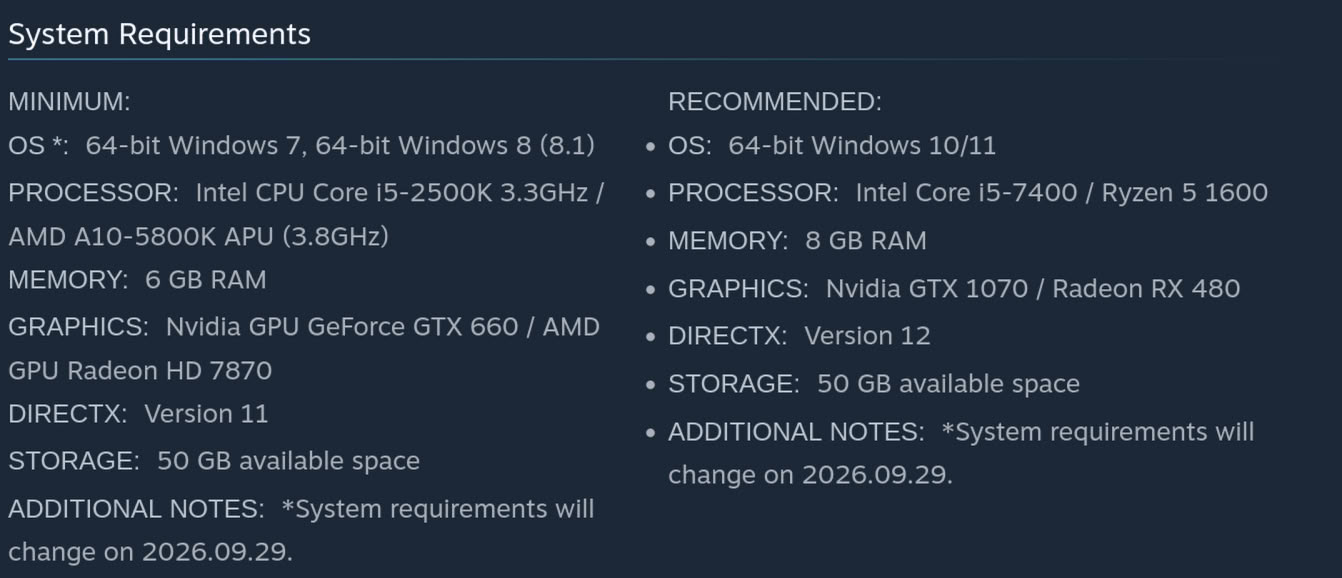
CD Projekt Red announced The Witcher 3: Wild Hunt Remastered at Gamescom 2026, revealing a visual, performance, and gameplay upgrades coming as a free update to The Witcher 3 for existing owners. Owners of The Witcher 3: Wild Hunt Complete Edition will see their game update to the Remaster on September 29, but that upgrade will come with significantly higher demands of their gaming rigs, with the minimum PC system requirements now exceeding the recommended PC system requirements in the CPU department and more or less matching them on the GPU side of things.

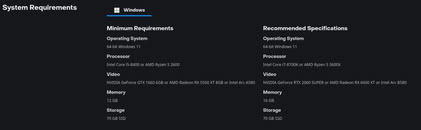
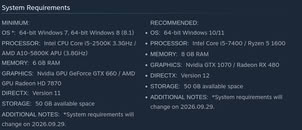
According to the Remaster's Battle.Net store page, where the updated minimum specs were revealed first, The Witcher 3: Wild Hunt Remastered will call for an Intel Core i5-8400 or an AMD Ryzen 5 2600, paired with 12 GB of RAM and 70 GB of SSD storage. Previously, The Witcher 3: Wild Hunt only called for an Intel Core i5-2500K or an AMD A10-5800K.

Death Stranding 2: On the Beach PC Minimum Specifications Revealed Alongside Graphics Enhancements

Death Stranding 2: On the Beach is slated to launch on March 19 for PC after almost nine months as a PS5 exclusive, and Nixxes and Kojima Productions just revealed the minimum PC hardware requirements, as well as the supported upscaling and graphical enhancement options, in a PlayStation Blog post. According to the blog post, the absolute minimum spec, which gets you 30 FPS as 1080p with low settings, requires an AMD Ryzen 3 3100 or Intel Core i3-10100, 16 GB of RAM, and an NVIDIA GeForce GTX 1660 or AMD Radeon RX 5500 XT 8 GB. Medium, or 1080p with medium settings, requires an RTX 3060 12 GB or Radeon RX 6600, and an AMD Ryzen 5 5600 or Intel Core i5-11400. Stepping it up to High (or recommended specs), which gets you 1440p at 60 FPS with high settings, requires an AMD Radeon RX 6800 or NVIDIA GeForce RTX 3070 and an AMD Ryzen 7 5700X or Intel Core i7-11700. Very High, or 4K resolution at 60 FPS with very high settings, calls for an upgrade to an NVIDIA GeForce RTX 4080 or Radeon RX 9070 XT, while the CPU and memory specs remain the same as for the High tier. All spec tiers require 16 GB of memory, Windows 11 or Windows 10 1909 or up, and at least a 150 GB SSD.

Death Stranding 2: On the Beach will also offer PC players support for both 21:9 and 32:9 ultrawide aspect ratios, and players with 16:9 displays can simulate a cinematic experience by opting for a 21:9 aspect ratio with black bars on the top and bottom of the display—this option will also be introduced for PS5 at the same time as the PC release. PC players will also get support for upscaling tech from all three GPU manufacturers: NVIDIA DLSS 4, AMD FSR 4, and Intel XeSS 2, with both frame generation and upscaling options available. These upscaling options can be used in conjunction with Dynamic Resolution Scaling, and players will be able to adjust upscaling quality. The game will also see the debut of Pico—Progressive Image Compositor—on PC. This is the upscaling technology used by Death Stranding 2 on PS5 and developed by Guerrilla Games for the Decima engine, and it can also be used alongside all available frame generation options and on all available graphics card manufacturers. The game will also offer native AA options for those not interested in upscaling.

First AMD Radeon RX 9000 Series GPU Appears in Steam Survey Rankings

Back in December, AMD's current RDNA 4 GPU lineup apparently showed little impact on Steam's Hardware and Software Survey results. However, as we enter 2026, data from December 2025 has been processed, and the first Radeon RX 9000 series GPU has appeared in the survey rankings. At 100+ ranking, the first AMD Radeon RX 9000 series GPU based on the RDNA 4 IP is the Radeon RX 9070 SKU, commanding a 0.22% share of all gamers participating in the survey. This is also the only RDNA 4 GPU present on the list, meaning that all the remaining SKUs are below 0.15% of the total share, hence not shown in this ranking.

For other AMD GPU SKUs, there is a slight change in the overall structure, where the RDNA 3-based Radeon RX 7800 XT is the most popular AMD gamer GPU with a 1.57% share this December. This dethrones the previous RDNA 2-based Radeon RX 6600, which now stands at 1.51% of the overall group. This includes the market share of AMD GPUs on both Windows and Linux-based PCs. Additionally, this is the first time RDNA 4-based GPUs have appeared on the Steam Survey list since the initial launch in March, finally showcasing the share of the latest AMD graphics.

AMD Radeon RX 9000 Series Still Absent from Steam Hardware Survey

As we enter December, Valve has completed processing data and officially released the November Steam Hardware and Software Survey, highlighting trends in the gaming industry. Interestingly, AMD's latest RDNA 4 designs from the Radeon RX 9000 series have yet to make a significant impact on the market, indicating that many Steam survey participants are not using AMD Radeon RX 9000 series GPUs. The top spot in the GPU usage list is held by NVIDIA's GeForce RTX 4060 (notebook), with the first AMD product appearing nine spots later. Valve lists this first AMD Radeon GPU as an unnamed entry, likely representing integrated GPUs or other systems-on-chip products with unconventional configurations compared to standard discrete GPUs.

The first AMD discrete GPU on the list is the older RDNA 2-based Radeon RX 6600, followed by the RDNA 3-based RX 7800 XT. However, nine months after the RDNA 4 series began selling, there are no RDNA 4 GPUs present in the general survey. This could suggest that Steam gamers prefer other options or that the RDNA 4 series isn't selling well. While we don't have a definitive conclusion, the data points to a concerning trend.

AMD Releases Software Adrenalin Edition 25.9.1 WHQL Drivers

AMD officially released its AMD Software Adrenalin 25.9.1 WHQL drivers, adding new game support and enabling wider FidelityFX Super Resolution (FSR) 4 support. The list of new games includes Borderlands 4 and Hell Is Us, which are now supported on all compatible Radeon GPUs. Perhaps even the biggest feature add-on is the support for FSR 4, which can be enabled for most games that support FSR 3.1 with DirectX 12. This is a significant addition, as AMD gamers previously relied on custom, third-party community tools such as AMD GPU Profile Manager and OptiScaler. Additionally, AMD has fixed a wide range of issues, including those affecting older generation GPUs like the Radeon RX 6600 series, which now don't experience corruption while playing Mafia: The Old Country. The issue of SteamVR not detecting PlayStation controllers has also been fixed. You can see a complete changelog below.

DOWNLOAD: AMD Software Adrenalin 25.9.1 WHQL.

AMD Falling Behind: Radeon dGPUs Absent from Steam's Top 20

As we entered November, Valve just finished processing data for October in its monthly update of Steam Hardware and Software Survey, showcasing trend changes in the largest gaming community. And according to October data, AMD's discrete GPUs are not exactly in the best place. In the top 20 most commonly used GPUs, not a single discrete SKU was based on AMD. All of them included NVIDIA as their primary GPU choice. However, there is some change to AMD's entries, as the Radeon RX 580, which used to be the most popular AMD GPU, just got bested by the Radeon RX 6600 as the most common choice for AMD gamers. The AMD Radeon RX 6600 now holds 0.98% of the GPU market.

NVIDIA's situation paints a different picture, as the top 20 spots are all occupied by NVIDIA-powered gamers. The GeForce RTX 3060 remains the most popular GPU at 7.46% of the GPU market, but the number two spot is now held by the GeForce RTX 4060 Laptop GPU at 5.61%. This is an interesting change since this NVIDIA GPU was in third place, right behind the regular GeForce RTX 4060 for desktops. However, laptop gamers are in abundance, and they are showing their strength, placing the desktop GeForce RTX 4060 in third place, recording 5.25% usage.

Lenovo Embraces the AI PC Era with New ThinkCentre Desktops Powered by AMD Ryzen PRO 8000 Series Desktop Processors

Lenovo has unveiled a selection of ThinkCentre desktops powered by AMD Ryzen PRO 8000 Series desktop processors with up to 16 TOPS (trillion operations per second) of integrated NPU capability dedicated to process AI workloads, including the performance focused ThinkCentre M75t Gen 5, the flexible ThinkCentre M75s Gen 5, and the compact ThinkCentre M75q Gen 5. Designed to meet the diverse needs of modern business, the ThinkCentre M75 Gen 5 family of desktops harnesses the AI capability of its component while optimizing its energy efficiency to deliver impressive results.

"The AI PC era is already here and at Lenovo we are embracing it to unlock new possibilities," said Sanjeev Menon, vice president and general manager, Worldwide Desktop Business in Intelligent Devices Group, Lenovo. "The need for businesses to integrate AI into their operations continues to grow and our ThinkCentre M75 family of desktops, with a strong and stable power supply, the ability to upgrade components when needed, and the space to expand memory and optimize thermal management are the ideal options to enhance productivity with AI without heavy investments. Lenovo and AMD have a long-standing partnership focused on delivering value to our customers and we know users will be delighted by the leap in performance of our new desktops."

AMD Radeon RX 7600 Final Specs and Power Figures Leaked, Uses 6 nm

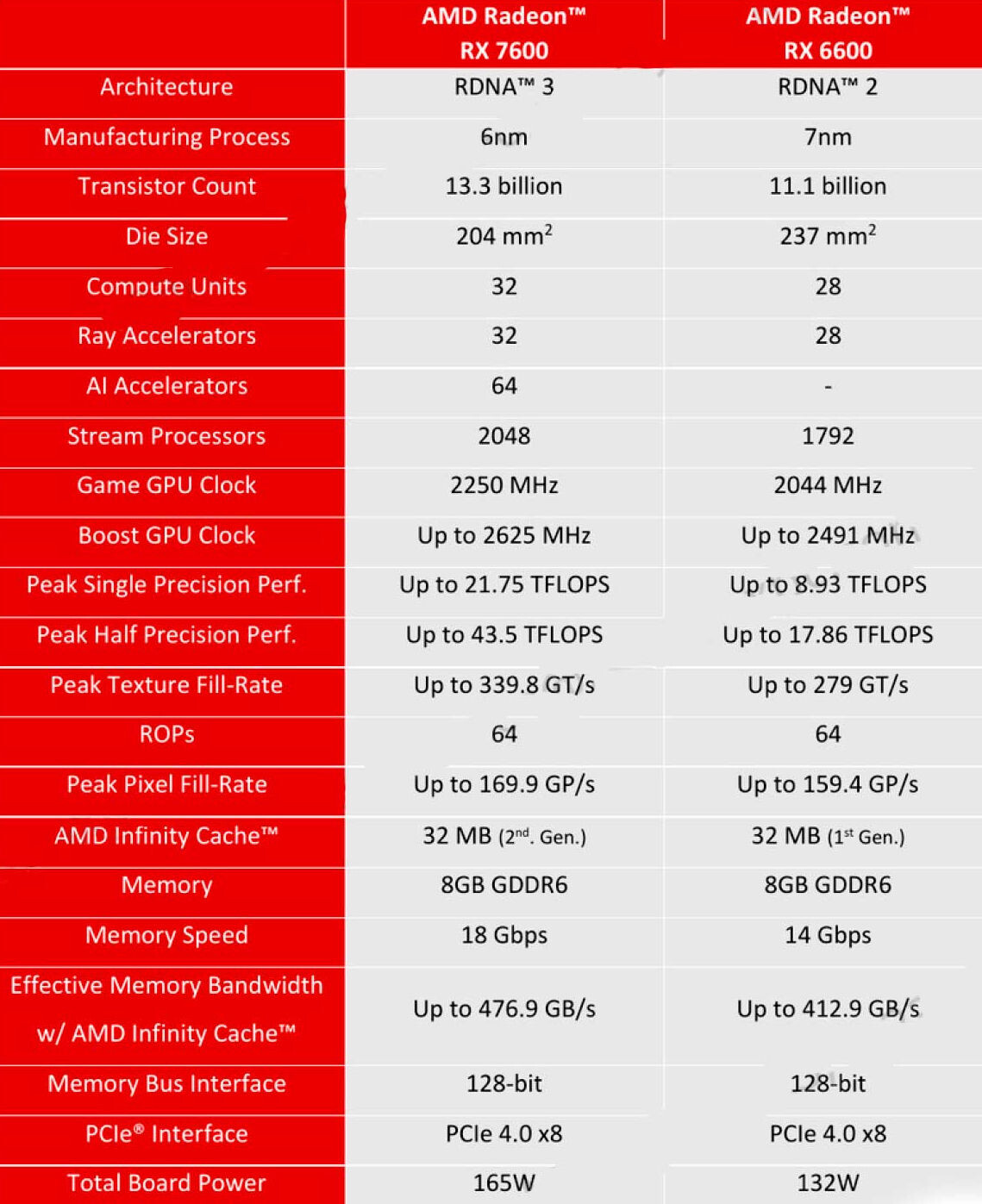
Here are the final specifications of the Radeon RX 7600 RDNA3 graphics card, bound for launch later this month. The specs list springs up some surprises. To begin with, while the GPU at the heart of the RX 7600 is based on the latest RDNA3 graphics architecture, it is built on the older 6 nm (DUV) silicon fabrication process—the same one on which the previous "Navi 24" was based. The silicon has a transistor count of 13.3 billion, about 2 billion more than the 7 nm "Navi 23" Powering the RX 6600 series, but a die-size of 204 mm². The GPU has a PCI-Express 4.0 x8 host interface, and a 128-bit GDDR6 memory interface. As the RX 7600, it has a TBP (total board power) value of 165 W, which is over 30 W more than the RX 6600.

At this point, it's not known whether the RX 7600 maxes out the silicon it is based on. It gets 32 RDNA3 compute units (CU), which work out to 2,048 stream processors (with the same dual-issue instruction rate feature as the RX 7900 series); 32 Ray Accelerators, and 64 AI Accelerators. The GPU has 128 TMUs, and 64 ROPs. The GPU has 32 MB of second-generation Infinity Cache memory. The 8 GB of GDDR6 memory ticks at 18 Gbps, which over the 128-bit memory bus works out to 288 GB/s of memory bandwidth. AMD claims that when coupled with the on-die cache, the "effective bandwidth" is 476.9 GB/s. NVIDIA is putting out similar "effective" figures for its RTX 4060 series, so this could become a norm. The RX 7600 comes with a game frequency of 2250 MHz, and 2625 MHz boost. AMD is making 550 W as its PSU recommendation, compared to the 450 W it did for the RX 6600. The company considers the RX 7600 to be the logical successor of the RX 6600 (and neither the RX 6600 XT nor the RX 6650 XT).

Possible AMD Radeon RX 7600 Specs Leaked

Possible specifications of the upcoming AMD Radeon RX 7600 graphics card leaked to the web. At this point we don't know if the RX 7600 maxes out the silicon it is based on (with room for a faster RX 7600 XT). The leak appears to be from marketing materials of the RX 7600. It speaks of 32 Compute Units. This works out to the same 2,048 stream processors as the previous-generation RX 6600 XT, but an increase from the 1,792 of the RX 6600. The mention of AI accelerators confirms that this GPU is based on the latest RDNA3 graphics architecture.

The other RDNA3 feature referenced is the Radiance Display Engine, which supports the latest DisplayPort 2.1 and HDMI 2.1a outputs, along with 12 bpc color, and support for resolutions as high as 4K 180 Hz with a single cable. Apparently, the GPU that the RX 7600 is based on has 32 MB of Infinity Cache memory, which is the same amount as the previous-generation "Navi 23" silicon powering the RX 6600 series. For the flagship "Navi 31," the Infinity Cache memory size is generationally reduced to 96 MB (from 128 MB on "Navi 21,") because the memory bus width has generationally increased to 384-bit (from 256-bit). This could mean that the RX 7600 has a 128-bit wide memory bus, given that its Infinity Cache size is unchanged from that of the RX 6600 series.

AMD Brings ROCm to Consumer GPUs on Windows OS

AMD has published an exciting development for its Radeon Open Compute Ecosystem (ROCm) users today. Now, ROCm is coming to the Windows operating system, and the company has extended ROCm support for consumer graphics cards instead of only supporting professional-grade GPUs. This development milestone is essential for making AMD's GPU family more competent with NVIDIA and its CUDA-accelerated GPUs. For those unaware, AMD ROCm is a software stack designed for GPU programming. Similarly to NVIDIA's CUDA, ROCm is designed for AMD GPUs and was historically limited to Linux-based OSes and GFX9, CDNA, and professional-grade RDNA GPUs.

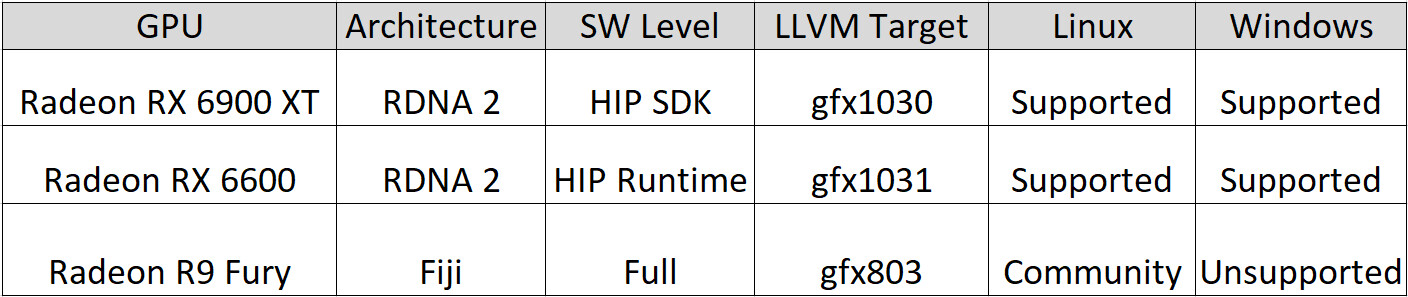
However, according to documents obtained by Tom's Hardware (which are behind a login wall), AMD has brought support for ROCm to Radeon RX 6900 XT, Radeon RX 6600, and R9 Fury GPU. What is interesting is not the inclusion of RX 6900 XT and RX 6600 but the support for R9 Fury, an eight-year-old graphics card. Also, what is interesting is that out of these three GPUs, only R9 Fury has full ROCm support, the RX 6900 XT has HIP SDK support, and RX 6600 has only HIP runtime support. And to make matters even more complicated, the consumer-grade R9 Fury GPU has full ROCm support only on Linux and not Windows. The reason for this strange selection of support has yet to be discovered. However, it is a step in the right direction, as AMD has yet to enable more functionality on Windows and more consumer GPUs to compete with NVIDIA.

AMD Bundles "The Last of Us Part 1" with Radeon RX 6000 and RX 7000 Graphics Cards

AMD updated its game bundle campaign for Radeon graphics cards to include "The Last of Us Part 1." The new bundle went live as the previous one for "The Callisto Protocol" and "Dead Island 2" ended on February 4. The new bundle includes the latest RX 7000 series graphics cards in its list of eligible products. Starting February 5, new purchases of AMD Radeon graphics cards or prebuilt gaming desktops with them, in select markets and through participating retailers, will be eligible to a free copy of "The Last of Us Part 1." Eligible graphics cards include Radeon RX 7900 XTX, RX 7900 XT, RX 6950 XT, RX 6900 XT, RX 6800 XT, RX 6800, RX 6750 XT, RX 6700 XT, RX 6700, RX 6650 XT, RX 6600 XT, RX 6600, RX 6500 XT, and RX 6400, so the full stack of desktop AMD Radeon RX 6000 series and RX 7000 series products, are eligible.

AMD Radeon RX 6600M on Desktop PCBs Being Sold for $180-ish

With next-generation GPUs around the corner, the market seems to be flooded with ASICs for any board partner willing to buy them and use as they see fit—including building desktop graphics cards with mobile GPUs. Several Chinese board partners are found selling desktop graphics cards based on the mobile Radeon RX 6600M at prices ranging between the equivalent of USD $180 to $214.

The RX 6600M has essentially the same specs as the desktop RX 6600 (non-XT), with 1,792 stream processors across 28 RDNA2 compute units, 8 GB of 14 Gbps GDDR6 memory across a 128-bit wide memory bus, and similar clock-speeds of 2177 MHz (compared to 2044 MHz of the desktop RX 6600). In fact the RX 6600M has much better typical board power specs of 100 W, compared to 132 W of the desktop RX 6600. The best part of this deal has to be the price. An RX 6600 (non-XT) starts around the $250-mark in the US market. So even with shipping costs added, the $180 RX 6600M comes across as a slightly better deal.

Soonfoals the Latest AMD Radeon Add-in Board Partner

The ecosystem of AMD AIBs (add-in board partners) increased this month, when Chinese consumer electronics company Weijian International launched the Soonfoals brand of AMD Radeon graphics cards. The name purportedly indicates fast-moving foals (young horses). From the looks of it, Soonfoals will focus on entry-mainstream SKUs, with its current lineup including cards based on the Radeon RX 6650 XT, RX 6600, RX 6500 XT, and RX 6400. Products include a single-slot, low-profile card based on the RX 6400, and dual-slot, dual-fan cards based on the other GPUs, including a premium-looking brand extension called "Lightning," denoting factory-overclocked RX 6650 XT and RX 6600 cards. From the looks of it, Soonfoals will look to grow locally in the Chinese market first.

GALAX Intros GeForce RTX 2060 12GB 1-Click OC Graphics Card

GALAX today joined other NVIDIA board partners in launching its custom-design GeForce RTX 2060 12 GB graphics card. NVIDIA re-launched the RTX 2060, based on the "Turing" graphics architecture, with double the memory amount and a few more CUDA cores—2,176 vs. 1,920 on the original. This is NVIDIA's response to the Radeon RX 6600. The custom-design board by GALAX, which will also be sold under the KFA2 brand in certain markets, features an aluminium fin-stack heatsink with direct-touch heat-pipes, and a pair of 90 mm fans that stay off when the card is idling. It pulls power from a single 8-pin PCIe power connector. The card is factory-overclocked with 1695 MHz GPU Boost, compared to 1650 MHz NVIDIA reference, but a software-based 1-click OC mode can bump up the boost clock to 1710 MHz. The memory ticks at 14 Gbps (GDDR6-effective). The company didn't reveal pricing.

AMD 4800S Desktop Kit Launching 2022 Supporting Radeon RX 6600

The AMD 4800S desktop kit appears to be a successor to the 4700S which featured a repurposed Ariel SoC from the PlayStation 5 with the integrated RDNA2 graphics disabled. The 4700S Mini-ITX kit featured a single PCIe x4 Gen 2.0 slot which limited compatibility to lower-end graphics cards and restricted the availability of high-speed storage or connectivity. The upcoming 4800S Micro-ATX kit appears to remedy these issues by upgrading to a different Zen 2 chip possibly the one used by Microsoft in the Xbox Series X/S consoles with a PCIe Gen 4.0 link. The desktop system will support AM4 coolers and includes an M.2 slot for SSD storage or WiFi connectivity. AMD is planning to release the 4800S desktop kit in Q1 2022 with the board being manufactured by MSI and bundled with a TUL (PowerColor) Radeon RX 6600 graphics card.

Micron Delivers High-Performance GDDR6 Memory for AMD Radeon RX 6000 Series Graphics Cards

Micron, today announced that its high-performance 16Gb / 16 Gbps GDDR6 memory solution is now available with AMD Radeon RX 6000 Series graphics cards built on the AMD RDNA 2 gaming architecture. Using Micron's advanced 1z process technology, this latest version of GDDR6 enables up to 512 GB/s system performance for demanding applications like gaming and graphics. Today's announcement continues Micron's rich history of innovation and collaboration with industry leaders to deliver breakthrough performance that enables the most advanced gaming solutions.

As graphics and gaming applications become more demanding, so do the requirements for high bandwidth memory and system performance. Modern gamers expect high-resolution, immersive experiences, and GDDR6 delivers with its support of fast frame rates. The result is excellent performance and speed that minimize lag time and provide gamers with lifelike effects.

ASRock Announces Radeon RX 6600 Challenger Series Graphics Cards

ASRock, the leading global motherboard, graphics card and mini PC manufacturer, today launched new Challenger series products based on AMD Radeon RX 6600 GPUs. Built on the 7 nm manufacturing process, the new ASRock graphics cards offer support for the DirectX 12 Ultimate API, hardware-accelerated ray tracing, HDMI 2.1, PCI Express 4.0, and the Microsoft Windows 11 operating system. With a wealth of exclusive features, the new graphics cards are designed to provide visually stunning, high-refresh rate 1080p gaming experiences to the midrange market.

The new graphics cards are built on the breakthrough AMD RDNA 2 gaming architecture, designed to deliver the optimal balance of performance and power efficiency. Offering 32 MB of high-performance AMD Infinity Cache, 8 GB of GDDR6 memory, AMD Smart Access Memory and other advanced features, the new graphics cards are designed to bring next-generation desktop gaming experiences to the midrange market. They also support the AMD FidelityFX Super Resolution open-source spatial upscaling solution, which is designed to increase framerates while delivering high-resolution gaming experiences.

Gigabyte Launches AMD Radeon RX 6600 Eagle 8G Graphics Card

Gigabyte Technology Co. Ltd, a leading manufacturer of premium gaming hardware, today announced a new AMD Radeon RX 6600 graphics card - the Gigabyte Radeon RX 6600 Eagle 8G. The Eagle graphics card is the best choice for those who desire a unique design optimized for power efficiency and durability, and the ability to experience incredible high-framerate 1080p gaming.

AMD Radeon RX 6600 graphics cards are based on the breakthrough AMD RDNA 2 gaming architecture, designed to deliver the optimal balance of performance and power efficiency. Offering 32 MB of high-performance AMD Infinity Cache, 8 GB of GDDR6 memory, AMD Smart Access Memory technology and other advanced features, the new graphics cards are designed to bring next-generation desktop gaming experiences to the midrange market. They also support AMD FidelityFX Super Resolution, an open-source spatial upscaling solution designed to increase framerates in select titles while delivering high-resolution gaming experiences.

PowerColor Unveils Radeon RX 6600 Series Graphics Cards

TUL Corporation, a leading and innovative manufacturer of AMD graphic cards since 1997, today announced the launch of the PowerColor Radeon RX 6600 HELLHOUND and FIGHTER graphics cards. The latest AMD Radeon RX 6600 series graphics cards are designed to deliver butter smooth high-fidelity, high-refresh rate 1080p gaming experiences.

AMD Radeon RX 6600 graphics cards are based on the breakthrough AMD RDNA 2 gaming architecture, designed to deliver optimal balance of performance and power efficiency. Offering 32 MB of high-performance AMD Infinity Cache, 8 GB of GDDR6 memory, AMD Smart Access Memory 1 and other advanced features, the new graphics cards are designed to bring next-generation desktop gaming experiences to the midrange market. They also support the AMD FidelityFX Super Resolution open-source spatial upscaling solution, which is designed to increase framerates while delivering high-resolution gaming experiences.

MSI Unveils Radeon RX 6600 MECH 2X Graphics Card

As a leading brand in True Gaming hardware, MSI is proud to announce the MSI Radeon RX 6600 MECH 2X graphics card, designed to deliver incredible 1080p gaming experiences for a wide range of enthusiast gamers. The new graphics cards are built on the breakthrough AMD RDNA 2 gaming architecture, designed to deliver the optimal balance of performance and power efficiency. Offering 32 MB of high-performance AMD Infinity Cache, 8 GB of GDDR6 memory, AMD Smart Access Memory 1 and other advanced features, the new graphics cards are designed to bring next-generation desktop gaming experiences to the midrange market. They also support the AMD FidelityFX Super Resolution open-source spatial upscaling solution, which is designed to increase framerates while delivering high-resolution gaming experiences.

AMD Announces Radeon RX 6600 Graphics Card

AMD today launched the AMD Radeon RX 6600 graphics card, designed to provide visually stunning, high-refresh rate 1080p gaming experiences to the midrange market. The AMD Radeon RX 6600 graphics card leverages breakthrough AMD RDNA 2 architecture, the only gaming architecture that spans from desktop PCs, laptops and consoles to mobile devices and automotive infotainment systems. Offering 32 MB of high-performance AMD Infinity Cache, 8 GB of GDDR6 memory, AMD Smart Access Memory technology and support for the Microsoft Windows 11 operating system, the AMD Radeon RX 6600 graphics card is designed to bring next-generation desktop-level experiences to PC gamers. It also supports the AMD FidelityFX Super Resolution open-source spatial upscaling solution, which is designed to increase framerates in select titles while delivering high-resolution gaming experiences.

The AMD Radeon RX 6600 graphics card is designed with the needs of future-ready, high-performance 1080p gamers in mind. Capable of driving 100+ FPS in top AAA titles, the AMD Radeon RX 6600 graphics card also offers up to 1.3X better performance-per-watt than the competition in select titles in 1080p at max settings.

AMD Radeon RX 6600 Graphics Cards from XFX, ASRock, & PowerColor Pictured

AMD is expected to announce their Radeon RX 6600 graphics card on October 13th according to leaked documents. The graphics card will feature a cut-down Navi 23 GPU with 28 Compute Units and 1,792 stream processors compared to 32 and 2,048 on the RX 6600 XT. The card has also been revealed to feature 8 GB of GDDR6 memory running at 14 Gbps on a 128-bit memory bus. The first images of cards from board partners including XFX, ASRock, and PowerColor have been published by VideoCardz covering 5 different RX 6600 models.

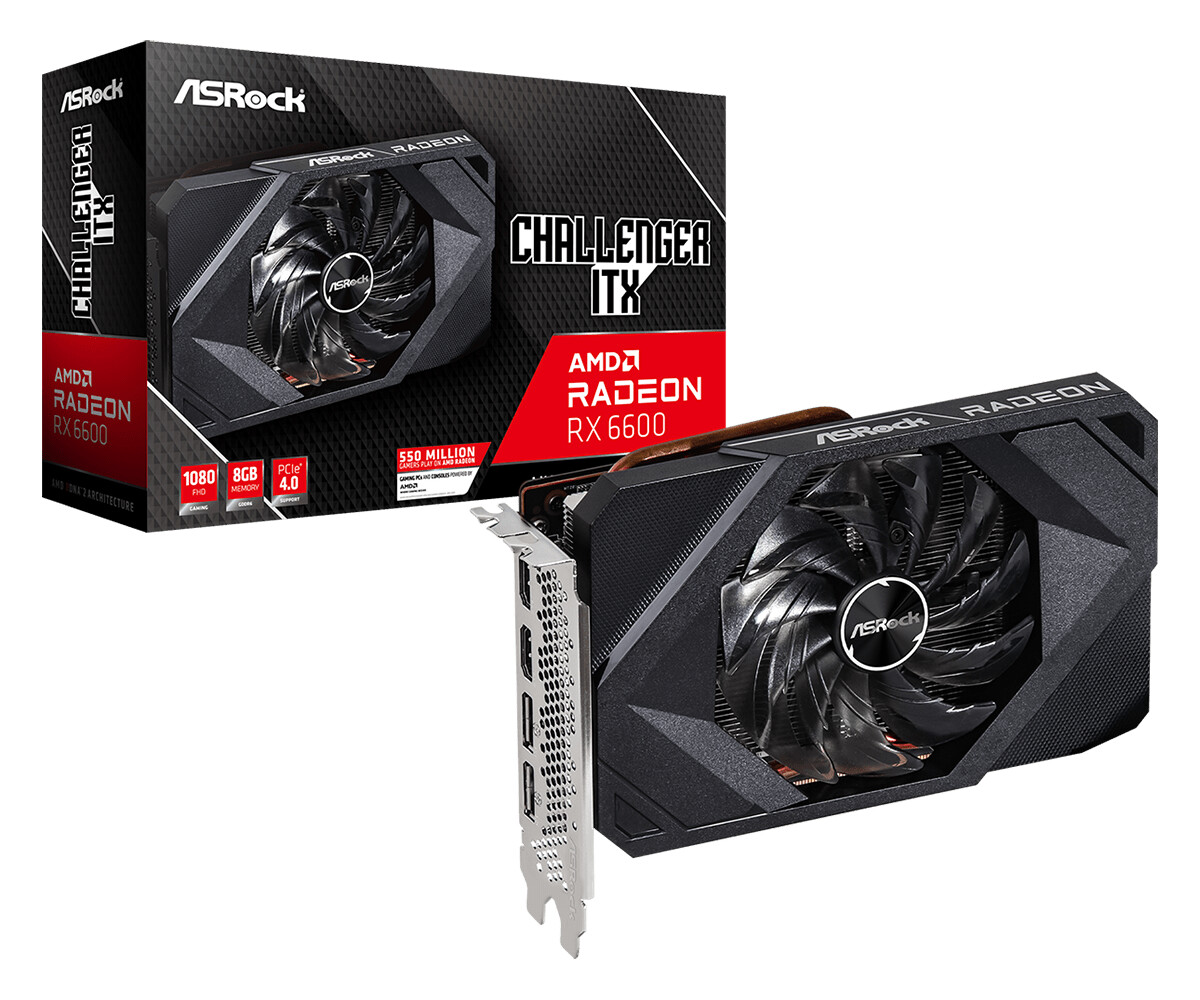
The XFX Speedster SWFT 210 features a unique shorter PCB design with a relocated 8-pin power connector in addition to a redesigned backplate which differs from the RX 6600 XT model. PowerColor appears to be releasing Hellhound and Fighter models with identical designs as their RX 6600 XT counterparts featuring 2-slot cooling and single 8-pin power connectors. ASRock is preparing two Challenger series models both sharing the same PCB with the single-fan Challenger ITX and dual-fan Challenger D. These new cards will reportedly match the NVIDIA GeForce RTX 3060 according to a leaked internal benchmark.

AMD Radeon RX 6600 Memory Clocks and Other Specs Revealed

Ahead of its launch, memory clock speeds of the upcoming AMD Radeon RX 6600 graphics card was leaked to the web by someone with access to a sample. GPU-Z detected the memory clocks on this card to be 14 Gbps, which is slower than the 16 Gbps clocks on the RX 6600 XT. This gives the RX 6600 about 12.5% lower memory bandwidth than its sibling (224 GB/s vs. 256 GB/s). Among the other specs detected by GPU-Z are 28 compute units, amounting to 1,792 stream processors (vs. 32 CUs and 2,048 of the RX 6600 XT); the same 8 GB memory amount and 128-bit memory bus width, and almost 2.50 GHz engine boost frequency. VideoCardz claims that in official benchmarks by AMD, the RX 6600 is shown trading blows with the GeForce RTX 3060.

Dutch and Portuguese Shops Leak AMD Radeon RX 6600 Pricing

Got €600 to spare? Great, as that means that you can afford an AMD Radeon 6600 graphics card when they launch sometime next month. Courtesy of both a Dutch and a Portuguese computer shop, we now have an idea of what the cards will cost ahead of the retail launch which is said to be on the 13th of October.

The Portuguese shop also kindly posted pictures of the Sapphire Pulse Radeon RX 6600, which comes as expected with 8 GB of GDDR6 memory, which it lists for €589.90. The Dutch shop was less forthcoming with their MSI Radeon RX 6600 MECH 2X 8 GB, but to be honest, it might not matter what these cards look like at these kinds of price points. The MSI card is listed at €600,41, so make sure you bring some coins as well.

AMD Radeon RX 6600 Reviews Set to Release October 13th

The AMD Radeon RX 6600 is expected to launch in October after documents received by VideoCardz reveal that reviews for the card are set to be published on October 13th. The documents reveal that board partners who will be releasing cards for review will need to have informed AMD by September 15th and can begin shipping them to reviewers on September 29th. The AMD Radeon RX 6600 will use the Navi 23 GPU with 4 Compute Units disabled for a total of 28. This will give the card 1792 Stream Processors which will be paired with 8 GB of GDDR6 memory. The documents also show that AMD is not planning to release an RX 6600 reference card so no pricing information was included. We expect that the card will be shortly available after the listed review embargo is lifted on October 13th at 9 AM EST.
Return to Keyword Browsing
Nov 12th, 2026 00:07 CST change timezone

New Forum Posts

Popular Reviews

TPU on YouTube

Controversial News Posts