News Posts matching #Xbox Series X

Return to Keyword Browsing

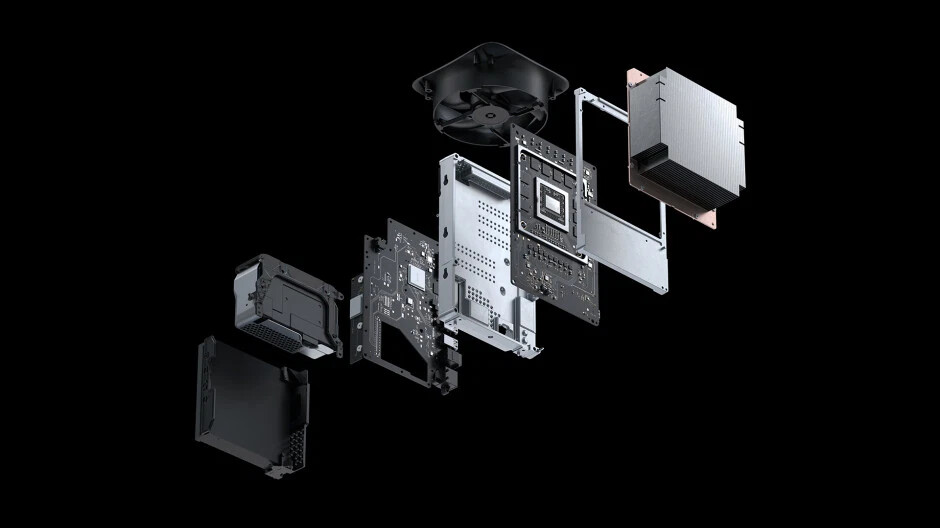
Complete Hardware Specs Sheet of Xbox Series X Revealed

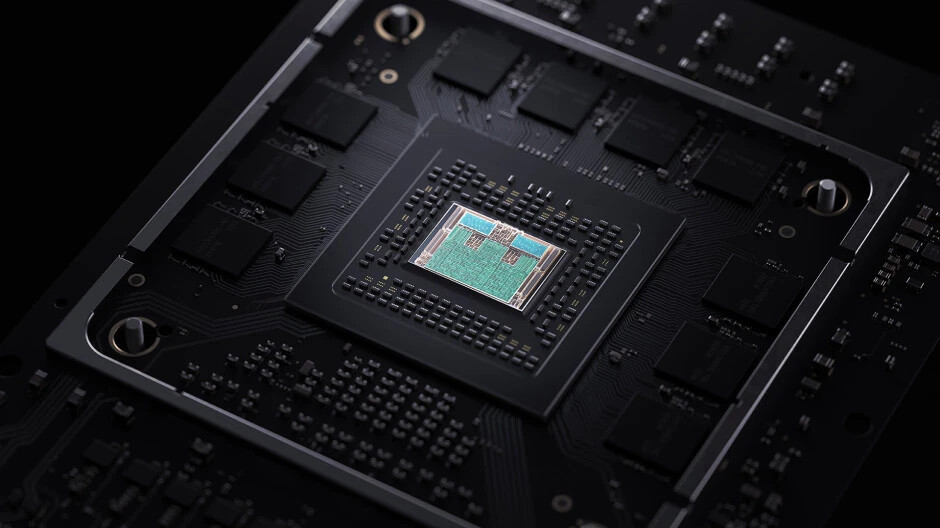
Microsoft just put out of the complete hardware specs-sheet of its next-generation Xbox Series X entertainment system. The list of hardware can go toe to toe with any modern gaming desktop, and even at its production scale, we're not sure if Microsoft can break-even at around $500, possibly counting on game and DLC sales to recover some of the costs and turn a profit. To begin with the semi-custom SoC at the heart of the beast, Microsoft partnered with AMD to deploy its current-generation "Zen 2" x86-64 CPU cores. Microsoft confirmed that the SoC will be built on the 7 nm "enhanced" process (very likely TSMC N7P). Its die-size is 360.45 mm².

The chip packs 8 "Zen 2" cores, with SMT enabling 16 logical processors, a humongous step up from the 8-core "Jaguar enhanced" CPU driving the Xbox One X. CPU clock speeds are somewhat vague. It points to 3.80 GHz nominal and 3.66 GHz with SMT enabled. Perhaps the console can toggle SMT somehow (possibly depending on whether a game requests it). There's no word on the CPU's cache sizes.



Xbox Series X Semi-custom SoC Features 320-bit Memory Interface, 10 GB or 20 GB Memory

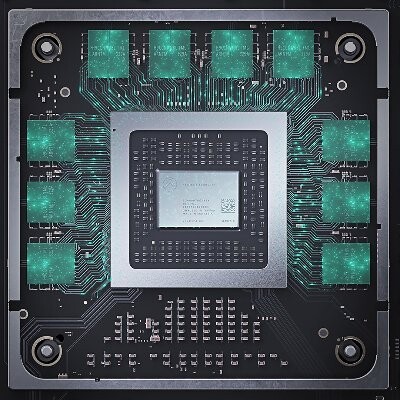
Microsoft's upcoming Xbox Series X entertainment system is shaping up to be a technological monstrosity. Xbox group head at Microsoft, Phil Spencer, last revealed a picture of its semi-custom SoC back in January, by setting it as his Twitter display picture. Over the following weeks, many more technical details, such as the chip's 12 TFLOP/s combined compute power, would be let out. Spencer updated his display picture revealing a segment of the Xbox Series X mainboard with the SoC and memory chips surrounding it. The picture reveals the large SoC package in the center, surrounded on three sides by ten memory chips, possibly GDDR6, each with its own wiring to the SoC. This indicates that the SoC features a 320-bit wide memory interface.

As for the memory density, there's no way to tell. It could be 10 GB if those are 8 Gbit memory chips, or 20 GB if those are 16 Gbit. It boils down to which device the Xbox Series X the company wants to succeed. The Xbox One S features 8 GB of DDR3, while the spruced up Xbox One X features 12 GB of GDDR5. If the new Xbox Series X succeeds the latter, then it could very well feature 20 GB, more so given Microsoft's lofty design goals (4K UHD gaming with real-time ray-tracing). Microsoft leverages hUMA to use a common memory pool for both the CPU and GPU. Designed in collaboration with AMD on a TSMC 7 nm-class node (likely the N7P), the SoC features "Zen 2" CPU cores, and a GPU based on the RDNA2 graphics architecture.
Xbox Series X memory

Microsoft Confirms Xbox Series X Specs - 12 TFLOPs, Custom APU With Zen 2, RDNA 2, H/W Accelerated Raytracing

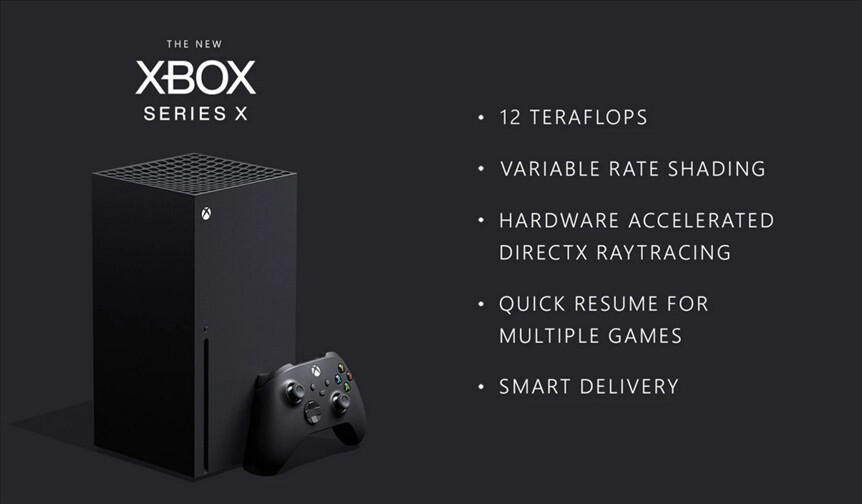
Microsoft has confirmed the official specs for the Xbox Series X games console, due Holiday 2020 (think November). The new specs announcement confirms the powerhouse of a console this will be, with its peak 12 TFLOPs compute being 8 times that of the original Xbox One, and twice that of the Xbox One X, which already quite capable of powering true 4K experiences. This 12 TFLOPs figure is a mighty impressive one - just consider that AMD's current highest-performance graphics card, Radeon VII, features a peak 13.4 TFLOPs of computing power - and that's a graphics card that was launched just a year ago.

The confirmation also mentions support for Hardware-Accelerated raytracing, something that all but confirms the feature being built into AMD's RDNA 2 microarchitecture (of which we are expecting news anytime now). this, alongside Variable Rate Shading (VRS) support, brings AMD to feature parity with NVIDIA's Turing, and should allow developers to optimize their performance and graphical targets without any discernible quality loss.

People Can Fly, Square Enix Release Gameplay Trailer for Next-Gen Videogame Outriders

People Can Fly and Square Enix today released a gameplay trailer for their upcoming, next-gen game Outriders. The game, which will be available in current-gen systems as well as Xbox Series X, PS5 and PC, is a 1-3 player, drop-in drop-out co-op RPG shooter which promises to be set in a futuristic, dark sci-fi universe. The premise is as such: humanity as we know it abandoned Earth in search of a new home, which they thought they had found in the form of Enoch. A worldwide, storm-like event dubbed The Anomaly (which may have been produced by more than weather phenomena, I wager) forced humanity back into cryo-suspension whilst they waited for the proverbial storm to pass. The eventually reawakened ones find burning powers within themselves that will force them to confront their humanity, evolve - and eventually, to become something different.

People Can Fly describe the game as "Players will create their own Outrider and embark on a journey across a hostile planet. With rich storytelling spanning a diverse world, they will leave behind the slums and shanty towns of the First City and traverse forests, mountains and deserts in pursuit of a mysterious signal." You can expect an arsenal of weapons and supernatural powers, though the exact nature of the game's world and systems (open-world, quasi-open world, or some such) still haven't been clarified. Expect the game to drop come holiday 2020, right alongside the next-generation console launch. A reveal stream will be available via Twitch in about two days - there's a countdown timer in the official Outriders page.

Microsoft Confirms E3 2020 Presence, Xbox Series X Details; Sony Makes a Pass on the Expo

The Electronic Entertainment Expo (hence, E3) was, for years, one of those unmissable tech events with an unmistakable gravitas. All companies that actually meant something took attendance to woo the globe with the latest games, entertainment systems, and advances in technology. It still retains most of that glamour, even if some of its sheen is slightly rubbed off already. However, we can expect E3 2020 to the stage for a number of reveals from companies, and one of those companies is Microsoft. Phil Spencer has already confirmed that Microsoft will have a strong presence at E3, and with that being the case, you can expect new games, more information on already announced games (more Halo Infinite, please), and additional information pertaining the company's Xbox Series X games console.

But while some are still betting on E3, others have started to go their own way by organizing their own events. Sony has announced that they will be skipping E3 2020 in favor of hundreds of smaller, yet more globally seeded events, citing that the Entertainment Software Association's (ESA) vision for their 2020 show doesn't exactly align with what Sony is aiming at with its products. Still, you know 2020 will be a packed year for gaming, both in the console and PC spaces.

Xbox Head Posts "Project Scarlett" (Xbox Series X) SoC Picture, Has that 7nm Tinge

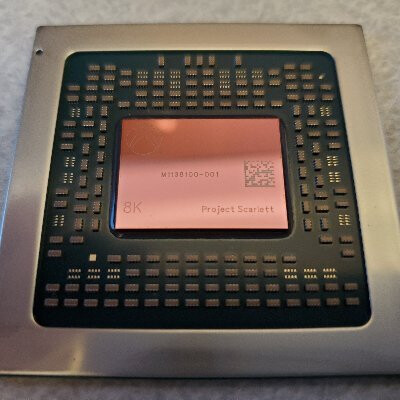
Phil Spencer, head of the Xbox division at Microsoft, posted a picture of the semi-custom SoC at the heart of the company's upcoming "Project Scarlett" Xbox Series X game console as his Twitter avatar. The picture reveals a chip that looks visibly similar to that of "Project Scorpio" (Xbox One X). The picture was also taken from an angle that reveals the pinkish/auburn tinge of 7 nm AMD chips made at TSMC. You'll find the same tinge on chips such as "Navi 10" when viewed from an angle. The die unabashedly bears the "Project Scarlett" and "8K" markings.

Next-generation game consoles are marketing 4K 60 Hz and 8K gaming capability. They likely use a combination of dynamic resolution-scale and variable rate shading to achieve this. The "Project Scarlett" SoC is a semi-custom chip co-designed by Microsoft and AMD, and uses CPU cores based on the company's "Zen 2" microarchitecture, combined with a powerful GPU based on RDNA2, which features hardware-accelerated ray-tracing and variable-rate shading. Hardware enthusiasts on Twitter are abuzz with estimating the die-size of the SoC, with calculations pinning it around the 350 mm² mark ±10 mm², or roughly similar to that of "Project Scorpio," but one must factor in the switch to 7 nm from 16 nm significantly increasing transistor-density.
Return to Keyword Browsing
Nov 11th, 2026 04:16 CST change timezone

New Forum Posts

Popular Reviews

TPU on YouTube

Controversial News Posts