News Posts matching #ssd

Return to Keyword Browsing

Century Intros New USB 3.0 SATA Drive Cloning Dock

Century Tech of Japan introduced a new SATA HDD/SSD cloning dock with a snap-on design (model: CRAS2U3CP). The dock allows you to quickly clone a SATA HDD/SSD without needing a host machine, as well as connect any two SATA drives to a host machine over USB 3.0 interface, as USB Mass Storage devices, with transfer rates of up to 200 MB/s. The top of the unit has a row of LEDs that displays the progress of disk cloning. When not connected to a host over USB, the device requires power drawn from an AC adapter. Measuring 70 x 16 x 65 mm (WxDxH), it weighs about 55 g, and can be carried around in a small pouch. Slated for next week, the CRAS2U3CP from Century is priced at 4,980 JPY (US $61).

Intel Makes SSD 910 PCI-Express Family Official

Intel today finally announced its SSD 910 "Ramsdale" PCI-Express SSD family. This is Intel's first SSD in the PCI-Express add-on card form-factor. Like its 2.5" SSD 710 series, the SSD 910 utilizes HET-MLC NAND flash chips, arranged in four SSD subuits. SSD 910 design consists of three stacked PCBs, the one with the PCI-Express 2.0 x8 bus interface holds a PCI-Express to SAS bridge (essentially a RAID controller), and four SAS/NAND ASICs (SSD controllers). Each controller is wired out to its NAND flash memory chips, which are arranged in the other PCBs.

The PCIe-SAS bridge is made by LSI. The SSD 910 series comes in two variants based on capacity: 400 GB and 800 GB. The 400 GB variant has just two SSD subunits, and hence provides transfer rates (according to an older article) of 1 GB/s reads and 750 MB/s writes, with 90,000 IOPS reads, with 38,000 IOPS writes; while the 800 GB variant, with its four subunits, provides 2 GB/s reads with 1 GB/s writes, and 180,000 IOPS reads, with 75,000 IOPS writes. The launch price of the SSD 910 400 GB variant is US $1,929; while the 800 GB variant is priced at US $3859, at launch.

Indilinx Everest Essentially Marvell Silicon with Custom Firmware: OCZ

For those who thought with the Indilinx buyout and release of Everest and Kilimanjaro series NAND flash controllers, OCZ is on course of becoming a largely self-sufficient SSD industry player, here's a revelation. Its new Everest series silicon, used in recently-launched SSD families (such as Octane and Vertex 4), is essentially a re-badged Marvell controller (found on SSDs such as Crucial M4, Intel SSD 510), with custom firmware developed by OCZ. This discovery by Anandtech was confirmed by OCZ (Indilinx).

The Indilinx Everest (Octane and Petrol series) and Everest 2 (Vertex 4 series), are both re-badged Marvell chips with Indilinx firmware. Although it doesn't change anything, it perfectly explains how OCZ could come up with two "new" SSD controllers (Everest and Everest 2) almost instantly, after the Indilix acquisition. Everest 1 is essentially a higher-clocked Marvell 88SS9174, while Everest 2 could very well be a re-badged Marvell 88SS9187, according to the source.

Crucial Releases "000F" Firmware Update for M4 SSD, Enhances Power-Loss Protection

Crucial is known for issuing firmware updates for its M4 series SSDs that bring significant improvements, be it the 0009 update that introduced performance improvements by as much as 20%, or the 0309 update that fixed a lot of BSOD instability issues. Introduced on Wednesday, the newest firmware update, "000F", introduces the following changes:
  • Improved compatibility with certain SAS expanders and peripheral RAID cards.
  • Improved throughput stability under extremely heavy workloads.
  • Improved data protection in the event of unexpected, asynchronous power loss.
With higher performance, improved OS-level stability, and now with higher throughput stability and improved data protection in the event of power loss, Crucial M4 is closer to being the perfect consumer SSD.

DOWNLOAD: Crucial M4 000F Firmware Update Windows 7 Updater Utility, Manual Boot File, Instructions

Buffalo Announces a Trio of External SSDs

Buffalo Inc. has today unveiled the SSD-PEU3 family of external solid state drives. Coming in two color versions - red and black, these SSDs measure 98 x 57 x 13 mm, they weight 70 grams, and feature a glossy finish, and a USB 3.0 interface enabling transfer speed of up to 266.7 MB/s.

The SSD-PEU3 drives are backed by a one-year warranty and are set to become available at the end of this month priced at $105 (64 GB model), $168 (128 GB) and $392 (256 GB).

Intel SSD 910 Series PCI-Express Launch Imminent

Intel is on the brink of launching its new line of enterprise PCI-Express SSDs, codenamed "Ramsdale", carrying the market name "SSD 910 Series". The new SSD 910 series is coming to existence leapfrogging SSD 710 series, which was also codenamed "Ramsdale", but never made it to the market. The original Ramsdale SSD 720 was meant to be primarily based on SLC NAND flash memory with the probability of an MLC variant, Intel decided against launching it, probably because it was hedging its bets on 25 nm HET-MLC NAND flash, which provides endurance levels closer to SLC, while offering the capacity-advantage of MLC. The SSD 910 implements this new NAND flash standard that attempts to offer the best of both SLC and MLC.

The new SSD 910 will be available in two capacity options: 400 GB and 800 GB. Built as a PCI-Express expansion card, the SSD 910 consists of three stacked PCBs that hold SSD subunits and HET-MLC NAND flash chips, lots of them. Each of these subunits interfaces with the core logic over SAS. The core logic connects to the host over PCI-Express 2.0 x8 bus interface. The 400 GB variant provides sequential read speeds up to 1 GB/s, and up to 750 MB/s writes. The 800 GB variant provides up to 2 GB/s reads, with up to 1 GB/s writes.

Microsemi Announces Availability of SSD with Unique Ruggedized SATA Connector

Microsemi Corporation, a leading provider of semiconductor solutions differentiated by power, security, reliability and performance, today announced the availability of its ultra secure TRRUST-Stor solid state drive with a unique, ruggedized SATA connector designed to solve severe shock and vibration issues prevalent in defense and industrial applications. Designed in partnership with Hypertronics Corporation, a leading provider of high-performance interconnect systems, the new connectors are designed for operation in hostile environments where industry-standard SATA connectors are inadequate.

"The weakest link in many embedded applications is the connector, which can sabotage the operation of critical hardware," said BJ Heggli, vice president of Strategic Development and assistant general manager for Microsemi. "Our new connector family protects against the effects of severe shock and vibration, which safeguards the flow of data. As a result, we can now offer customers what is perhaps the most secure and rugged SSD available on the market."

Micron Announces mSATA Solid-State Drive for Ultrathin Laptops

Micron Technology, Inc., one of the world's leading providers of advanced semiconductor solutions, today announced a new solid-state drive (SSD) that broadens Micron's client product portfolio to serve the rapidly emerging Ultrabook category. The newly announced drive is based on the proven architecture of Micron's popular RealSSD C400 drives, providing the same high performance and reliability.

The C400 mSATA drive is designed to work in ultrathin, high-performance SSD-based systems and can also act as a cache drive in dual-drive systems. SSD-caching systems have both a hard-disk drive and a low-capacity SSD. These systems use software to automatically identify the most frequently used files and programs and then access those files from the SSD, providing greater performance than a hard-disk drive, but at a lower price point than a stand-alone SSD.

Kingston Digital Releases HyperX 3K Solid-State Drive

Kingston Digital, Inc., the Flash memory affiliate of Kingston Technology Company, Inc., the independent world leader in memory products, today announced the HyperX 3K SSD, a high-performance, lower priced solid-state drive enabling users to experience ultra-responsive gaming, multitasking and multimedia computing power. Powered by the second-generation SandForce SF-2281 processor and based on SATA Rev. 3.0 (6 Gb/s) interface, Kingston HyperX 3K SSD is the ideal high-performance upgrade solution for budget-minded gamers, enthusiasts, multitaskers, overclockers and system builders.

HyperX 3K SSD loads games and applications faster, increases frames-per-second for an improved gaming experience and allows for quick transfers and edits of large media files. It has incredible sequential read/write throughputs of 555/510 MB/s and max random R/W IOPS of 85k/74k. HyperX 3K SSD features SandForce DuraClass technology to provide best in class endurance, and to maximize life span and durability under the most intensive environments.

Toshiba Develops NPEngine, Directly Streams Video Content from SSD to IP Networks

Toshiba Corporation today announced the development of NPEngine, the world's first hardware engine for streaming servers that directly delivers video content from SSD to IP networks, without accessing the server's CPU or memory resources. NPEngine can simultaneously deliver up to 64,000 high quality video streams at a rate of 40Gigabit per sec, far surpassing the performance of a typical server, and reducing power consumption, the number of servers and the space required.

Toshiba will showcase a server integrating the NPEngine at the NAB show in Las Vegas, from April 16 to 19. Server products running NPEngine will be available this year.

Renice Technology Releases Expanded mSATA SSD, Pushes Capacity to 240 GB

Renice Technology Co., Ltd has just released a large capacity 240 GB mSATA solid state hard drive (SSD). Now Renice is one of only a handful of manufacturers able to make such large capacity thin, fast storage devices, and will be at the vanguard of their rapidly expanding use.

Renice is a prominent manufacturer of SSD (solid state drives). The brand new series is named Renice X3 50 mm mSATA (MO-300B) SSD, and it can be used in tablet PCs, mobile computers, road surveillance systems and other embedded storage applications. Renice X3 50 mm mSATA (MO-300B) SSD has been well-received since its release in America and Europe.

PNY Showcases High Performance Gaming Products at PAX East

PNY Technologies, Inc. ("PNY") will showcase the all new XLR8 GeForce GTX 680 2048MB GDDR5 graphics card, 2133MHz DDR3 desktop memory kit, Smart Active HDMI Cables, and a sneak peak at their brand new revamped line-up of XLR8 Solid State Drives at the PAX East 2012 exhibition.

PNY has once again partnered with Newegg.com at the 3-day gaming festival, being held April 6th - 8th at the Boston Convention Center. Visitors to PNY's booth (#613) will be offered the opportunity to take part in free play, live tournaments, contests, prize giveaways, and more. Attendees can enjoy the free play on the gaming stations -- built with PNY products, featuring games such as Street Fighter 4, StarCraft 2, Counter-Strike: Global Offensive Beta and Call of Duty: Modern Warfare 3.

MOSAID First to Achieve Single Channel, Full Performance 16-Die NAND Flash Stack

MOSAID Technologies Inc. today announced that it is sampling the industry's first NAND Flash MCP (multi-chip package) with a 16-die NAND stack operating on a single high-performance channel.

MOSAID's 512Gb HLNAND (HyperLink NAND) MCP combines a stack of 16 industry standard 32Gb NAND Flash die with two HLNAND interface devices to achieve 333MB/s output over a single byte-wide HLNAND interface channel. Conventional NAND Flash MCP designs cannot stack more than four NAND dies without suffering from performance degradation, and would require two or more channels to deliver similar throughput.

MSI GT70 SuperRAID Solution Pictured, Tested

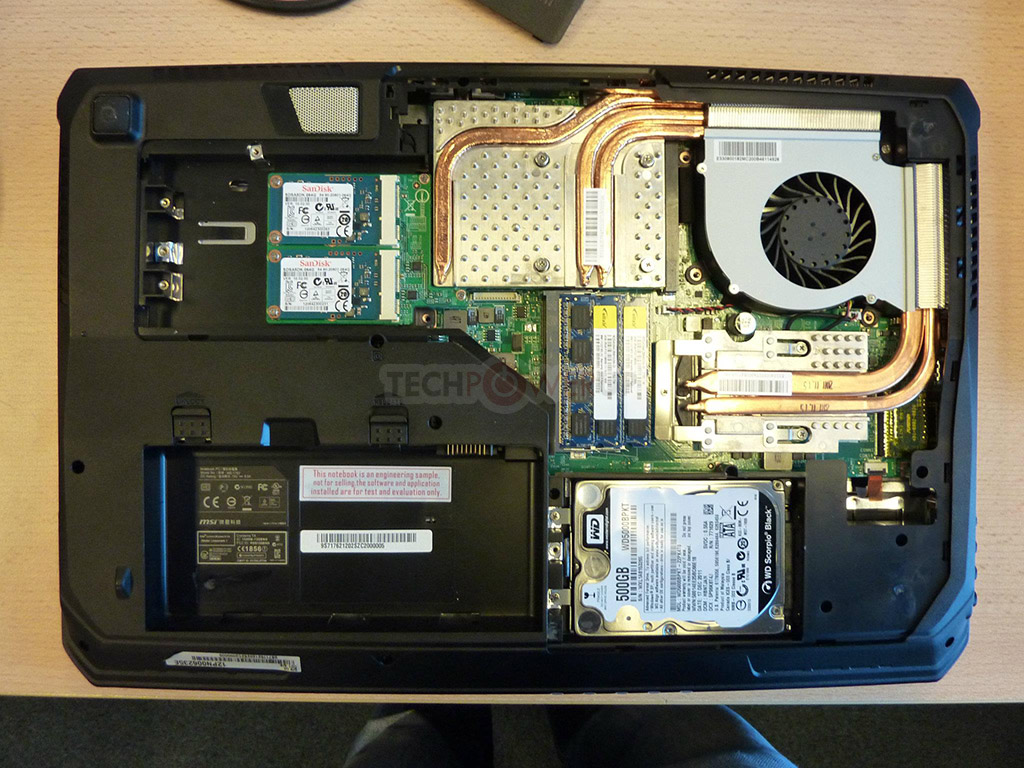
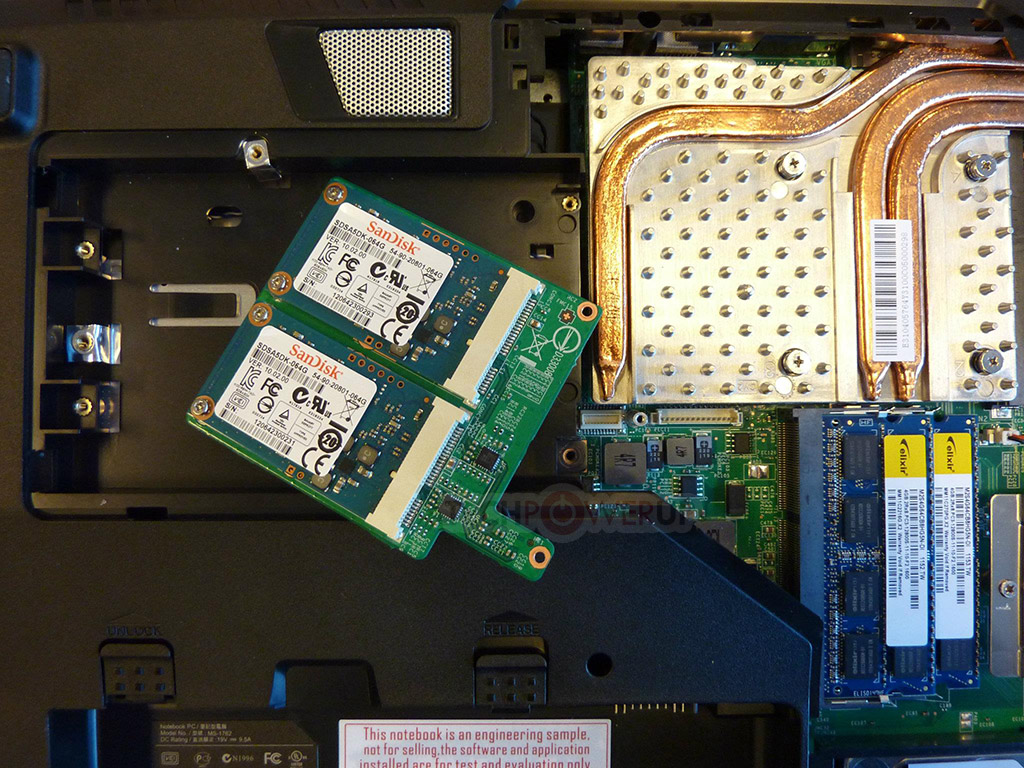
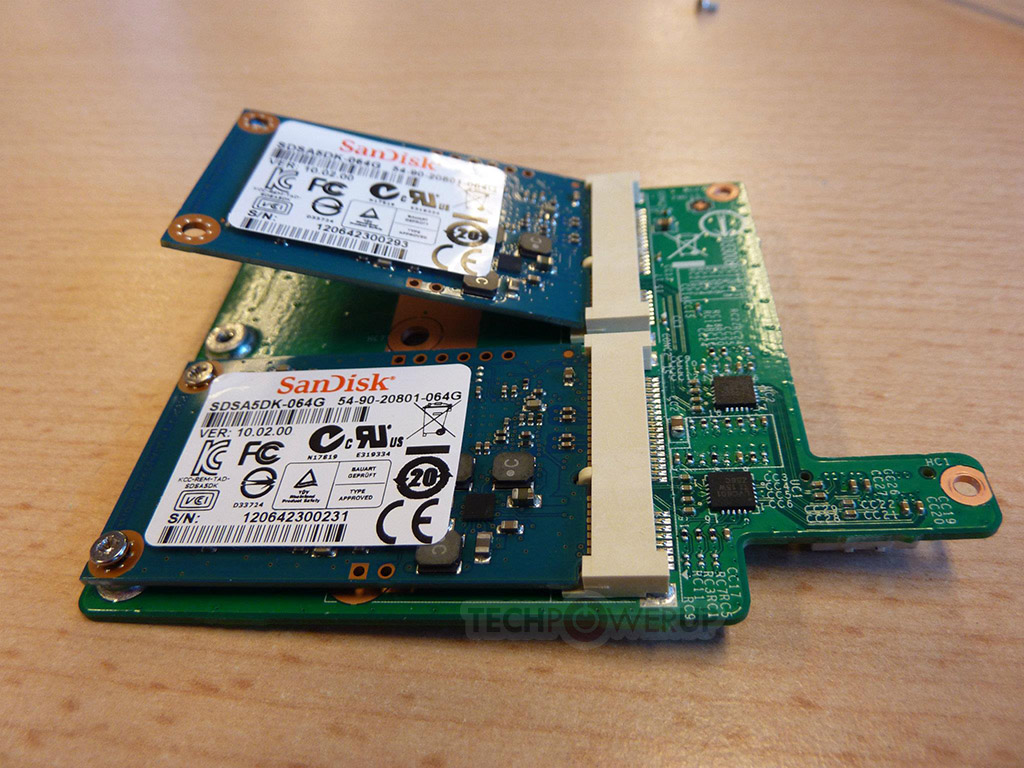
MSI released pictures and performance numbers of its in-house SuperRAID storage design that's implemented in its GT70 gaming notebook. The GT70 has two drive bays, one of which holds a 500 GB WD Scorpio Black hard drive, and the other, the SuperRAID module. The hard drive is tasked with just storage and a system recovery partition, while the SuperRAID module is where the action is.

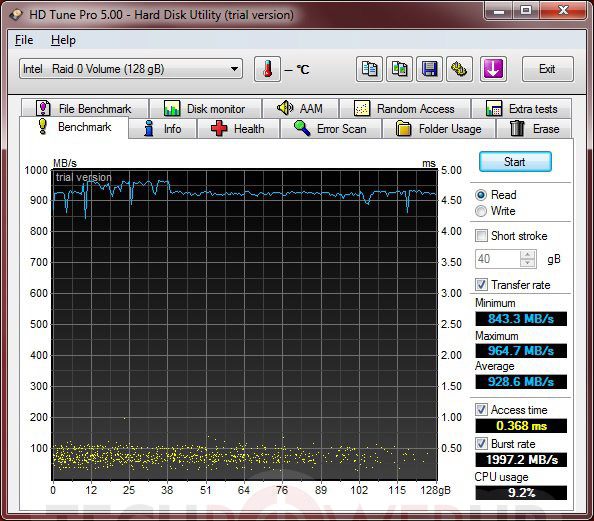
Simply put, the SuperRAID module is a PCB with a RAID controller, and two mSATA 6 Gb/s slots. Each of these slots holds a SanDisk U100 64 GB mSATA SSD. Each of these SSDs come with rated sequential transfer rates as high as 440 MB/s (reads) with 220 MB/s (writes), but striped in RAID 0, the volume churns out tested transfer rates as high as 964 MB/s (max. read), 928 MB/s (avg. read), and 843 MB/s (min. read), when tested by HDTune Pro 5.00. The SuperRAID module is bootable, and holds the operating system and programs. MSI claims with transfer speeds well over 900 MB/s, it has the fastest storage solution among gaming notebooks.

OCZ Technology Launches Next Generation Indilinx Everest SSD Controller Platform

OCZ Technology Group, Inc., a leading provider of high-performance solid-state drives (SSDs) for computing devices and systems, today introduced Indilinx Everest 2, its next-generation SSD platform that delivers an industry-best performance of 120,000 random input/output operations per second (IOPS) for SATA-based drives.

In addition to this unprecedented transactional performance, the Everest 2 features the most advanced flash management capabilities which can significantly extend NAND flash life and enhance SSD reliability. This innovative controller platform will debut in OCZ's new Vertex 4 SSD product line.

The Indilinx Everest 2 family of solid state drive processors establishes a new computing and storage paradigm by delivering breakthrough performance and uncompromising reliability to next-generation SSDs. Combining a 400M Hz dual-core CPU, 6 Gbps SATA Revision 3.0 interface, and support for the latest, most advanced NAND flash memory technology available, Everest 2 exceeds the needs of the most demanding SSD environments.

OCZ Announces the Indilinx Everest 2-based Vertex 4 Series SSD

OCZ Technology Group, Inc., a leading provider of high-performance solid-state drives (SSDs) for computing devices and systems, today introduced the Vertex 4 SATA III SSD series featuring the company's advanced Indilinx Everest 2 controller platform.

The Vertex 4 delivers the industry's highest input/output operations per second (IOPS) performance for SATA-based drives across a wide variety of application workloads making this fourth generation flagship product line ideally suited for demanding computing and workstation environments. It consistently accomplishes superior real world performance over the long term regardless of whether the data streams are in compressed or uncompressed formats.

I-O Data Starts Shipping SSDN-3T120B SSD

I-O Data began shipping the SSDN-3T120B solid-state drive. Originally manufactured by Toshiba, the SSDN-3T120B is a 120 GB drive in the 2.5-inch SATA 6 Gb/s form-factor, with sequential speeds of 480 MB/s (reads), 350 MB/s (writes); and random-access speeds of 440 MB/s (reads), 340 MB/s (writes), with 4K random seek performance of 73,000/58,000 IOPS (read/write). Its pricing is open to the retailers.

Intel Officially Launches SSD 313 Series

Intel made its SSD 313 series official, its product page was activated, and ARK pages of its variants maintain the products are already launched. The SSD 313 series succeeds SSD 311 series, it consists of SSDs specifically designed for SSD-caching technologies such as Intel Smart Response Technology, and upcoming technologies that the upcoming "Ivy Bridge" platform brings with it, including "Rapid Start" and "Smart Connect". The SSD 313 Series is introduced in two variants, a 20 GB variant, and a 24 GB variant.

The 20 GB variant offers sequential performance up to 220 MB/s and 100 MB/s (read and write), while the 24 GB variant offers 160 MB/s and 115 MB/s, which might make one wonder about the need for a 24 GB variant, given that it's also slower at 4K random-seek performance 33,000 IOPS / 4,000 IOPS vs. 36,000 IOPS / 3,300 IOPS of the 20 GB. One reason behind the 24 GB variant's existence could be that a combination of different Intel technologies partition the SSD, taking away small amounts of capacity. The extra 4 GB of capacity might more than make up for the slightly lower performance. Both drives use SLC NAND flash chips, which are more durable than MLC NAND flash, and can take more rewrite cycles (something that factors in heavily for caching SSDs). Both drives are available in 2.5" SATA 3 Gb/s and mSATA 3 Gb/s form-factors. The 20 GB variant was earlier put to test.

Corsair Gifts Gamers at PAX East 2012

Corsair, a worldwide designer and supplier of high-performance components to the PC gaming hardware market, today announced its participation and activities at PAX East 2012, an annual festival for tabletop, console and PC gamers being held in Boston, Massachussetts from April 6th to April 8th. Corsair will be located in booth #1150.

Corsair has teamed up with Digital Storm, Intel, and NVIDIA to give away a fully configured dream gaming PC each day of the event. These awesome dream machines will be built using Corsair's PC cases, power supplies, CPU coolers, SSDs, and Vengeance memory. These gaming PCs will also Intel Core desktop processors and NVIDIA GeForce GTX graphics cards.

A-Tech Fabrication Intros HeatSync 1200 Fanless Ultra-Slim HTPC

A-Tech Fabrication, a company that specializes in hand-crafted HTPCs, unveiled the HeatSync 1200 fanless HTPC. The part that makes it fanless is the chassis itself, which is made of aluminum, with fins on the sides, that dissipate heat. Copper heat pipes transfer heat from key components such as the CPU and chipset to the sides of the chassis, which takes care of the rest. Although most of the chassis is anodized black, with its front-panel, you can choose between silver and black options.

The HeatSync 1200 internally packs an Intel DH61AG thin mini-ITX motherboard, which seats an Intel Core i3-2100T dual-core 35W processor, clocked at 2.50 GHz. 4 GB Corsair Vengeance SO-DIMM memory comes standard. Also standard is the Intel SSD 310 40 GB mSATA SSD. Considering there are no mechanical hard drives, or a PSU with active-cooling (a 160W power-brick does the job), the HeatSync 1200 is literally silent. A consumer IR (CIR) receiver with Windows Media Center remote, and Windows 7 Home Premium make for the rest of it.

Mach Xtreme Technology Announces the 2.5" SATA II MX-JET ULTRA Series SSD

Mach Xtreme Technology Inc., a worldwide leader in top performance, high reliability and user-friendly designed PC components, today announced improved MX-JET ULTRA Series 2.5" SSD for mainstream users. MX-JET ULTRA Series delivers blazing fast, smooth and stutter free performance at an affordable price point.

The MX-JET ULTRA Series SSD provides outstanding performance, endurance and power efficiency resulting in exceptional user experience. This series is offering users robust data protection with enhanced hardware BCH ECC engine, StaticDataRefresh technology support and data shaping for higher data reliability.

Intel SSD 313 "Hawley Creek" SSD Stripped Apart, Tested

With 3rd generation Core "Ivy Bridge" processors, and 7-series "Panther Point" chipset, Intel will also release a new line of cache-SSDs to complement its Smart Response Technology (SRT) feature, which provides a decent performance middle-ground between HDDs, and expensive SSDs. The SSD 313 "Hawley Creek" family will replace SSD 310 "Larson Creek" family. It consists of drives that make use of relatively low amounts of SLC NAND flash memory (which have much higher endurance than MLC NAND flash, making them ideal for caching). Built in the 2.5" SATA and mSATA form-factors, the drives will be available in two variants; the 20 GB variant offers 220/100 MB/s (reads/writes), with 36,000 4K random read IOPS, while the 24 GB variant offers 160/115 MB/s (reads/writes), with 33,000 4K random read IOPS.

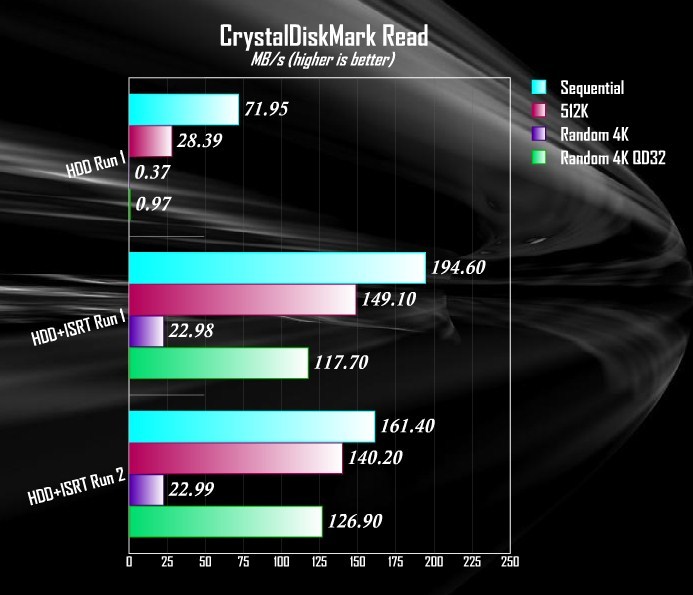
HWBOX.gr got to test the SSD 313 20 GB variant on a current generation Z68 motherboard (ASUS Maximus IV Extreme-Z), and post its findings. The Greek tech-site tested its performance in what it's meant to do: SSD caching using Intel SRT. Findings show a healthy boost in performance, with synthetic benchmarks, including synthetic read/write performance, random-access (IOPS), PCMark, and real-world tests such as Windows 7 boot-time, and startup of content-creation applications, but the performance-difference between SRT and plain-HDD narrowed as tests with data-loads grew, which is expected. SSD caching merely places "hot-data" (frequently-accessed data of the HDD on the SSD, for quicker access), and shunts data in and out of the SSD, as "heat" of data on the HDD changes competitively. Find a ton of more test results at the source link.

Intel SSD 330 Series Could Have Sweet Pricing: Report

Intel's upcoming mainstream consumer SSD line, the SSD 330 series, could have attractive pricing, which could catalyze further proliferation of SSD technology, according to a LaptopReviews report, citing tease-listings by online retailers and other sources. The new lineup will embrace SATA rev. 3.0 (6 Gb/s) standard, and offer performance that takes advantage of it. The 120 GB variant of the SSD 330, for example, was listed for US $149, on MacMall.com, the listing is removed. This gives it a price/GB on par with other 120 GB SATA 6 Gb/s SSDs in the market, which underwent several rounds of price-adjustments to get there.

The SSD 330 series from Intel, will be available in three capacities, 60 GB, 120 GB, and 180 GB. The 120 GB and 180 GB variants offer sequential transfer-rates of up to 500 MB/s (read) and 450 MB/s (write); the 60 GB variant offers 500 MB/s (read), and 400 MB/s (write). These drives use IMFlash Technologies-made 25 nm MLC NAND flash, and offer standard feature-set that includes support for TRIM, NCQ, 256-bit AES data-encryption, and limited SMART attributes.

IDC Forecasts Hard Disk Drive Industry Will Return to Growth After a Difficult 2011

In the wake of two massive and tragic natural disasters, worldwide hard disk drive (HDD) unit shipments experienced a year-over-year decline of 4.5% in 2011. Although efforts to clean and repair flooded factory buildings and equipment will take most of the first half of 2012, HDD and HDD component production is expected to return to preflood output levels in the second half of this year. According to a new forecast from International Data Corporation (IDC), the HDD industry will record year-over-year unit shipment growth of 7.7% in 2012 and a compound annual growth rate (CAGR) of 9.6% for the 2011-2016 forecast period.

Due to the imbalance in supply and demand that resulted from the Thailand floods, HDD prices have moved higher in recent months. HDD vendors are taking advantage of this opportunity to reset prices and recover some of the excessive price erosion that began in 2009. IDC expects year-over-year HDD revenue growth to exceed shipment growth in 2012, a precedent for the industry. Assuming the industry is successful with hybrid solid state hard drives (hybrid SSHDs), industry revenue could approach $50 billion by 2016 with a 2011-2016 CAGR of 8.6%.

OCZ Develops SSDs for Scientific Computing Servers at John Hopkins University

OCZ Technology Group, Inc. (Nasdaq:OCZ), a leading provider of high-performance solid-state drives (SSDs) for computing devices and systems, is pleased to announce the Deneva 2 Series SSDs will be used as the storage device of choice in a pending 'Data-Scope' research project at The Johns Hopkins University (JHU) to create servers for scientific data processing. This initiative to maximize data processing power is spearheaded by Dr. Alexander Szalay, Alumni Centennial Professor in the university's Department of Physics and Astronomy and Director of the JHU Institute for Data Intensive Engineering and Science.

With the goal of creating an affordable, powerful computational environment that can be used as a blueprint for future science applications, the JHU project comprises a system of nearly one hundred servers using hundreds of OCZ Deneva 2 SSDs combined with regular hard disk drives with two tiers for storage and computing. These powerful yet inexpensive systems also serve to expose students and researchers to leading-edge technology at an early stage.
Return to Keyword Browsing
Nov 19th, 2026 00:57 PST change timezone

New Forum Posts

Popular Reviews

TPU on YouTube

Controversial News Posts