 91
AMD Ryzen 7 7700X3D Review
Overclocking, Boost & Clock Frequencies »Temperatures
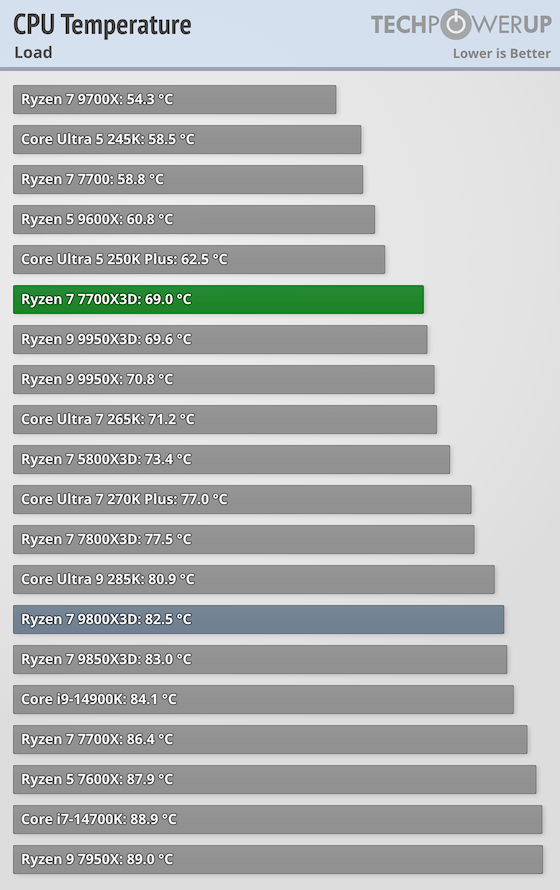
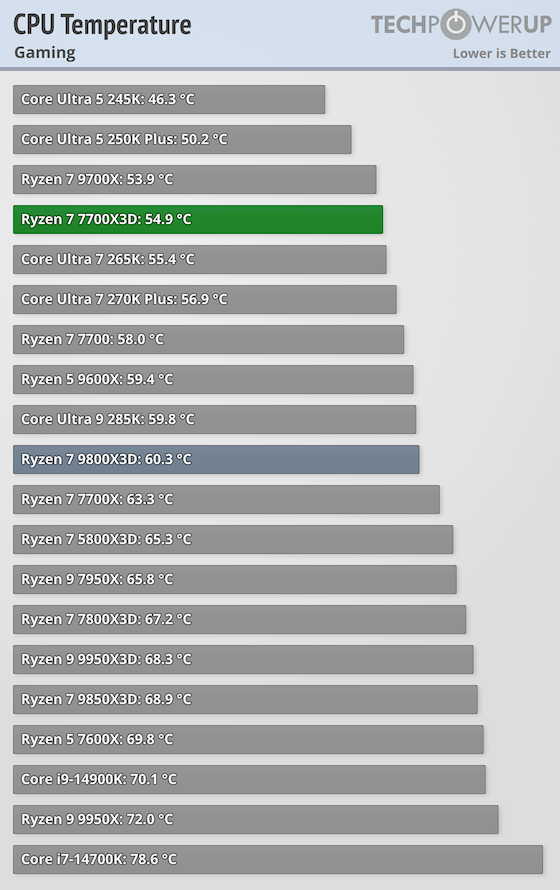
Application temperatures are measured using Blender, a highly demanding rendering load, which will load all cores completely, but that's still realistic and is not a synthetic stress test such as Prime95. For gaming, we picked Cyberpunk 2077, its modern engine is multi-thread aware and will try to spread as many tasks as possible over many CPU cores, when available. Even when a game uses multiple threads it doesn't load each CPU core as heavily as rendering, for example, so there's some scope for power savings here.Note that unless indicated otherwise, all processors are tested at stock conditions with their power limit active, which is why some Intel temperatures are surprisingly low. As designed by Intel, these CPUs can exceed their TDP for a few seconds (PL2), but in the long term, the power limit (PL1) is respected, which brings temperatures down considerably. Both tests report the steady-state temperature after an extended runtime of at least 10 minutes. Temperatures are based on delta T, normalized to 25°C, that's why the temperature of some CPUs is higher than their throttle point, because the room temperature was below 25°C.
AMD's first-generation Ryzen 7000-series X3D processors, including the 7700X3D, run a lower 89°C thermal target instead of the 95°C used by non-X3D Zen 4—the 3D V-Cache is stacked on top of the cores and can't tolerate as much heat, so AMD caps the temperature to protect it. In practice the 7700X3D stays well clear of that limit anyway: its low 4550 MHz clock and modest power draw keep it at just 69°C in Blender and 55°C while gaming. As on other AM5 processors, this limit can't be raised.
Nov 14th, 2026 11:35 CST
change timezone
Latest GPU Drivers
New Forum Posts
- What can the FX 8320 do today? Here is the answer. (23)
- Ddr4 instead of ddr5 for 9060xt 8 gb over 5060 8 gb (7)
- Your PC ATM (36414)
- TPU's Nostalgic Hardware Club (22161)
- What card do I get for VR? (27)
- Microsoft Exchange/365 outages? (62)
- Tell me about your favourite graphics card (54)
- Opinion on Monitor Replacement (7)
- Slow SSD read speeds - help! (5)
- Show us your collections thread!! (366)
Popular Reviews
- AMD Zen 6 Technical Deep Dive
- Corsair HX1000i Shift Crystal Review
- ASUS ROG Strix B850-I Gaming Wi-Fi7 W Review
- NZXT C1200 Platinum Review
- Upcoming Hardware Launches 2027 (Updated Nov 2026)
- Montech King 95 3D PRO Review
- NZXT H7 RGB+ Review
- NZXT H5 Review
- Phantom Blade Zero Performance Benchmark Review - 35 GPUs Tested
- XPG NIMBUS PLUS Review - Mid-range Chair With Strong Competitors
TPU on YouTube
Controversial News Posts
- NVIDIA Co-Founder and CEO Jensen Huang Officially Resigns (398)
- OpenAI CEO Argues Home PCs Waste the World's Limited DRAM Supply (152)
- NVIDIA Launches Investigation Into Jensen Huang's Relationship With Suspected Chinese Spy (136)
- Intel "Raptor Lake Next" 16-Core and 20-Core CPUs Surface (130)
- Legendary Game Studio BioWare Shuts Down Following EA Layoffs (104)
- Dell CEO Says the Memory Shortage Will Get Worse in 2027 (95)
- NVIDIA GeForce RTX 50-Series Scheduled for up to $500 Price Hike This Week (89)
- Modder Fits RTX 5090 With Four 8-Pin Connectors, Halving Current per Wire (80)