 80
AMD Zen 6 Technical Deep Dive
Helion Racks »EPYC Embedded 9006
Alongside the server launch, AMD announced the EPYC Embedded 9006 Series SP7. Tarang Shah, senior product manager for the EPYC Embedded x86 portfolio, noted that this is the first time AMD has launched an embedded EPYC product alongside the commercial server part rather than months behind it.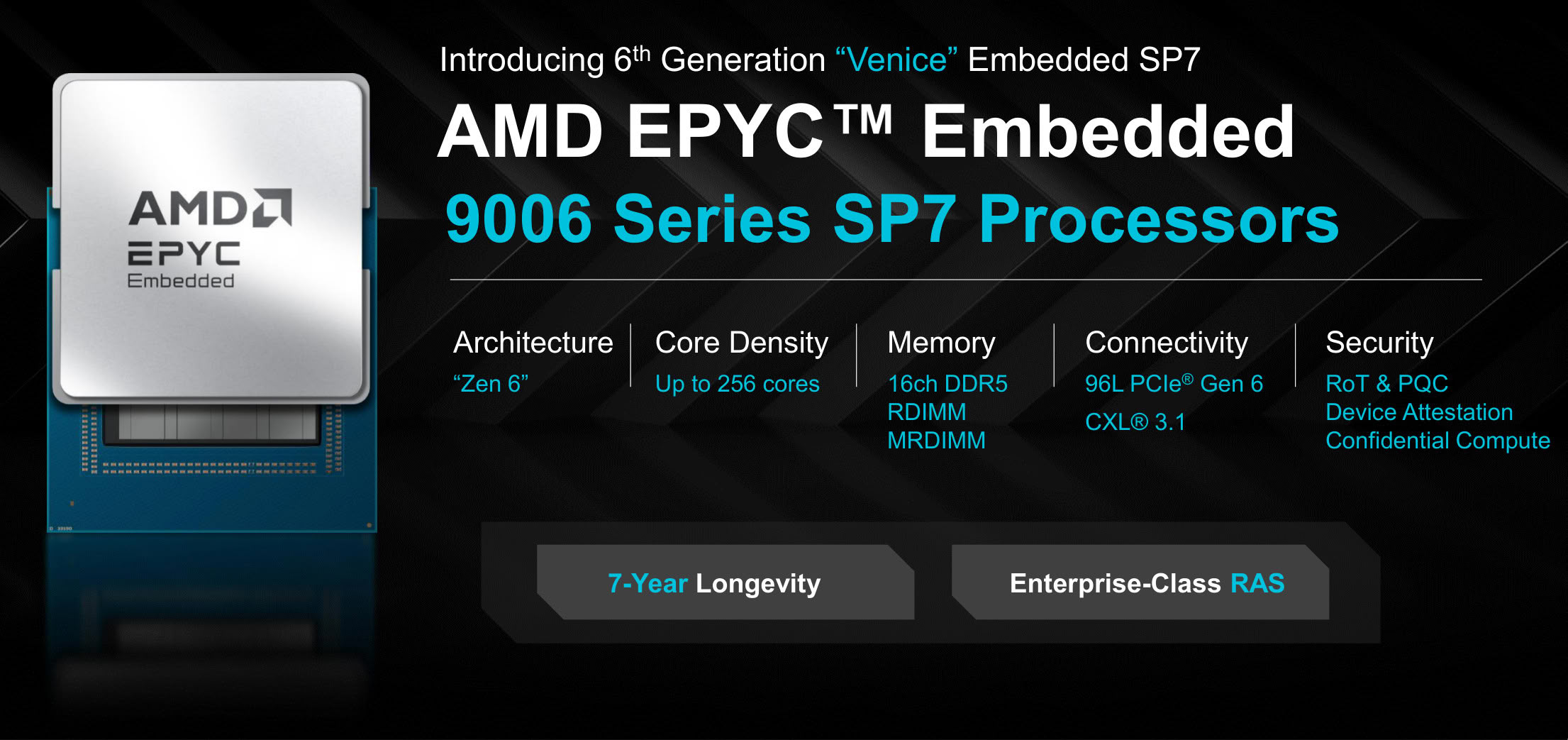
The target applications are semiconductor automated test equipment, high-end firewalls and enterprise storage controllers. All three are seeing the same pressure: AI infrastructure growth means faster memory and I/O devices to validate, more network traffic to inspect, and more data to move and process.
For test equipment in particular, the PCIe Gen 6 and CXL 3.1 support is the entire point. You cannot validate Gen 6 SSDs at full speed on a Gen 5 host, and until now there was no x86 server CPU that could do it.
Specifications
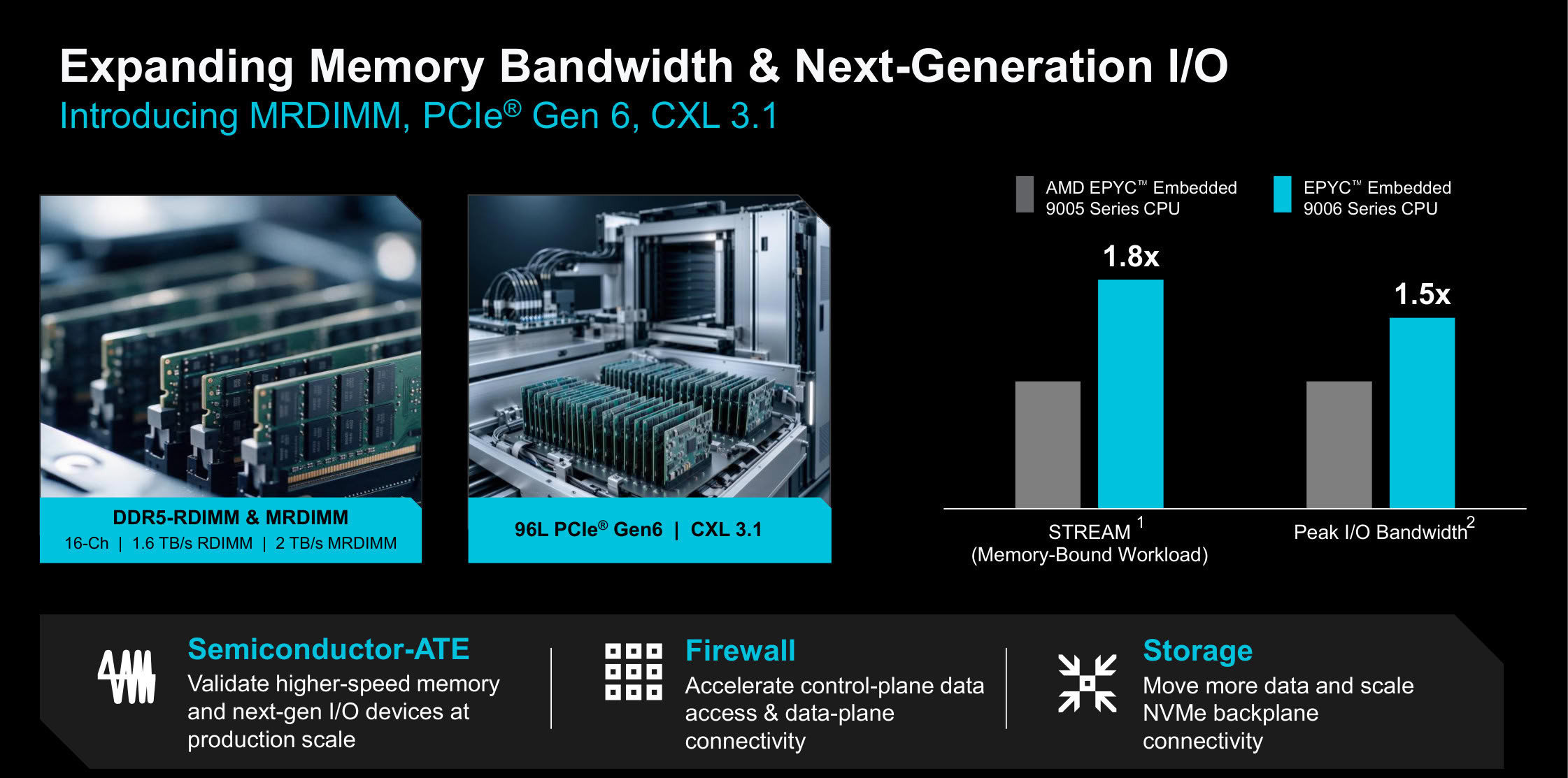
The embedded parts share the Venice SP7 silicon and platform: Zen 6 architecture, up to 256 cores, 16 channels of DDR5 with RDIMM and MRDIMM support, 96 lanes of PCIe Gen 6 and CXL 3.1. All SKUs support the full memory channel and PCIe lane count, which is unusual and useful—embedded designs often need the I/O more than the cores.
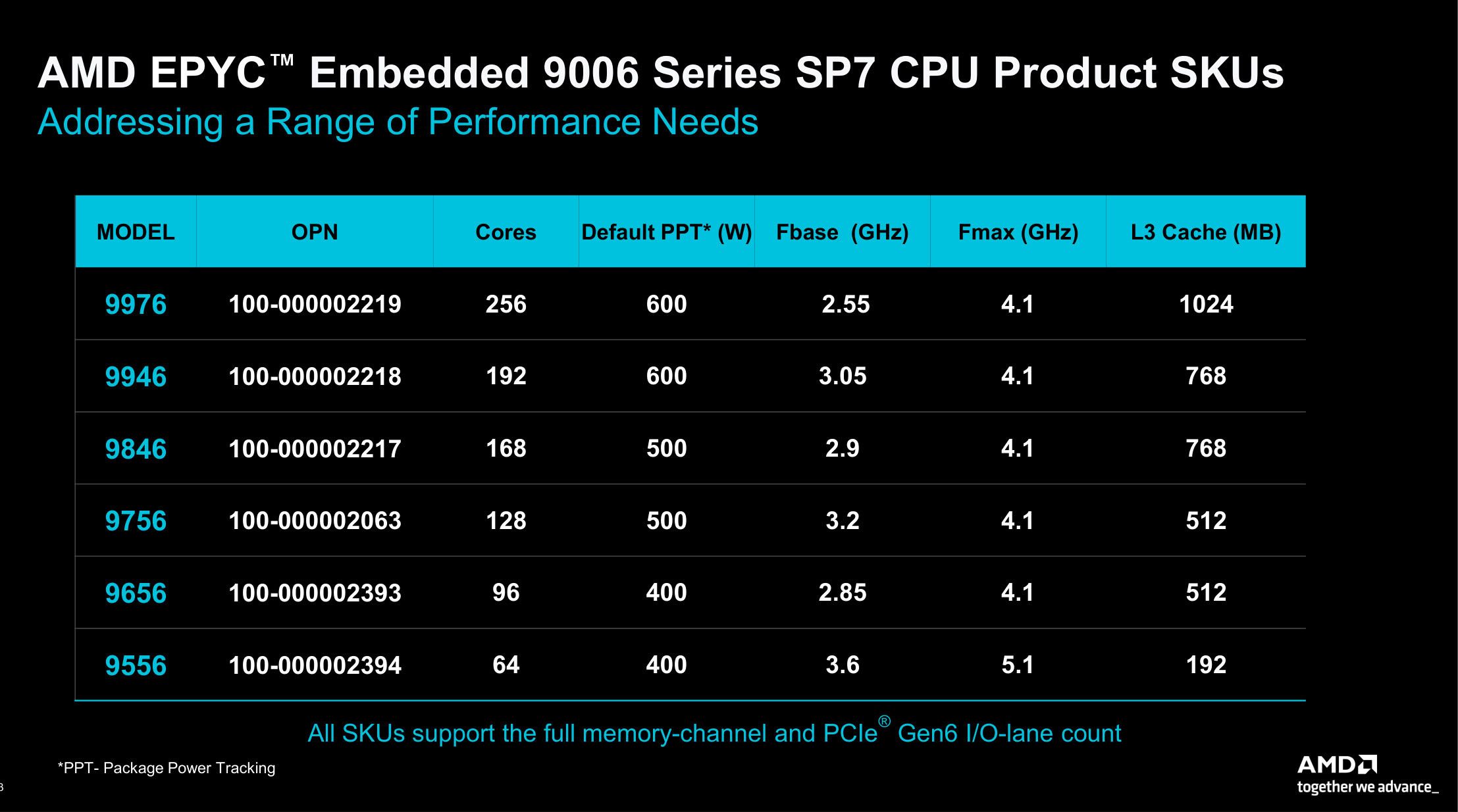
| Model | Core | Cores / Threads | L3 per Core | Power Limit | Base Clock | Boost Clock | L3 Cache |
|---|---|---|---|---|---|---|---|
| 9976 | Zen 6c | 256 / 512 | 4 MB | 600 W | 2.55 GHz | 4.1 GHz | 1024 MB |
| 9946 | Zen 6c | 192 / 384 | 4 MB | 600 W | 3.05 GHz | 4.1 GHz | 768 MB |
| 9846 | Zen 6c | 168 / 336 | 4.57 MB | 500 W | 2.9 GHz | 4.1 GHz | 768 MB |
| 9756 | Zen 6c | 128 / 256 | 4 MB | 500 W | 3.20 GHz | 4.10 GHz | 512 MB |
| 9656 | Zen 6c | 96 / 192 | 5.33 MB | 400 W | 2.85 GHz | 4.1 GHz | 512 MB |
| 9556 | Zen 6 | 64 / 128 | 3 MB | 400 W | 3.6 GHz | 5.1 GHz | 192 MB |
The 4.10 GHz ceiling across the top five models marks them as Zen 6c. The cache totals are consistent with whole CCD32s, 1024 MB being eight, 768 MB six and 512 MB four, but AMD also ships CCD32s with half the L3 disabled, as the SP8 9736 on the SKU page shows, so the 168-core part could be six dies at 28 cores or eight at 21, the 96-core part four at 24 or eight at 12, and the cache per core is the only thing the table settles. The 9556 is the outlier, with a 5.1 GHz boost that puts it in Zen 6 territory, and 192 MB of L3 that only adds up one way: eight 12-core dies with 8 cores and half the cache enabled on each. Its server namesake in our CPU database is a different chip altogether, 64 Zen 6c cores at 4.3 GHz with 384 MB of L3 and a 300 W limit.
Performance and Availability
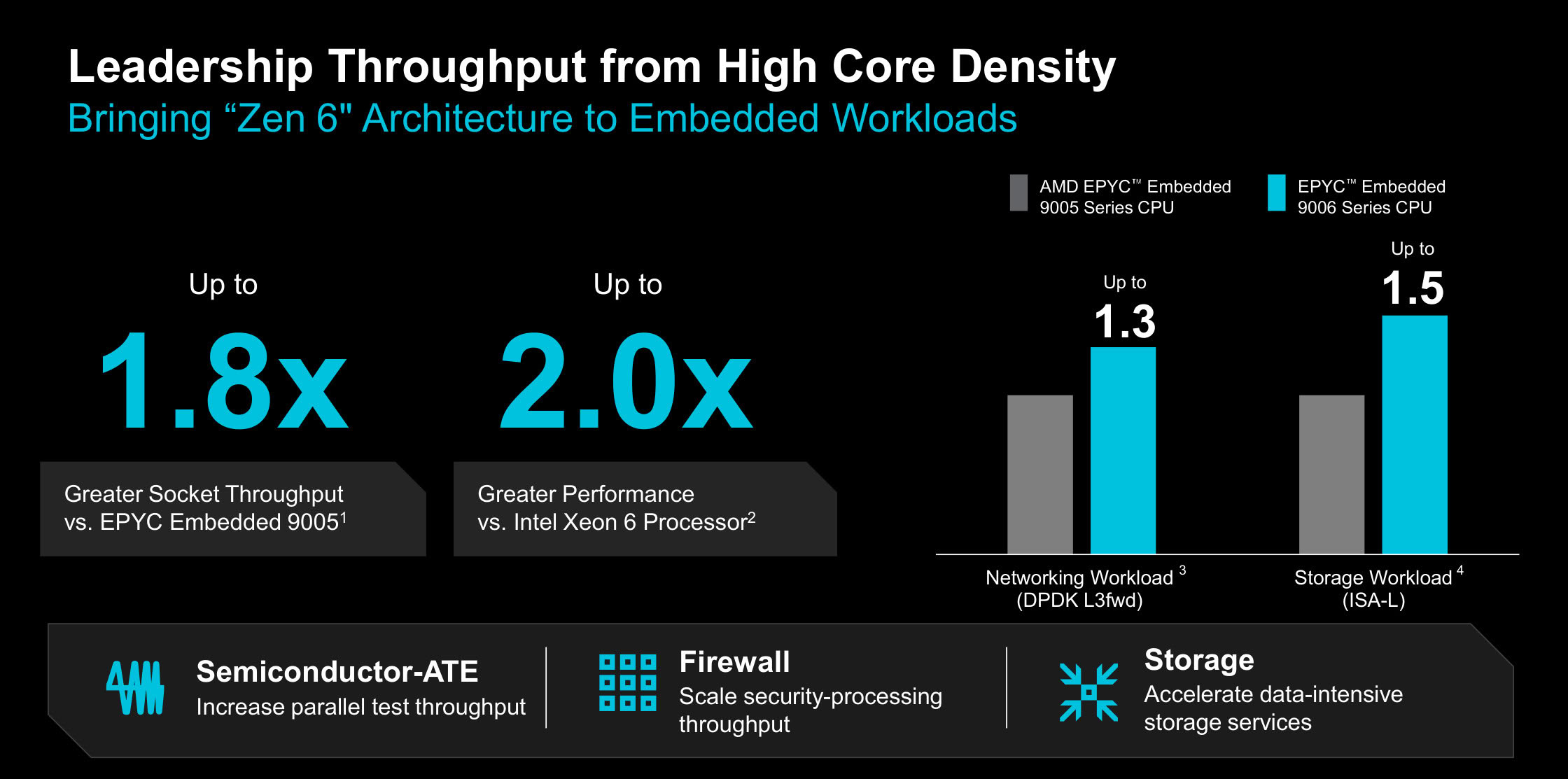
AMD claims up to 1.8x the socket throughput of the EPYC Embedded 9005 series on SPECrate 2017_int_base, and 2.0x the performance of a comparable Intel Xeon 6 processor. On the workloads that matter to the target markets, it claims 1.3x on DPDK L3 forwarding, 1.5x on ISA-L storage algorithms, 1.8x on STREAM and 1.5x peak I/O bandwidth, all against the previous generation.
Embedded customers get seven-year product availability, long-term BIOS and security support, and drop-in compatibility with the next generation in the same SP7 socket.
Production starts in November 2026. The 128-core SKU is available on November 15, with the rest expected in late December. ODM systems from Portwell, Lanner and IEI are expected to ship from January 2027.
Nov 11th, 2026 03:07 CST
change timezone
New Forum Posts
- I cannot download games that are larger than 30–40 GB. (82)
- Meeting point of those who broke their GPUs. Please share what GPUs you've burned, shattered, ionized or melted accidentally. (33)
- Excessively high prices for RAM (88)
- Warning for Windows 10 and 11 users running newer AMD GPU drivers (42)
- budget home NAS – X79, X99 or another platform? (126)
- What are you playing? (26204)
- When you could finally run Crysis maxed out? (19)
- What Speakers Are You You Using For Your Computer (346)
- Lets talk PC Audio (388)
- Current Sales, Bundles, Giveaways (10445)
Popular Reviews
- AMD Zen 6 Technical Deep Dive
- Upcoming Hardware Launches 2027 (Updated Nov 2026)
- Gigabyte Z890I Aorus Ultra Review
- INNOCN 45C1R Review - Two QHD Screens, Zero Bezels
- XPG NIMBUS PLUS Review - Mid-range Chair With Strong Competitors
- Phantom Blade Zero Performance Benchmark Review - 35 GPUs Tested
- Gears of War: E-Day Performance Benchmark Review - 35 GPUs Tested
- NZXT H7 RGB+ Review
- be quiet! Light Mount TKL Keyboard Review
- NZXT H5 Review
TPU on YouTube
Controversial News Posts
- OpenAI CEO Argues Home PCs Waste the World's Limited DRAM Supply (152)
- NVIDIA Launches Investigation Into Jensen Huang's Relationship With Suspected Chinese Spy (136)
- Intel "Raptor Lake Next" 16-Core and 20-Core CPUs Surface (130)
- Legendary Game Studio BioWare Shuts Down Following EA Layoffs (104)
- Dell CEO Says the Memory Shortage Will Get Worse in 2027 (95)
- NVIDIA GeForce RTX 50-Series Scheduled for up to $500 Price Hike This Week (88)
- Modder Fits RTX 5090 With Four 8-Pin Connectors, Halving Current per Wire (80)
- AMD Radeon Owners Can Now Run Nearly Every DLSS Feature Through Fan-Made Mod (80)