 18
ASRock Radeon RX 9070 XT Monster Hunter Wilds Edition Review
Pictures & Teardown »Introduction

ASRock Radeon RX 9070 XT Monster Hunter Wilds Edition is a special graphics card model that's officially licensed by Capcom to celebrate one of 2025's biggest AAA RPG releases. Although it's not declared as such officially, this card is based on ASRock's RX 9070 XT Steel Legend OC, but with many exclusive design uplifts. To begin with, the cooler shroud features a two-tone trim including silver and cyan finish from the game's color scheme; and a matching backplate. The backplate has a die-cast print of a monster from the game. Along the top of the card, we see the acrylic ARGB-illuminated Steel Legend logo being replaced by an Arkveld logo from the game. Out of the box, the card comes with an ARGB lighting scheme that aligns with the general aesthetic of the game. Lastly, the fans have groovy decals themed after the game.
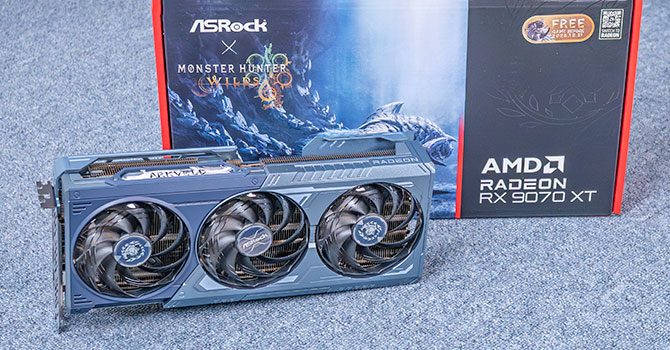
AMD Radeon RX 9070 XT is this generation's fastest GPU from the red team, and is powered by the company's latest RDNA 4 graphics architecture. The card offers abundant performance to plow through Monster Hunter Wilds at high resolutions, such as 4K Ultra HD, and 1440p. RDNA 4 sees AMD withdraw from the enthusiast-segment, and focus on winning the performance segment with the best price-performance, without compromising on features. AMD made advances to shoring up the ray tracing and AI acceleration performance of its GPUs with RDNA 4. The company also advanced its performance upscaling technology with FSR 4, which taps into machine learning to significantly improve image quality at every performance tier over the previous FSR 2.2. AMD is planning to sign off 2025 with Project Redstone, a suite of feature additions to FSR 4 such as ML-based radiance caching, ray reconstruction, and frame generation, which close technological gaps with NVIDIA.
AMD designed the RDNA 4 architecture around the 4 nm EUV foundry node, and the Navi 48 silicon powering the Radeon RX 9070 series is a classic monolithic chip built entirely on 4 nm, unlike its predecessors from the RDNA 3 generation that were based on chiplets that combined 5 nm and 6 nm on a merit-basis. This, together with architecture-level advances AMD made to the shader engines translate into a large uplift in performance per Watt over RDNA 3. The RDNA 4 architecture provides a nearly 100% increase in ray tracing performance over the previous generation, and significant increases in AI acceleration performance to enable ML-based models powering the various FSR 4 and Redstone technologies. With a CU count of 64, or 4,096 stream processors, AMD is able to match its previous-gen enthusiast-segment GPUs with 50% higher CU counts. This is thanks not just to the IPC improvements, but also the much higher clock speeds these GPUs operate at.
Radeon RX 9070 XT maxes out the 4 nm Navi 48 silicon it's based on, with 64 compute units making 4,096 stream processors, 64 RT accelerators, and 128 AI accelerators. The GPU also has 256 TMUs, and 128 ROPs. RX 9070 XT gets 16 GB of 20 Gbps GDDR6 memory, with 640 GB/s of memory bandwidth. AMD has innovated several architecture-level memory management optimizations, with which AMD can hold on to older GDDR6 memory standards even as NVIDIA has moved on to GDDR7. AMD did implement PCI-Express Gen 5 for the host interface, and board vendors have the freedom to implement modern 12V-2x6 power connectors if they want to. ASRock's own RX 9070 XT Taichi has it.
ASRock is pricing the Radeon RX 9070 XT Monster Hunter Wilds at $650, a $50 premium over the regular RX 9070 XT Steel Legend graphics card that's going for $600. The premium covers its unique design, which could appeal to die-hard fans of the game, and gaming content creators planning on creating a Monster Hunter Wilds-themed build. This is not just a sticker-job, ASRock used die-cast printing on the backplate, it also used a unique color scheme on the cooler shroud and the ARGB ornament. Also included is a game key for the full Monster Hunter Wilds game (valid until Dec 31 2025), which is a $40 value or so. In terms of clock speeds, the MHW Edition ticks at reference frequency.
| Price | Cores | ROPs | Core Clock | Boost Clock | Memory Clock | GPU | Transistors | Memory | |
|---|---|---|---|---|---|---|---|---|---|
| RTX 4070 | $500 | 5888 | 64 | 1920 MHz | 2475 MHz | 1313 MHz | AD104 | 35800M | 12 GB, GDDR6X, 192-bit |
| RX 7800 XT | $470 | 3840 | 96 | 2124 MHz | 2430 MHz | 2425 MHz | Navi 32 | 28100M | 16 GB, GDDR6, 256-bit |
| RTX 4070 Super | $600 | 7168 | 80 | 1980 MHz | 2475 MHz | 1313 MHz | AD104 | 35800M | 12 GB, GDDR6X, 192-bit |
| RX 7900 GRE | $550 | 5120 | 160 | 1880 MHz | 2245 MHz | 2250 MHz | Navi 31 | 57700M | 16 GB, GDDR6, 256-bit |
| RTX 4070 Ti | $700 | 7680 | 80 | 2310 MHz | 2610 MHz | 1313 MHz | AD104 | 35800M | 12 GB, GDDR6X, 192-bit |
| RTX 5070 | $540 | 6144 | 80 | 2325 MHz | 2512 MHz | 1750 MHz | GB205 | 31100M | 12 GB, GDDR7, 192-bit |
| RTX 4070 Ti Super | $750 | 8448 | 96 | 2340 MHz | 2610 MHz | 1313 MHz | AD103 | 45900M | 16 GB, GDDR6X, 256-bit |
| RX 7900 XT | $620 | 5376 | 192 | 2000 MHz | 2400 MHz | 2500 MHz | Navi 31 | 57700M | 20 GB, GDDR6, 320-bit |
| RX 9070 | $530 | 3584 | 128 | 2070 MHz | 2520 MHz | 2518 MHz | Navi 48 | 53900M | 16 GB, GDDR6, 256-bit |
| RX 9070 XT | $600 | 4096 | 128 | 2400 MHz | 2970 MHz | 2518 MHz | Navi 48 | 53900M | 16 GB, GDDR6, 256-bit |
| ASRock RX 9070 XT Monster Hunter Wilds | $660 | 4096 | 128 | 2400 MHz | 2970 MHz | 2518 MHz | Navi 48 | 53900M | 16 GB, GDDR6, 256-bit |
| RTX 5070 Ti | $750 | 8960 | 96 | 2295 MHz | 2452 MHz | 1750 MHz | GB203 | 45600M | 16 GB, GDDR7, 256-bit |
| RX 7900 XTX | $750 | 6144 | 192 | 2300 MHz | 2500 MHz | 2500 MHz | Navi 31 | 57700M | 24 GB, GDDR6, 384-bit |
| RTX 4080 | $850 | 9728 | 112 | 2205 MHz | 2505 MHz | 1400 MHz | AD103 | 45900M | 16 GB, GDDR6X, 256-bit |
| RTX 4080 Super | $1000 | 10240 | 112 | 2295 MHz | 2550 MHz | 1438 MHz | AD103 | 45900M | 16 GB, GDDR6X, 256-bit |
| RTX 5080 | $1000 | 10752 | 112 | 2295 MHz | 2617 MHz | 1875 MHz | GB203 | 45600M | 16 GB, GDDR7, 256-bit |
| RTX 4090 | $1800 | 16384 | 176 | 2235 MHz | 2520 MHz | 1313 MHz | AD102 | 76300M | 24 GB, GDDR6X, 384-bit |
| RTX 5090 | $2600 | 21760 | 176 | 2017 MHz | 2407 MHz | 1750 MHz | GB202 | 92200M | 32 GB, GDDR7, 512-bit |
Nov 26th, 2026 00:33 CST
change timezone
Latest GPU Drivers
New Forum Posts
- What's your main Black Friday / Cyber Monday purchase? (11)
- AI generated images... (236)
- Claude credits purchased on or after Dec. 7 now have an expiry date (17)
- Strange PC issues with Z690 setup (5)
- RTX 5080 problems, random troubleshooting "log" (8)
- Slow boot, can't launch monitoring software, general lag (38)
- Linpack Xtreme Released (512)
- Exploring Local LLMs: Models, Hardware and Setup Experiences (1)
- Smokin Hot Lappy (10)
- Gacha Games - Discussions, Pulls, Updates, etc. (1165)
Popular Reviews
- ASRock X870E Challenger Wi-Fi White Review
- VZMORE AX9 Max Review
- Upcoming Hardware Launches 2027 (Updated Nov 2026)
- Microsoft Surface Laptop Ultra Review - The Next-gen Arm Laptop
- AMD Ryzen 7 9800X3D Review - The Best Gaming Processor
- AMD Zen 6 Technical Deep Dive
- Corsair RM1200e (Second Generation) Review
- Phantom Blade Zero Performance Benchmark Review - 35 GPUs Tested
- Pulsar Office Tour & First Look at P1 Dual-Sensor Mouse
- Ocypus lota P1000 Review
TPU on YouTube
Controversial News Posts
- Jensen Huang Reinstated as CEO of NVIDIA (573)
- NVIDIA Co-Founder and CEO Jensen Huang Officially Resigns (492)
- Report: Jensen Huang Eyes NVIDIA Comeback (281)
- Open Letter Asking NVIDIA to Reinstate Jensen Huang Passes 115,000 Signatures (184)
- OpenAI CEO Argues Home PCs Waste the World's Limited DRAM Supply (152)
- NVIDIA Launches Investigation Into Jensen Huang's Relationship With Suspected Chinese Spy (136)
- Intel "Raptor Lake Next" 16-Core and 20-Core CPUs Surface (130)
- Intel Razor Lake Gets a 12 P-Core bLLC Chip With No E-Cores, Per Leak (94)