 4
GMKtec M6 Ultra Review
Value & Conclusion »Power and Noise Levels
Power and efficiency are just as important as raw performance in a compact system, so I measured how much it draws at idle, under CPU stress, during GPU-heavy tests, and while gaming. These measurements were captured using a Shelly smart power relay, taking advantage of its API-based logging to track real-time wattage and build accurate per-second consumption profiles. I also monitored the system's noise levels while idle and when under sustained load.Idle Power Draw
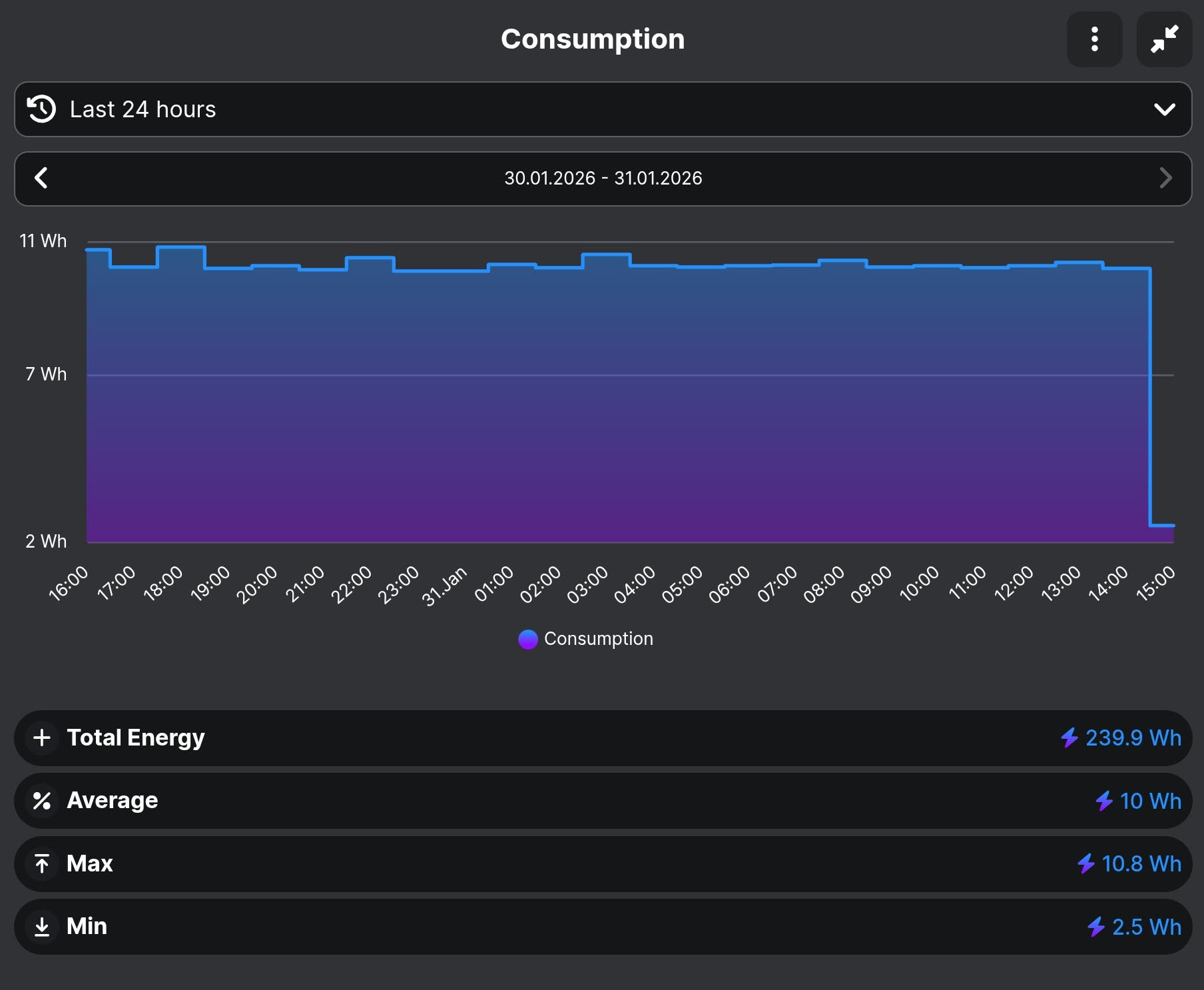
Over a full 24-hour idle period, the GMKtec M6 Ultra shows very steady and well-controlled power behavior, averaging 10 W, with brief peaks up to 10.8 W and a low point of 2.5 W. For nearly the entire day, power draw remains within a tight 9.5 to 10.5 W range, indicating consistent idle operation without unexpected spikes or background activity ramping up.
In context, this idle draw is slightly higher than what we typically see from the most power-efficient Mini-PCs, which often settle closer to around 8 W under similar conditions. However, the difference is modest, and the M6 Ultra's power use remains stable and predictable.
At an average of 10 W, leaving the system idle around the clock would result in roughly 87.6 kWh of annual energy use, which means about $13 to $18 per year, depending on your local rates. While the cost difference is relatively small, it does place the M6 Ultra toward the upper end of the idle power range among the Mini-PCs we've tested.
CPU and GPU Power Draw
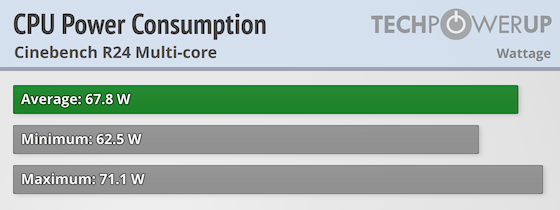
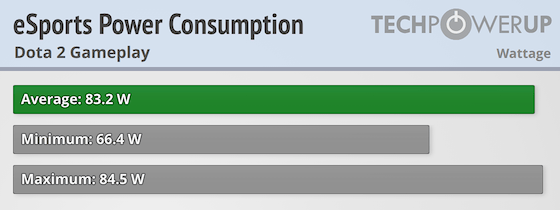
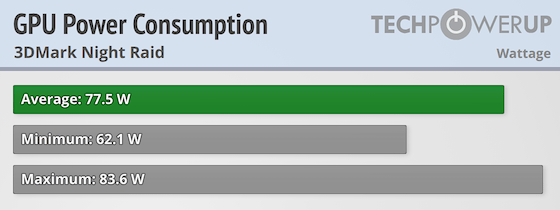
We also tested three real-world power-load scenarios: an esports gaming pass with Dota 2, which gives a good view of mid-load stability and clock consistency; a GPU-oriented run using Night Raid, which exposes how the APU reacts to scene changes and mixed rendering workloads; and a heavy Cinebench multicore pass that stresses all CPU cores simultaneously to show long-term power delivery.
Cinebench Multicore
During the Cinebench multicore run, the Ultra 6 averaged 69.3 W, with a minimum of 65.8 W and a peak of 78.1 W. This is higher than average for a compact system, but the narrow range shows the CPU can sustain heavy all-core workloads without power instability or visible throttling once boost behavior settles.
eSports Gaming (Dota 2)
In Dota 2, power consumption averaged 72.2 W, dipping to 64.6 W during lighter moments and peaking at 79.9 W during heavier action. The consistently elevated draw suggests the system keeps both CPU and iGPU actively engaged throughout gameplay rather than scaling down aggressively between scenes.
3DMark Night Raid
Night Raid averaged 76.9 W, with lows of 62.1 W and a maximum of 83.2 W during more demanding scenes. The wider spread is normal for this mixed CPU and GPU benchmark and shows the system ramping power up and down appropriately as workload intensity changes rather than holding an unnecessarily high draw throughout.
Here's a full view of the GMKtec M6 Ultra's power draw across all three profiles:
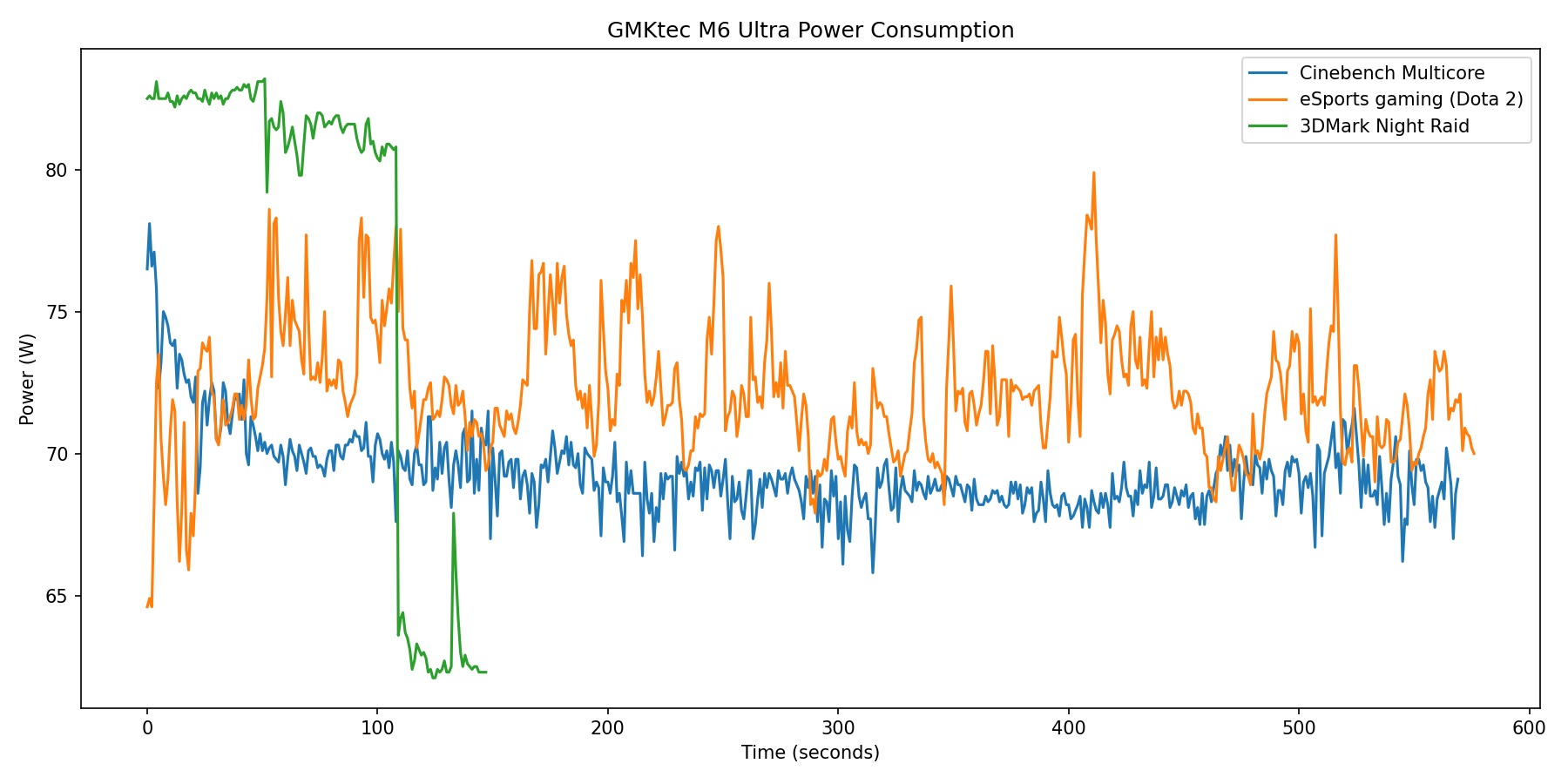
Overall, the M6 Ultra uses more power than many similar compact systems, especially during gaming and workloads that stress both the CPU and GPU. In practice, this means the system prioritizes staying quick and responsive, but it does so by drawing more power than is strictly needed for these tasks.
Noise Levels
Noise was measured using a digital sound level meter placed roughly 30 cm from the system. During idle and light desktop tasks like web browsing, writing, or general productivity work, the M6 Ultra is effectively silent and blends easily into a typical room.Under sustained load, such as during my AIDA64 stress testing, Cinebench multicore runs, or long game installations through Steam, fan noise becomes more noticeable. Measured levels range between 41 and 43.5 dB, with the system fan producing a steady sound that includes a slight high-pitched hum. This is most noticeable in quieter rooms, though it does not come across as overly loud if there is any white noise. While clearly audible under heavy workloads, this is in line with what is expected from a compact Mini-PC designed to maintain consistent performance under load.
Nov 14th, 2026 00:22 CST
change timezone
Latest GPU Drivers
New Forum Posts
- Requesting original VBIOS for Gigabyte RX 5700 XT GAMING OC 8G Rev 2.0 (Micron) (1)
- Tell me about your favourite graphics card (35)
- What are you playing? (26216)
- no "PhysX" workable (9)
- AI generated images... (224)
- Crimson Desert (31)
- RenoDX HDR - how to view the differnce Before&After in game? (0)
- Displayport DP80 3M (10ft) cable that can achieve 80gbps stable? (5)
- I'll flash a ASUS ROG Strix RX480 O8G in Cause of Code 43, as a Newbie (1)
- Opinion on Monitor Replacement (6)
Popular Reviews
- AMD Zen 6 Technical Deep Dive
- Corsair HX1000i Shift Crystal Review
- NZXT C1200 Platinum Review
- Upcoming Hardware Launches 2027 (Updated Nov 2026)
- ASUS ROG Strix B850-I Gaming Wi-Fi7 W Review
- Montech King 95 3D PRO Review
- NZXT H7 RGB+ Review
- NZXT H5 Review
- Phantom Blade Zero Performance Benchmark Review - 35 GPUs Tested
- XPG NIMBUS PLUS Review - Mid-range Chair With Strong Competitors
TPU on YouTube
Controversial News Posts
- NVIDIA Co-Founder and CEO Jensen Huang Officially Resigns (380)
- OpenAI CEO Argues Home PCs Waste the World's Limited DRAM Supply (152)
- NVIDIA Launches Investigation Into Jensen Huang's Relationship With Suspected Chinese Spy (136)
- Intel "Raptor Lake Next" 16-Core and 20-Core CPUs Surface (130)
- Legendary Game Studio BioWare Shuts Down Following EA Layoffs (104)
- Dell CEO Says the Memory Shortage Will Get Worse in 2027 (95)
- NVIDIA GeForce RTX 50-Series Scheduled for up to $500 Price Hike This Week (89)
- Modder Fits RTX 5090 With Four 8-Pin Connectors, Halving Current per Wire (80)