 4
GMKtec M6 Ultra Review
Web & Office Productivity »General Performance
AIDA64 Cache and Memory
First up in our performance analysis is AIDA64's memory benchmark. This test gives a clear picture of how quickly the CPU and memory subsystem can move data. Since the Radeon iGPU relies on system RAM, bandwidth and latency play a direct role in both everyday performance and graphics performance.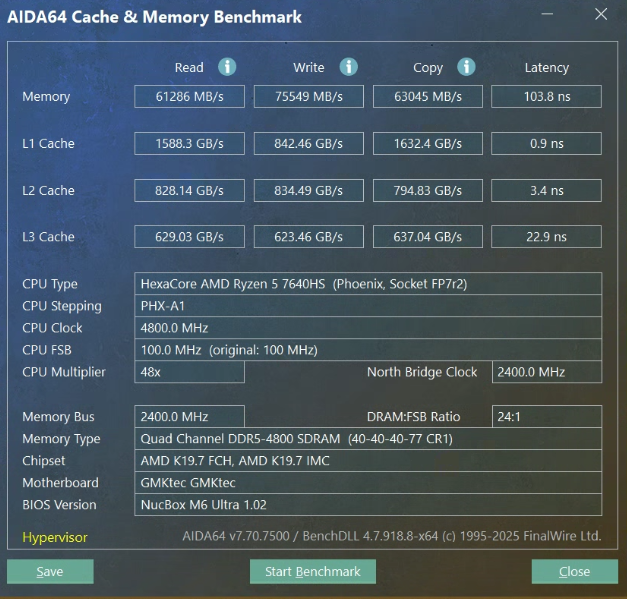
Here, the GMKtec M6 Ultra posts 61,286 MB/s for read, 75,549 MB/s for write, and 63,045 MB/s for copy, with measured latency coming in at 103.8 ns. Those figures are right in line with what a dual-channel DDR5-4800 configuration typically delivers on a Ryzen 7000-series mobile platform. Read and copy throughput land where expected as well, while write performance trails faster DDR5-5600 setups but still holds up well for day-to-day multitasking and heavier mixed workloads. Cache results across L1, L2, and L3 are very strong too, which helps offset some of the memory latency in real-world use and keeps the system feeling quick when jumping between tasks.
Cinebench
Cinebench measures how well the CPU handles both single-threaded and multithreaded rendering. It is a simple way to compare real compute performance across systems.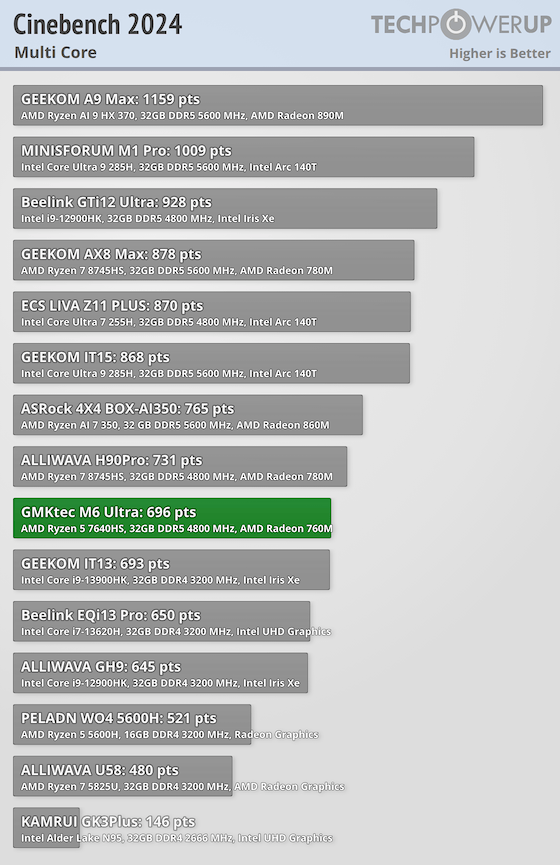
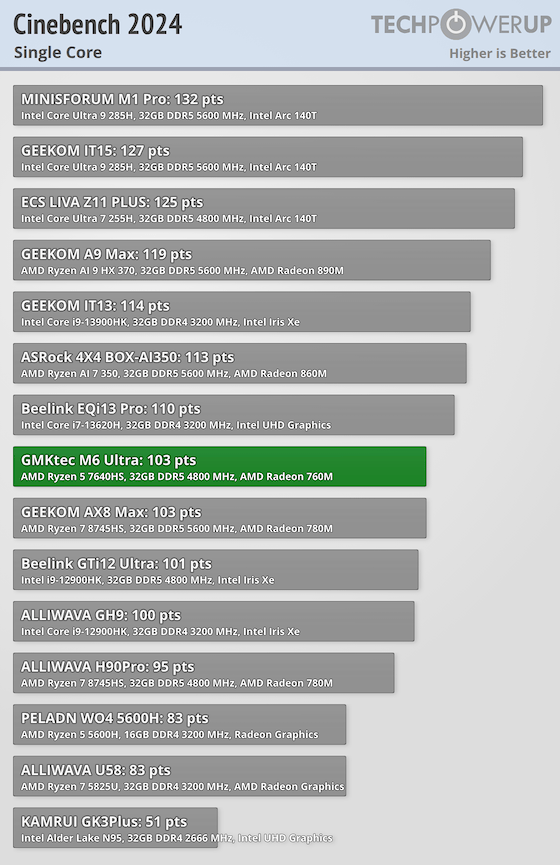
The GMKtec M6 Ultra scores 146 in multicore and 51 in single-core. This demonstrates the limits of the Ryzen 5 7640HS when constrained by the compact chassis of a Mini-PC, but multicore performance still holds up well for everyday productivity, light content creation, and sustained workloads that rely on multiple threads.
7-Zip
7-Zip's internal benchmark stresses compression and decompression, which shows how the CPU handles file-heavy tasks like installs, archiving, and packaging.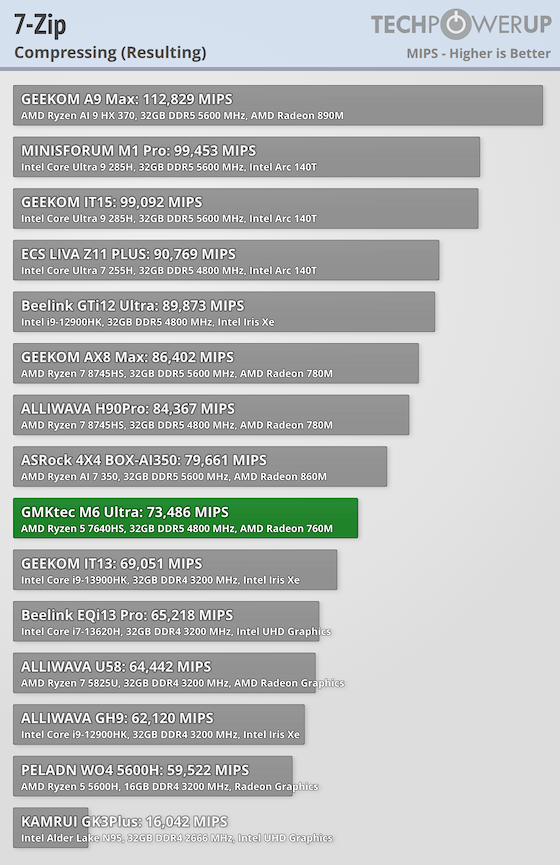
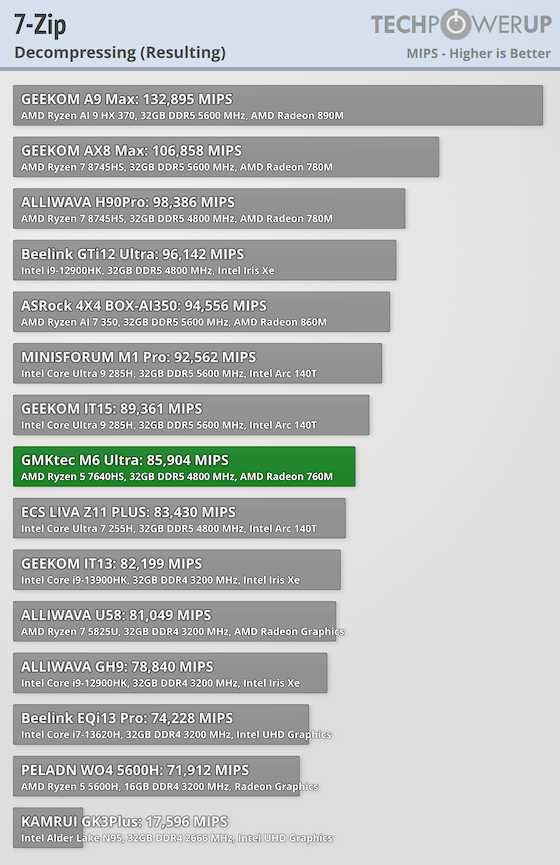
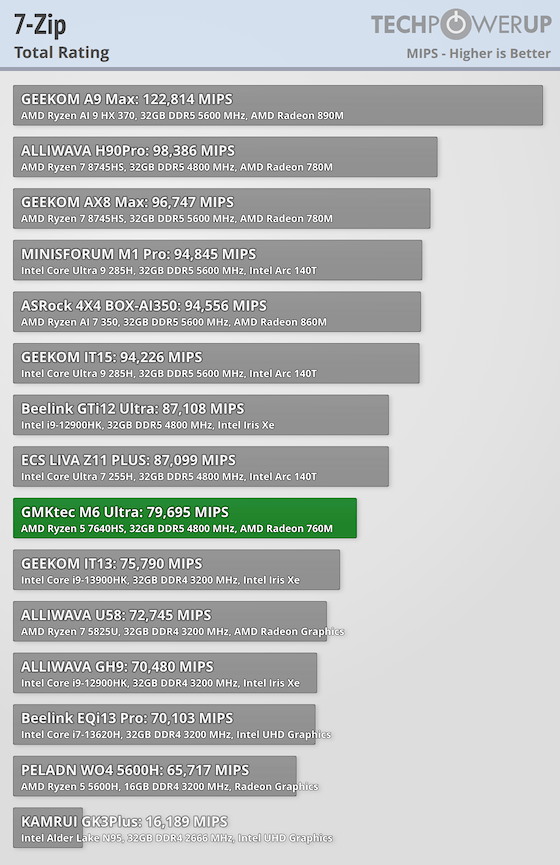
Here, the M6 Ultra posts 73,486 MIPS in compression and 85,904 MIPS in decompression, resulting in a 79,695 total rating. Decompression performance is especially solid and keeps pace with several older Intel H-class systems. For real-world use, tasks like unpacking large archives or game installations feel quick and consistent.
PCMark 10
PCMark measures day-to-day responsiveness across web, conferencing, documents, multitasking, and light content creation.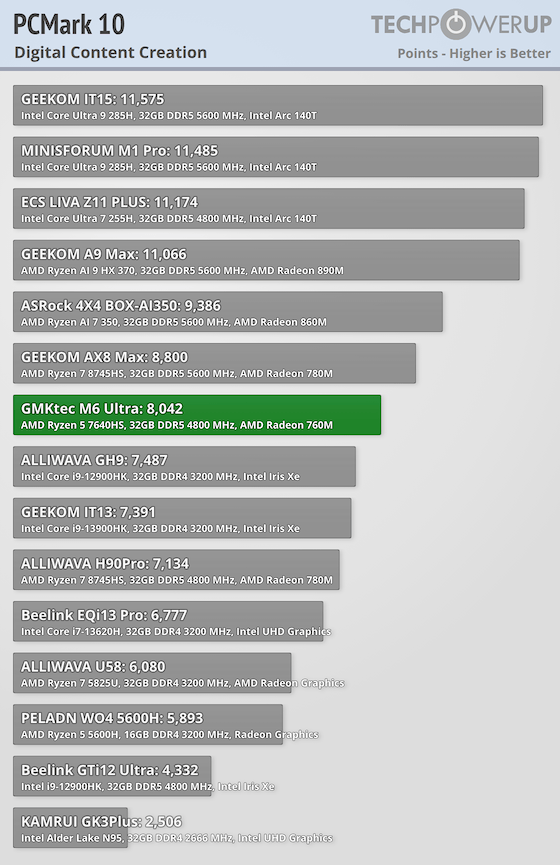
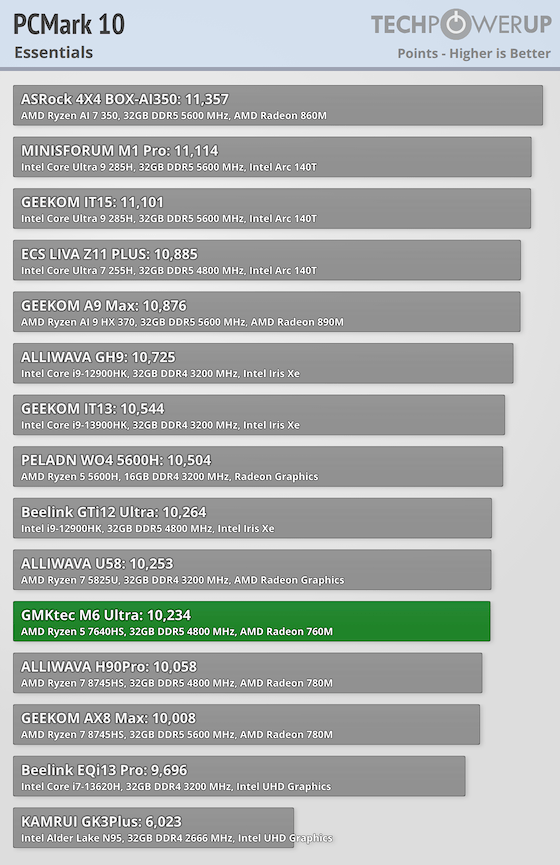
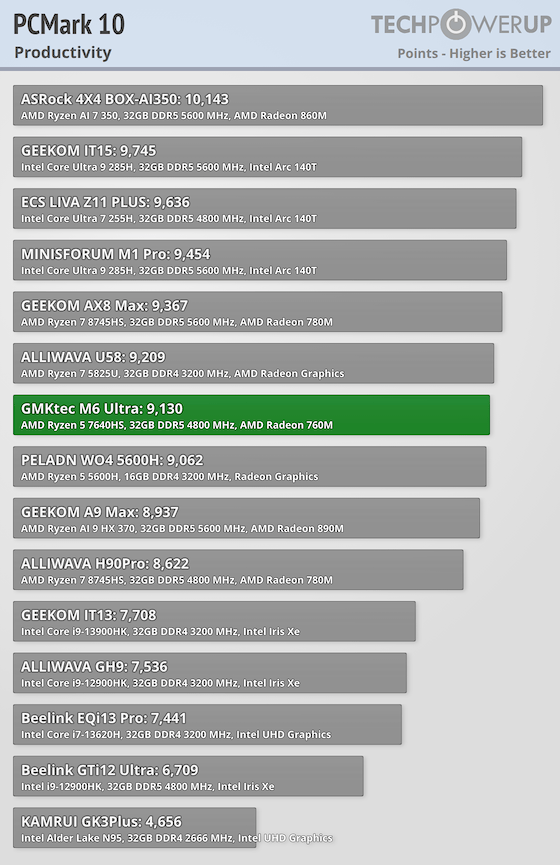
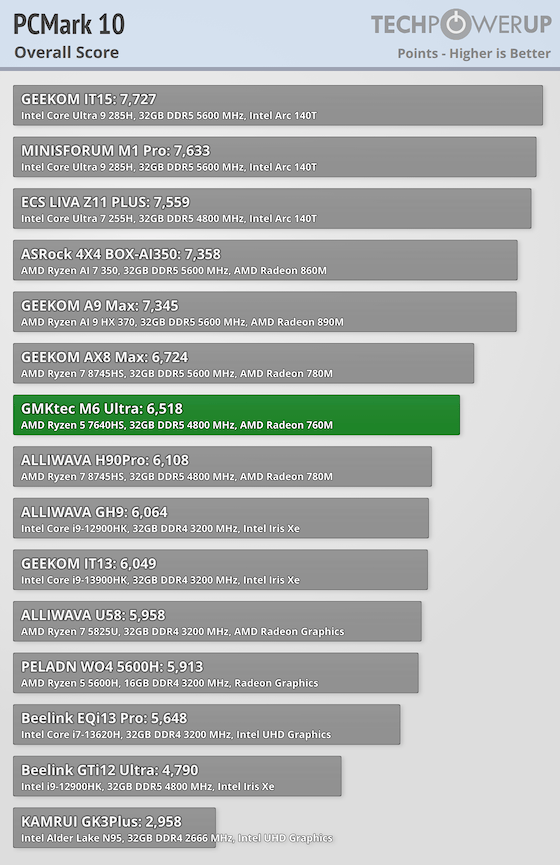
The M6 Ultra scores 10,234 in Essentials, 9,130 in Productivity, 8,042 in Digital Content Creation, and an overall score of 6,518. Essentials performance is strong, which lines up with how fast the system feels during web use and general desktop work. Productivity results are also decent for office tasks and multitasking.
Y-Cruncher
Y-Cruncher stresses the CPU with an extremely heavy math workload, making it a good stress test for stability and raw compute.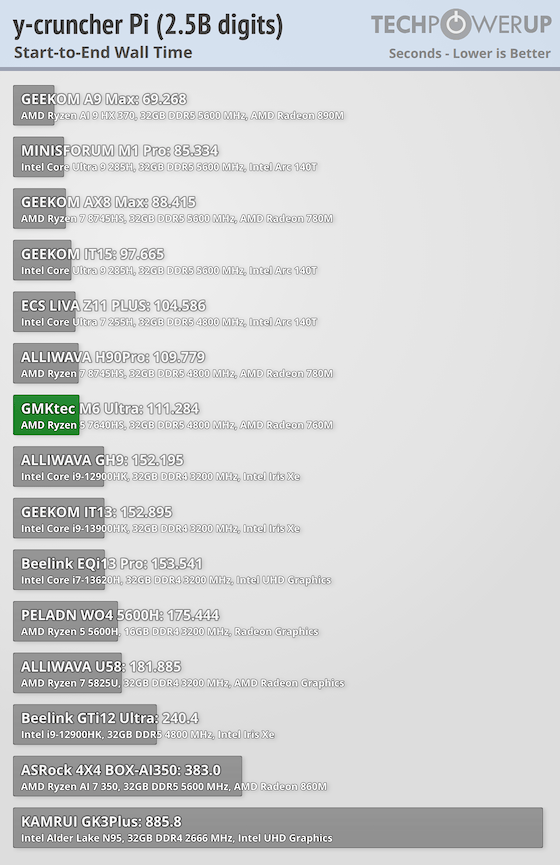
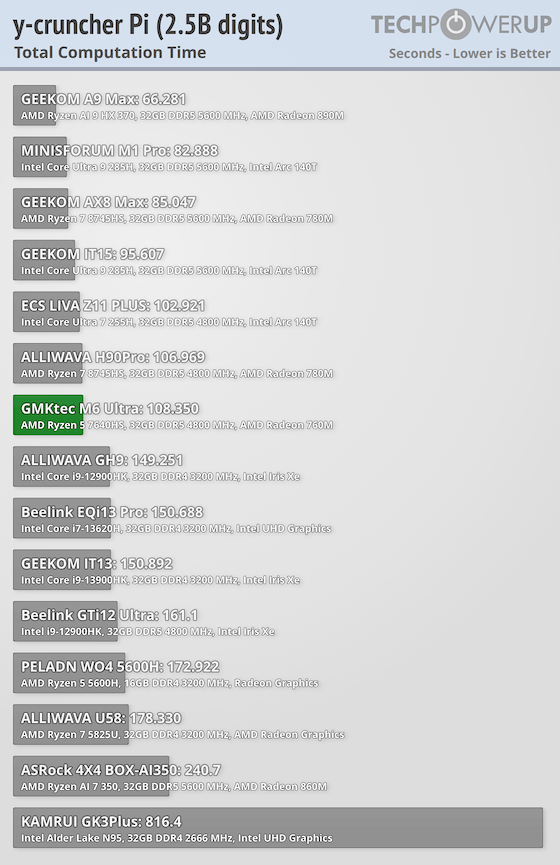
The M6 Ultra completes the 2.5B Pi calculation in 108.350 seconds, with a wall time of 111.284 seconds. That places it behind higher-end Ryzen AI and Core Ultra systems, but still well ahead of older U-series and budget CPUs. For a compact Ryzen 5 system, this is solid sustained performance.
Geekbench
Geekbench covers a wide range of real workloads and gives a balanced look at CPU strength.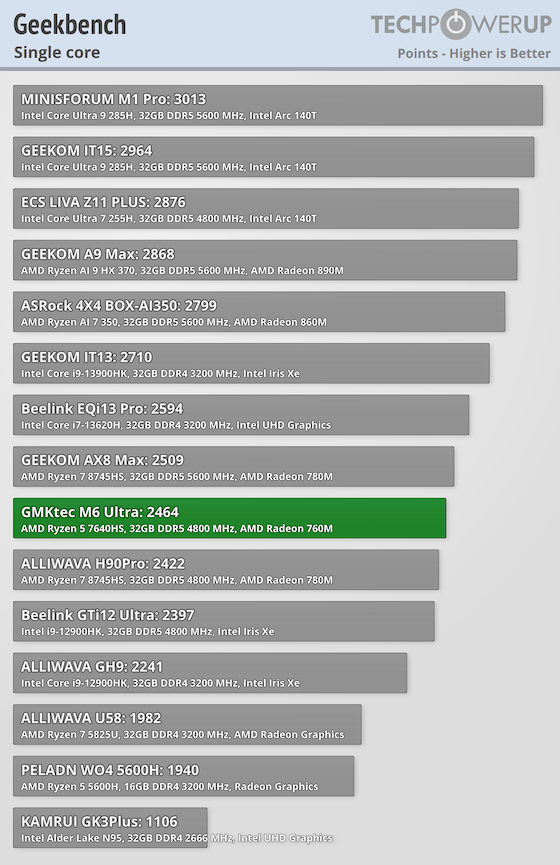
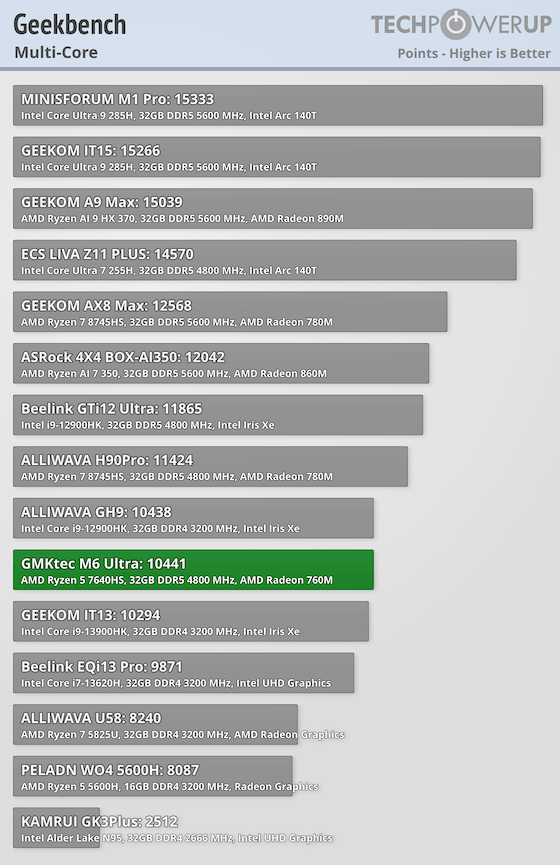
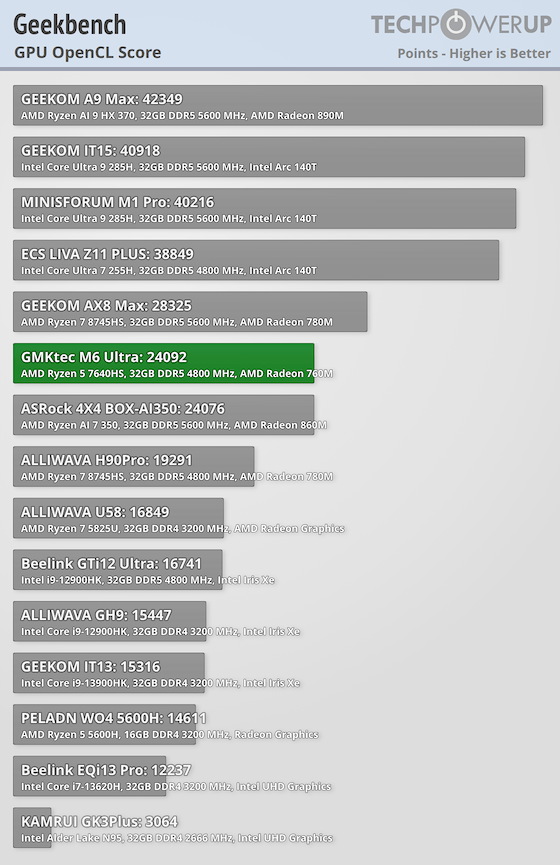
On the GMKtec M6 Ultra, Geekbench comes in at 2,191 single-core and 9,871 multicore. For GPU compute, it hits 24,597 in OpenCL. The CPU score tells us that it should perform well in everyday use, while the OpenCL result gives the iGPU enough room for lighter creative work and acceleration-friendly apps, as long as expectations stay in iGPU territory.
Nov 13th, 2026 22:26 CST
change timezone
Latest GPU Drivers
New Forum Posts
- What are you playing? (26214)
- Tell me about your favourite graphics card (30)
- no "PhysX" workable (8)
- AI generated images... (224)
- Crimson Desert (31)
- RenoDX HDR - how to view the differnce Before&After in game? (0)
- Displayport DP80 3M (10ft) cable that can achieve 80gbps stable? (5)
- I'll flash a ASUS ROG Strix RX480 O8G in Cause of Code 43, as a Newbie (1)
- Opinion on Monitor Replacement (6)
- TMOG - post your benchmark results here (16)
Popular Reviews
- AMD Zen 6 Technical Deep Dive
- Corsair HX1000i Shift Crystal Review
- NZXT C1200 Platinum Review
- Upcoming Hardware Launches 2027 (Updated Nov 2026)
- ASUS ROG Strix B850-I Gaming Wi-Fi7 W Review
- Montech King 95 3D PRO Review
- NZXT H7 RGB+ Review
- NZXT H5 Review
- Phantom Blade Zero Performance Benchmark Review - 35 GPUs Tested
- XPG NIMBUS PLUS Review - Mid-range Chair With Strong Competitors
TPU on YouTube
Controversial News Posts
- NVIDIA Co-Founder and CEO Jensen Huang Officially Resigns (379)
- OpenAI CEO Argues Home PCs Waste the World's Limited DRAM Supply (152)
- NVIDIA Launches Investigation Into Jensen Huang's Relationship With Suspected Chinese Spy (136)
- Intel "Raptor Lake Next" 16-Core and 20-Core CPUs Surface (130)
- Legendary Game Studio BioWare Shuts Down Following EA Layoffs (104)
- Dell CEO Says the Memory Shortage Will Get Worse in 2027 (95)
- NVIDIA GeForce RTX 50-Series Scheduled for up to $500 Price Hike This Week (89)
- Modder Fits RTX 5090 With Four 8-Pin Connectors, Halving Current per Wire (80)