 49
MSI GeForce RTX 5080 Expert OC Review
Pictures & Teardown »Introduction

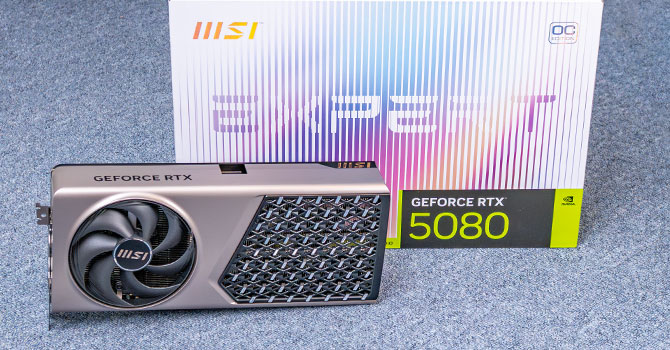
MSI GeForce RTX 5080 Expert OC is a premium custom design RTX 5080 graphics card by MSI that targets creators and content professionals primarily, and gamers that want a graphics card with a mature-looking design in their builds. It is also an attempt by the company to level up to the artistic finesse of NVIDIA's first-party Founders Edition. MSI launched Expert-series graphics cards based on the GeForce RTX 5080 and the RTX 5070 Ti just a few days ago, with regular and OC variants. In this review, we take the top RTX 5080 Expert OC for a spin.
MSI debuted the Expert line of graphics cards with the previous generation RTX 4080 Super and RTX 4070 Ti Super, and tried to replicate the dual-axial flow-through cooler design of the RTX 40-series Founders Edition graphics cards. We reviewed the RTX 4080 Super Expert, but were left disappointed, as the card offered close to no performance uplift over the Founders Edition card, and had the weakest cooling solution. MSI likely put great effort into redesigning its RTX 50-series Expert graphics cards without losing out on the core design language that defines Expert—high build quality, premium and sophisticated looks, and MSI's own take on dual-axial flow-through. The Expert series is part of MSI's two-pronged approach to exceeding the standards set by Founders Edition cards. The Expert series targets creators that game on the side, while the SUPRIM series targets enthusiast gamers. Creators can pair the MSI RTX 5080 Expert OC with NVIDIA's GeForce Studio drivers that are optimized for a number of content creation productivity suites.
The GeForce RTX 5080 is a powerful enthusiast-segment GPU that's next only to the flagship RTX 5090. It is designed for maxed out gameplay at 4K Ultra HD resolution, including with ray tracing, and the new DLSS 4 with Multi Frame Generation enabling newer experiences, such as 4K high refresh-rate. The RTX 5080 is powered by the Blackwell graphics architecture, which introduces Neural Rendering, a potentially revolutionary concept in consumer 3D graphics, which leverages generative AI models to create photorealistic objects that are combined with raster 3D graphics the same way ray traced objects are. DLSS 4 sees NVIDIA replace the convoluted neural network (CNN) based AI models driving the upscaling, ray-reconstruction, and frame-generation features with newer transformer based models that are more accurate and improve image quality at every performance tier. Multi Frame Generation lets up to 3 frames following every conventionally rendered frame to be drawn by AI, effectively quadrupling frame-rates and reducing CPU requirements of high refresh rate gaming.
With Blackwell, NVIDIA has improved every key component of the GPU over the previous Ada Lovelace architecture, which is important given that the company is building these chips on the same NVIDIA 4N foundry node. The new Blackwell CUDA cores not just introduce generational IPC increases, but are also redesigned to accelerate neural shaders. The 4th generation RT core, besides lowering the performance cost of ray tracing, comes with optimization for mega geometry—ray traced objects with much more complex geometry (more surfaces for rays to interact with). The 5th generation Tensor cores lay the groundwork for not just for neural rendering, but also introduce support for newer data formats, including FP4.
The GeForce RTX 5080 is based on the GB203 silicon, which it maxes out, enabling all 84 streaming multiprocessors (SM) physically present on the chip. It also comes with 16 GB of 30 Gbps GDDR7 memory across the chip's full 256-bit wide memory bus, for 960 GB/s of memory bandwidth. With 84 SM, the RTX 5080 gets 10,752 CUDA cores, 336 Tensor cores, 84 RT cores, 336 TMU, and the chip's full complement of 112 ROPs. NVIDIA also took the opportunity to modernize the display controllers of the GPU to support the latest DisplayPort 2.1 with UHBR20 and HDMI 2.1 standards; and updated the video encode and decode acceleration engines.
MSI has boosted the GeForce RTX 5080 Expert OC factory overclocked speeds to 2715 MHz boost compared to 2617 MHz on the reference, while leaving the memory untouched at 30 Gbps (GDDR7 effective). The company has given this card the same marquee as its MSI PRO range of commercial notebooks and desktops targeting creators and businesses. The MSI RTX 5080 Expert OC is priced at $1300 in the United States, but in Europe you can find it for the equivalent of $1100.
| Price | Cores | ROPs | Core Clock | Boost Clock | Memory Clock | GPU | Transistors | Memory | |
|---|---|---|---|---|---|---|---|---|---|
| RTX 4070 Super | $600 | 7168 | 80 | 1980 MHz | 2475 MHz | 1313 MHz | AD104 | 35800M | 12 GB, GDDR6X, 192-bit |
| RX 7900 GRE | $550 | 5120 | 160 | 1880 MHz | 2245 MHz | 2250 MHz | Navi 31 | 57700M | 16 GB, GDDR6, 256-bit |
| RTX 4070 Ti | $700 | 7680 | 80 | 2310 MHz | 2610 MHz | 1313 MHz | AD104 | 35800M | 12 GB, GDDR6X, 192-bit |
| RTX 5070 | $550 | 6144 | 80 | 2325 MHz | 2512 MHz | 1750 MHz | GB205 | 31100M | 12 GB, GDDR7, 192-bit |
| RTX 4070 Ti Super | $750 | 8448 | 96 | 2340 MHz | 2610 MHz | 1313 MHz | AD103 | 45900M | 16 GB, GDDR6X, 256-bit |
| RX 7900 XT | $620 | 5376 | 192 | 2000 MHz | 2400 MHz | 2500 MHz | Navi 31 | 57700M | 20 GB, GDDR6, 320-bit |
| RX 9070 | $550 | 3584 | 128 | 2070 MHz | 2520 MHz | 2518 MHz | Navi 48 | 53900M | 16 GB, GDDR6, 256-bit |
| RX 9070 XT | $615 | 4096 | 128 | 2400 MHz | 2970 MHz | 2518 MHz | Navi 48 | 53900M | 16 GB, GDDR6, 256-bit |
| RTX 5070 Ti | $750 | 8960 | 96 | 2295 MHz | 2452 MHz | 1750 MHz | GB203 | 45600M | 16 GB, GDDR7, 256-bit |
| RX 7900 XTX | $750 | 6144 | 192 | 2300 MHz | 2500 MHz | 2500 MHz | Navi 31 | 57700M | 24 GB, GDDR6, 384-bit |
| RTX 4080 | $850 | 9728 | 112 | 2205 MHz | 2505 MHz | 1400 MHz | AD103 | 45900M | 16 GB, GDDR6X, 256-bit |
| RTX 4080 Super | $1000 | 10240 | 112 | 2295 MHz | 2550 MHz | 1438 MHz | AD103 | 45900M | 16 GB, GDDR6X, 256-bit |
| RTX 5080 | $1000 | 10752 | 112 | 2295 MHz | 2617 MHz | 1875 MHz | GB203 | 45600M | 16 GB, GDDR7, 256-bit |
| MSI RTX 5080 Expert OC | $1100 | 10752 | 112 | 2295 MHz | 2715 MHz | 1875 MHz | GB203 | 45600M | 16 GB, GDDR7, 256-bit |
| RTX 4090 | $1800 | 16384 | 176 | 2235 MHz | 2520 MHz | 1313 MHz | AD102 | 76300M | 24 GB, GDDR6X, 384-bit |
| RTX 5090 | $2200 | 21760 | 176 | 2017 MHz | 2407 MHz | 1750 MHz | GB202 | 92200M | 32 GB, GDDR7, 512-bit |
Nov 18th, 2026 15:39 PST
change timezone
Latest GPU Drivers
New Forum Posts
- Got a new laptop! What should I do with it? (4)
- Dell Workstation Owners Club (3514)
- Making a game in Godot engine (2)
- [Poll] 12V-2x6 Connector Protection: What Are You Using? (WireView / Ampinel / Equalizer / Other / Nothing) (39)
- Last game you purchased? (1406)
- Time to upgrade CPU and MOBO (34)
- Can i play GTA 6 now? (Joke) (7)
- Honestly, do you care about GTA VI? (146)
- What are you playing? (26234)
- Very unusual two gaming-pc scenarios. (12)
Popular Reviews
- Acemagic Retro X3 Review
- Upcoming Hardware Launches 2027 (Updated Nov 2026)
- AMD Zen 6 Technical Deep Dive
- ASUS ROG Strix B850-I Gaming Wi-Fi7 W Review
- Corsair HX1000i Shift Crystal Review
- Ugreen NASync DXP4800 GT Review
- Biwin Black Opal NV7400 2 TB Review
- Pulsar Office Tour & First Look at P1 Dual-Sensor Mouse
- AMD Ryzen 7 9800X3D Review - The Best Gaming Processor
- Chieftec Iceberg PRO 360 DARK Review
TPU on YouTube
Controversial News Posts
- NVIDIA Co-Founder and CEO Jensen Huang Officially Resigns (478)
- Report: Jensen Huang Eyes NVIDIA Comeback (192)
- Open Letter Asking NVIDIA to Reinstate Jensen Huang Passes 115,000 Signatures (184)
- OpenAI CEO Argues Home PCs Waste the World's Limited DRAM Supply (152)
- NVIDIA Launches Investigation Into Jensen Huang's Relationship With Suspected Chinese Spy (136)
- Intel "Raptor Lake Next" 16-Core and 20-Core CPUs Surface (130)
- Legendary Game Studio BioWare Shuts Down Following EA Layoffs (104)
- Dell CEO Says the Memory Shortage Will Get Worse in 2027 (95)