 11
QNAP TS-432X Review - Arm Based NAS
Value & Conclusion »Power
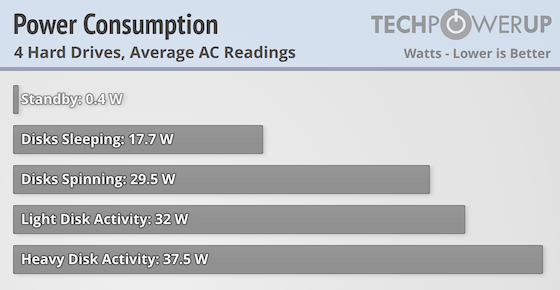
Arm based SoCs are generally known for being power efficient, but it seems like the Annapurna Labs Alpine AL524 is just getting too old to be power efficient against the most recent generations of Intel SoCs, at least if we compare it to the Intel Processor N95 in the TerraMaster F4-424. The two are almost identical in terms of power use, although we did change to a more accurate means of measuring power usage, as it can measure power usage below 1 watt. However, it doesn't deviate much from our old readings once we move above 10 watts, which is where most of the NAS devices we test tend to be in terms of power usage while switched on. In use, there's a negligible difference between the two devices and it shows that the old Arm Cortex-A57 doesn't quite cut it in terms of power efficiency. Note that the power consumption test was done with the TS-432X connected via its native 2.5 Gbps Ethernet interface and the 10 Gbps card we used for testing removed from the NAS. We have the same kind of gripe here as with the TerraMaster F4-424, the idle power draw is too high, but beyond that, the power usage is reasonable. We did see a few peaks at 40 to 50 watts, but these lasted at the most for 10 to 20 seconds, and we even saw the rare spike when at idle otherwise. That said, there's nothing out of the ordinary here, but we also weren't able to meet QNAP's lower claims of a mere 13 watts with the hard drives at idle, although the power usage during operation was similar to QNAP's 33 watt figure.
Noise
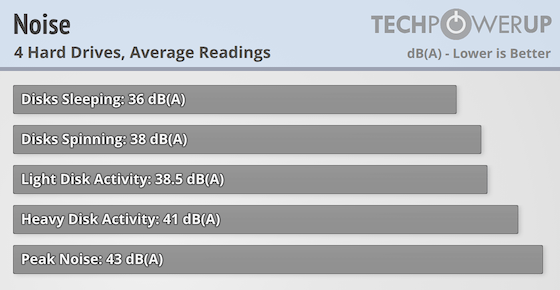
The 120 mm fan in the TS-432X was running at a fairly low 930 rpm during normal operation, and we never saw it go past 960 rpm during our testing. As such, the variation in noise isn't that huge and what you really hear is the noise from the hard drives. This is also why the noise test didn't see any big jumps either. The cheaply made drive caddies do seem to make the TS-432X a tad noisier than it should have to be though, as they don't appear to absorb the vibrations from the drives in the same way as some of the better NAS drive caddies do. Even so, at a meters distance, all you really hear is the grinding noise of the drives and nothing from the fan, so the TS-432X is unlikely to annoy anyone due to loud or high-pitched fan noise, as there is next to none unless you get really close to it.
Temperature
As QNAP has been in the NAS game for quite some time, all the features you'd expect to find are present in the QTS operating system, including extensive temperature monitoring. At idle, the system temperature was reported as 30 degrees C, with the CPU at 47 degrees C and the drives at between 26 and 28 degrees C. Even during reasonably heavy use—using the 2.5 Gbps interface—the CPU temperature never exceeded 50 degrees C and the drives didn't exceed 32 degrees C, suggesting that QNAP has done a good job when it comes the cooling setup of the TS-432X. We'd expect the temperatures to increase somewhat if a 10 Gbps add-in card is used, as at least the Aquantia/Marvell cards that QNAP offers as an optional upgrade, produce a fair bit of heat.
Nov 14th, 2026 00:18 CST
change timezone
Latest GPU Drivers
New Forum Posts
- Requesting original VBIOS for Gigabyte RX 5700 XT GAMING OC 8G Rev 2.0 (Micron) (1)
- Tell me about your favourite graphics card (35)
- What are you playing? (26216)
- no "PhysX" workable (9)
- AI generated images... (224)
- Crimson Desert (31)
- RenoDX HDR - how to view the differnce Before&After in game? (0)
- Displayport DP80 3M (10ft) cable that can achieve 80gbps stable? (5)
- I'll flash a ASUS ROG Strix RX480 O8G in Cause of Code 43, as a Newbie (1)
- Opinion on Monitor Replacement (6)
Popular Reviews
- AMD Zen 6 Technical Deep Dive
- Corsair HX1000i Shift Crystal Review
- NZXT C1200 Platinum Review
- Upcoming Hardware Launches 2027 (Updated Nov 2026)
- ASUS ROG Strix B850-I Gaming Wi-Fi7 W Review
- Montech King 95 3D PRO Review
- NZXT H7 RGB+ Review
- NZXT H5 Review
- Phantom Blade Zero Performance Benchmark Review - 35 GPUs Tested
- XPG NIMBUS PLUS Review - Mid-range Chair With Strong Competitors
TPU on YouTube
Controversial News Posts
- NVIDIA Co-Founder and CEO Jensen Huang Officially Resigns (380)
- OpenAI CEO Argues Home PCs Waste the World's Limited DRAM Supply (152)
- NVIDIA Launches Investigation Into Jensen Huang's Relationship With Suspected Chinese Spy (136)
- Intel "Raptor Lake Next" 16-Core and 20-Core CPUs Surface (130)
- Legendary Game Studio BioWare Shuts Down Following EA Layoffs (104)
- Dell CEO Says the Memory Shortage Will Get Worse in 2027 (95)
- NVIDIA GeForce RTX 50-Series Scheduled for up to $500 Price Hike This Week (89)
- Modder Fits RTX 5090 With Four 8-Pin Connectors, Halving Current per Wire (80)