 10
Sandisk DC SN861 7.68 TB Review
Thermal Analysis & Throttling »Machine Learning - AI
To evaluate SSD performance in real-world AI workloads, we tested the load times of various deep learning models. These include both image classifiers (such as ResNet, VGG19, and EfficientNet) and a large language model (LLaMA 2 7B). Since model sizes and complexities vary widely, we calculated the geometric mean across all tests to provide a clear and balanced comparison. The chart below gives an at-a-glance view of which drives handle AI-related loading tasks most efficiently.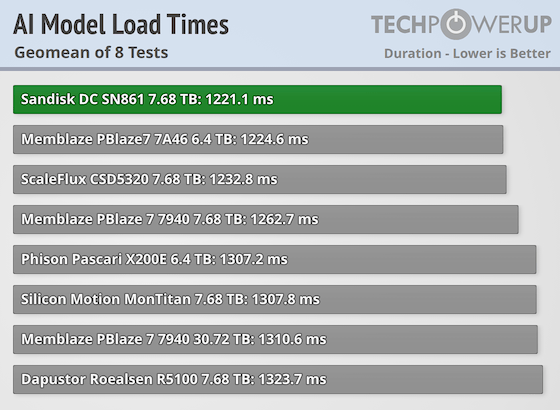
The chart above presents the average of all our comparisons, including tests with LLMs (Large Language Models) such as LLaMA 2 7B, as well as various image classification models that will be detailed below.
Individual Test Results
Large Language Models
To evaluate real-world AI performance, we use a benchmark that measures the time it takes to load the LLaMA 2 7B large language model from SSD storage into system and GPU memory. The procedure replicates a typical machine learning workflow, where models need to be initialized quickly for inference or fine-tuning. Using the Hugging Face Transformers library in offline mode ensures the model is loaded entirely from local storage, without network interference. The tokenizer and full model are preloaded using PyTorch in float16 precision to simulate a realistic deployment scenario, and the total loading time—from disk to memory—is recorded. By running the benchmark test across multiple SSDs, we can identify which ones deliver the fastest model initialization times, a critical factor for AI tasks that demand low startup latency.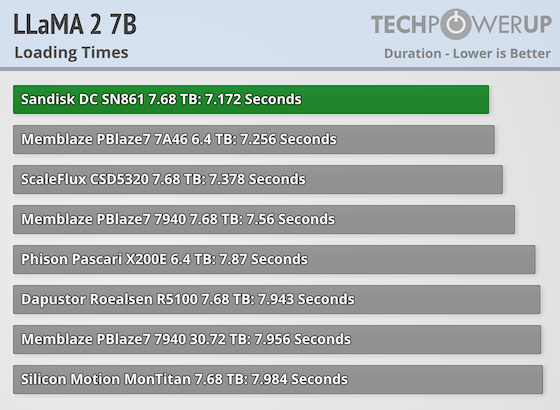
Image Classification Models Benchmark
Our benchmark measures the loading time of large image classification models by analyzing two stages: transfer from SSD to system memory, and then to the GPU. Each model is loaded 20 times to calculate an average and standard deviation for reliable results.The goal is to compare loading efficiency across architectures—particularly important in production environments where startup time affects overall performance, such as real-time inference or resource-constrained systems. These results help highlight models that strike a good balance between accuracy and load time.
Resnet 101
ResNet-101 is a deep convolutional neural network with 101 layers, designed to improve training in very deep models using residual connections. These shortcuts help prevent vanishing gradients, allowing the network to learn complex features effectively. It's widely used in image classification and object detection tasks.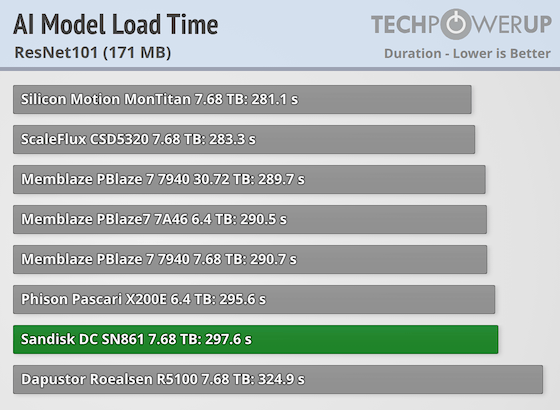
Resnet 152
ResNet-152 is a deep convolutional neural network with 152 layers, part of the ResNet family, known for using residual connections to enable training of very deep models. These shortcut connections help prevent vanishing gradients, allowing the network to learn effectively even at great depth. ResNet-152 offers high accuracy and is commonly used in image classification, object detection, and other computer vision tasks that require deep feature learning.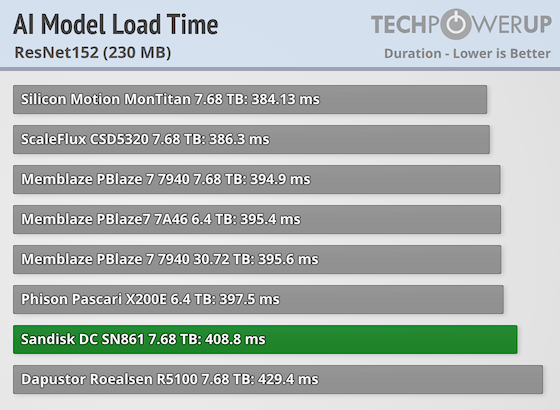
Resnet 201
ResNet-201 is an extended version of the ResNet architecture with 201 layers, designed to capture even more complex patterns in visual data. Like other ResNet models, it uses residual connections to maintain training efficiency and prevent issues like vanishing gradients. It's commonly used in high-accuracy image classification and deep feature extraction tasks.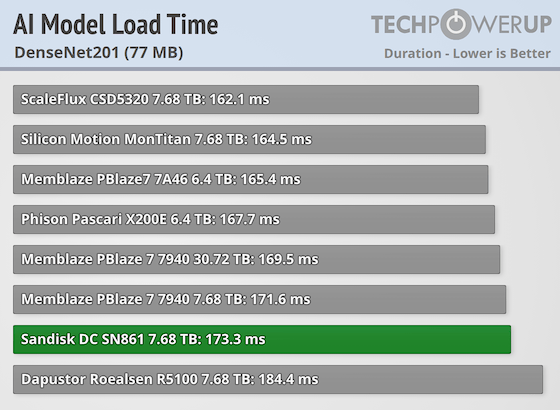
VGG19
VGG19 is a deep convolutional neural network with 19 layers, developed by the Visual Geometry Group at the University of Oxford. It uses a simple architecture based on stacked 3x3 convolutional layers and 2x2 max-pooling, followed by fully connected layers. Despite its simplicity, VGG19 is known for its strong performance in image classification tasks and has been widely used for feature extraction and transfer learning.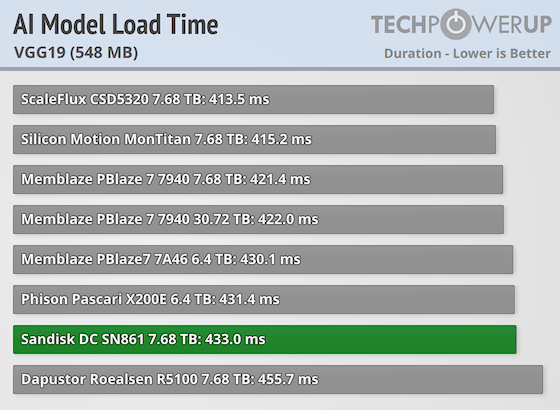
InceptionV3
InceptionV3 is a deep convolutional neural network developed by Google as part of the Inception family. It features a highly optimized architecture that uses parallel convolutional layers of different sizes within the same module, allowing the network to capture features at multiple scales efficiently. InceptionV3 balances depth and computational cost, making it both powerful and relatively lightweight compared to other deep models. It's widely used for image classification, object detection, and transfer learning tasks.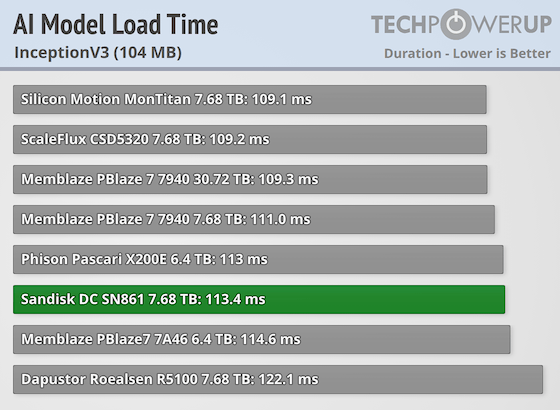
EfficientNet
EfficientNet is a family of convolutional neural networks developed by Google that focuses on optimizing accuracy while minimizing computational cost. It introduces a compound scaling method that uniformly scales depth, width, and resolution using a simple coefficient, achieving better performance with fewer parameters. EfficientNet models are known for being highly efficient and accurate, outperforming many larger networks in image classification and transfer learning tasks across various benchmarks.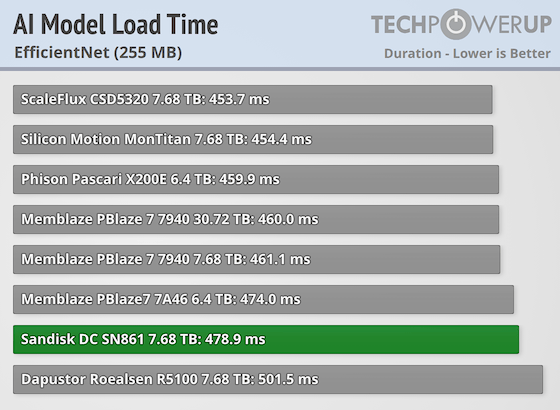
Swin Transformer B
Swin Transformer-B (Base) is a vision transformer model designed for image recognition and other computer vision tasks. Unlike traditional CNNs, it uses self-attention mechanisms in a hierarchical structure, processing images in non-overlapping windows that shift across layers—hence the name Swin (Shifted Windows). The "B" version refers to the Base model, which balances performance and computational cost. Swin Transformer-B achieves strong accuracy on benchmarks like ImageNet and is widely used in tasks like object detection, segmentation, and image classification.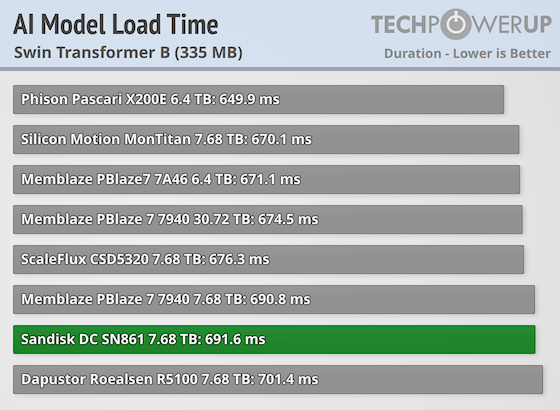
Nov 15th, 2026 21:15 CST
change timezone
Latest GPU Drivers
New Forum Posts
- GPU Temperatures Rise Very Quickly in FurMark – Is This Normal? (6)
- Will zen 6 mobos have anything extra vs current ones? (46)
- Your PC ATM (36435)
- It’s been fascinating times in Retro agian r36s isn’t even worth 50-65 dollars no more and newly listed Rm36 64gb 4in IPS models for only 34 dollars. (6)
- Power supply noise stops when I move the mouse (10)
- Can you guess Which game it is? (320)
- What is the latest game you finished or 100% (203)
- HP Office Jet 7740 Pro - Supply system problem with replacement cartridge (4)
- What are you playing? (26224)
- WarpCoreBench scores! (55)
Popular Reviews
- ASUS ROG Strix B850-I Gaming Wi-Fi7 W Review
- Corsair HX1000i Shift Crystal Review
- AMD Zen 6 Technical Deep Dive
- Upcoming Hardware Launches 2027 (Updated Nov 2026)
- Montech King 95 3D PRO Review
- NZXT C1200 Platinum Review
- Phantom Blade Zero Performance Benchmark Review - 35 GPUs Tested
- AMD Ryzen 7 9800X3D Review - The Best Gaming Processor
- NZXT H5 Review
- NZXT H7 RGB+ Review
TPU on YouTube
Controversial News Posts
- NVIDIA Co-Founder and CEO Jensen Huang Officially Resigns (430)
- Open Letter Asking NVIDIA to Reinstate Jensen Huang Passes 115,000 Signatures (184)
- OpenAI CEO Argues Home PCs Waste the World's Limited DRAM Supply (152)
- NVIDIA Launches Investigation Into Jensen Huang's Relationship With Suspected Chinese Spy (136)
- Intel "Raptor Lake Next" 16-Core and 20-Core CPUs Surface (130)
- Legendary Game Studio BioWare Shuts Down Following EA Layoffs (104)
- Dell CEO Says the Memory Shortage Will Get Worse in 2027 (95)
- NVIDIA GeForce RTX 50-Series Scheduled for up to $500 Price Hike This Week (89)