Tuesday, August 25th 2009

Intel Plans 3.40 GHz Celeron E3900 for 2010
Although a large chunk of products based on the new sockets LGA-1156 and LGA-1366 arrive in 2010, effectively pushing LGA-775 out of the extreme, performance, and upper mainstream segments, Intel will continue launching new low-end LGA-775 processors in an effort to digest inventories of motherboards and memory compatible to that socket. The company's grassroot processor brand Celeron will be updated with the E3000 series, consisting of dual-core processors based on the Wolfdale-1M core. The 45 nm based core offers the essential features for basic computing, while running cool and priced low.
Two quarters ahead of its expected launch, sources in the Chinese media unearthed Celeron E3900, perhaps the last SKU in the E3000 series. Slated for Q1 2010, the Celeron E3900 runs at 3.40 GHz (200 MHz x 17), with an FSB speed of 800 MHz. It has a shared L2 cache size of 1 MB, and supports the most common instruction sets including SSE3, SSSE3, and x86-64, although SSE4.1 and Intel-VT isn't part of it. The latest company roadmap of the essential and value segments show that the company looks as far as Q3 2010 with its Celeron and Core 2 Duo brand products, with existing number schemes. In essence, retailers in Q3 2010 shouldn't have stock problems selling you these processors.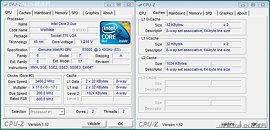
Source:
INPAI
Two quarters ahead of its expected launch, sources in the Chinese media unearthed Celeron E3900, perhaps the last SKU in the E3000 series. Slated for Q1 2010, the Celeron E3900 runs at 3.40 GHz (200 MHz x 17), with an FSB speed of 800 MHz. It has a shared L2 cache size of 1 MB, and supports the most common instruction sets including SSE3, SSSE3, and x86-64, although SSE4.1 and Intel-VT isn't part of it. The latest company roadmap of the essential and value segments show that the company looks as far as Q3 2010 with its Celeron and Core 2 Duo brand products, with existing number schemes. In essence, retailers in Q3 2010 shouldn't have stock problems selling you these processors.

30 Comments on Intel Plans 3.40 GHz Celeron E3900 for 2010
The introduction of running the CPU at a ratio instead of on par with the bus was a great improvement in CPU design. It's a lot easier to design a CPU with a higher multiplier than it is to make one with a faster bus rate. And up to x8-x12 it gives good increases in performance. But when you go past that the curve gets shallower, it levels out some, it still increases as the multi goes up but not nearly as fast as it did for lower multipliers.
@JrRacinFan: I understand, and we're both pretty much arguing the same side of the argument. But threads like this (and the thread at TSF that I linked this from) get read by a lot of people over time. You google "Intel E3900" and this is one of the first results. So I'm mostly trying to put information out there for those who don't know a ton, who maybe just know the basics.
Obviously the higher bus speed gives better performance, so two processors clocked at the same speed can perform differently, the one with the lower multipler and higher bus speed will perform better, this is common overclocking knowledge. If you max out the chip before the board, lower the multipler to push a little more performance out of it. It is for this very reason that I lowered the multipler on my Q6600 to 8, and ran the board at 400MHz, the chip would only do 3.2GHz. The same is true of my E1400.
However, I don't believe the issue with the high multipler is as big as you make it seem. And overclockers will definitely be lowering the multiplier on this thing to get higher FSB speeds. I mean just to get to 266FSB, the processor will need to run at 4.5GHz, and I highly doubt this processor will be good for that speed on reasonable cooling(though maybe).
Essentially what Intel has done is given us the closes thing we are going to get to a cheap unlocked Wolfdale. Having a multipler that can vary anywhere between 17 and 6 is going to be fun.
Either way, we agree that the higher bus improves performance, not because there is a dely caused by the multiplier, but because there is more bandwidth to communicate with the rest of the system.
Bandwidth good, multi "bad" :p