Thursday, September 21st 2017
AMD CrossFireX Scaling is Actually Pretty Terrible with Mixed RX Vega
Yes, this is the third post today about AMD introducing multi GPU support for RX Vega with their Crimson ReLive 17.9.2 beta drivers but it had to be made. First up, the caveats- we were only able to test the driver on a CrossFire setup involving one RX Vega 64 and one RX Vega 56 GPU so results with two of the same may differ. Secondly, these are beta drivers so there is a level of lenience here I am willing to afford to AMD. That said, the driver which came with its own announcement and internal results had to show something good and this means showing good scaling across multiple games.
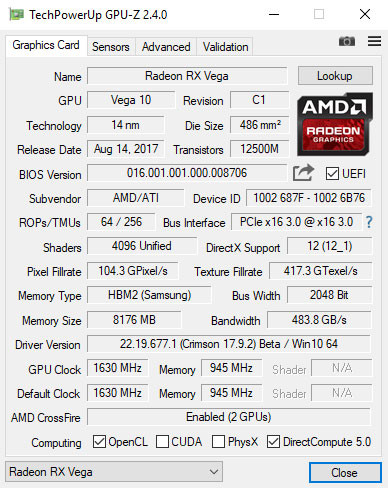
The driver allows CrossFire to be enabled with a mix of the two Vega 10 SKUs, and we set about testing a few games from our GPU benchmark suite using the same testing methodology as always. Tests were done at 4K to minimize a CPU bottleneck of any kind, and the games tested include some of the most popular games today including some that AMD themselves used in the announcement. However, after a few hours of testing, we can simply not recommend using the driver for CrossFire- at least for a mixed setup as we did. More on this after the break.

 Enabling CrossFire with GPUs that are based off the same die and family but with a different shader count has been something AMD has done for a few generations now, and we continue to appreciate this remaining an option. However, this is no excuse for the performance we are seeing here, be it a driver issue or otherwise. As can be seen from the chart above, a lot of games not only show poor scaling relative to a single RX Vega 64 but actually negative scaling. The negative scaling can potentially be a result of Vega 56 slowing down the Vega 64 card here, but then we are back to zero to minimal scaling again. Of the four games that do, three were in AMD's results chart that went around earlier today as well. This is really disappointing performance, and to make it worse we also faced visual artifacts and display corruption in a few games including Witcher 3 (pictured), Prey and Dishonored 2. We also tried having RX Vega 56 be the primary card to see if that changes anything, and the results were within error margins more often than not with a few results actually being higher (5-10%) than with RX Vega 64 as the primary card. There was also a blue screen that greeted us during the switch, so do not attempt to do so often.
There is another interesting train of thought departing this station of results. AMD has had CrossFire profiles for the previous Polaris (and older) architecture GPUs for most of the games tested here, and they showed consistent, if not great, scaling with those older cards. But based on the inconsistent scaling across game titles here, it appears that AMD may have to create new CrossFire profiles for all games with their RX Vega GPUs based off the Vega microarchitecture. This merits more analysis and testing, but we are definitely curious whether this is indeed the case and, if so, what is the reason behind it knowing that Vega is an evolution of GCN, and not a complete departure from it.
AMD, with Lisa Su temporarily taking over RTG leadership, has a big challenge ahead with the enthusiast graphics solutions market and we can only hope the situation is better with 2x RX Vega 64 (or 56), else this is another thing that is not going to help them.
The driver allows CrossFire to be enabled with a mix of the two Vega 10 SKUs, and we set about testing a few games from our GPU benchmark suite using the same testing methodology as always. Tests were done at 4K to minimize a CPU bottleneck of any kind, and the games tested include some of the most popular games today including some that AMD themselves used in the announcement. However, after a few hours of testing, we can simply not recommend using the driver for CrossFire- at least for a mixed setup as we did. More on this after the break.


There is another interesting train of thought departing this station of results. AMD has had CrossFire profiles for the previous Polaris (and older) architecture GPUs for most of the games tested here, and they showed consistent, if not great, scaling with those older cards. But based on the inconsistent scaling across game titles here, it appears that AMD may have to create new CrossFire profiles for all games with their RX Vega GPUs based off the Vega microarchitecture. This merits more analysis and testing, but we are definitely curious whether this is indeed the case and, if so, what is the reason behind it knowing that Vega is an evolution of GCN, and not a complete departure from it.
AMD, with Lisa Su temporarily taking over RTG leadership, has a big challenge ahead with the enthusiast graphics solutions market and we can only hope the situation is better with 2x RX Vega 64 (or 56), else this is another thing that is not going to help them.
73 Comments on AMD CrossFireX Scaling is Actually Pretty Terrible with Mixed RX Vega
I think Microsoft, Nvidia and AMD have repeated it like 1 million times and people still don't get it.
The perplexing part is why they use Vega instead of Polaris in Raven Ridge. I'd be interested in seeing a budget Vega card with GDDR5.
I used to love my ATI cards damn it.
Witcher 3 probably never got real crossfire support.
I did waste a lot of time trying to make it work flawlessly, and found no solution for blinking XP meter, for example.
AMD and ATI together, well, they have an advantage as long as x86 is the highest performing architecture.
DX12 is first and foremost a way to cut costs through homogenization with consoles AND enabling higher CPU performance for lower segment CPUs as core counts go up but clock speeds stay low. The rest? That's just some added bonus, that we may or may not get.
Why people still bother these days is beyond me.
At the end of the day there was nothing to predict because it was a known thing. A disproportionate response to that was unpredictable.
Don't know what misleading campaigns you have seen about Vega and gaming performance , if anything the amount of information they released was minimal at best. I don't remember any false statements they had on that matter , the crossfire demo was done without any performance metrics or other claims as far as I remember.
But on the other hand, it's different to have a card stressing the bus after overclocking and have a card stressing the bus at it's defaults. Polaris should have come out with an 8 pin or two 6 pin connectors. Or at lower frequencies. Tech press' response, about anything not perfect from AMD, it was already known, it wasn't something to predict, it was already known how the press will react and they should had avoided it.
Vega's campaign was also a mistake. AMD is NOT a football team, AMD shouldn't be running a marketing campaign about poor Voltas like it is addressing the typical, no brain, football team fanatic. Crossfire in presentations was also misleading and was making people questioning Vega's performance way before it's official announcement. Throwing Poor Voltas and Crossfires at the same time, was sending the opposite signals to people waiting for Vega and in the end backfired. I am considered an AMD fan and I was getting attacked by another member in a Greek forum for not believing that Vega will come close to 1080 Ti. Today forum members like that guy, AMD fans like that guy, had lost every credibility in the eyes of other members, because they believed that Poor Volta campaign.
I do agree on one thing though , they do know how the press reacts to everything they put out , but they never took that into account. Unfortunately when that will happen , they will just end up mirroring what Nvidia does and I'm not so sure the consumer will benefit from that.
The press' behavior has changed after Polaris. It's less negative towards AMD. There are some exceptions, like the way this article is written, but exceptions, not the rule like it was before Polaris.