Monday, June 22nd 2026
AMD FSR Upscaling 4.1 Officially Released for Radeon RX 7000 GPUs
AMD has officially released the RDNA 3-focused FSR Upscaling 4.1 model for the Radeon RX 7000 series of graphics cards. This marks the first step towards deploying the FSR 4 technology across all RDNA gaming GPUs. According to a post on X by AMD's Jack Huynh, Senior Vice President and General Manager of the Computing and Graphics Group, FSR Upscaling 4.1 is now available for RDNA 3 GPUs. With the latest AMD Software: Adrenalin Edition 26.6.2 graphics driver download, Radeon RX 7000 series gamers can enjoy more than 300 games running FSR 4.1, providing a significant performance boost and finally offering features that RDNA 4 gamers have been enjoying for a while. You can find some AMD-provided performance comparisons in the slides below.
We have confirmed that AMD's FSR Upscaling 4.1 model for RDNA 3 GPUs is fundamentally different from the RDNA 4 version. RDNA 4 has native processing for 8-bit floating point data, allowing FSR 4.1 on RDNA 4 to run on FP8 data types. To get the FSR 4.1 Upscaling model to run on RDNA 3, AMD must convert this to 8-bit integer data, as RDNA 3 hardware uses INT8 data types without FP8 support. Generally, integer math is sufficient to optimize these models, but the conversion work is necessary, which explains the delay between RDNA 4 and RDNA 3 support. This difference required AMD to completely modify the FSR 4.1 model for the new data type and ensure there is no quality loss in the final visual output. AMD officially states that the visual fidelity is on par with the FSR 4.1 model that runs on RDNA 4.
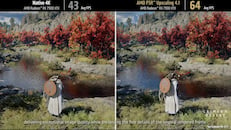
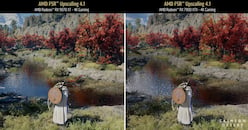
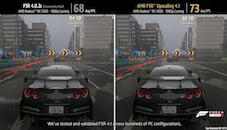 Finally, AMD is also addressing RDNA 3-based APUs. Since integrated graphics are inherently weaker than discrete GPU solutions, some additional performance optimizations are needed. AMD claims that they are working on this with fine-tuned "lightweight machine learning models" to support FSR 4.1. Whether this includes RDNA 3.5 remains to be seen, but Valve's recent leak of the INT8-based FSR 4.1 model shows that the technology runs on RDNA 3.5 without issues, so future updates from AMD are expected.

Source:
Jack Huynh on X
We have confirmed that AMD's FSR Upscaling 4.1 model for RDNA 3 GPUs is fundamentally different from the RDNA 4 version. RDNA 4 has native processing for 8-bit floating point data, allowing FSR 4.1 on RDNA 4 to run on FP8 data types. To get the FSR 4.1 Upscaling model to run on RDNA 3, AMD must convert this to 8-bit integer data, as RDNA 3 hardware uses INT8 data types without FP8 support. Generally, integer math is sufficient to optimize these models, but the conversion work is necessary, which explains the delay between RDNA 4 and RDNA 3 support. This difference required AMD to completely modify the FSR 4.1 model for the new data type and ensure there is no quality loss in the final visual output. AMD officially states that the visual fidelity is on par with the FSR 4.1 model that runs on RDNA 4.


106 Comments on AMD FSR Upscaling 4.1 Officially Released for Radeon RX 7000 GPUs
These GPUs should have been supported from the very start. The particulars of how it happens do not matter to gamers, who should have a thoroughly supported product and a first class experience.
I'm just going to say it, if the FSR 4 source code had never leaked, and people got first-hand experience that they had a working build as far back as the original FSR 4.0 release yet chose not to complete it due to corporate directive and a conscious decision to impose planned obsolescence on their previous generation GPUs in an effort to upsell some RX 9000 cards, you'd never have received this thing, nor that vague promise for an update for the RX 6000 series.
Also, those of us who understand GPU hardware and software know these things are not actually hardware locked despite what these companies claim, anything Nvidia/AMD/Intel makes could run interchangeably between these vendors, they just choose to not do it, it's not exactly a mystery.
Also, it still doesn't outdo DLSS 4.5 or even DLSS 4, both of which were available for all RTX users right at launch.
But I DO have several bones to pick. You honestly think I like spending thousands of dollars to deal with 600 watt electrical fire hazard? I do it because it's either this, or having half the performance on tap and being a complete afterthought to game developers, who more often than not scoff at the notion of Radeon GPUs. You never receive priority support for new features, that when they don't end up selectively disabled because of bugs and near-impossible communication with driver engineering. I can't even expect their cards to be fully supported for more than 2-3 years before it gets thrown in some "maintenance mode" scheme.
So, what's their answer? Half-heartedly release something that should've been out a year ago, and expect headpats for it.
I wish I could make this up, but since it doesn't bother any of you, that's well within your right, you make your choices, I make mine, what else can any of us do
What isn't surprising though is the Nvidia fans on a high horse coming in to hate anyway, I find it weird Nvidia users are so upset over something that doesn't affect them.
I do find it weird AMD users are so upset over the PC gaming community backlash netting an absolute win for RDNA 2-3.5 users both current and future, the word they're looking for is thankyou.
By the way you sound, you're not near hating AMD. You're knee deep in it. Whatever they do, you'll always find something that's wrong with their approach. Just look in the mirror, man. I know you'll reject this whole post, but at least I've tried.
On the topic, this is great news! The whole media shenanigans could have been done better, but at least the feature is here for RDNA 3 and that's what matters in the end.
If AMD had said something along the lines of "These are beta versions, we are working on a version that is better in performance and have the same image quality as in RDNA4, please give us some time" that would have been lightyears better than this mess and I would have been patiently waiting for the proper release.
That's probably the last time I'm going to moan on this mess. I will now go on to see how far upscaling has gone since FSR3...
The "something" could have been more vague than the lines I wrote, like "we are still working on polishing FSR4 on RDNA2/3 please be patient".
Now that would have gotten flak from opposite fanboys especially if the wait ended up being very long, but at least that sounds better than "no comment" in the ears of RDNA2/3 users.
I think some of us are looking for problems where there is none at this point. If you're an RDNA 3 user, you've got FSR 4 now, which is great. If you're not an RDNA 3 user, you don't care, which is also great. There's always a reason to be angry about something, but I'd rather take things at face value and be happy when I can. Everything else is a waste of time.
Many folks here on the forum here are quite permissible and forgiving, mostly because they're older folks whose needs and demands aren't exactly as strict anymore, have fond memories of their Radeons of the mid-2000's or dislike Nvidia's way of doing business. I don't particularly blame them for that. Sure, there's also the fanatical clique (I'm sure you can tell 🥰), but overall it tends to be reasonable-y. I stand out like a sore thumb because I'm happy to point out the elephant in the room.
So, I call out on their PR lies and backwards priorities all the time, for example, the insane fact they're currently pushing three driver branches with completely different code bases and functionality under the same name, that they've started to do aggressive market segmentation, etc. - these are truthful and verifiable statements, but it's a rather inconvenient image to have of something you're supposed to idolize, so the negative reaction is quite predictable.I mean, you know that this was never even in the cards, because from the very start, when we first learned about the existence of FSR 4, all the way back in that first leak... it already worked on all "unsupported" models. It wasn't finished, sure, but 90%+ of the work was already done. It just needed fine tuning and some optimization, which doesn't take 1-2 years to do unless this is the absolute lowest priority.