Friday, December 15th 2017

SAPPHIRE Launches Their RX Vega Nitro+ Series of graphics Cards
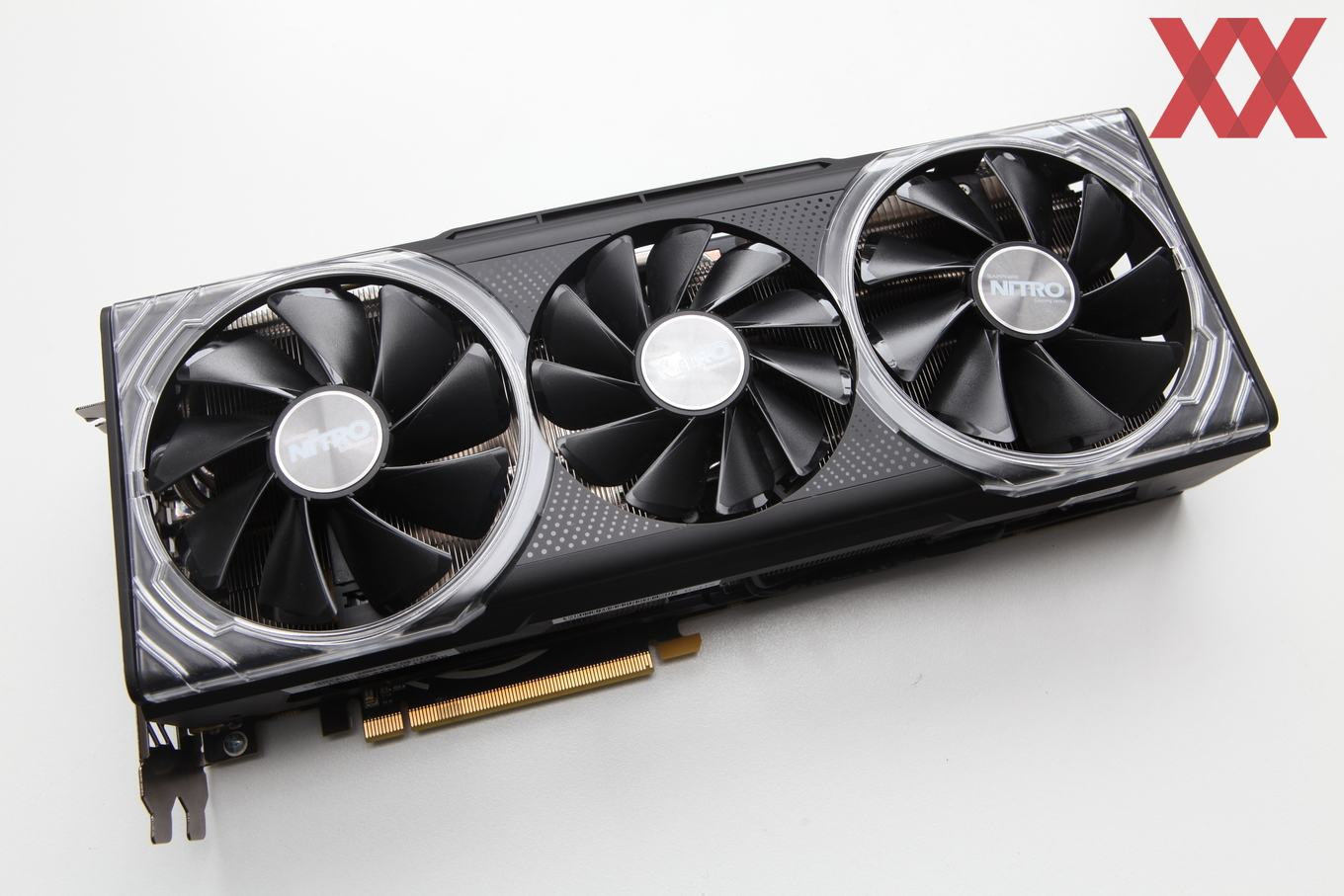
After aeons of waiting, one of AMD's foremost AIB partners, Sapphire, has come out with a fully custom edition of AMD's RX Vega flagship graphics cards. The new RX Vega 64 Nitro+ and RX Vega56 Nitro+ graphics cards bring Sapphire's engineering to the RX Vega table, offering much better thermal, acoustic, and performance characteristics than AMD's air-based reference models.
The Sapphire RX Vega Nitro+ series of graphics cards feature a triple-fan, 2.5 slot design and a whopping 3x 8-pin power delivery system - and yes, you read that right, this applies to both the Vega 64 and Vega 56 models. The increased thermal headroom provided by the substantial cooling solution, and the beefed-up power delivery system, mean Sapphire are shipping these graphics cards with a hefty 12-14% base-clock increase over AMD's reference models, making these the fastest (in frequency) factory-overclocked RX Vega graphics cards money can buy. The cards also ship with dual-BIOS, a fan header for either a side-panel or front-panel fan whose speed you want to be under the graphics' card control, and a VGA support plate - a smart move by Sapphire, considering the RX Vega 64 Nitro+ comes in at almost 1.6 kg.


Sources:
Hardware Luxx, via Videocardz
The Sapphire RX Vega Nitro+ series of graphics cards feature a triple-fan, 2.5 slot design and a whopping 3x 8-pin power delivery system - and yes, you read that right, this applies to both the Vega 64 and Vega 56 models. The increased thermal headroom provided by the substantial cooling solution, and the beefed-up power delivery system, mean Sapphire are shipping these graphics cards with a hefty 12-14% base-clock increase over AMD's reference models, making these the fastest (in frequency) factory-overclocked RX Vega graphics cards money can buy. The cards also ship with dual-BIOS, a fan header for either a side-panel or front-panel fan whose speed you want to be under the graphics' card control, and a VGA support plate - a smart move by Sapphire, considering the RX Vega 64 Nitro+ comes in at almost 1.6 kg.


93 Comments on SAPPHIRE Launches Their RX Vega Nitro+ Series of graphics Cards
That is... brave.
I have a different theory for you:
AMD, in order to lower production costs, has been releasing products with high quality variance (compared to more expensive competition).
So yes, this means that the factory voltage and clocks are on the safe side. And you can often pull a lot more from your AMD product.
Obviously, some samples won't cope very well with this.
The big difference between overclocking and undervolting is: the former is much easier to control. The card runs too hot, you just ease on the OC (or it does it automatically).
Undervolting results in operational errors and instability, which is... well... much worse. :)
The 9570 could be shaved off a 60watts off the wall by simplying undervolting the chip. The RX480 had the same issue as well (20 up to 40 watts depending on quality). The VEGA copes with heat created by a pretty high voltage which hampers the maximum boost clock.
So yeah, undervolting might shave off here and there, it's a fun thing yes, as AMD always was with OC'ing their products, but it's actually not our task or job.
What's next? You expect industrial clients to undervolt/overclock EPYC and Radeon Instinct? :-)Around the web, every gun owner, who tried to commit suicide, failed.Apple has just released their new iMac Pro with a Vega GPU. Apple was most likely building up stock and using all Vega parts they could lay their hands on. And it will get even worse when the Mac Pro arrives. Everyone thinking about buying a Vega for their PC should just look for another option.
I suspect trying to compete with a 314 mm² GPU with a much larger 486 mm² HMB2 GPU isn't ideal either way.
But hey.... I'm no business man.
What is being discussed is the variance of products.
If variance is low, the manufacturer can apply factory setting near the average.
If variance is high, they have to configure them a lot below the average, because too many samples would not survive higher performance.
And this is exactly the problem with AMD. As a result some product samples have a lot of OC headroom. But some don't. You never know what you'll get.
We've seen this with Ryzen lately. Some can get to 4.1GHz, some are stuck at 3.9. And that's all fine.
The problem arises when someone is asking for CPU advice and what he gets is: "buy a Ryzen, OC it to 4.1GHz and it'll be awesome".
Now, Vega is something else, because it's already pushed pretty far by the factory. So now it's more about undervolting than OC.
And of course some Vega samples will happily undervolt, some won't.
The issue is, as mentioned above, the nature of these modification. OC stability is easy to test. For undervolting it's not that obvious.
OC potential is not being advertised by anyone. Ever. They always guarantee a) base clocks and b) boost clocks when minimum required conditions are met (usually thermal and power delivery). Anything beyond that is pure luck and it can be 5MHz or 200MHz.
BTW: I needed info about Radeon Instinct today and what a surprise.
MI6 is a Polaris. MI8 is based on Fiji! Only the MI25 variant is based on Vega.
How is that possible? How bad is Vega? It's like AMD admitting they've totally failed on the efficiency front.
Now I'm slightly worried about the Intel+Vega MCM. I really wanted that to be in my next notebook...
www.overclockers.co.uk/sapphire-radeon-rx-vega-triple-fan-64-8gb-hbm2-pci-express-graphics-card-limited-edition-gx-38d-sp.html
These are the prices we should compare and, no offense, watercooling doesn't look very sensible (unless you're really devoted to the idea).