Tuesday, June 19th 2018

AMD Radeon Vega 12 and Vega 20 Listed in Ashes Of The Singularity Database
Back at Computex, AMD showed a demo of their Vega 20 graphics processor, which is produced using a refined 7 nanometer process. We also reported that the chip has a twice-as-wide memory interface, effectively doubling memory bandwidth, and alsomaximum memory capacity. The smaller process promises improvements to power efficiency, which could let AMD run the chip at higher frequencies for more performance compared to the 14 nanometer process of existing Vega.
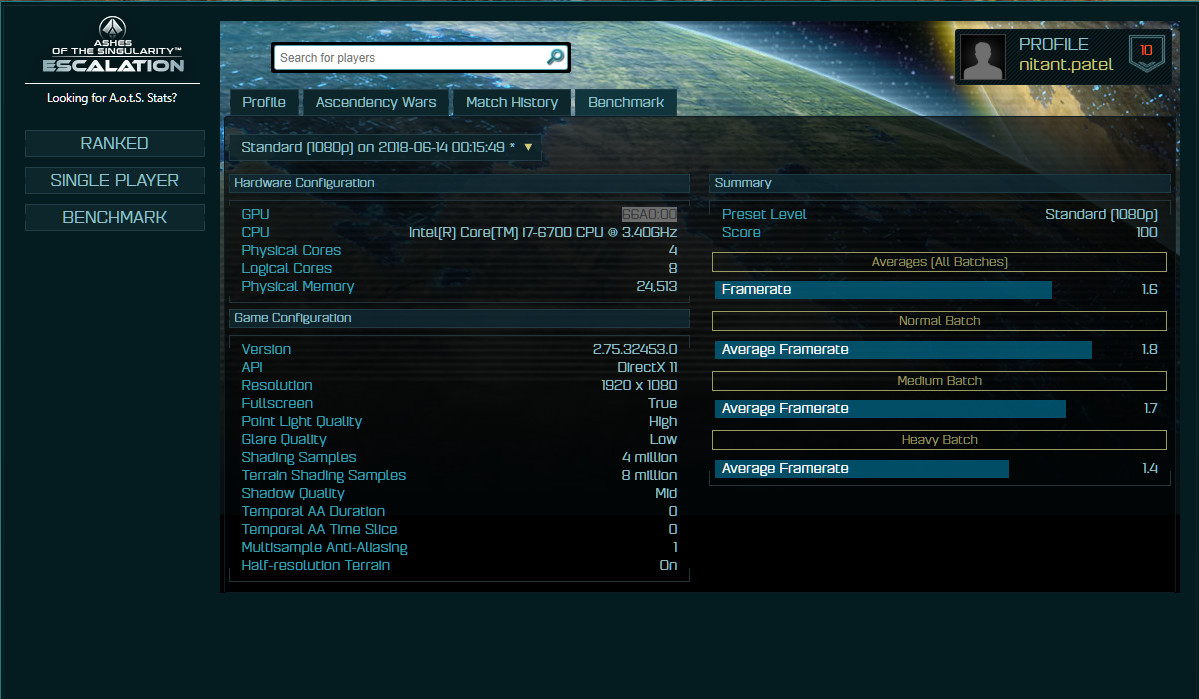
As indicated by AMD during Computex, the 7 nanometer Vega is a product targeted at High Performance Compute (HPC) applications, with no plans to release it for gaming. As they clarified later, the promise of "7 nanometer for gamers" is for Navi, which follows the Vega architecture. It's even more surprising to see AOTS results for a non-gaming card - my guess is that someone was curious how well it would do in gaming. The device ID 66A0 has been never seen before and is sufficiently far away from Vega 10 (687F) to indicate that AMD treats Vega 20 as a really new product and not as a minor revision. We expect Vega 20 to be used on a Radeon Instinct card first, with 32 GB of HBM2 memory and 4096 shaders, a professional workstation card called "Radeon Pro Vega 20" could also be possible, as indicated by other leaks, but I'm skeptic whether AMD really wants to put the "20" from the GPU codename into the official marketing name, going against what they used for "Vega 64".
 The second card listed is Vega 12, for which very little is known. Its device ID 69A0 is also from a new, unused value range. It is rumored that Vega 12 is targeted at lower-end, mobile markets, possible to offer an alternative to Polaris. We also wouldn't be surprised to see improved power management on Vega 12, to cater better for mobile devices, which require higher energy efficiency. Please note that Vega 12 does not indicate the number of CUs (like on Vega 64 for instance), but rather represents the internal GPU codename, like Vega 10.

Sources:
Vega 12, Vega 20
As indicated by AMD during Computex, the 7 nanometer Vega is a product targeted at High Performance Compute (HPC) applications, with no plans to release it for gaming. As they clarified later, the promise of "7 nanometer for gamers" is for Navi, which follows the Vega architecture. It's even more surprising to see AOTS results for a non-gaming card - my guess is that someone was curious how well it would do in gaming.


51 Comments on AMD Radeon Vega 12 and Vega 20 Listed in Ashes Of The Singularity Database
I suppose it's lowends turn tbh.
We've seen the hype ahead of Fiji, Polaris and Vega, and we know how they turned out. Now once again the forums heat up, this time about Navi and shrinks of Vega, and the usual Youtubers pour fuel on the fire. It's astounding how much faith some put in TSMC's 7nm node to solve all of AMD's problems. Even if we assume TSMC 7nm is free of the problems 40nm/28nm/20nm/16nm all suffered from, we might hope for something like ~40% improved efficiency or ~30% more performance(through higher clocks), but that will be towards the end of the 7nm lifecycle, not Q1 2019. And AMD will have to choose between better efficiency or higher clocks, or a mix, but they can't get the full potential of both.
People should remember that a GTX 1080 performs about 80% better per watt than RX 480 or RX Vega 64, so just a die shrink will not be enough for AMD to keep up. "Consumer Volta" would easily beat a die shrink of Vega, and would probably do well against Navi too, despite the advantage of a smaller node. Also remember that 7 nm will not ship in massive volumes in Q1 2019, so AMD will have too choose which chips to prioritize.
And your post is the first I've Seen sensationaling the dedate here.
@jabbadap I heard Vega 14 is for mobile uses.
How is Vega going to "scale" out of this problem? Pascal offers ~80% more performance per watt, consumer "volta" will push that even further. Not even the best node shrink imaginable will come close to compensating for that.
And you're one of those who still spin the "AMD is better at newer APIs"-story. Well, there is nothing inherently benefiting Vega in either Direct3D 12 nor Vulkan, and the games people like to use as examples doesn't even use these APIs natively. We've been hearing this since the early days of GCN, and we're still waiting for AMD's "future proof" hardware to pay off…
Raven = Vega 3, 6, 8, RX Vega 10, 11
Vega 12 = RX Vega 18~24 Desktop and or Mobile (naming is unknown)
Vega 11 = RX Vega 28~36 Desktop and or Mobile (naming is unknown) <-- may have been canceled
Vega 10 = RX Vega 56, 64
The placement of the id is in igp range
Vega 12 and 20 are the only new cores right now
Oh, and price, increase the price, Huang, the market is ready.
usually cheap means superannuated old crap.
Just nothing more than Ryzen+ to Polaris ... that's entails few tweaks to perhaps the memory controller or whatever cheap and quick "corrections" and just say it's going to the 12nm process. That could tide over many (ie 1080p) who haven't had a chance to upgrade since before Polaris and I think there's a bunch of them. And, as with Ryzen+ get some price reductions, sure GDDR is supposedly hard to get and pricey, but see if they can hold the same MSRP that they had in June 2016. I don't see Nvidia looking to release some *1160* at anything south of $329, while first Founder Editions at $400.
But I agree there's only Vega 12 and Vega 20 chips are pretty much only certain new vegas.
Vega is slower than anticipated, but not so bad.
I just bought a Vega 64 Liquid Edition and a NITRO+ Vega 64.