Friday, November 2nd 2018

AMD's Zen 2 Could be Revealed on November 6th, "Next Horizon" Event Scheduled
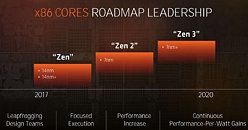
AMD Investor Relations will host a "Next Horizon" event on November 6th, and although there is no confirmation on what products will be announced there, the title alone makes us think about AMD's Zen 2 architecture. The company has just explained that on that day their executives will "discuss the innovation of AMD products and technology, specifically designed with the datacenter on industry-leading 7 nm process technology". AMD announced Ryzen and quite a lot of details about the Zen's processors on their last "Horizon" event, so it seems plausible that the incoming event will be perfect to talk about its next-gen architecture. That focus on the 7 nm process technology will probably make AMD talk about their new Vega graphics, but it seems end users will have to wait, as datacenters come first.
Source:
Overclock3D


43 Comments on AMD's Zen 2 Could be Revealed on November 6th, "Next Horizon" Event Scheduled
IMO if they can, they should do this to really then the competition heat up!
EDIT: changed "dGPU" to "iGPU"
The release dates from RX Vega and Radeon Pro WX cards is also a nice telling sign of this. Usually there is a good 5 or more month lag between consumer and commercial GPU releases but AMD only had a one month lag in the announcement of Vega based Radeon Pro cards the WX 9100 and SSG were announced in September 2017 one month after the August 2017 release of Vega. AMD very much pushed commercial sales and marketing of Vega over consumer.
For an example of those features. Vega introduced the ability to allow for secondary memory storage locations in the form of a HDD or SSD attached to the card. (Radeon SSG). This allows for rendering very large projects on the GPU. This is obviously not a gamer oriented feature. AMD had a test card based on Fiji for this type of card but it was to slow for commercial use Vega with it's ability to directly access the SSD allowed them to make a marketable product.
There were more server/commercial focused changes (like infinity fabric). But yeah even though Vega was a semi powerful gaming GPU it was not the sole purpose of that GPU. AMD wanted and needs a profitable GPU and thanks to Nvidia having so much of the market WE are not AMD's focus. Why sell a GPU for $500 at a minimal profit when you can sell that same chip for $2000 a piece not to mention those customers buy many cards at a time.
The claim that Vega was never meant for gaming is 100% BS. Ahead of launch, every fan claimed it was going to be the greatest thing ever, but then suddenly came up with the excuse when realizing the performance, and saying that it's okay since it was "never meant for gaming anyway…".Instinct MI6(Polaris based) and Instinct MI8(Fiji based) was launched in December 2016, Vega-based Instinct MI25 was launched June 2017, along with Vega Frontier Edition.
Vega 64 was supposed to be launched in early May 2017, but postponed to August due to supply issues.Once again you get all the facts wrong; consumer Vega 64 was heavily delayed.
One company had R&D budget to pursue half a dozen of hares, another one, starved to near death, was focusing its minuscule budget on CPU front; surprising they even have mid range offerings.
But no no, let's pretend we have no idea about, to put it softly, harsh financial situation AMD was (and still largely is) in: bad, baaaad AMD, how dare you not to have high end competitive card?!!
Oh, and one more thing, had it been AMD with problems that nVidia has with 2xxx series, there would be one major shitstorm about sooo poor quality control.
I have said this many times over, the market is always self regulating and most people end up with the products they want (or rather what they think they want ). Currently this means 106 class GPUs from Nvidia for 500$. Enjoy, AMD can't/wont do anything to change that. I also laugh my ass off when I see people hoping Intel is going to come crashing in and save the day. These are desperate times indeed :laugh:
But I do find Intel entering the market exciting.
I'd say Hawaii was comparable, Fury X was comparable, but Tahiti was 'strong'. It had great balance and it offered something the competition lacked with its 3GB VRAM and wide bus plus a lot of core grunt; it was really GCN in its sweet spot. Nvidia's 680 wasn't really enough to eclipse it, and it was the best they had until Kepler refresh (discounting the 1K$ Titan).
It is also the 7970 that created the fabled 'fine wine' argument because this GPU was released with meagre driver support but can still play ball today with much improved performance. If we talk about mindshare, that GPU on its own, along with the 7950 as a poor man's alternative, has done more for AMD than the past three refresh gens combined.
If there is one universal truth about mindshare it is that you cannot gain any of it with midrange or entry level GPUs. Proof: everything Intel has done on GPU, and everything AMD has done in the past few years. Its like a Dacia car, you know it drives alright and you know its cheap but you also know it won't break any records and that every opportunity to cut corners has been taken. Its the car you buy because you can't afford anything else. That is kind of where Polaris is at right now. In the meantime, Nvidia is selling BMW's even if they are just 1.1 city cars with a shitty engine ie. cut down GP104's with clocked down GDDR5X. And they can only call them a BMW because they've got that M5 model at the very top breaking records.
Sorry for the crappy car analogy, but I couldn't think of anything better :D
Nvidia mindshare kind of exploded when they released Titan. The card nobody in their right mind would buy, but when they cut it down into a poor man's version with the 780, we jumped on it, and they enabled themselves a new tier and price point for high end GPU. That is why today some people consider a 104 die 'mid range' when even Nvidia says its a high end segment SKU. Prior to Titan, both competitors tried similar tricks with dual GPU solutions like the 690 and 290X2.