Wednesday, January 23rd 2019

Bulldozer Core-Count Debate Comes Back to Haunt AMD
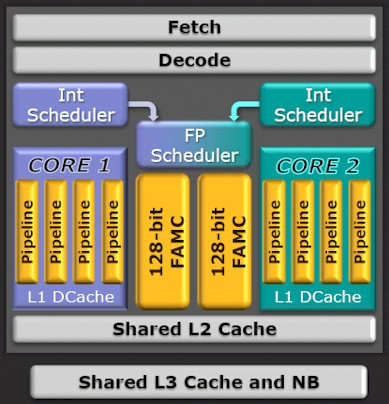
AMD in 2012 launched the FX-8150, the "world's first 8-core desktop processor," or so it says on the literal tin. AMD achieved its core-count of 8 with an unconventional CPU core design. Its 8 cores are arranged in four sets of two cores each, called "modules." Each core has its own independent integer unit and L1 data cache, while the two cores share a majority of their components - the core's front-end, a branch-predictor, a 64 KB L1 code cache, a 2 MB L2 cache, but most importantly, an FPU. There was much debate across tech forums on what constitutes a CPU core.
Multiprocessor-aware operating systems had to be tweaked on how to properly address a "Bulldozer" processor. Their schedulers would initially treat "Bulldozer" cores as fully independent (as conventional logic would dictate), until AMD noticed multi-threaded application performance bottlenecks. Eventually, Windows and various *nix kernels received updates to their schedulers to treat each module as a core, and each core as an SMT unit (a logical processor). The FX-8350 is a 4-core/8-thread processor in the eyes of Windows 10, for example. These updates improved the processors' performance but not before consumers started noticing that their operating systems weren't reporting the correct core-count. In 2015, a class-action lawsuit was filed against AMD for false marketing of FX-series processors. The wheels of that lawsuit are finally moving, after a 12-member Jury is set up to examine what constitutes a CPU core, and whether an AMD FX-8000 or FX-9000 series processor can qualify as an 8-core chip.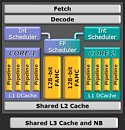
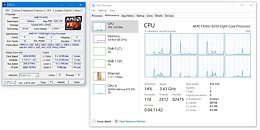 US District Judge Haywood Gilliam of the District Court for the Northern District of California rejected AMD's claim that "a significant majority of" consumers understood what constitutes a CPU core, and that they had a fair idea of what they were buying when they bought AMD FX processors. AMD has two main options before it. The company can reach an agreement with the plaintiffs that could cost the company millions of Dollars in compensation; or fight it out in the Jury trial, by trying to prove to 12 members of the public (not necessarily from an IT background) what constitutes a CPU core and why "Bulldozer" qualifies as an 8-core silicon.
The plaintiffs and defendants each have a key technical argument. The plaintiffs could point out operating systems treating 8-core "Bulldozer" parts as 4-core/8-thread (i.e. each module as a core and each "core" as a logical processor); while the AMD could run multi-threaded floating-point benchmark tests to prove that a module cannot be simplified to the definition of a core. AMD's 2017 release of the "Zen" architecture sees a return to the conventional definition of a core, with each "Zen" core being as independent as an Intel "Skylake" core. We will keep an eye on this case.
Source:
The Register
Multiprocessor-aware operating systems had to be tweaked on how to properly address a "Bulldozer" processor. Their schedulers would initially treat "Bulldozer" cores as fully independent (as conventional logic would dictate), until AMD noticed multi-threaded application performance bottlenecks. Eventually, Windows and various *nix kernels received updates to their schedulers to treat each module as a core, and each core as an SMT unit (a logical processor). The FX-8350 is a 4-core/8-thread processor in the eyes of Windows 10, for example. These updates improved the processors' performance but not before consumers started noticing that their operating systems weren't reporting the correct core-count. In 2015, a class-action lawsuit was filed against AMD for false marketing of FX-series processors. The wheels of that lawsuit are finally moving, after a 12-member Jury is set up to examine what constitutes a CPU core, and whether an AMD FX-8000 or FX-9000 series processor can qualify as an 8-core chip.

The plaintiffs and defendants each have a key technical argument. The plaintiffs could point out operating systems treating 8-core "Bulldozer" parts as 4-core/8-thread (i.e. each module as a core and each "core" as a logical processor); while the AMD could run multi-threaded floating-point benchmark tests to prove that a module cannot be simplified to the definition of a core. AMD's 2017 release of the "Zen" architecture sees a return to the conventional definition of a core, with each "Zen" core being as independent as an Intel "Skylake" core. We will keep an eye on this case.
369 Comments on Bulldozer Core-Count Debate Comes Back to Haunt AMD
What's next, suing because the L3 cache is shared, so overall, a "core" does not get the fully dedicated resource?
When you have such a mess, it's always open for interpretation. Some may say "yes, it's 8 cores with shared components", some (like me) will say that this is 4 cores with extra stuffin'.
Sun did use similar approach in the past to make their CPUs more multithreading-capable, and while each core had 2 integer units and 1 floating point unit it was still being called one CPU core (capable of running 8 threads).
This is the same consumer that still buys into 'dual core' Intel chips that have i7 plastered on top, you know, that name that tends to represent a quad core in the desktop world since forever :p
Baseless case is baseless, IMO. AMD should certainly win this and if they don't, faith in humanity -100Amen.
I think the only real approach here is the direct comparison to SMT and how AMD can explain that one is a 'core' and the other is SMT. They can bring their Ryzen die shots for that.
Going even further back, people bought AMD's 5x86 and later K6 (and variants), knowing fully well they didn't measure up to Intel in FP performance. But since they were offered at a better price, they were good enough for plenty of people.
I still agree that it's missleading, but at least you get the info on your first google hit.
FX-8150, for example: www.amd.com/en/products/cpu/fx-8150
Also, Wikipedia is not amd.com. If third-party sites have more info about your product than an official product page and it's presented in a more usable manner, it's definitely a f%$^k up on AMD's part.
it is a loose loose really but either way hopefully AMD has learned something from this
No FPUs, no pipelining, no duplicate of nothing. But good luck because neither AMD nor Intel have made CPU cores that look like that for more than 3 decades now.Details about the architecture that they used were made public and several publications made some pretty in depth analyses on it. Clearly that was never the case.But somehow AMD was expected to spoon feed complex computer architecture concepts to them ? Try explain to a customer why CPUs from both AMD and Intel with duplicate front ends show up as having more cores in various programs. Come on.Then unfortunately you don't know enough about this subject as was the case with many.
You knew exactly what you were getting as a customer and if you didn't its entirely your own fault. Average Joe and Jane don't build PCs. They buy a laptop, let a shop build one, or let us build one.
Stop trying to find a good argument here because there is none. This case exists because perhaps there's some money to be had. Not because some customers were left out in the cold (which is what they should be used for).FX Bulldozer, let's try (see thumbnail below)
There is even a nice picture with schematic/die shot, clearly specifying two integer and one FP unit and shared cache.
And here comes the kicker. Let's do i7 Core as well? You tell me what's more informative for a first google hit...
here the ol girl if any one wonders what she looks like.