Thursday, March 21st 2019

NVIDIA: Turing Adoption Rate 45% Higher Than Pascal, 90% of Users Buying Upwards in Graphics Product Tiers
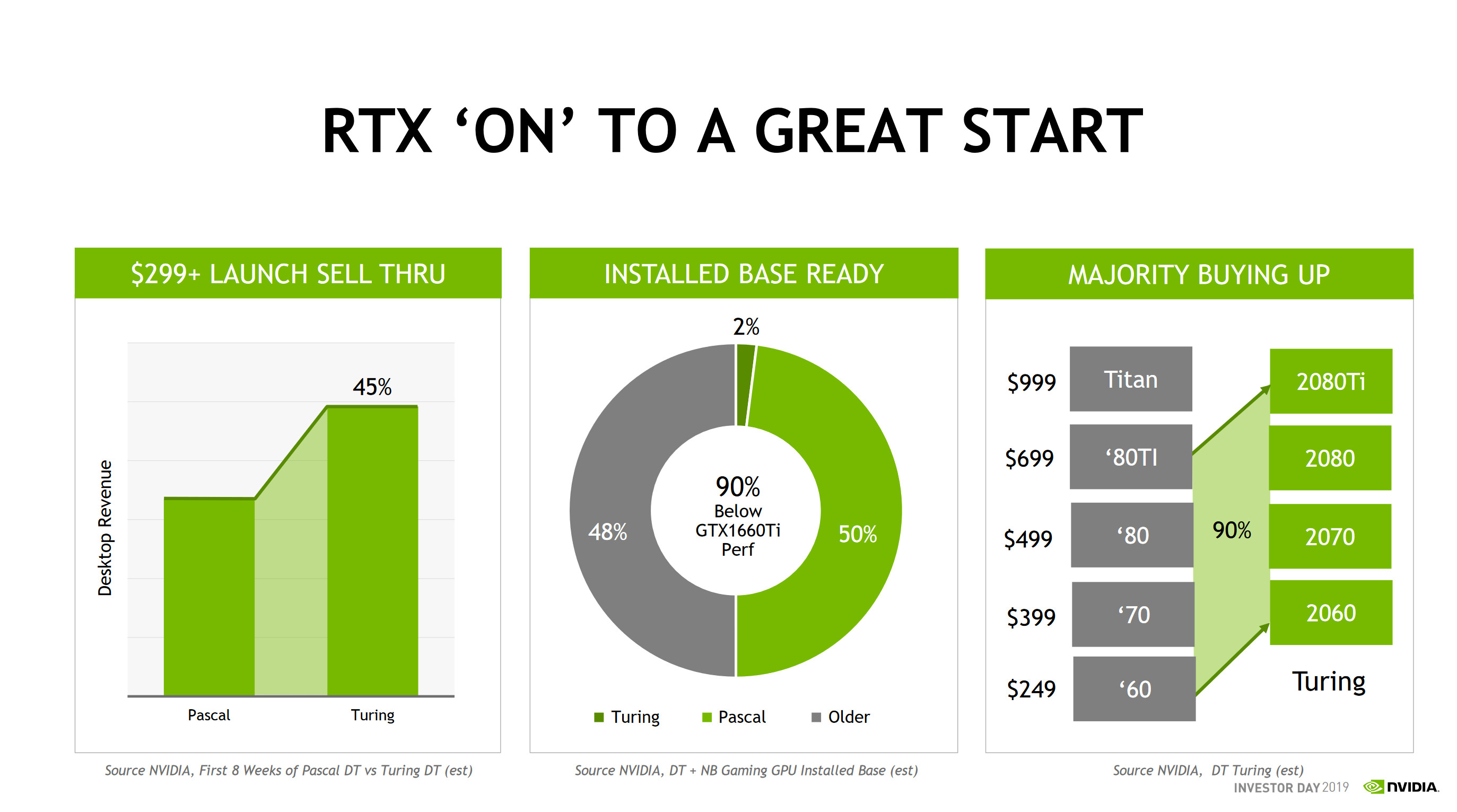
NVIDIA during its investor day revealed some interesting statistics on its Turing-based graphics cards. The company essentially announced that revenue for Turing graphics cards sales increased 45% over that generated when NVIDIA introduced their Pascal architecture - which does make sense, when you consider how NVIDIA actually positioned its same processor tiers (**60, **70, **80) in higher pricing brackets than previously. NVIDIA's own graphics showcase this better than anyone else could, with a clear indication of higher pricing for the same graphics tier. According to the company, 90% of users are actually buying pricier graphics cards this generation than they were in the previous one -which makes sense, since a user buying a 1060 at launch would only have to pay $249, while the new RTX 2060 goes for $349.
Other interesting tidbits from NVIDIA's presentation at its investor day is that Pascal accounts for around 50% of the installed NVIDIA graphics cards, while Turing, for now, only accounts for 2% of that. This means 48% of users sporting an NVIDIA graphics card are using Maxwell or earlier designs, which NVIDIA says presents an incredible opportunity for increased sales as these users make the jump to the new Turing offerings - and extended RTX feature set. NVIDIA stock valuation grew by 5.82% today, likely on the back of this info.

Source:
NVIDIA via WCCFTech
Other interesting tidbits from NVIDIA's presentation at its investor day is that Pascal accounts for around 50% of the installed NVIDIA graphics cards, while Turing, for now, only accounts for 2% of that. This means 48% of users sporting an NVIDIA graphics card are using Maxwell or earlier designs, which NVIDIA says presents an incredible opportunity for increased sales as these users make the jump to the new Turing offerings - and extended RTX feature set. NVIDIA stock valuation grew by 5.82% today, likely on the back of this info.

111 Comments on NVIDIA: Turing Adoption Rate 45% Higher Than Pascal, 90% of Users Buying Upwards in Graphics Product Tiers
Early days, but they are selling.
EDIT: My bad, I read 1080 it as 1080 ti.
I've decided to take notes and go passive aggressive from now on (for future reference).
tpucdn.com/reviews/AMD/Radeon_VII/images/relative-performance_1920-1080.png
tpucdn.com/reviews/AMD/Radeon_VII/images/relative-performance_2560-1440.png
At 1080p Radeon VII has a 1% advantage compared to the reference 2070....it overclocks 8.2% .... 100.0 x 1.082 = 108.2
At 1080p 2070 has a 1% disadvantage compared to the Radeon VII....it overclocks 8.2% .... 99.0 x 1.133 = 112,2
With both cards OC'd the 2070 (I used Zotac from TPU Review), 2070 is 37% faster @ 1080p
At 1440p Radeon VII has a 6% advantage compared to the reference 2070....it overclocks 8.2% .... 106.0 x 1.082 = 114.7
At 14400p 2070 has a 6% disadvantage compared to the Radeon VII....it overclocks 8.2% .... 94.0 x 1.133 = 106.5
Radeon VII is 7.7% faster @ 1440p
Other considerations ...
Unigen Heaven FPS: 131.0 (A) / 145.4 (N)
Peak Gaming Power: 313 watts (A) / 250 watts (N) ... A is 63 watts higher
Noise @ Load: 43 dbA (A) /35 dbA (N) ... 75% louder
Temps @ Load + OC: 76 C (A) / 69 (N) ... 7 C hotter
Cost: $700 (A) / $500 (N)
Other Considerations (1080p): I wouldn't normally see either of these as targeted for 1080p, but if that's where ya are I see several pluses for the 2070 ... a) It is slightly faster b) at this resolution just about every game in the test will allow you to drop G-Sync and use ULMB, or c) just about every game (recognizing of course that support is not there for most games at this time) when supported will have more then enough fps such that the performance penalty will still leave you well above 60 fps.
Other Considerations (1080p): At 1440p, the VII is the better card ... still I'd much rather have the ability to use ULMB than have the extra 7% performance. But if ya don't have a 144 Hz G-Sync monitor, then ya can't use ULMB so the VII makes more sense from a performance standpoint. Only the noise would keep me from going that way if i can't use ULMB anyway.
I don't understand all the negativity with the VII, it's a perty decent card in that it splits the performance wins at 1080p and 1440p with the 2070. The temperature and power differences are closer than we usually see and the noise if the only real annoyance. If we see AIB versions, AMD could improve significantly .... but still, right now, the pice is nutz .... I don't see a market for reference Radeon VIIs for more than $475 ... AIB cards, if they can improve a bit could get away with $525Depends on your PoV .... if you rooting for one side or the other it's significant .... if ya stockholder, none of them will care :) ... no doubt selling 2080 Tis at twice what must be twice what they cost to make is driving part of that.
The RTX 2070 now has 0.50% market share (36th place)
The RTX 2080 now has 0.40% market share (49th place)
The RTX 2080 Ti now has 0.21% market share (82nd place)
I don't think we'll see the 2060 pop onto the list till end of March and I think it will top the other 3 cards when it does.
By comparison ....
The RX 580 now has 0.94% market share (17th place)
The RX 480 now has 0.58% market share (29th place)
The RX 460 now has 0.35% market share (52nd place)
The RX 570 now has 0.28% market share (65th place)
The RX 470 now has 0.25% market share (68th place)
The two Vegas combine for 0.19% market share (86th place)
My eyes are crossed counting those rows, I'll bet some of those last few rankings are off. But items of concern:
a) The ridiculously priced 6 month old 2080 Ti has already outsold the two Vega cards (17 months on market) combined by a factor of > 2.5 to 1.0 ... and the 2080 by > 2.0 : 1.0
b) The are more GTX 1060 cards in use (15.88%) than all AMD cards combined (14.68 %) ... more than 10 times as many as the 480 / 580 competition.
c) AMD has only 1 card in the top 20 .... 2 in the top 50. Last month AMD had 15.3% ... that's a 4% drop in just 30 days. Intel dropped from 10.6 to 10.15% over the same period.
Methinks AMD has gotta move pricing down to push sales. The 1660 Ti, 2060 and 2070 I think will sit still for a while but i think the 208- will be $650 by May.
Costs still have to be deducted from that initial figure.
Also increase in revenue does not equate to an increase in product adoption, it can reflect many things.
The a competitor starts competing with you selling at $1.50 ... that attracts loads of customers ... and you sell 3,000 dogs for $4500 revenue but $0 profit.
Right now the profit margin on the 2080 Ti gotta be 100% ... the 20160 / 1660 Ti much larger revnue, must smaller profit margin.
How about they publish data on the volume of actual 'units' sold with Pascal VS Turing?
I believe Nvidia is taking advantage of having no competition at the 2080 Ti level but I wish someone with insider info would step up and tell us by how much. Right now we have no frame of reference because there isn't anything else like the 2080 Ti to compare it with.
For 5 years ngreedia kept selling their top-tier chips only for 1000$ and more, leaving bits and pieces like GM200-310, then GP102. And now they sell *104 tier chip for almost 1000 bucks. *quick reminder: how much was the GTX 560Ti?
And I’m not even mentioning other restrictions they apply in order to strict users even more - like hardware voltage limit, so you won't be able to overclock you good old 1080 Ti to the level of (2080Ti -10%). So you have to buy pricier card if you want a little more.
Best case is if amd/intel releases those things they smithing ATM - and I suppose their cards are only 30-50% of top end TU100/102 perfomance - and nvidia dropping prices only in targeded market, claiming any other, faster product of their own “exclusive, worth paying extra”.
Yeah, huge chip tier card is only >1200$ more from now on. Thus I’d like to ask thois junkies “How do you feel now, spending ~1500-2000$ each year or two for lower tier and 2500-5000$ For higher tier highend card? I mean any *Ti and Titan?”
And btw, they sell low end card for 600$ - guess what index gtx 550 Ti chip had?