Thursday, March 21st 2019

NVIDIA: Turing Adoption Rate 45% Higher Than Pascal, 90% of Users Buying Upwards in Graphics Product Tiers
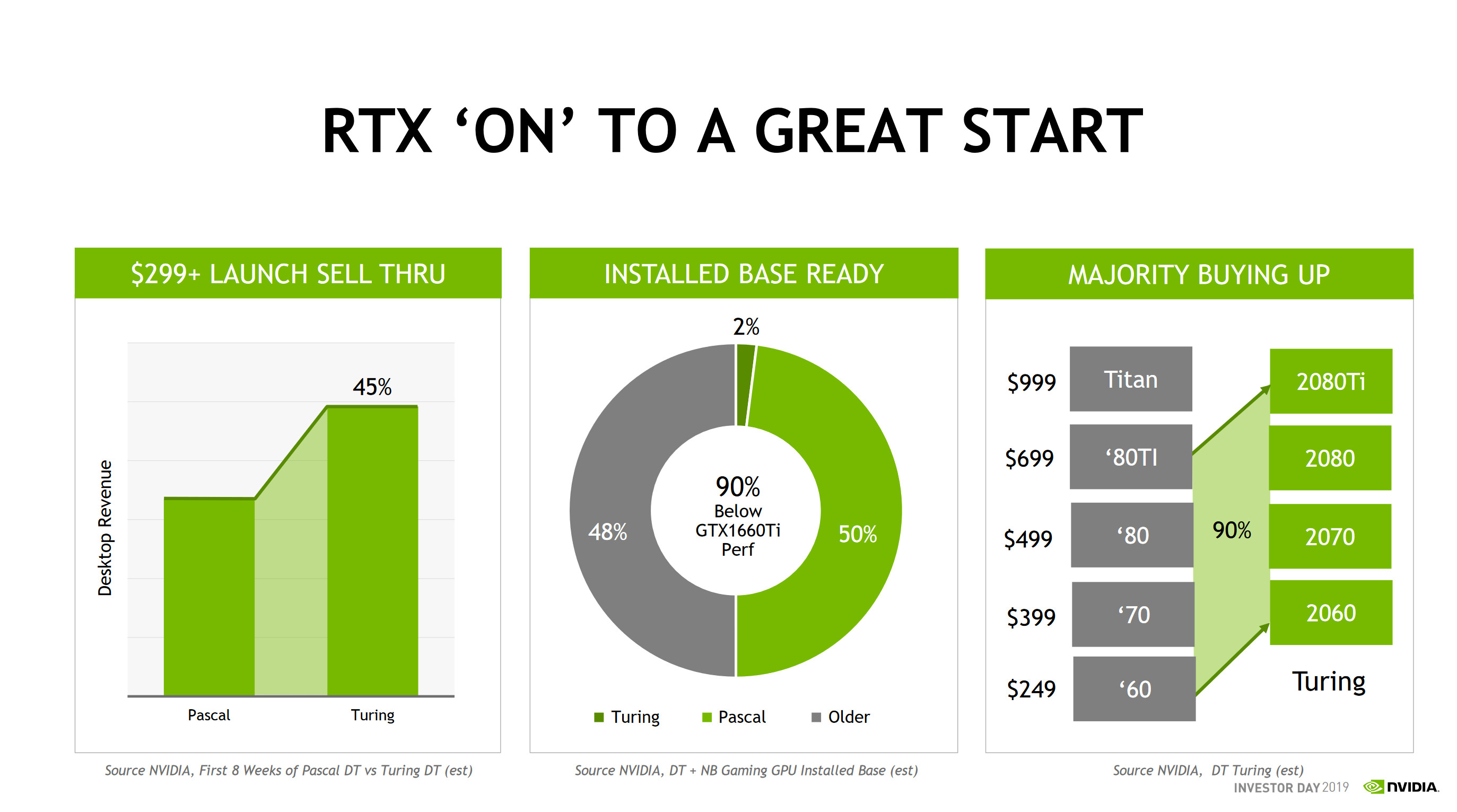
NVIDIA during its investor day revealed some interesting statistics on its Turing-based graphics cards. The company essentially announced that revenue for Turing graphics cards sales increased 45% over that generated when NVIDIA introduced their Pascal architecture - which does make sense, when you consider how NVIDIA actually positioned its same processor tiers (**60, **70, **80) in higher pricing brackets than previously. NVIDIA's own graphics showcase this better than anyone else could, with a clear indication of higher pricing for the same graphics tier. According to the company, 90% of users are actually buying pricier graphics cards this generation than they were in the previous one -which makes sense, since a user buying a 1060 at launch would only have to pay $249, while the new RTX 2060 goes for $349.
Other interesting tidbits from NVIDIA's presentation at its investor day is that Pascal accounts for around 50% of the installed NVIDIA graphics cards, while Turing, for now, only accounts for 2% of that. This means 48% of users sporting an NVIDIA graphics card are using Maxwell or earlier designs, which NVIDIA says presents an incredible opportunity for increased sales as these users make the jump to the new Turing offerings - and extended RTX feature set. NVIDIA stock valuation grew by 5.82% today, likely on the back of this info.

Source:
NVIDIA via WCCFTech
Other interesting tidbits from NVIDIA's presentation at its investor day is that Pascal accounts for around 50% of the installed NVIDIA graphics cards, while Turing, for now, only accounts for 2% of that. This means 48% of users sporting an NVIDIA graphics card are using Maxwell or earlier designs, which NVIDIA says presents an incredible opportunity for increased sales as these users make the jump to the new Turing offerings - and extended RTX feature set. NVIDIA stock valuation grew by 5.82% today, likely on the back of this info.

111 Comments on NVIDIA: Turing Adoption Rate 45% Higher Than Pascal, 90% of Users Buying Upwards in Graphics Product Tiers
Maybe the 20xx series is a fluke like some of the other cards on that chart with the wildly inflated price and the 30xx series will be more reasonable once the tech is mature, I dont know but Nvidia seems to indicate they are happy with $999 being the price for the flagship card.I dont know what your problem is the numbers are right there in your chart I clearly stated that I used the 2017 cost in my initial post
Anyway you want to break it down the the math says the average of the "price January 2017 dollars" is $634.50
Is the chart wrong ? is 2017 dollars column not accounting for inflation ?
In 2006, we had 8800GTX (top of the line) and it was about $650. That inflates to about $795 today. The cheapest 2080 Ti right now on Amazon is $1,290. That is a whopping $500 icing on the cake after adjusted inflation.
Skip to one year later with the 8800 Ultra which was about $830. That inflates to about $1,025. Again, the 2080 Ti still demands >$260 after adjusted inflation. Do note that $1,290 is being conservative!
You aren't doing yourself any favors by justifying the purchase of that overpriced card. Just stop already. Lying to yourself is a great disservice among other things...
AMD clearly struggles on GPU department, Vega 7 is bad for the company, it is expensive to produce and is to be priced to be barely competitive, which is quite unusual for AMD.
Bringing it up in this thread is more of a declaration of own mental capacity.
www.newegg.com/Product/Product.aspx?Item=9SIAAZU8SX5634
Sorry your logic is otherwise incorrect as well.We're not trying to justify it. We don't have to. We don't make the decisions on pricing. NVidia does. All I tried to do was explain it and help bring examples of the past to the discussion so people can stop bemoaning and whining something that has happened before, will always happen and that it's the nature of business; sell a premium product for a premium price.Take your own advice.That's not what's happening. We're just recognizing historical trends for what they are, recognizing NVidia is a business, in business to make money and is pricing their products according to what they want to make money. If you, or anyone else, doesn't like that, don't buy their cards. Go get something else or get a console.You need to stop trolling and acting like a child.
Corporate boards have a fiscal responsibility to maximize shareholder profit. When the cards were selling faster than they could supply them, prices will rise. You can't make money on what you don't have to sell. You can't sell cards when your competitions offers more performance for the same price so the proce is set by what the customer cnsider's relative vaue.
If I have to pay for a card that the market refuses to provide a good deal on, then I will simply acknowledge that a gamer has gotta do what a gamer has gotta do.
What I am not going to do is blow smoke up my own ass or especially others to feel better about the purchase by justifying it with nonsense. That only influences everyone else towards being a good little consumer whore which society loves to be these days.
There is no instruction on inflation to be given efi; I layed it all out for you so your argument fell flat.