Monday, March 30th 2020

AMD Ryzen 9 4900HS Torpedoes Intel's Core i9 Mobile Lineup, Fastest Mobile Processor
Reviews of AMD's flagship mobile processor, the Ryzen 9 4900HS went live today, and the verdict is clear. Intel has lost both performance and battery-efficiency leadership over its most lucrative computing segment: mobile client computing. In a Hardware Unboxed review comparing the 4900H to Intel's current Core i9 flagship, the i9-9880H, the AMD chip at its stock 45 W TDP beats the Intel one even with the Intel chip configured to 90 W cTDP.
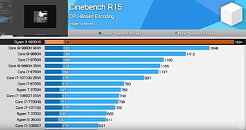
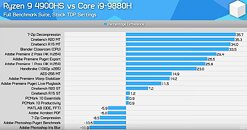
The 4900HS posts 11.9% higher CineBench R20 score (both chips are 8-core/16-thread) when the Intel chip is bolstered with 90 W cTDP, and a whopping 33% faster when the i9-9980H is at its stock settings, and 54% faster when its capped at 35 W cTDP. It also ends up over 150% faster than AMD's last fastest mobile processor, the 12 nm "Picasso" based Ryzen 7 3750H. The story repeats with CineBench R15 (4900H being 34% faster than stock i9-9880H), 18% faster at Handbrake HEVC, 25% faster at Blender "Classroom," and 35% faster at 7-Zip benchmark. The AMD chip lags behind by 12% in the less-parallelized Photoshop. On creativity apps that do scale with cores, such as Premiere "Warp Stabilizer 4K," the 4900HS is 12.6% faster. Gaming performance remains an even split between the two chips. Find several more interesting test results and commentary in the Hardware Unboxed presentation here. Intel has already announced a response to the 4900HS in the form of the i9-10980HK.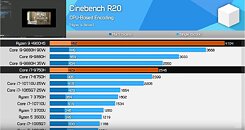

The 4900HS posts 11.9% higher CineBench R20 score (both chips are 8-core/16-thread) when the Intel chip is bolstered with 90 W cTDP, and a whopping 33% faster when the i9-9980H is at its stock settings, and 54% faster when its capped at 35 W cTDP. It also ends up over 150% faster than AMD's last fastest mobile processor, the 12 nm "Picasso" based Ryzen 7 3750H. The story repeats with CineBench R15 (4900H being 34% faster than stock i9-9880H), 18% faster at Handbrake HEVC, 25% faster at Blender "Classroom," and 35% faster at 7-Zip benchmark. The AMD chip lags behind by 12% in the less-parallelized Photoshop. On creativity apps that do scale with cores, such as Premiere "Warp Stabilizer 4K," the 4900HS is 12.6% faster. Gaming performance remains an even split between the two chips. Find several more interesting test results and commentary in the Hardware Unboxed presentation here. Intel has already announced a response to the 4900HS in the form of the i9-10980HK.


211 Comments on AMD Ryzen 9 4900HS Torpedoes Intel's Core i9 Mobile Lineup, Fastest Mobile Processor
But for someone like me, these ones without a webcam are no-go. No integrated webcam, no fun, just more problems because you need to occupy a USB port.
Come on, look at how smartphones develop in recent years - top notch, integrated in the screen camera, integrated and invisible fingerprint scanner, etc beauties.
I need the webcam for messaging and chat apps.
Skype, conference calls, meetings, etc stuff.You can always buy it in Germany or another country where it's cheaper. From some US states, you can take it with 0% VAT.
:shadedshu: :kookoo:
On the other hand, it does come with a GTX 1650Ti, but is it the TU117 or TU116 based GPU? I thought it was the Max-Q, but apparently I was mistaken.
The Zephyrus G14 is probably not aimed at your general usage, but the upcoming Lenovo Flex 14/15 with the U-series would be.
I agree that Intel is out of ace in their sleeves in this case. The 14nm is clearly outclassed by 7nm no matter how you cut it. On the desktop space, Intel may still be able to push clockspeed and get single core advantage, but at the expense of immense power requirement which I believe is closing in on 300W with an all core turbo. On the laptop space, they do not have the luxury of pulling ridiculous amount of power. So try as they can with ridiculous boost marketing, independent benchmarks will reveal the weakness, especially when the load is sustained.
In this case, I feel torpedoed is a mild way of putting it. If we look at pricing and performance as a whole, AMD basically just nuked Intel. I believe Intel can only respond with price cuts since they lost the performance crown.This highlights the problem that Intel is facing now. As they bump up clockspeed to try to compete, their processor will increasingly not suit a light weight laptop.
From PCworlds review
I had to go look back at 9700k results out of curiosity since it seems none of their owners took part in the R20 benchmark..... it seems to score less than 4000 at stock.
Pretty impressive for a 35w part in a 3.5lbs laptop
Other than that, this looks absolutely fantastic. Hoping for a follow-up with RDNA 2 GPUs and a faster freesync-equipped display. Other than that this looks frighteningly close to my dream laptop. Just 1.6kg with that kind of performance and that battery life? Insane.
geizhals.eu/?cat=nb&xf=6763_Ryzen+4000
Also he was impressed that on stress it was able to boost ~3.8Ghz and he was saying that it's impressive that it's boosting 500Mhz above the base clock while this HS model has 3.0Ghz as base -not 3.3Ghz like 4900H.
I don't get it how they can make mistakes like that while the software's used to bench clearly shows 4900HS 3.0Ghz.
Now he should be even more impressed :).
Also- I am really interested how thin and light could 4900HS ultrabook without dGPU gonna be... imagine this CPU with slim 99WH Battery ultrabook :-)
fundis at play!Most mobile chips behave like this, boosting higher while the things are cool then stable down to it's official TDP (35W)...
The 3900H is a 45W part, it will behave same as the 3900HS except that when it stables down it will be 45W instead.
Tell it again. I dare you, I double dare you!
*I'm actually starting to consider a laptop now for decent gaming. FINALLY some real CPU power in a small package. Intel hasn't managed to do this for any continuous workload in the past decade... go figure. This is a landslide right here in AMD's favor. Even the faster Intel HQ quads I had can't hold a candle to this. DAYUM.
It even solidifies the idea that the 9900K, top end desktop MSDT performance, mind you, is within reach of smaller form factors. CrazyYou wonder but when asked to the reason why you wonder or whether you had a point, all we heard was crickets.
And I understand why, given your usual stance on laptop CPUs. This one right here blows all your arguments away in one fell swoop. Live and learn. Intel isn't making fantastic laptop CPUs, it was shit and we could all see why, and was quickly deteriorating too with those abysmal clocks.
These benches point it out perfectly. You speak of testing properly, but it is well known among reviewers by now that laptop CPUs have predefined TDPs and reviews handily go around that, they even SPECIFY the TDP budgets now - and test it.
And as for that boosting behaviour you linked... I'll refrain from putting an Intel graph next to it, because that would just be too brutal. What I'm seeing here in your link is, by definition, a boost as you would want it. Long sustain at very good clock, only to drop down to somewhat lower performance to land at a highly efficient, but STILL performant clockspeed. And not slow down to a crawl instead. Oh, and idling? Apparently it does that better, too.
This underlines how archaic Intel's Turbo really is, even with the stupid bandaids they applied. AMD learned, clearly, from Nvidia's GPU Boost and managed to transplant most of that to its CPUs, adding even more smart logic underneath. Navi is fast going the same way, already doing most of what GPU Boost does as well. They finally got the memo. And how!
It baffles me why OEMs would not want to present such a sweet spot, honestly. Too disruptive?