Monday, May 31st 2021

AMD Announces Ryzen 5000G and PRO 5000G Desktop Processors
AMD today announced the launch of its first Ryzen 5000 series desktop processors with integrated graphics, under the Ryzen 5000G and Ryzen Pro 5000G lines. These processors are based on the 7 nm "Cezanne" silicon, featuring up to 8 CPU cores based on the "Zen 3" microarchitecture, an iGPU based on the "Vega" graphics architecture with up to 8 compute units, but updated display- and media-acceleration engines; 512 KB of L2 cache per core, and 16 MB of L3 cache that's shared between all eight cores. Built in the Socket AM4 package, the processors are compatible with AMD 500-series chipset motherboards. The chips feature PCI-Express Gen 3 downstream I/O.
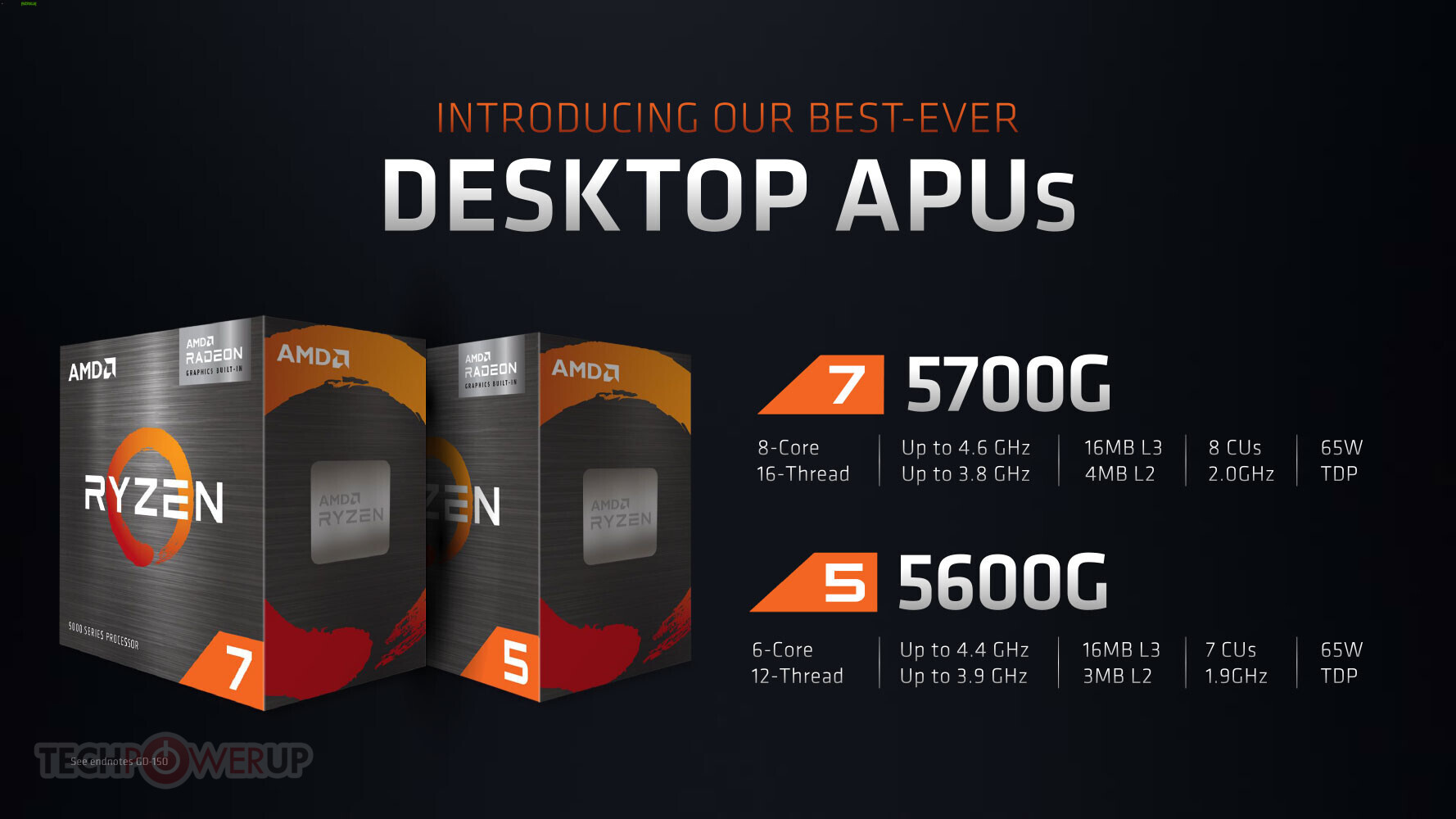
The consumer Ryzen 5000G series include the Ryzen 7 5700G, and the Ryzen 5 5600G. The 5700G features an 8-core/16-thread CPU, clock speeds of 3.80 GHz, with up to 4.60 GHz boost, and all 8 iGPU compute units being unlocked with up to 2.00 GHz engine clocks. The 5600G, on the other hand, has a 6-core/12-thread CPU clocked at 3.90 GHz, with up to 4.40 GHz boost, and 7 iGPU compute units with up to 1.90 GHz engine clocks. Both chips have their TDP rated at 65 W. AMD claims that the 5700G beats the Core i7-11700 in a variety of content creation and iGPU gaming tasks, as shown in the graphs below; and the iGPU is capable of 1080p e-sports gaming. The 5700G is priced at USD $359, and the 5600G goes for $259. Both chips are available from August 5, 2021.


 Moving on to the commercial desktop processor segment, and AMD launched three Ryzen Pro 5000G series processors. These chips are nearly identical to the consumer 5000G, but with two categories based on TDP—the 65 W Pro 5000G series, and the 35 W Pro 5000GE series. The chips feature additional security features, including AMD Shadow Stack technology, Secured-core PC, and FIPS 140-3 certification. The chips also feature AMD Pro management features, a set of features similar to Intel vPro.


 Among the Pro 5000G series are the 8-core/16-thread Pro 5750G; the 6-core/12-thread Pro 5650G, and the 4-core/8-thread Pro 5350G, with their 35-Watt counterparts, the 5750GE, 5650GE, and 5350GE, respectively. The Pro 5750G is clocked at 3.80 GHz with up to 4.60 GHz boost, while the 5650G does 3.90 GHz with up to 4.40 GHz boost, and the 5350G does 4.00 GHz, with up to 4.20 GHz boost. The "GE" SKUs on average lower the nominal clock speeds by 400-800 MHz, and feature aggressive power management to achieve the power target. The company didn't release pricing for the Pro SKUs as they're sold exclusively in the commercial desktop segment, via OEMs.


 The AMD Ryzen PRO 5000G desktop processor slide-deck follows.


The consumer Ryzen 5000G series include the Ryzen 7 5700G, and the Ryzen 5 5600G. The 5700G features an 8-core/16-thread CPU, clock speeds of 3.80 GHz, with up to 4.60 GHz boost, and all 8 iGPU compute units being unlocked with up to 2.00 GHz engine clocks. The 5600G, on the other hand, has a 6-core/12-thread CPU clocked at 3.90 GHz, with up to 4.40 GHz boost, and 7 iGPU compute units with up to 1.90 GHz engine clocks. Both chips have their TDP rated at 65 W. AMD claims that the 5700G beats the Core i7-11700 in a variety of content creation and iGPU gaming tasks, as shown in the graphs below; and the iGPU is capable of 1080p e-sports gaming. The 5700G is priced at USD $359, and the 5600G goes for $259. Both chips are available from August 5, 2021.



37 Comments on AMD Announces Ryzen 5000G and PRO 5000G Desktop Processors
Just looking at their presentation today, AMD is putting a lot of thought in the mobile (notebook) gaming segment. To me, this seems ripe for them making APUs like they have in the PS5 and XSX, but without the budget constraints. Making an entire class of APUs to go into gaming laptops priced in the 1000-1500 range would be a big hit.
Why do you think you'll get a lot of hate? Kind of a pessimistic outlook, certainly on a tech forum.
Chiplet-based APUs have been a dream of many since the first chiplet CPUs, but they still seem a ways out. Either they'd need to put the iGPU in the IOD, which would make it huge (it's already quite sizable, after all, and adding at least 3 CUs plus all the media blocks, display output blocks and the like would need some space), and would require it to be made on a cutting-edge node rather than GloFo 12nm like today. The other alternative is to put a GPU die (GCD?) in place of the second CCD, though that would require AMD to have a suitably sized GPU die to use - which they don't, and haven't for quite a few years. Lexa/RX 550 at 110mm² is still a bit too large, and is way too old at this point. Navi 23 at 236mm² is far too large to sit in place of a ~80mm² CCD. There would also be issues with memory bandwidth holding back a larger iGPU, etc., though those can be overcome with very fast DDR4 to some extent. The revised WSA recently seems to indicate that AMD wants to move to 7nm IODs though, which might make room for the inclusion of a small iGPU across the board. I would certainly welcome this - if nothing else, it would be great for troubleshooting without a dGPU. DDR5 will also be of great benefit to future iGPUs of course, so perhaps we'll actually see a proper chiplet APU on AM5? I'm hopeful.That would be interesting, but OEMs are unlikely to bite - remember how few OEMs made use of KBL-G? I think the main reason is cooling - cooling a separate CPU and GPU in a notebook is always going to be easier than the increased thermal density of a high powered (100W+) APU. Keeping the APU cool might be fine, but it would inevitably lead to a significant hot spot in the chassis. Laying out the PCB might also be difficult, as you'd need a very large VRM setup for the APU, and possibly a semi-exotic RAM layout (256-bit (LP)DDR5?). Still, it could make for some cool designs if they made it and helped OEMs engineer products around it. I think a more realistic APU approach would be gaming APUs for the >$1000 range though, targeting mid-to-high 1080p gaming. Much easier to implement, much easier to cool, more flexible in terms of form factor, and maybe even usable as a socketed desktop product :)