Saturday, September 3rd 2022
Folio Photonics Announces Breakthrough Multi-Layer Optical Disc Storage: 10 TB for $50
Folio Photonics, a leading pioneer of immutable active archive, today announced that it has achieved a significant breakthrough in multi-layer optical storage disc technology that will enable an unprecedented level of cost, security and sustainability advantage. Leveraging patented advancements in materials science, Folio Photonics has developed the first economically viable, enterprise-scale optical storage discs with dynamic multi-layer write/read capabilities, which will enable the development of radically low-cost/high-capacity disc storage.
"Folio Photonics is on a path to engendering far greater data densities than was thought possible several years ago," said John Monroe, lead analyst at Furthur Market Research and former VP analyst in the data center infrastructure group at Gartner. "Using next-generation materials, patented polymer extrusion, and film-based disc construction processes (distinct from mere optical layering), in concert with customized optical pickup units (OPUs), Folio Photonics appears poised to deliver a new optical technology that enables eight or 16 film layers per side per disc, as opposed to only three optical layers per side per disc for archival discs today, with a roadmap to add additional layers over time."
 Data growth is overwhelming existing storage technologies, and today's outdated enterprise storage technologies fail to address three key pain points of cost, cybersecurity and sustainability. The high cost of storage is untenable with exploding data growth, cyber threats continue to escalate, and data centers are a major contributor to energy/water usage and CO2 emissions. Current hard disk drive (HDD) and LTO tape roadmaps reflect insufficient technological advancement to meet user needs and desired price points in the future.
Folio's technology milestone proves the feasibility of its materials, manufacturing and optics and shifts the company from the research phase to product development. With disc availability targeted for 2024, Folio's multi-layer disc capacity is expected to start at 10 TB per cartridge (1 TB per disc) with an aggressive roadmap to multi-TB capacities. The roadmap is enabled by the addition layers due to its easily scalable polymer co-extrusion process as well as significant increases in capacity per layer.
"Our talented engineering team - under the leadership of founder and CIO Dr. Kenneth Singer - has pioneered a fresh approach to optical storage that overcomes historical constraints and puts unheard of cost, cybersecurity and sustainability benefits within reach," said Steven Santamaria, Folio Photonics CEO. "With these advantages, Folio Photonics is poised to reshape the trajectory of archive storage."
Folio Photonics optical discs will provide a powerful combination of game-changing characteristics that make data archives ACTIVE.
Folio Photonics is well positioned to be a leader in the archival storage market, projected to be $10B+1, 2.68+2 Zettabytes in 2025. It plans to start with adoption in the immutable active archive use case and expand to become a standard for all archive data. Folio's manufacturing advantages drive room for significant channel/partner margin and profitability and position the company for sustainable growth and continued investment in the business.
"Archival storage data comprises up to 80 percent of all data according to industry estimates, and Folio Photonics is in a strong position to be a leading player in this large, fast-growing market," said Fred Moore, president, Horison Information Strategies. "Archival data is typically unchanging, presenting itself as 'write once' and requiring immutability. At the same time, artificial intelligence (AI), machine learning (ML) and Big Data analytics are increasing activity and accessibility requirements for archival storage systems. As a result, the demand for immutable active archives will only increase as immutability and higher performance requirements reshape the exploding secondary storage paradigm."
Unlike tape, Folio Photonics ACTIVE archive storage will provide random access to archives to ensure effective data retrieval. Unlike HDD, its ACTIVE archive storage is Immutable by Design and offers a 5X lower acquisition price - roughly $25/TB for HDDs and less than $5/TB for Folio. Folio Photonics discs are highly sustainable and will provide 80 percent power savings over HDDs. In addition, its ACTIVE archive storage is not vulnerable to electromagnetic pulse (EMP) attacks, offers an air gap to ensure cybersecurity and provides a media lifespan of 100 years.
"Folio's next-generation storage media will radically reduce the upfront cost and TCO while making data archives active, cybersecure, and sustainable - an ideal combination for data center and hyperscale customers. We believe that it will disrupt and reenergize the multi-billion-dollar data storage industry with its breakthrough financial and sustainability upside," added Santamaria.
Source:
Folio Photonics
"Folio Photonics is on a path to engendering far greater data densities than was thought possible several years ago," said John Monroe, lead analyst at Furthur Market Research and former VP analyst in the data center infrastructure group at Gartner. "Using next-generation materials, patented polymer extrusion, and film-based disc construction processes (distinct from mere optical layering), in concert with customized optical pickup units (OPUs), Folio Photonics appears poised to deliver a new optical technology that enables eight or 16 film layers per side per disc, as opposed to only three optical layers per side per disc for archival discs today, with a roadmap to add additional layers over time."
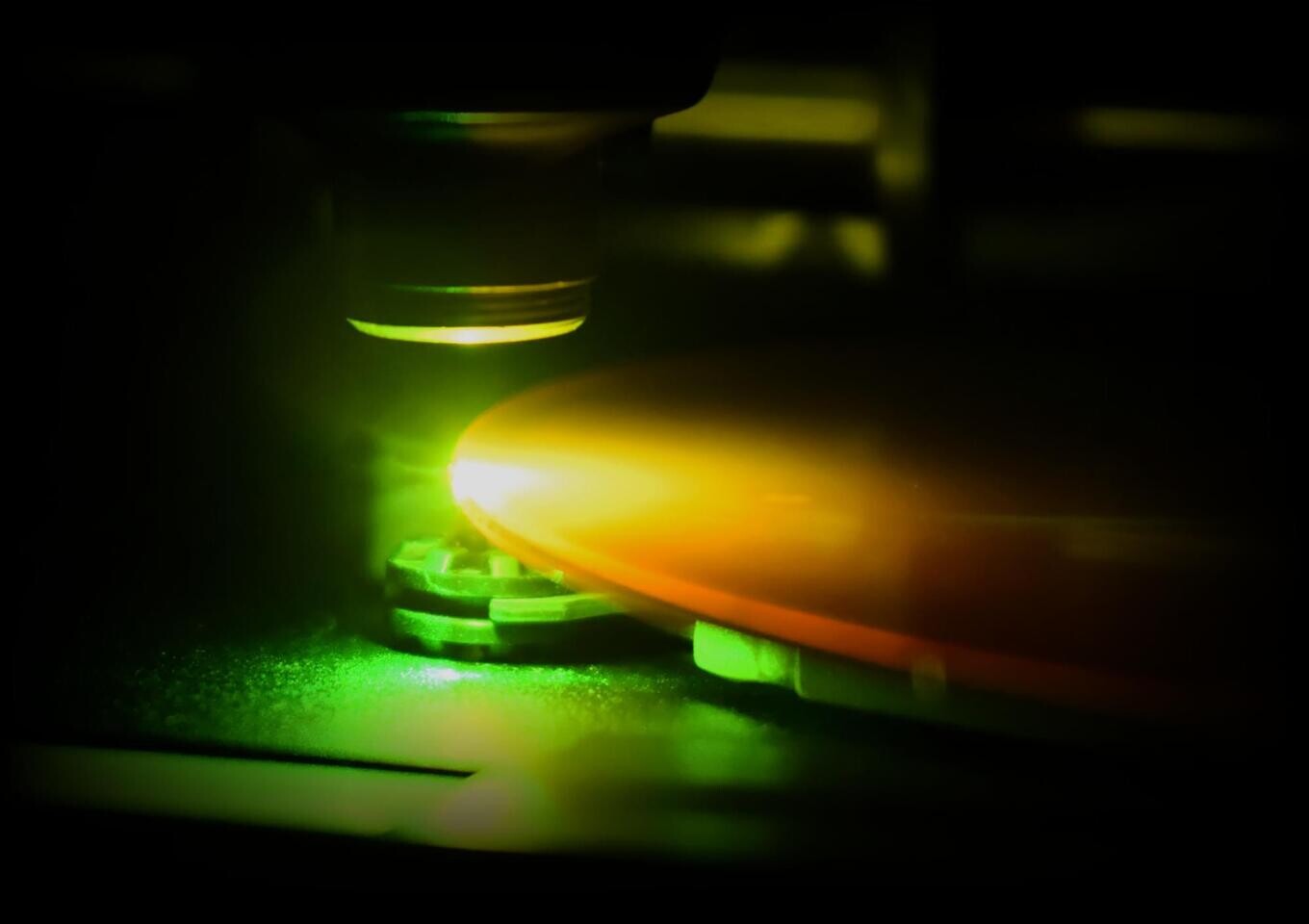

Folio's technology milestone proves the feasibility of its materials, manufacturing and optics and shifts the company from the research phase to product development. With disc availability targeted for 2024, Folio's multi-layer disc capacity is expected to start at 10 TB per cartridge (1 TB per disc) with an aggressive roadmap to multi-TB capacities. The roadmap is enabled by the addition layers due to its easily scalable polymer co-extrusion process as well as significant increases in capacity per layer.
"Our talented engineering team - under the leadership of founder and CIO Dr. Kenneth Singer - has pioneered a fresh approach to optical storage that overcomes historical constraints and puts unheard of cost, cybersecurity and sustainability benefits within reach," said Steven Santamaria, Folio Photonics CEO. "With these advantages, Folio Photonics is poised to reshape the trajectory of archive storage."
Folio Photonics optical discs will provide a powerful combination of game-changing characteristics that make data archives ACTIVE.
Folio Photonics is well positioned to be a leader in the archival storage market, projected to be $10B+1, 2.68+2 Zettabytes in 2025. It plans to start with adoption in the immutable active archive use case and expand to become a standard for all archive data. Folio's manufacturing advantages drive room for significant channel/partner margin and profitability and position the company for sustainable growth and continued investment in the business.
"Archival storage data comprises up to 80 percent of all data according to industry estimates, and Folio Photonics is in a strong position to be a leading player in this large, fast-growing market," said Fred Moore, president, Horison Information Strategies. "Archival data is typically unchanging, presenting itself as 'write once' and requiring immutability. At the same time, artificial intelligence (AI), machine learning (ML) and Big Data analytics are increasing activity and accessibility requirements for archival storage systems. As a result, the demand for immutable active archives will only increase as immutability and higher performance requirements reshape the exploding secondary storage paradigm."
Unlike tape, Folio Photonics ACTIVE archive storage will provide random access to archives to ensure effective data retrieval. Unlike HDD, its ACTIVE archive storage is Immutable by Design and offers a 5X lower acquisition price - roughly $25/TB for HDDs and less than $5/TB for Folio. Folio Photonics discs are highly sustainable and will provide 80 percent power savings over HDDs. In addition, its ACTIVE archive storage is not vulnerable to electromagnetic pulse (EMP) attacks, offers an air gap to ensure cybersecurity and provides a media lifespan of 100 years.
"Folio's next-generation storage media will radically reduce the upfront cost and TCO while making data archives active, cybersecure, and sustainable - an ideal combination for data center and hyperscale customers. We believe that it will disrupt and reenergize the multi-billion-dollar data storage industry with its breakthrough financial and sustainability upside," added Santamaria.
42 Comments on Folio Photonics Announces Breakthrough Multi-Layer Optical Disc Storage: 10 TB for $50
Or go the way of zip disk and fail to saturate market.
I agree with your previous posts. I'd be happy to pay $50 for 10 TB of permanent optical storage, provided the drive isn't overly expensive.
For any optical media standard such as this to be successful, it requires a foothold in the market - and if it manages to get a foothold like Blu-ray disc did and media starts to cheapen, and more and more manufacturers begin to issue drives and all, then I would probably have one of those in my rig, too. For the media to get popular, it will also have to have a reasonable level of performance, even if for archival purposes it may not matter that much, a lot of people (and I would assume most today) would 100% care they had to retrieve a 10 TB archive at say, the maximum sustainable 12x Blu-ray speed (around 54 MB/s theoretical maximum, probably half this in most cases), which would take an hilariously long amount of time to retrieve from media.
and so far,using cd/dvd/BD and even M-disc for backup, in the past 20y,
i have yet to see a single of em, (non-cd discs) fail, cant say that for hdds,
and i had 10x more of those.
and anyone worried about degradation: if its important, its backed up,
which for "pros" means more than a single backup, so any possible "fail" of a disc
is really irrelevant for the ppl doing it right...
Assuming a slow burn of the full 10 TB (10000 GB) at this 1x data rate, which you'd want for archival, you'd be looking at ~620 hours, or over 25 consecutive days non stop to write a full disc, assuming that the speed remains constant and excluding any media finalization time if applicable. It'd take the full bandwidth of SATA III (6 Gbps) over 3 hours to do the job.
I would argue speed up over Blu-ray need to be in the order of 100x+ to make this viable as a practical medium :oops:
not sure which video media your refering to, but (4K) BDs can do at least 150Mbit/s (playback),
as thats what most movies are being recorded/or at least the final file going on the disc..
The 50Mbit range was like 10y ago.
At least from what ive seen extracting files from (demo) discs at work (to use usb storage)