Thursday, March 5th 2026
Imec Partners with Atlas to Develop Permanent DNA-Based Data Storage Technology
imec, a global leader in nano-electronics and digital innovation, and Atlas Data Storage, a pioneer of production-scale DNA data storage, today announce a new strategic partnership to accelerate the development of digital data storage using synthetic DNA. The collaboration combines Atlas' ASIC design expertise and scalable DNA synthesis technology with imec's deep expertise in advanced chip development, fabrication, and integration. In addition to prototyping and strategic support, imec is investing in Atlas.
As data creation and storage accelerates in the AI age, magnetic media such as tape and hard disk drives face unavoidable limits in density, sustainability, cost, and long-term reliability. DNA data storage compresses vast datasets into tiny volumes while ensuring ultra-long durability with minimal energy and maintenance.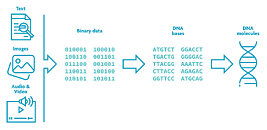
 DNA, nature's most compact and durable information storage medium, has preserved the evolution of life over billions of years within its biochemical four-letter code. One gram of DNA can potentially encode up to hundreds of petabytes of digital data, achieving dramatic footprint and energy improvements impossible with magnetic storage media. While magnetic media requires data migration due to media deterioration - rewriting to new tapes and disk drives - DNA remains stable for thousands of years when properly encapsulated, meaning stored data never needs migration.
DNA & Silicon: 100's of Gigabytes of data in a single synthesis cycle
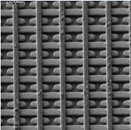
To help bring Atlas' vision to life, imec co-developed and monolithically manufactured a custom, exceptionally dense nano-scale array of electrochemical cells on top of a control CMOS ASIC designed by Atlas. The integrated chip orchestrates and controls millions of individual synthesis sites.
"To make DNA-based digital data storage viable, the synthesis throughput needs to scale by several orders of magnitude over today's approach," explains Siraj Nour ElAhmadi, Atlas Chief Operating Officer. "To meet this challenge, we anchored our solution on silicon, leveraging the very large-scale integration benefits afforded by CMOS technology. Our collaboration with imec was crucial to build the nano device layer on top of our CMOS ASIC. imec's 300 mm silicon platform is key to reach the necessary throughput and scale."
"One of the challenges was etching the platinum devices at very small dimensions, explains Simone Severi, imec Vice President of R&D. "Another critical design challenge was minimizing leakage currents between neighbouring devices at these extremely small dimensions. Our R&D team developed a custom process flow to ensure electrical isolation and stable operation across the dense array, a key enabler for reliable synthesis at scale."
IC-Link by imec manages the supply chain to source Atlas custom wafer for further post-processing on imec's processing line.
As demand for data storage grows, so does the need for sustainable high-density storage solutions. imec and Atlas partnership shows how the convergence of life science and semiconductors can unlock radically new ways to store, sense, and process data.
Research and investment partnership
Beyond the technical collaboration, imec and Atlas Data Storage are embarking in a deeper strategic collaboration where imec will become a shareholder of Atlas Data Storage. This approach is part of imec's venturing strategy where selected ventures benefit of the same type of support and strategic alignment as imec's own spinoffs. "With this approach, imec becomes a direct investor in Atlas Data Storage," observes Olivier Rousseaux, imec director of venture development. "As with other imec venture portfolio companies, Atlas will benefit from cutting-edge R&D and nano fabrication processing capabilities, as well as hands-on business support, leveraging imec's unique ecosystem of partners, investors and venture capital funds."
Sources:
Imec, Atlas Data Storage
As data creation and storage accelerates in the AI age, magnetic media such as tape and hard disk drives face unavoidable limits in density, sustainability, cost, and long-term reliability. DNA data storage compresses vast datasets into tiny volumes while ensuring ultra-long durability with minimal energy and maintenance.


DNA & Silicon: 100's of Gigabytes of data in a single synthesis cycle
To help bring Atlas' vision to life, imec co-developed and monolithically manufactured a custom, exceptionally dense nano-scale array of electrochemical cells on top of a control CMOS ASIC designed by Atlas. The integrated chip orchestrates and controls millions of individual synthesis sites.
"To make DNA-based digital data storage viable, the synthesis throughput needs to scale by several orders of magnitude over today's approach," explains Siraj Nour ElAhmadi, Atlas Chief Operating Officer. "To meet this challenge, we anchored our solution on silicon, leveraging the very large-scale integration benefits afforded by CMOS technology. Our collaboration with imec was crucial to build the nano device layer on top of our CMOS ASIC. imec's 300 mm silicon platform is key to reach the necessary throughput and scale."
"One of the challenges was etching the platinum devices at very small dimensions, explains Simone Severi, imec Vice President of R&D. "Another critical design challenge was minimizing leakage currents between neighbouring devices at these extremely small dimensions. Our R&D team developed a custom process flow to ensure electrical isolation and stable operation across the dense array, a key enabler for reliable synthesis at scale."
IC-Link by imec manages the supply chain to source Atlas custom wafer for further post-processing on imec's processing line.
As demand for data storage grows, so does the need for sustainable high-density storage solutions. imec and Atlas partnership shows how the convergence of life science and semiconductors can unlock radically new ways to store, sense, and process data.
Research and investment partnership
Beyond the technical collaboration, imec and Atlas Data Storage are embarking in a deeper strategic collaboration where imec will become a shareholder of Atlas Data Storage. This approach is part of imec's venturing strategy where selected ventures benefit of the same type of support and strategic alignment as imec's own spinoffs. "With this approach, imec becomes a direct investor in Atlas Data Storage," observes Olivier Rousseaux, imec director of venture development. "As with other imec venture portfolio companies, Atlas will benefit from cutting-edge R&D and nano fabrication processing capabilities, as well as hands-on business support, leveraging imec's unique ecosystem of partners, investors and venture capital funds."
14 Comments on Imec Partners with Atlas to Develop Permanent DNA-Based Data Storage Technology
This actually is pretty neat, though doesn't DNA like to mutate sometimes? Guess that's not much different from bit flips on other storage mediums.
"Oh no, my storage drive got cancer and is now corrupted!"
Also curious about the performance of this tech. Would it be more like tape-based storage?
So that's probably like using a NAS on a 10Mbit connection. Their current marketing is to use it for permanent long term storage. That makes me think it's not fast enough for normal backups, just offsite archives like corps have to do for compliance with data retention laws.
Saving all your images and video
Does it matter, is the real question.
the thing microsoft just made looks like it's far more promissing
I really would like a medium i can write terabytes of information to and make a significant dent in what needs to be kept on harddrives.