Tuesday, January 13th 2026

Seagate Starts Shipping Its 32 TB CMR Exos, SkyHawk AI and IronWolf Hard Drives
Seagate Technology plc (NASDAQ: STX), a global leader in mass-capacity data storage, is showcasing advanced storage solutions at Intersec 2026 that help power the transformation of AI-driven video analytics into searchable, decision-ready intelligence. The edge-to-cloud portfolio is designed to help businesses unlock the full value of their data and make smarter, faster decisions.
AI applications in video image analytics (VIA) are fueling unprecedented data growth at the network edge. IDC reports that more than 75% of organizations expect their video data to at least double over the next five years, as AI adds summaries, annotations, and metadata to every frame. This surge is driven by new use cases across industries - from accelerating investigations and automating alerts to ensuring compliance and enabling deep operational insights.
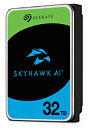
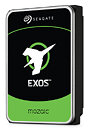
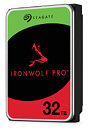 To help meet this demand, Seagate highlights its latest mass-capacity storage breakthroughs at Intersec. Building on its leadership in CMR technology, the company brings industry-leading 32 TB hard drives across its Exos, SkyHawk AI, and IronWolf Pro portfolio to channel and retail partners. Following the blueprint established in hyperscale cloud environments - where Seagate Mozaic technology at higher capacities is already proven - enterprise customers can confidently scale AI workloads across today's complex hybrid and multi-cloud infrastructures. Hard drives deliver unmatched capacity, performance, and scalability enabling businesses to efficiently store and process massive volumes of data, supporting AI adoption at the edge and in data centers.
"AI applications, like computer vision, are transforming how video is used across industries," said Melyssa Banda, SVP of Edge Storage and Solutions at Seagate. "From smart city initiatives to retail and critical infrastructure, video is becoming a searchable business intelligence, and it's changing how operations run day-to-day. This pivot demands a new kind of data backbone: mass-capacity storage at the edge and in the data center to keep insights flowing and archives searchable. Without it, the promise of AI-powered video analytics stalls."
Availability and Pricing:
SkyHawk AI, Exos, and IronWolf Pro 32 TB hard drives are available starting January 14 through Seagate's authorized channel partners worldwide.
Recommended retail price:
Source:
Seagate
AI applications in video image analytics (VIA) are fueling unprecedented data growth at the network edge. IDC reports that more than 75% of organizations expect their video data to at least double over the next five years, as AI adds summaries, annotations, and metadata to every frame. This surge is driven by new use cases across industries - from accelerating investigations and automating alerts to ensuring compliance and enabling deep operational insights.


"AI applications, like computer vision, are transforming how video is used across industries," said Melyssa Banda, SVP of Edge Storage and Solutions at Seagate. "From smart city initiatives to retail and critical infrastructure, video is becoming a searchable business intelligence, and it's changing how operations run day-to-day. This pivot demands a new kind of data backbone: mass-capacity storage at the edge and in the data center to keep insights flowing and archives searchable. Without it, the promise of AI-powered video analytics stalls."
"From smart city initiatives to retail and critical infrastructure, video is becoming a searchable business intelligence, and it's changing how operations run day-to-day." Seagate SVP of Edge Storage and Solutions, Melyssa BandaTo learn more, visit us at Intersec booth SA H19. Seagate experts are there to provide you with the latest updates on cutting-edge technologies designed to address the needs of the AI-driven data surge.
Availability and Pricing:
SkyHawk AI, Exos, and IronWolf Pro 32 TB hard drives are available starting January 14 through Seagate's authorized channel partners worldwide.
Recommended retail price:
- $699.99 - SkyHawk AI
- $729.99 - Exos
- $849.99 - IronWolf Pro
36 Comments on Seagate Starts Shipping Its 32 TB CMR Exos, SkyHawk AI and IronWolf Hard Drives
I hope if I howled at that big red moon coming up that I'll be given a NAS full of the ironwolves at least lol
www.seagate.com/content/dam/seagate/en/content-fragments/products/datasheets/skyhawk-ai/skyhawk-ai-DS1960-16C-2509US-en_US.pdf
The Exos ones are stated to be CMR for the higher capacity ones, but the rest do not state explicitly that they are CMR. www.seagate.com/content/dam/seagate/en/content-fragments/products/datasheets/exos-portfolio-refresh/exos-ds2046.1-2512-en_us_V3.pdf
So if you choose to buy Exos units, you'd best do your research before purchase.
people need to buy at least 2 of these, but even then, that would be a TON of time to restore from backup
We've actually reached a tipping point where more advanced forms of RAID are actually likely to give you more trouble when a drive fails.
But aside dumbasses like me that'd use it as a standalone drive, a 32 TB drive is likely to always be used in RAID configurations in which you'd need multiple drives failing for the RAID to fail so yeah, just swap drives and let the RAID array continue working as usual.
Oh and it's the same for WD where Red Pro is more expensive than UltraStar. I i very much doubt they bundle three years of services with Red Pro to justify the higher price.Also much slower...And that is worth an extra $120? WD does the same. What's the excuse there?Every time new capacity is released someone complains about the single point of failure.
Backups? Hello? You should always have backups regardless if you run ten 1TB drives or one 32TB drive.
Also there is no need to backup every single bit of 32TB. Backup primarily the things that cannot be replicated or re-downloaded from somewhere.
Things that can be re-downloaded do not really need to be included in a backup.
Sure of you have the space then go for it as it saves bandwidth of having to re-download terabytes of data. Especially if your internet is slow.Dual actuator drives were and interesting experiment, but considering they haven't produced anything bigger than the initial 18TB models and other HDD manufacturers have not done these we can assume dual actuator is dead. Which is a shame because the capacities keep increasing, but the speeds have not kept up. This means that RAID rebuild times and backups keep taking longer and longer.
I've got multiple drives because my most important files (family photos) are backed up to multiple locations just in case.
The issue is that with these kind of large drives, there's so much data that has to be synchronised that people have ended up having drives fail on them due there being too much stress on the drives during the rebuild. Not saying it's a common thing, but it happens, especially with older drives.
I moved to two 20 TB drives in RAID 1, as I doubt I'll have both drives fail at once, plus I back up the really important stuff to an external drive.
I was using MergerFS and Snapraid on my old NAS, but it was a bit messy.I don't think I said it was, but it appears to be the only difference that I can find, based on the spec sheets.
Given the recovery cost I was quoted on a click of death drive for me was 1500aud (1000USD) for a small drive, which is baked into the cost of about 8 drives based on the premium, ostensibly that has value to some.Yeah, but slower for what, these drives are aimed at nas deployments where the throughput of a single ssd is capped by usually at best a 10g nic. 4 spinning rust devices push the same data stream albeit at lower iops. But if you're in the need for ssd iops at that capacity, you're not likely to be considering these drives at all.I have to agree with the lack of development on dual actuators.
Rebuild times have been an issue since about 24tb where the 1 non recoverable bit read every 10^15 meant a full read of the drive would statistically mean an error, compounding the rebuild potentially.
My first hard drive in my Amiga was 40 meg, it used to read @ 150kb a second, which meant it could read the entire drive in about 4 1/2 minutes, now full read time of an average 8tb drive takes over 11 hours.
Capacity now nearing 1,000,000x the size of my first drive but only 2,000x the max transfer rates. I don't expect parity, but we need the growth to at least hit the sata bus limits.
Can't stress enough these things though
1. Raid is NOT a backup
2. If you would be at a loss/out of business/devasted about 'this' data, then it needs to be backed up properly.
Having said all these things, I am eying these drives off for my next nas now, this is the size I have been waiting for, 4x current largest drives.
Perhaps the technology isn't yet ready/cheap enough for much higher capacities or maybe there's a physical constraint/limit stopping it from going much further for now, or maybe there just isn't a market for it due to the massive existence of SSDs these days (or at least before the AI companies bought half the wafers in the last few months). If the latter is true, maybe there will be a market now. SSD pricing through the roof and being able to sell a hard drive that's twice as fast as the competition's could be a total win for Seagate if the price for a dual actuator drive isn't too far from the single ones' and the HDD prices don't also go straight into the stratosphere.