Thursday, November 3rd 2022
AMD Radeon RDNA3 Graphics Launch Event Live-blog: RX 7000 Series, Next-Generation Performance
AMD today is expected to launch its next-generation RDNA3 graphics architecture and next-generation Radeon RX 7000-series graphics cards, along with new gaming technologies as part of the company's "together we advance_gaming" event, unfurled by CEO Dr Lisa Su. In this live-blog we track the various announcements made in the event.
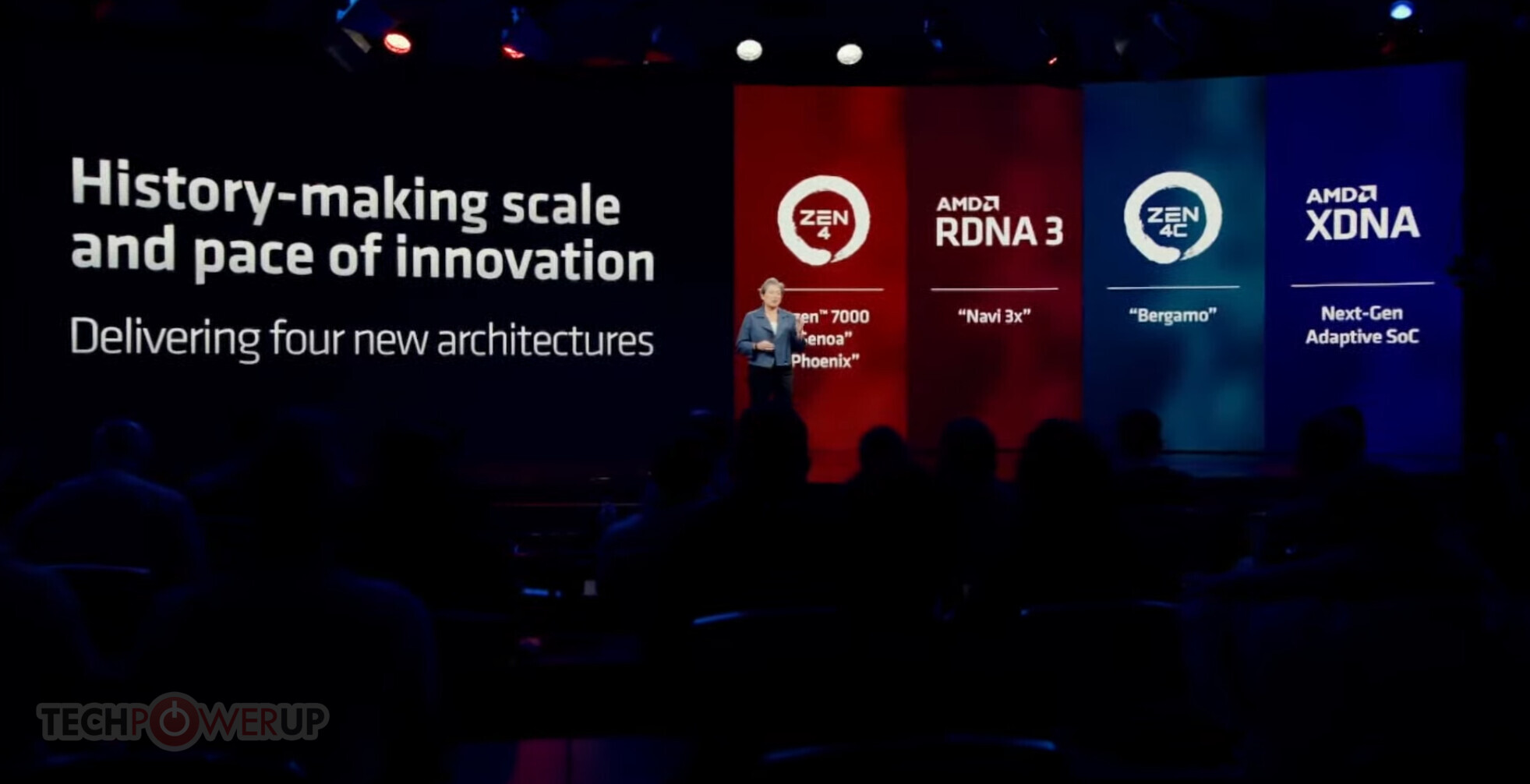
 20:01 UTC: AMD's roadmap is supremely busy:

 20:02 UTC: "today it's all about gaming"
20:03 UTC: AMD covers practically every gaming form-factor right now. 20:04 UTC: Lisa named 5800X3D, the company is definitely manufacturing more.
20:05 UTC: RDNA3: World's first chiplet gaming GPU: 20:06 UTC: Graphics Compute Die on 5 nm, Memory Controller Dies on 6 nm
20:07 UTC: 61 TFLOP/s compute power. That's nearly 3x over the 23 TFLOP's of the predecessor
20:08 UTC: here it its, the Navi 31: 20:08 UTC: 54% perf/W gain, similar to that of RDNA2 vs RDNA
 20:09 UTC: Here they are, the RX 7900 XTX and RX 7900 XT:
 20:09 UTC: 300 mm2 GCD, 6x 37 mm2 MCDs, graphics-relevant Infinity Fabric
 20:11 UTC: Each MCD has 16 MB of Infinity Cache, and 64-bit memory path. Together, the Navi 31 has 384-bit GDDR6 memory I/O. Peak bandwidth to 5.3 TB/s
20:12 UTC: This is the all-new compute unit, with 64 dual-pumped stream processors, AI accelerators, and new-gen RT accelerator (50% RT performance) 20:13 UTC: 2.7X AI performance uplift with the AI accelerators.
20:15 UTC: Radiance Display Engine: The GPU gets DisplayPort 2.1 native support: 4K @ 480 Hz possible, 8K at 165 Hz possible, with a single cable.
20:16 UTC: Dual Media Accelerator Engines 20:17 UTC: RDNA3 reintroduces decoupled clock domains, with shaders running at a different frequency than the front-end:
 20:18 UTC: 61.6 TFLOPs peak throughput
20:18 UTC: Architecture design goals met: 20:19 UTC: RX 7900 XTX is designed for 4K
20:20 UTC: 70% performance uplift over RX 6950 XT! 20:21 UTC: The card is surprisingly compact.
 20:21 UTC: 355 W board power, just two 8-pin
 20:22 UTC: RX 7900 XT
 20:22 UTC: DisplayPort 2.1 allows you to actually play at 4K @ 480 Hz
 20:24 UTC: Samsung unveils an 8K Ultrawide for CES
 20:24 UTC: 8K @ 165 Hz possible
 20:26 UTC: 96 FPS AC: Valhalla at 8K!
20:27 UTC: Halo Infinite to get Ray Tracing 20:27 UTC: Ray Tracing Performance is +60% over the previous generation:
 20:28 UTC: Oh joy, a tech demo:
 20:30 UTC: AMD FSR3 with Fluid Motion Frames announced: DLSS 3-like frame generation: Coming in 2023
 20:32 UTC: In summary:
 20:37 UTC: Hyper-RX unifies Boost and Anti-Lag into a single one-click feature:
 20:41 UTC: SmartAccess Video leverages video-acceleration of both the GPU and the Ryzen 7000-series iGPU:
 20:34 UTC: AMD Advantage coming to pre-built desktops, combine RX 7000-series with Ryzen 7000-series processors:


 20:42 UTC: AMD is aggressively pricing the Radeon RX 7900 XTX at $999, and RX 7900 XT at $899, both available from December 13



20:03 UTC: AMD covers practically every gaming form-factor right now.

20:05 UTC: RDNA3: World's first chiplet gaming GPU:

20:07 UTC: 61 TFLOP/s compute power. That's nearly 3x over the 23 TFLOP's of the predecessor


20:12 UTC: This is the all-new compute unit, with 64 dual-pumped stream processors, AI accelerators, and new-gen RT accelerator (50% RT performance)

20:15 UTC: Radiance Display Engine: The GPU gets DisplayPort 2.1 native support: 4K @ 480 Hz possible, 8K at 165 Hz possible, with a single cable.
20:16 UTC: Dual Media Accelerator Engines


20:18 UTC: Architecture design goals met:

20:20 UTC: 70% performance uplift over RX 6950 XT!


20:27 UTC: Halo Infinite to get Ray Tracing


143 Comments on AMD Radeon RDNA3 Graphics Launch Event Live-blog: RX 7000 Series, Next-Generation Performance
How many of those are included in prebuilt machines, laptops, or from people who buy Nvidia cause they have the same mentality of it’s the best?
Who are you trying to convince here? Does AMD pay rent for that space in your head, or does Nvidia? Competition is good, a premium card for less than a grand is great. Now go have a juice box and relax
They should develop their tech but not charge people in advance for something that is not in the majority of games.
There are 243 Dx12 (100%) games
144 of (58%) those games support Some type of Raytracing.
So, it doesn't need everyone to have a 4090. We can see Nvidia selling under $600 cards, still at premium. Why? Because consumers go and buy blindly Nvidia. Why Nvidia gets in those prebuild systems? Because consumers ask for them. Why do we see Nvidia in most expensive laptops? Because consumers ask for them.I am trying to convinse no one. Just pointing at a different perspective than your and others. You think a good price and rasterization will heal the market that today is close to a monopoly, resembling the CPU market when AMD was still selling Bulldozer CPUs? AMD is building very good GPUs, but it is missing the point. It needs to beat Nvidia in it's own game, RayTracing, to make it's brand look more than just a second grade option.
I will avoid going your way with personal attacks. I will only say this. Competition is good when it exists.
No, listing the data does not make one a fanboy. I'm going to go touch grass, something I recommend others here do as well.
RX 7000 does not have to be the best performing GPU in it's generation to be successful, especially when it comes to pricing and/or power consumption. RTX 4090 is a HALO product. It's 1.6k+ price tag is absurd. It's power consumption is a joke in a world where - like here in Germany - the price for a kW/h just doubled this year. But comments like the quoted one above show that people still just look on performance numbers: So sad! - to quote a person I really despise.Defending a company makes me think you are a fanboy of said company.
Perhaps this is just a first step, testing if they can decouple essential parts like the memory controllers and cache, and the next generation will test splitting the compute core up into smaller dies. Given that yields and production costs massively favour smaller dies, there's the potential for huge performance gains if or when AMD figure it out for consumer products.
Raytracing performance is meh. 7900-series RT uplift of 1.5-1.6x pretty much matches the 1.5-1.7x improvements over 6900-series for everything else. Perhaps I'm not understanding the announcement, but it seems like raytracing performance has increased by about zero relative to everything else. IMO AMD needed to increase raytracing performance by 50% more than their raster performance improvements if they want to fully compete with Nvidia this generation.
Maybe AMD don't care, just like me. As someone with a RTX 3070 and an RX 6700 on hand, raytracing is still shit anyway. I've borrowed a 3090 to mess around with an most RT games still failed to deliver compelling graphics or playable framerates on my 4K TV. RT reflections are just about the only aspect worth enabling because they're quite obviously an improvement over screen-space reflections. Global Illumination and raytraced shadows are just horrific performance destroyers for pitifully small differences to the final output.
Perhaps the RTX5000-series will finally have enough raytracing power to keep up with advances in games' graphical requirements but for now the 4090 is basically just about good enough to render 4K60 in 2-year-old titles without using a cheaty upscaler as a crutch. That's impressive, but also depressingly unfit for the 4K120 and 1440p240 monitors of yesteryear.
I think we should apologize to the native english speakers for butchering their language.
AMD doesn't need another Polaris or an RX 5700 to grab people's attention. AMD needs a killer product because Nvidia has managed to turn the GPU market to their own playground. And tech press is supporting them lately. For example, those last months many articles about GPU pricing where totally focusing on Nvidia cards. AMD was dropping prices across the board and most articles where focusing on the price drops of the originally ridiculously overpriced RTX 3090. Nvidia is everywhere in articles and AMD a footnote. AMD came very close to Nvidia with RX 6000 series. RX 7000 series should have been a leap forward, but I don't see it. It's another RX 5700.
That's what I care about. I don't care if any 4090/7900XTX spits 5000fps at 16K on CS GO.
I want RT performance at 1440p.
AMD doesn't need to compete at ultra high end level. I'm more than happy if they deliver a 7900XT with 3090/Ti level of RT performance.
I'm happy with their prices as long as the numbers are there.
Do you know when the review embargo is lifted?
The 5700 xt did not even support rt, and was way slower than the 2080 Ti.
Now 7900 XTX will probably come close to RTX 4090 in raster, but still it will be losing badly on RT performance. Most people here disagree with me about the significance of RT performance. But I believe most consumers who will pay over $800 for a new graphics card will be looking at that parameter especially. The majority of tech press and YouTubers will also focus on that, playing Nvidia's marketing game.
I hope I am wrong, most people think I am wrong, but until I see AMD's market share going up and people buying with their brains, meaning choosing an RX 6600 over an RTX 3050 for example, I am afraid I am closer to being correct.
Lastly, let's not forget that Nvidia only needs to reduce prices.
The very first thing is something that looks like a good deal.
This looks like a really good deal. There IS RT performance, let's face it. It will be playable, the gap today isn't even up to a point where it is a total no deal for RT on AMD. So you'll play your five games on it, and that's that.
Let's see the gaming library progress a bit on the RT front before we start calling it a must have feature. Its really not. Games look pretty without it. Games run like shit with it, in a relative sense. The technology is still sub par in both camps.
When you save a CPU+board+RAM worth on your GPU, let's see how that balances out ;) And another thing, for those tech enthusiasts - what is more interesting, the first, fattest chiplet GPU on the planet that can actually game, or a few more FPS showing the same RT effects? We are well into territory where performance in the majority of games is solid down to upper midrange.
I'm still gaming on a 2016 GPU... No complaints.'Some type' yes, and how many are worth playing? And on the other side of the coin, how many would run below par on RDNA3? Its going to be a stupendously tiny subset.
RDNA2 is already killing it with performance/Watt and I think there are plenty of people like me who don't want a 300W, 450W, or even 600W graphics card. If I can tolerate a 250W card, is it an AMD card or an Nvidia card that gets me the best experience within that power budget?
Also, there's no sensible way to shoehorn a cards with silly-high power draw into a laptop. The mobile 3080 was so utterly castrated by the form factor that a desktop 3060Ti could match or often beat it. The 40-series power consumption has increased by 50%, but the laws of physics still dictate how much copper fin surface area you can squeeze into a laptop and still blow air through it. Don't even get me started on laptop power bricks that weigh more than any laptop I'd consider buying, let alone the fact you need TWO of them to power some laptops....
Stop the insulting jabs at each other.
Thread bans, warnings forthcoming for any more of these antics.
Thank You
Take notice: This is a warning post... you have been warned
They trippled shaders count & doubled RT core count.
They only double instructions pre-clock count while needing it to be more than over quadrupled.
Normally you double shaders & RT cores & increase the front end. That usually means the front end is quadrupled.
seems like they have the front end quintupled. Also if the R.O.P's are only 128 then that's a real disappointment too.