Tuesday, November 22nd 2022
GPU Sales See Biggest Quarterly Drop Since 2009 Recession: JPR
Jon Peddie Research reports the growth of the global PC-based graphics processor unit (GPU) market reached 75.5 million units in Q3'22 and PC CPU shipments decreased by -19% year over year. Overall, GPUs will have a compound annual growth rate of 2.8% during 2022-2026 and reach an installed base of 3,138 million units at the end of the forecast period. Over the next five years, the penetration of discrete GPUs (dGPUs) in the PC will grow to reach a level of 26%.
Year-to-year total GPU shipments, which include all platforms and all types of GPUs, decreased by -25.1%, desktop graphics decreased by -15.43%, and notebooks decreased by -30%—the biggest drop since the 2009 recession. AMD's overall market share percentage from last quarter decreased by -8.5%, Intel's market share increased by 10.3%, and NVIDIA's market share decreased by -1.87%, as indicated in the following chart.
 Overall GPU unit shipments decreased by -10.3% from last quarter, AMD shipments decreased by -47.6%, Intel's shipments rose by 4.7%, and NVIDIA's shipments decreased by -19.7%.
Quick highlights
GPUs have been a leading indicator of the market because a GPU goes into a system before the suppliers ship the PC. Most of the semiconductor vendors are guiding down for the next quarter, an average of -0.21%. Last quarter, they guided -2.79%, which was too high.
Jon Peddie, president of JPR, noted, "The third quarter is usually the high point of the year for the GPU and PC suppliers, and even though the suppliers had guided down in Q2, the results came much below their expectations.
"All the companies gave various and sometimes similar reasons for the downturn: the shutdown of crypto mining, headwinds from China's zero-tolerance rules and rolling shutdowns, sanctions by the US, user situation from the purchasing run-up during Covid, the Osborne effect on AMD while gamers wait for the new AIBs, inflation and the higher prices of AIBs, overhang inventory run-down, and a bad moon out tonight.
"Generally, the feeling is Q4 shipments will be down, but ASPs will be up, supply will be fine, and everyone will have a happy holiday," Peddie said.
JPR also publishes a series of reports on the graphics add-in board market and PC gaming hardware market, which covers the total market, including systems and accessories, and looks at 31 countries.
Pricing and availability
JPR's Market Watch is available and sells for $2,750. This report includes an Excel workbook with the data used to create the charts, the charts themselves, and supplemental information. The annual subscription price for JPR's Market Watch is $5,500 and includes four quarterly issues. Full subscribers to JPR services receive TechWatch (the company's bi-weekly report) and a copy of Market Watch as part of their subscription.
Click here to learn more about this significant report or to download it now. For more information, call 415/435-9368 or visit the Jon Peddie Research website at www.jonpeddie.com.
Year-to-year total GPU shipments, which include all platforms and all types of GPUs, decreased by -25.1%, desktop graphics decreased by -15.43%, and notebooks decreased by -30%—the biggest drop since the 2009 recession. AMD's overall market share percentage from last quarter decreased by -8.5%, Intel's market share increased by 10.3%, and NVIDIA's market share decreased by -1.87%, as indicated in the following chart.

Quick highlights
- The GPU's overall attach rate (which includes integrated and discrete GPUs, desktop, notebook, and workstations) to PCs for the quarter was 115%, down -6.0% from last quarter.
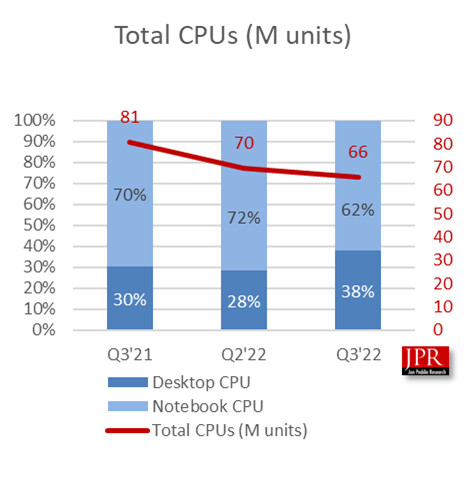
- The overall PC CPU market decreased by -5.7% quarter to quarter and decreased -by 18.6% from year to year.
- Desktop graphics add-in boards (AIBs that use discrete GPUs) decreased by -33.5% from the last quarter.
- This quarter saw 0.5% change in tablet shipments from last quarter.
GPUs have been a leading indicator of the market because a GPU goes into a system before the suppliers ship the PC. Most of the semiconductor vendors are guiding down for the next quarter, an average of -0.21%. Last quarter, they guided -2.79%, which was too high.
Jon Peddie, president of JPR, noted, "The third quarter is usually the high point of the year for the GPU and PC suppliers, and even though the suppliers had guided down in Q2, the results came much below their expectations.
"All the companies gave various and sometimes similar reasons for the downturn: the shutdown of crypto mining, headwinds from China's zero-tolerance rules and rolling shutdowns, sanctions by the US, user situation from the purchasing run-up during Covid, the Osborne effect on AMD while gamers wait for the new AIBs, inflation and the higher prices of AIBs, overhang inventory run-down, and a bad moon out tonight.
"Generally, the feeling is Q4 shipments will be down, but ASPs will be up, supply will be fine, and everyone will have a happy holiday," Peddie said.
JPR also publishes a series of reports on the graphics add-in board market and PC gaming hardware market, which covers the total market, including systems and accessories, and looks at 31 countries.
Pricing and availability
JPR's Market Watch is available and sells for $2,750. This report includes an Excel workbook with the data used to create the charts, the charts themselves, and supplemental information. The annual subscription price for JPR's Market Watch is $5,500 and includes four quarterly issues. Full subscribers to JPR services receive TechWatch (the company's bi-weekly report) and a copy of Market Watch as part of their subscription.
Click here to learn more about this significant report or to download it now. For more information, call 415/435-9368 or visit the Jon Peddie Research website at www.jonpeddie.com.
46 Comments on GPU Sales See Biggest Quarterly Drop Since 2009 Recession: JPR
Tbh i think by the looks of it AMD might have better time selling Rx 7000 series than Nvidia their RTX 4000 series.
Just wait for the next quarter - when the shipments and revenue fall further, because this isn't a normal launch, it's a post crypto crash one - just as the Turing was in 2018. And even worse, Turing cards had zero price / performance uplift, the RTX and DLSS alone were supposed to be the factor that would drive massive sales, but they didn't.
And now we have a price / performance regression, not just stagnation - $700 dollars will get you an Ada card slower than Ampere eqivalent, RTX 3080 - but it's OK, the reviewers will tell you that's normal, because you have to compare it to scalped crypto prices...
Right now, instead of looking on how to sell cards to gamers, Nvidia is probably looking which minable cryptocoin should they prop up with investing the real money into, since the whole crypto bubble is kind of revealing it's hollow inside.
Don't even look for other theories.
RTX 4080, the other high end card for $1200 - $1600 uses AD103 graphics processor chip with a die area of 379 mm²
- AMD: shipments decreased by 47.6%.
- NVIDIA: shipments decreased by 19.7%.
Yeah, sure, it's Nvidia's crypto sales crashed. :rolleyes:Maybe 84% of AMD buyers started to vote with their wallets?
"Speaking to Digital Trends, Nvidia CEO Jensen Huang was asked about the pricing of the graphics cards and said that high prices are here to stay. "Moore's Law is dead. The idea that the chip is going to go down in price is a story of the past," Huang said."
Retail Nvidia RTX 30-Series GPU Prices Are on the Rise
www.tomshardware.com/news/nvidia-gpu-prices-increasing-amd-downto infinite and beyond :D
nvidia/comments/z278rg
People love to live in their own little reality these days, defined by the walls of echo chambers. Power to them. There are similarities in the real world. Putin has an echo chamber much like it, its why his army performs so well. History repeats, I try to enjoy the show, and I'll never buy a Lada.
Its not entirely fair to compare the current price structure with the 2011~2016 28nm era. The first Titan was 561 sq mm and the fastest gaming GPU (980ti) on that node was a mere 600 sq mm (with a disabled SM, so about equal to Titan!) but still carried a major performance increase. That's exactly what progress means; more out of the same die space on the same node. That node was re-used for so many generations... Today we are shrinking every gen. So when the die in absolute size is even larger after 3 (?) shrinks with some intermediate steps even skipped, that's a major increase in cost. Especially in the current economy.
Margins are still filthy though
All I'm trying to illustrate is there is a lot of money flying around here and $1600 graphics cards aren't a heavy lift for many. The rich are getting richer at an incredible rate, many people cannot comprehend just how much money some people have, and many of those people live here. If people think graphics card prices are out of control they'd absolutely lose their minds if they looked at housing and cars. Even if the prices got cut in half a year from now, at these income levels the opportunity cost of losing out on the experience of ownership for that amount of time doesn't come close to penciling out.