Wednesday, February 1st 2023

AMD Ryzen 7000X3D Series Prices Revealed, Available Feb 28
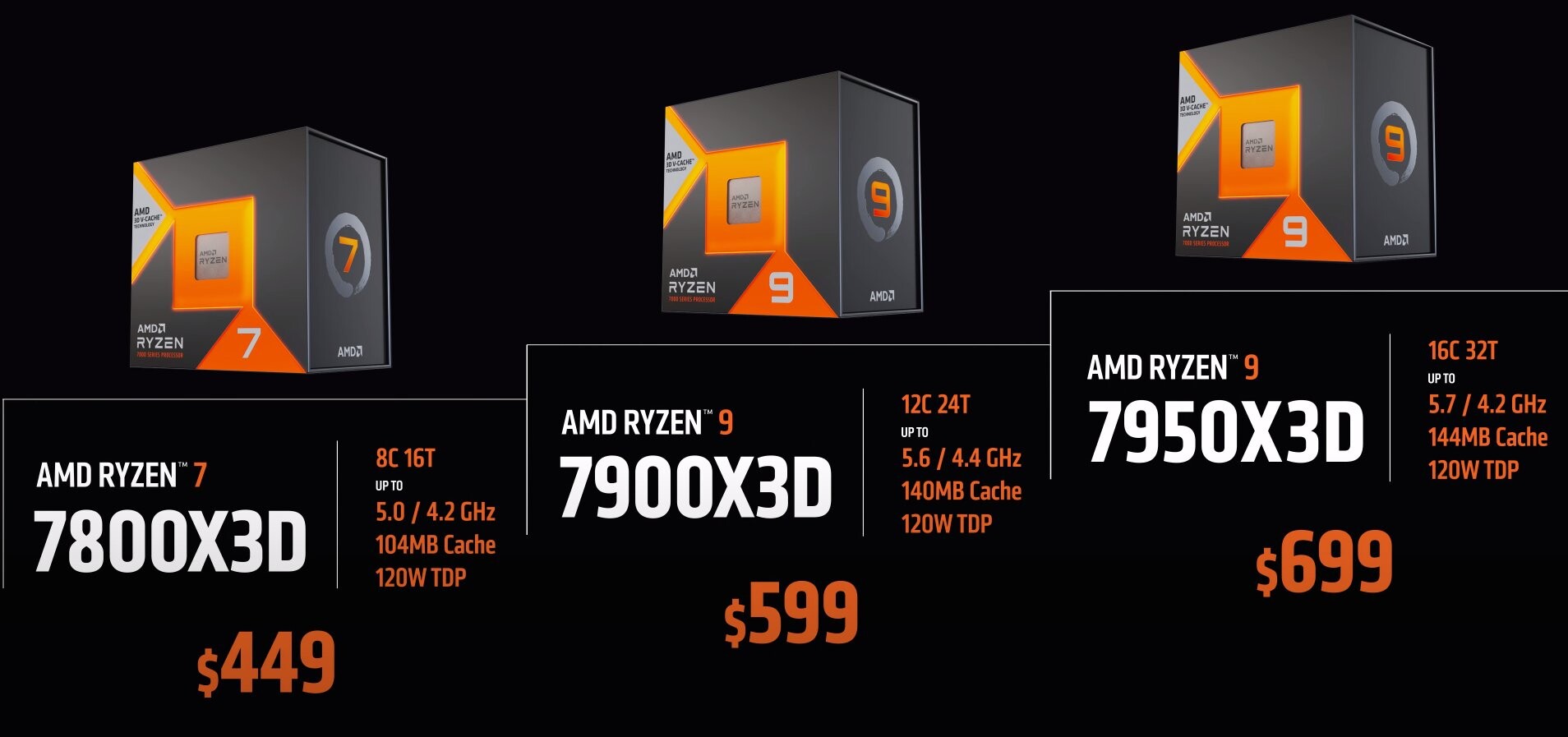
AMD today announced the retail channel pricing of its upcoming Ryzen 7000X3D "Zen 4" line of high-performance Socket AM5 desktop processors. These processors introduce the 3D Vertical Cache (3DV cache) technology, which the company claims has a significant impact on gaming performance, making them perform competitively with 13th Gen Core "Raptor Lake" processors, including the fastest i9-13900K, and possibly even the i9-13900KS. AMD announced retail availability from February 28, 2023 for the Ryzen 9 7950X3D and 7900X3D. The Ryzen 7 7800X3D launches on April 6, 2023.
The Ryzen 7 7800X3D 8-core/16-thread processor is priced at USD $449. The 12-core/24-thread Ryzen 9 7900X3D is priced at $599. The flagship 16-core/32-thread Ryzen 9 7950X3D is priced at $699. The 7800X3D launches at a $50 higher price than the $399 price that the Ryzen 7 7700X launched at, before settling down at $349. The 7900X3D launches at $599, which again is a $50 premium over the launch price of the Ryzen 9 7900X—currently going for $475. The top-dog 7950X3D launches at the same $699 price that the 7950X launched at, which has its price slashed all the way down to $575.
A video presentation by AMD follows.
Source:
GPUsAreMagic (Twitter)
The Ryzen 7 7800X3D 8-core/16-thread processor is priced at USD $449. The 12-core/24-thread Ryzen 9 7900X3D is priced at $599. The flagship 16-core/32-thread Ryzen 9 7950X3D is priced at $699. The 7800X3D launches at a $50 higher price than the $399 price that the Ryzen 7 7700X launched at, before settling down at $349. The 7900X3D launches at $599, which again is a $50 premium over the launch price of the Ryzen 9 7900X—currently going for $475. The top-dog 7950X3D launches at the same $699 price that the 7950X launched at, which has its price slashed all the way down to $575.
174 Comments on AMD Ryzen 7000X3D Series Prices Revealed, Available Feb 28
You can save money buying Intel with DDR4, but then you'll have to replace everything in a few years. With AMD, you'll only have to replace the CPU.
So if you want to save money now, you might as well buy AM4 with the 5800X3D, which is still on par with the newest CPUs, but much cheaper. But then you'll have a similar dilemma at the end of the AM5 life cycle, when you'll be thinking of upgrading. Although I doubt we'll be seeing DDR6 with the next AMD socket (AM5+ maybe?). It'll be too early, I think.
In my view, AMD made a series of bad decisions on this Ryzen 7000 series (such as the lack of compatibility with DDR4 memories and socket AM4) and Radeons RDNA3 offboard graphics cards with MCM scheme. A GPU die necessarily needs to be a single die to have the lowest possible latencies.
In this Ryzen 7000 generation, AMD should have made the CPU in a single die, with 2 MB of L2 cache per x86 core and with only 40 MB of L3. When the memory controller is on the same die of the x86 cores, the x86 cores have a very fast memory access (the fastest possible) and thus AMD CPUs would not need to have huge (and expensive) amounts of L3 cache memory. With 2 MB of L2 cache per x86 core, 40 MB of L3 on a CPU that has direct access to RAM is equivalent to ~80 MB of L3 on a CPU that has an intermediate chip between the x86 cores and the memory RAM. The main die (the CPU die that has the memory controller integrated) should be like this and, to increase the amount of x86 cores, it would be enough to add a chiplet of x86 cores, and the operating systems should be optimized to use mainly the cores of the main die.
And AMD should put the SATA controllers, USB controllers and other components on the chipset die that don't need to be made in an expensive lithography.
This image represents what I said about how Ryzen CPUs should be made:
AMD already has APU's (well not Zen 4 ones yet). I bet they included this useless iGPU because OEM's wanted it.
Also the initial pricing for Ryzen 7 models was absurd (Ryzen 9 was surprisingly reasonable).Well eventually DDR4 and AM4 would be left behind. Im kinda glad they did it in one go instead of confusing mess of DDR4/DDR5 support and both LGA and PGA versions of 7000 series.This is only the first generation. First generation Zen 1 was also not great. Give it some time to mature instead of asking to cancel it right away.
If you are referring to the iGPU then i see it as near useless for enthusiast class desktop CPU's. I mean i have several discrete cards laying around and so do most enthusiasts who would buy 7000 series CPU.L3 is cheaper than L2. It does add cost but not by that much. Plus it's always a balancing act. You cant just inscrease L2 by 2x without increasing it's latency. The whole architecture needs to account for that. The extra L3 on X3D chips did increase latency but thankfully not by much.I was already under the impression that all SATA connectivity comes from the chipset. But that's more on AsMedia than AMD for not including high speed standards in the chipset. Also in terms of system latency it's not good if for example mouse is connected to a USB port that comes from the chipset. Same with keyboard. So some should come from the CPU direct. Same with at least one M.2 slot for OS.
Upgrading the memory also depends on the CPU and whether they can make the infinity fabric any faster. The thing is, DDR5-6000 will still be ok for future Ryzen CPUs, while DDR4 would completely cripple them. It already kind of does it with Intel, many new games are starting to show significant benefits from DDR5, especially with ray tracing.
And it's still so much easier to just replace the memory instead of the motherboard. The latter can even render your Windows activation key useless.
On Intel you have no upgrade path anyway, so you can save money going with DDR4. If you want to save money on AMD, just go with AM4. You don't buy the newest hardware if you're looking for the highest value.
That iGPU would only be useful if it had a lot of CUs and had something extremely attractive, like encode AV1 videos.I think AMD should have released some models of Ryzen 7000 CPUs for socket AM4. So we would only need to change the CPU and not almost the entire PC. And AMD only makes money by selling CPUs, GPUs and chipsets. The expensive DDR5 memories decrease a lot the sales of Ryzen 7000 CPUs and motherboard chipsets. If there were Ryzen 7000 AM4 models, it would be good for both AMD and consumers. I think AMD still has time to release Ryzen 7000 AM4 models. AMD might even release models of Ryzen 9000 AM4 that it would sell a lot of CPUs.I think the GPU MCM scheme will never work fine. I think GPUs need to be single-die and have a lot of cache memory, like Nvidia did with the RTX 4000 GPUs, to have the lowest possible latencies.Can you post here a link that shows that the L2 cache is more expensive to manufacture than the L3? These chiplets made with this 3D L3 memory (made with TSVs) must have a very high rate of defective dies, which makes the other dies that were manufactured perfectly even more expensive.I think at least 4 SATA ports and the high speed USBs come from the Ryzen "IO-die" and not from the chipset.We are talking about a few nanoseconds (ns) only, not milliseconds...
AMD engineers need to do the calculations to discover if it's more advantageous to integrate all components (SATA, USB, etc) into the CPU (making it a SoC single die), or it is cheaper to put some components on the chipset (components that don't need to be made in such an advanced and expensive lithography).
And if the CPU is a SoC, the time, complexity and cost of manufacturing motherboards can be less.
A sliver was released on desktop with the highest margins possible just to satisfy the demand for new hardware for those willing to pay.
Why do you think the new GPUs are so expensive? Because they literally don't want to sell them. Why sell a $1600 RTX 4090, when you can sell a workstation version for three times as much, where the demand is so much higher.
Desktops are a tiny fraction of the overall market. New manufacturing tech is very expensive with limited throughput. Desktops are at the very bottom of the priority list.
Once the initial demand in professional markets gets satisfied and the supply of chips is increasing, desktops get cheaper products to start driving the supply down.
All these corporations care about is margins, and the highest margins are on servers, workstations and mobile devices. Desktop is the least profitable market.
The absence of AV1 encoding on the iGPU was one of the several bad decisions AMD made on this Ryzen 7000 and offboard Radeon RDNA3 GPUs generation.
I used to work for a corporation, so I know well how they think.
And, today, DDR4 3600 CL16 memories are cheap and I think they have enough performance for the Ryzen 7000 and future Ryzen 9000.Yes, but I'm talkin about Ryzen 7000's iGPUs.
They spent a lot of money to develop Zen 4, not Ryzen 7000. They don't want to sell Ryzen 7000 right now, they want to sell this - en.wikipedia.org/wiki/Zen_4#Server and this - en.wikipedia.org/wiki/Zen_4#Mobile