Wednesday, February 1st 2023

AMD Ryzen 7000X3D Series Prices Revealed, Available Feb 28
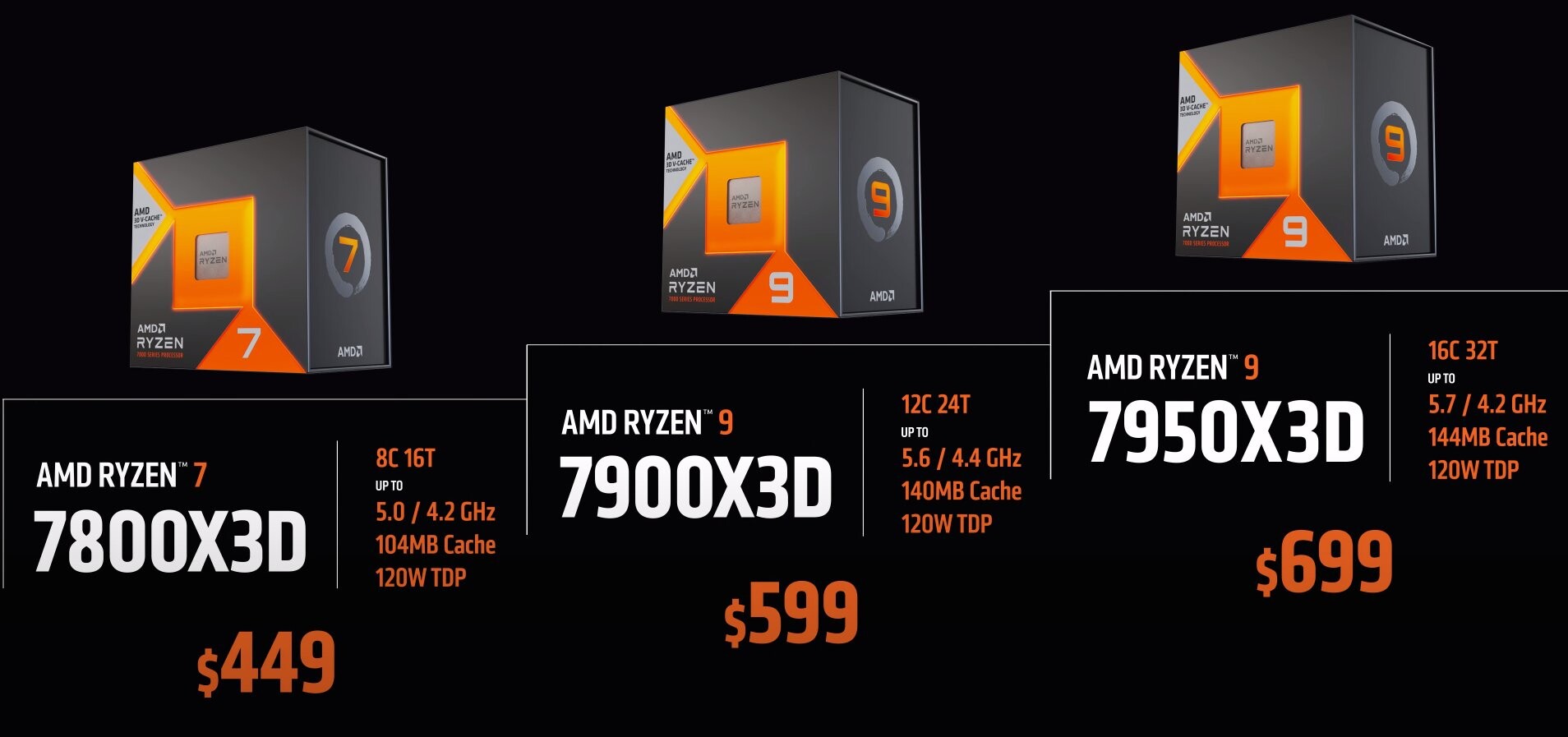
AMD today announced the retail channel pricing of its upcoming Ryzen 7000X3D "Zen 4" line of high-performance Socket AM5 desktop processors. These processors introduce the 3D Vertical Cache (3DV cache) technology, which the company claims has a significant impact on gaming performance, making them perform competitively with 13th Gen Core "Raptor Lake" processors, including the fastest i9-13900K, and possibly even the i9-13900KS. AMD announced retail availability from February 28, 2023 for the Ryzen 9 7950X3D and 7900X3D. The Ryzen 7 7800X3D launches on April 6, 2023.
The Ryzen 7 7800X3D 8-core/16-thread processor is priced at USD $449. The 12-core/24-thread Ryzen 9 7900X3D is priced at $599. The flagship 16-core/32-thread Ryzen 9 7950X3D is priced at $699. The 7800X3D launches at a $50 higher price than the $399 price that the Ryzen 7 7700X launched at, before settling down at $349. The 7900X3D launches at $599, which again is a $50 premium over the launch price of the Ryzen 9 7900X—currently going for $475. The top-dog 7950X3D launches at the same $699 price that the 7950X launched at, which has its price slashed all the way down to $575.
A video presentation by AMD follows.
Source:
GPUsAreMagic (Twitter)
The Ryzen 7 7800X3D 8-core/16-thread processor is priced at USD $449. The 12-core/24-thread Ryzen 9 7900X3D is priced at $599. The flagship 16-core/32-thread Ryzen 9 7950X3D is priced at $699. The 7800X3D launches at a $50 higher price than the $399 price that the Ryzen 7 7700X launched at, before settling down at $349. The 7900X3D launches at $599, which again is a $50 premium over the launch price of the Ryzen 9 7900X—currently going for $475. The top-dog 7950X3D launches at the same $699 price that the 7950X launched at, which has its price slashed all the way down to $575.
174 Comments on AMD Ryzen 7000X3D Series Prices Revealed, Available Feb 28
Imagine going to Bestbuy and the salesman telling you, "look, buy this TV here at $500 ... this is a great deal because TVs were like $5,000 40 years ago".
My take on the 7800X3D's price is not that it is too high by itself... it is more that it seems too high compared to the 6000/7000 (+ free game).
Now, perhaps this "disconnect" is due to the 6000/7000 being sold at a loss... in this case, seems like a good thing for consumers.
"Client segment revenue was $903 million, down 51% year-over-year due to reduced processor shipments resulting from a weak PC market and a significant inventory correction across the PC supply chain"
This is a fourth quarter 2022 financial result, compared to fourth quarter 2021 - when Ryzen 5000 CPUs were a year old and 5800x3D hasn't launched yet.
Continuing like nothin's wrong with the pricing of Ryzen 7000 platform is of course a valid strategy. Success will be visible in next financial reports.
Because in 2022 sales of PC were down greatly over last year and even AMD has slowed production of their CPU line because NO ONE IS BUYING THEM. That is why they reduced the pricing on the CPU"S
AND YET NO PRICE DECREASE ON AMD MOTHERBOARDS.
I am not going to spend 1 grand to get the same performance that I am getting now on my current Rig.
I am not going to spend 2+ grand to get an overall 30 to 40% increase over my old rig.
And as far as CPU performance increases IMHO it comes at the expense of wattage usage, Heat, Expensive DDR5 Ram and sometimes a PSU replacement.
I can buy a 5 to 10 grand or more rig in a heartbeat. No problems but I've build a good rig in a fraction of the price and get all of those things that need to be done now and a few years down the road.
These tidbits of increases of performance makes me not want to build a rig this year and perhaps the next year.
From a business sense it is not cost effected do so and in a personal sense. I'm not giving my money to Greedy tech companies as well.
The AMD Motherboard Tax has got to stop.
Intels RPL on a dead-end platform.... unappealing
AMD the value-king is now the wallet-king... unappealing
Shame really... i would have loved to have bought into AMD's AM5 3 year+ support plan. Wouldn't mind overspending somewhere in the ~$100 region for future GEN support + X3D. In its current form, we're wayyy over the ~$100 overspend. The 7800X3D, DDR5 RAM + decent Board (int-WIFI) is going for around £800-£900. If hot-perf GPUs were achievable for £500 i might have just splurged out - unfortunately thats not the case. I totally agree.... 30-40% increase in performance for the current post-pandemic/greedy asking prices is hardly an attractively satisfying investment.
We have heard everything, from how the Zen 4 was designed with 3D cache in mind from the start, so it should have only positive influence (doubt) to harsh reality, where AMD deleted the overclocking ability of new x3D models from the specs - same as with 5800x3D, so we should expect all other 3D cache downsides? Lower boost clocks? Confirmed. Lower multicore, productivity performance? It sure looks like it.
Making a dedicated gaming chip like 5800x3D with productivity sacrificed for higher gaming scores is one thing.
Making a whole high-end lineup, with productivity focussed 7900x and 7950x chips into gaming-only chips with lower productivity performance could really be a huge blunder.
Especially if we consider that games were, are and will be mainly GPU limited, unless you specifically adjust your gaming benchmarks to eliminate that GPU limitation (bencmarking in 720p...).
Most of us will not own an RTX 4090. And if by chance we do, we won't be using it in 720p or 1080p - where most quoted and highlighted CPU benchmarks are performed.
The hypothetical scenarios where such differences in CPU speeds will manifest in real life never really happen - if you buy an RTX 5090 Ti down the line (for $5000) you won't suddenly remove the GPU limitation, potentially exposing the differences in CPU speeds now shown only in 720p or 1080p benchmarking - because you'll be playing AAA game from that time, in resolution and settings from that time, and it will again be GPU limited. And performance in old games that won't tax the new GPU? They'll fly, who cares about a couple of percents you could have gotten with better dedicated gaming CPU if it's fast enough?
First, performance of 5800x3D. We all agree it trades higher gaming performance for lower productivity. It doesn't have overclocking ability, it has lower boost clocks...
And Ryzen 7000?
AMD removed references of overclocking on a 7000 x3D CPU specs pages, after first erroneously leaving them in:
AMD Ryzen 7000 X3D CPUs Don’t Feature Manual Overclocking
Lower max temperature for X3D CPUs:
AMD Ryzen 7000 X3D CPUs Have A 6C Lower Tjmax of 89C Versus The 95C On Non 3D V-Cache SKUs
AMD confirming the much lower boost clocks on 7800X3D:
"7800X3D is so much slower than the other two models. The eight-core chip has a peak boost speed of 5GHz, much lower than the 5.7GHz and 5.6GHz speeds of the 16-core and 12-core models."
Now I know people are excited about 7900X3D and 7950X3D still having high boost clocks - the CPU with two CCD chips could use non-X3D CCD primarily for productivity, boosting as high as non-3D cache CPU. And for games use CCD with 3D cache. And we trust Windows will be able to schedule that? :p Or will we be switching this manually?
So 7800x3D looks just like 5800x3D in it's limitations - it has no overclocking ability, it has lower boost freqencies, and it even has a new limitation - a lower max temperature. And we all know how Ryzen 7000 love to slam right into that Tjmax, even on water cooling.
7900x3D and 7950x3D have on paper an ability to circumvent those downsides - using primarily non-3D cache CCD for productivity, and 3D cache one for gaming.
But we'll apparently trust Microsoft's ability to schedule this. Microsoft, who couldn't schedule properly Threadrippers with two different CCDs, ones with direct cache connections and ones without. And Microsoft, who still has problems with scheduling Intel processors with P and E cores?
"Averaged over our application test suite, the Ryzen 7 5800X3D falls 3% behind the original Ryzen 7 5800X because the 5800X3D runs at lower clocks than its sibling. AMD confirmed that the 3D V-Cache die is limited to 1.35 V maximum operating voltage, a limit that applies to the whole processor due to the way power is routed into the CPU, including the compute cores. Since Zen 3 does require 1.5 V and above to reach the highest boost clocks, AMD had to reduce the core clocks a bit to ensure stability at all times."
Remember, this is a more expensive CPU, trailing the less expensive CPU in a really wide assortment of applications. And some applications really take a much greater hit than the calculated average - but it"'s more exciting to talk about the selected games that gain the biggest boost.
I know it's a trade off. But I believe it's a trade off for something gamers usually wouldn't even notice without benchmarking:
"Averaged over our 10 games at the CPU-bottlenecked 720p resolution, the Ryzen 7 5800X3D can gain an impressive 10% in performance over its 5800X counterpart."
The whole 10% at eye watering resolution of 720p! Of course, this gets diminishingly smaller as we raise the resolution to real world ones, at 1440p we're at 5%, at 4K we're way below the trade off of 3% loss of productivity.
So, 5800x3D in my eyes gives up tiny bit in productivity, and gains a tiny bit in gaming. A trade off, but it's not priced like one, it's priced as an improvement, and people were jumping on it like it really is a noticeable one.
And comparing previous generation of x3D with the newer one as flawed? Sure, it might be. But all the hopes that AMD somehow overcame the problems of adding an extra layer of cache are slowly evaporating as we see the same impact in specs as with 5800x. And it might have an even greater impact in productivity, we don't know what the 6 degrees lower Tjmax will bring. But I think it can't be insignificant - otherwise AMD wouldn't push for CPUs that jump to 95 degrees, a temperature that a while ago surely meant a badly mounted cooler.
Unfortunately not many places bother to test tic rates in games so the kinds of games that gain the most (and often don't need to top of the line GPUs to hit 4K60 or 4K120) don't even get tested.
I mean W1z does a Civ 6 test but it is FPS. Why on earth is anybody testing Civ 6 FPS? What a pointless benchmark where as turn time would be far more useful for comparing CPUs and for players of the game as well. Then there are the very clearly observed gains in ACC, iRacing, MSFS, World of Warcraft. Final Fantasy XIV, Factorio, Path of Exile etc which rarely get tested in reviews.
Look at those 1% lows even at 4K. Means keeping > 120 fps is possible which for an online sim racing game is pretty important and this test was done before the 4090 came out so with a 4090 the X3D will stretch its legs again.
So your conclusion is probably true for those who only play AAA games but beyond that there is an entire world of games out there which don't see the light of a benchmark suite and would really show the differences between CPU performance beyond just 'hurp durp at 4K only the gpu matters'.
Having only 6\8 cores at max hz for applications is not a good thing, it's a necessary compromise.
It will probably loss to vanilla 7900\50x across all tests except for the games that can utilize the extra cache.
So a good all around CPU's that cost extra with some compromise on all front (that is not the best\optimal) except for spacific gaming.
As I see it, only the 7800x3d make sense and purely for gaming purpose.
Interesting to see the reviews, hope they prove me wrong.
also, a shame AMD convinced everyone that freesync was superior to actual g-sync modules. the actual g-sync modules were superior to Nvidia's implementation. had to pay extra for it, but yeah a shame that AMD won that battle, i'd rather have a sync range of 1-165 vs 48-165 which is all AMD can do without the gsync module. Nvidia provides superior products, and always has, shame the industry allowed itself to be won over by AMD.
To compensate on the 3dv CCD lower speed the other CCD will need to go to and above 6GHz.
Also, I don't see prioritizing done 100% or even 95% optimal in the first year from lunch.
AMD will need to work closely with Microsoft on that.