Friday, August 25th 2023

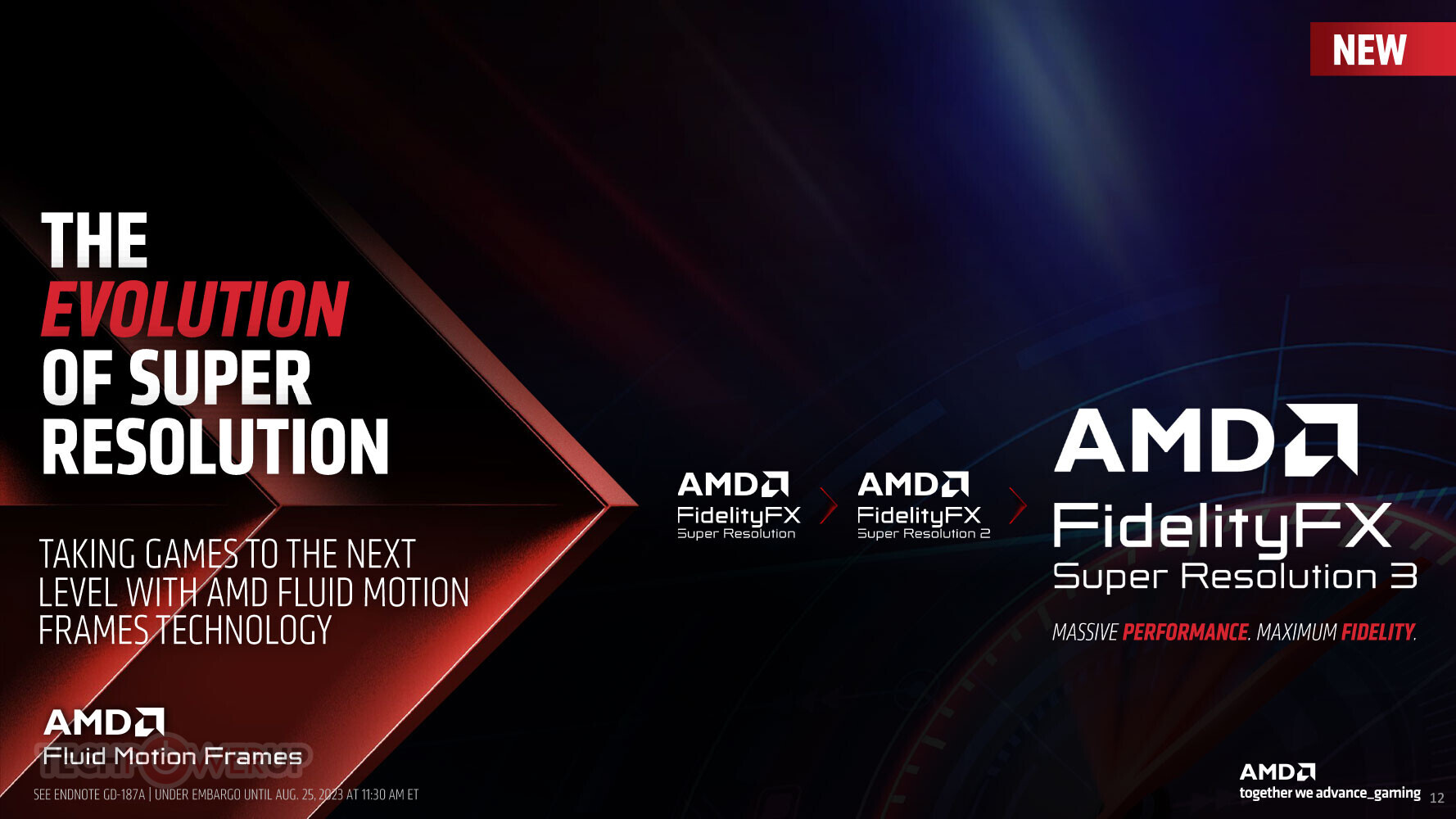
AMD Announces FidelityFX Super Resolution 3 (FSR 3) Fluid Motion Rivaling DLSS 3, Broad Hardware Support

In addition to the Radeon RX 7800 XT and RX 7700 XT graphics cards, AMD announced FidelityFX Super Resolution 3 Fluid Motion (FSR 3 Fluid Motion), the company's performance enhancement that's designed to rival NVIDIA DLSS 3 Frame Generation. The biggest piece of news here, is that unlike DLSS 3, which is restricted to GeForce RTX 40-series "Ada," FSR 3 enjoys the same kind of cross-brand hardware support as FSR 2. It works on the latest Radeon RX 7000 series, as well as previous-generation RX 6000 series RDNA2 graphics cards, as well as NVIDIA GeForce RTX 40-series, RTX 30-series, and RTX 20-series. It might even be possible to use FSR 3 with Arc A-series, although AMD wouldn't confirm it.

FSR 3 Fluid Motion is a frame-rate doubling technology that generates alternate frames by estimating an intermediate between two frames rendered by the GPU (which is essentially what DLSS 3 is). The company did not detail the underlying technology behind FSR 3 in its pre-briefing, but showed an example of FSR 3 implemented on "Forspoken," where the game puts out 36 FPS at 4K native resolution, is able to run at 122 FPS with FSR 3 "performance" preset (upscaling + Fluid Motion + Anti-Lag). At 1440p native, with ultra-high RT, "Forspoken" puts out 64 FPS, which nearly doubles to 106 FPS without upscaling (native resolution) + Fluid Motion frames + Anti-Lag. The Maximum Fidelity preset of FSR 3 is essentially AMD's version of DLAA (to use the detail regeneration and AA features of FSR without dropping down resolution).
AMD announced just two title debuts for FSR 3 Fluid Motion, the already released "Forspoken," and "Immortals of Aveum" that released earlier this week. The company announced that it is working with game developers to bring FSR 3 support to "Avatar: Frontiers of Pandora," "Cyberpunk 2077," "Warhammer II: Space Marine," "Frostpunk 2," "Alters," "Squad," "Starship Troopers: Extermination," "Black Myth: Wukong," "Crimson Desert," and "Like a Dragon: Infinite Wealth." The company is working with nearly all leading game publishers and game engine developers to add FSR 3 support, including Ascendant, Square Enix, Ubisoft, CD Projekt Red, Saber Interactive, Focus Entertainment, 11-bit Studios, Unreal Engine, Sega, and Bandai Namco Reflector.
AMD is also working to get FSR 3 Fluid Motion frames part of the AMD Hyper-RX feature that the company is launching soon. This is big, as pretty much any DirectX 11 or DirectX 12 game will get Fluid Motion frames, launching in Q1-2024.

Both "Forspoken" and "Immortals of Aveum" will get FSR 3 patches this Fall.

362 Comments on AMD Announces FidelityFX Super Resolution 3 (FSR 3) Fluid Motion Rivaling DLSS 3, Broad Hardware Support

#126
Dr. Dro
AusWolfIf implementing a technology in your game takes time, then why would you spend extra time to implement two very similar technologies when you could do just one that fits all, and call it a day? Maybe there's no conspiracy here, just capitalism, and limited game development times.
Yes, Nvidia agrees, developed and released the open source Streamline framework which serves this exact purpose. One implementation to service all three upscalers.

Intel adopted it and Nvidia provides DLSS precompiled for it, but AMD has refused to write and maintain an FSR plug-in for it.
Posted on Reply
#127
AusWolf
Dr. DroYes, Nvidia agrees, developed and released the open source Streamline framework which serves this exact purpose. One implementation to service all three upscalers.

Intel adopted it and Nvidia provides DLSS precompiled for it, but AMD has refused to write and maintain an FSR plug-in for it.
That doesn't really answer my question, though. If you were a developer, and had to choose which tech to use because of the limited time available, would you use the one that all gamers can enjoy, or the one that only X% can?
mrnagantNvidia has a paper on it actually comparing it against all their cards with tensor. Has FPS and latency data. They all have fps improvements with frame gen, but latency is worse on all previous generations to Ada, but it doesn't go into detail on how impactful the difference is and if their anti latency tech helps. The 3000 series also only has a very minor incr ase latency impact over Ada.
Well, they didn't refrain from enabling RT on certain GTX 1000 and 1600 cards, so I don't see why they should not enable FG on Turing onwards.
Posted on Reply
#128
Dr. Dro
AusWolfThat doesn't really answer my question, though. If you were a developer, and had to choose which tech to use because of the limited time available, would you use the one that all gamers can enjoy, or the one that only X% can?
Streamline implementation takes just the time of a single implementation and would support all technologies, it'd be a no brainer if AMD had decided to participate.

But in the shoes of a game developer targeting specifically the Windows PC platform, I'd probably implement DLSS and test games primarily on Nvidia hardware simply due to their market share (88% of the discrete graphics market share in Q3/22) and very high marketability of the tech (trendy name, influencers love it, etc.)
Posted on Reply
#129
oxrufiioxo
AusWolfIf implementing a technology in your game takes time, then why would you spend extra time to implement two very similar technologies when you could do just one that fits all, and call it a day? Maybe there's no conspiracy here, just capitalism, and limited game development times.
again my only annoyance is if you are only going to include one version at least make it good and not the shoddy implementation we typically get when it comes to FSR2.
Posted on Reply
#130
AnotherReader
oxrufiioxoIt uses Async Compute to work.


www.eurogamer.net/digitalfoundry-2023-amd-reveals-long-awaited-fsr-3-tech-and-frame-gen-for-every-dx11dx12-game

So far it sounds promising but there is some confusion about the driver base version only maybe working on 7000 series and the newer latency reducing antilag+ only working on 7000 series.
Thanks @oxrufiioxo. That's a good read and rather than pitching camps and advocating for multi-billion dollar companies, we should actually discuss this article. Regular FSR3 uses a combination of motion vector input from FSR 2 and optical flow analysis as the basis for interpolating frames. The actual computation relies on asynchronous compute to reduce the burden. The driver based solution, on the other hand, only uses optical flow and that makes it more limited.
Posted on Reply
#131
AusWolf
Dr. DroStreamline implementation takes just the time of a single implementation and would support all technologies, it'd be a no brainer if AMD had decided to participate.

But in the shoes of a game developer targeting specifically the Windows PC platform, I'd probably implement DLSS and test games primarily on Nvidia hardware simply due to their market share (88% of the discrete graphics market share in Q3/22) and very high marketability of the tech (trendy name, influencers love it, etc.)
88% is still not 100%. FSR is supported by 100% of current gen GPUs. For me that's enough reason to choose it over DLSS without a blink of an eye. Proprietary technologies (from any company) should die a painful death, imo.
oxrufiioxoagain my only annoyance is if you are only going to include one version at least make it good and not the shoddy implementation we typically get when it comes to FSR2.
That I can agree with.
Posted on Reply
#132
oxrufiioxo
AusWolf88% is still not 100%. FSR is supported by 100% of current gen GPUs. For me that's enough reason to choose it over DLSS without a blink of an eye. Proprietary technologies (from any company) should die a painful death, imo.


That I can agree with.
I'm all for things being open like with adaptive sync basically replacing Gsync in most monitors but only when the open version is as good or better than what a proprietary version offers. IF FSR could be substantially better on just RNDA 2/3 hardware for example I would prefer that vs a lesser more open version.

Especially when it comes to upscaling because currently if you can implement one they are all easy to implement. IT actually should be embarrassing for the developers at this point who only support FSR because modders mod in a better quality DLSS.

I actually like intel's approach better of having a version that works better on their hardware but a still lesser more open version.
Posted on Reply
#134
Pumper
Vya DomusIf AMD's driver level implementation of frame interpolation is decent this will make Nvidia look really bad
Unfortunately it's highly unlikely to do the job properly, otherwise, why would they demo it with irrelevant trash like Forspoken instead of Starfield?
Posted on Reply
#135
R0H1T
With it being more "open source" it'll probably also improve faster. But yes a lack of dedicated hardware would eventually be felt at the end.

Don't underestimate driver or other system level optimizations though!
www.youtube.com/watch?v=5hAy5V91Hr4
Posted on Reply
#136
Cybrshrk
kapone32The biggest Takeaway for me was Frame Generation in all Games.
Problem is that it's driver level and part of hypr-rx and therefor will be locked to rdna3 / 7000 series only... FSR3 will need to be directly integrated into the game for it to compatible with "all gpu's"
Kabouter PlopDriver level frame generation i guess AMD wins assuming NVIDIA isn't working on something similar already but then again NVIDIA only supports RTX 40 series with DLSS3 so i guess AMD wins this round without even trying.
Except that that's going to be a part of the new hypr-rx driver features and that tech is locked to rdna3 / 7000 series only!
AnotherReaderThanks @oxrufiioxo. That's a good read and rather than pitching camps and advocating for multi-billion dollar companies, we should actually discuss this article. Regular FSR3 uses a combination of motion vector input from FSR 2 and optical flow analysis as the basis for interpolating frames. The actual computation relies on asynchronous compute to reduce the burden. The driver based solution, on the other hand, only uses optical flow and that makes it more limited.
And the driver level version will only run on 7000 series / rdna3 gpu's... It's part of hypr-rx and that's locked to those cards only.
Posted on Reply
#137
Pumper
CybrshrkProblem is that it's driver level and part of hypr-rx and therefor will be locked to rdna3 / 7000 series only... FSR3 will need to be directly integrated into the game for it to compatible with "all gpu's"

Except that that's going to be a part of the new hypr-rx driver features and that tech is locked to rdna3 / 7000 series only!

And the driver level version will only run on 7000 series / rdna3 gpu's... It's part of hypr-rx and that's locked to those cards only.
So? According to AMD themselves, the AFMF solution will be a shitty variant of FSR3's frame generation. Why are you crying about it not being supported by everything when FSR3 will be and it's the superior system?
Posted on Reply
#138
Prima.Vera
Another proof that you don't need fancy Tensor Cores or whatever to run DLSS 3, just as scumbag nGreedia callously told us.
Once a greedy scumbag, always a scumbag.
Good job AMD.
Posted on Reply
#139
wolf
Better Than Native
Can't wait to see this in action and make up my own mind. A shame AMD are locking the driver level one to RX 7000 only (or higher, presumably).

As for the soup of mental gymnastics, flawed logic and inability to accept evidence and draw reasonable conclusions in the last 6 pages, I suppose it's become par for the course on forums, depending on the shade of your glasses.
Posted on Reply
#140
sLowEnd
wolfCan't wait to see this in action and make up my own mind. A shame AMD are locking the driver level one to RX 7000 only (or higher, presumably).

As for the soup of mental gymnastics, flawed logic and inability to accept evidence and draw reasonable conclusions in the last 6 pages, I suppose it's become par for the course on forums, depending on the shade of your glasses.
Looks like only Anti-Lag+ is limited to RX7000.

community.amd.com/t5/gaming/first-look-at-amd-fidelityfx-super-resolution-3/ba-p/626581
Posted on Reply
#141
AusWolf
CybrshrkProblem is that it's driver level and part of hypr-rx and therefor will be locked to rdna3 / 7000 series only... FSR3 will need to be directly integrated into the game for it to compatible with "all gpu's"


Except that that's going to be a part of the new hypr-rx driver features and that tech is locked to rdna3 / 7000 series only!


And the driver level version will only run on 7000 series / rdna3 gpu's... It's part of hypr-rx and that's locked to those cards only.
Who wants driver level frame generation in older games that run at hundreds of FPS on any RDNA 2 GPU anyway? Newer games that actually benefit from it will support it on game level, so no issues there.

This is a typical example of making a problem out of a non-problem just for the sake of it.
Posted on Reply
#142
gffermari
I don't like frame gen. in general. No matter if the frames are created by hardware like DLSS 3 frame gen. or by software like FSR3.
The thing is that the cards like 6800/XT and better can use it without many negatives of the tech (latency) while it's needed on the cards that are worse than the aforementioned.
And that's the problem. The lower end cards do not have the power to achieve normal base fps, so that the frame gen tech can work from.
Anyway, the image reconstruction is far more beneficial than this.

Practically as I see it, it will be useful mainly on consoles while on pc space, the cards that can use it properly, do not even need it.
Yes, most likely it will be worse than DLSS 3 frame gen. but it doesn't matter.
A credit has to be given to AMD anyway that it can be used on any card (with async compute) no matter the results.
Posted on Reply
#143
R0H1T
Well believe it or not this tech will make it to consoles & portable consoles & then you'll thank AMD, or Nvidia, for it so there's that :pimp:

Besides the hyperbole surrounding pros & cons of each implementation this is a godsend for smaller/mobile devices!

And yes it's probably also coming to an Exynos near you.
Posted on Reply
#144
apoklyps3
Some fan boys lost it entirely.
Seems AMD is the new villain in the pc market
Posted on Reply
#145
maxfly
Sadly there are much better, more mature discussions being had about this elsewhere. The camping is killing the vibe here.

Later.
Posted on Reply
#146
Vya Domus
PumperUnfortunately it's highly unlikely to do the job properly, otherwise, why would they demo it with irrelevant trash like Forspoken instead of Starfield?
What should they demo it with, enlighten us. Also why would it even matter what game it is ? You do understand how this works, right ? It just inserts a new frame in-between 2 consecutive ones, it works the same everywhere.
Posted on Reply
#147
Camm
To everyone going on about Streamline above.

Streamline doesn't support anything outside the PC ecosystem, with AMD supporting three different consoles (including the Nvidia powered Switch), Streamline would split FSR implementation for little benefit to itself. If Nvidia truly wants Streamline to be the default implementation approach, it'd bring support for GNM, GNMX and NVN to Streamline (even if its upscaling solutions themselves don't get ported).

As for Intel supporting Streamline, of course it would, XeSS is limited to PC, and as a low marketshare competitor, can use the implementation to push its own technology.
Posted on Reply
#148
Pumper
Vya DomusWhat should they demo it with, enlighten us. Also why would it even matter what game it is ? You do understand how this works, right ? It just inserts a new frame in-between 2 consecutive ones, it works the same everywhere.
They should demo it with the biggest game release in recent years, and officially AMD sponsored title, but they don't even mention Starfield as FSR3 supporting title. Makes no fucking sense. No on gives a shit about Forspoken.
Posted on Reply
#149
AusWolf
Vya DomusWhat should they demo it with, enlighten us. Also why would it even matter what game it is ? You do understand how this works, right ? It just inserts a new frame in-between 2 consecutive ones, it works the same everywhere.
Exactly this!

In order for FG to work (whether you call it DLSS 3 FG or FSR 3, it doesn't matter), you need 2 queued frames in the render pipeline to insert a 3rd one in between. If you want a decent, lag-free gaming experience, you should limit queued frames to 1. Conclusion: frame generation is pointless. Moving on. :)
Posted on Reply
#150
Kabouter Plop
AusWolfExactly this!

In order for FG to work (whether you call it DLSS 3 FG or FSR 3, it doesn't matter), you need 2 queued frames in the render pipeline to insert a 3rd one in between. If you want a decent, lag-free gaming experience, you should limit queued frames to 1. Conclusion: frame generation is pointless. Moving on. :)
So like vsync where the latency go's down the more frames are pushed out.
Posted on Reply
Nov 17th, 2026 14:40 CST change timezone

New Forum Posts

Popular Reviews

TPU on YouTube

Controversial News Posts