Monday, October 30th 2023

Qualcomm Snapdragon X Elite Put Through Graphics Tests, Beats AMD Radeon 780M iGPU in 3DMark
Qualcomm Snapdragon X is out to change the thin-and-light notebook market, and is out to eat the lunches of U-segment and possibly P-segment processors from Intel and AMD. The Arm based processor promises to be a competitor to Apple's M2 and M2 Max SoCs powering the latest generation of Macbooks, so Windows 11 and Chrome OS-based thin-and-lights could offer similar levels of performance and battery life. Geekerwan put the Adreno iGPU of the Snapdragon X Elite through a couple of benchmarks to show how they compare to the iGPUs of contemporary 15 W to 28 W class SoCs across Arm and x64 machine architectures, and a discrete NVIDIA GeForce RTX 3050 Laptop GPU.
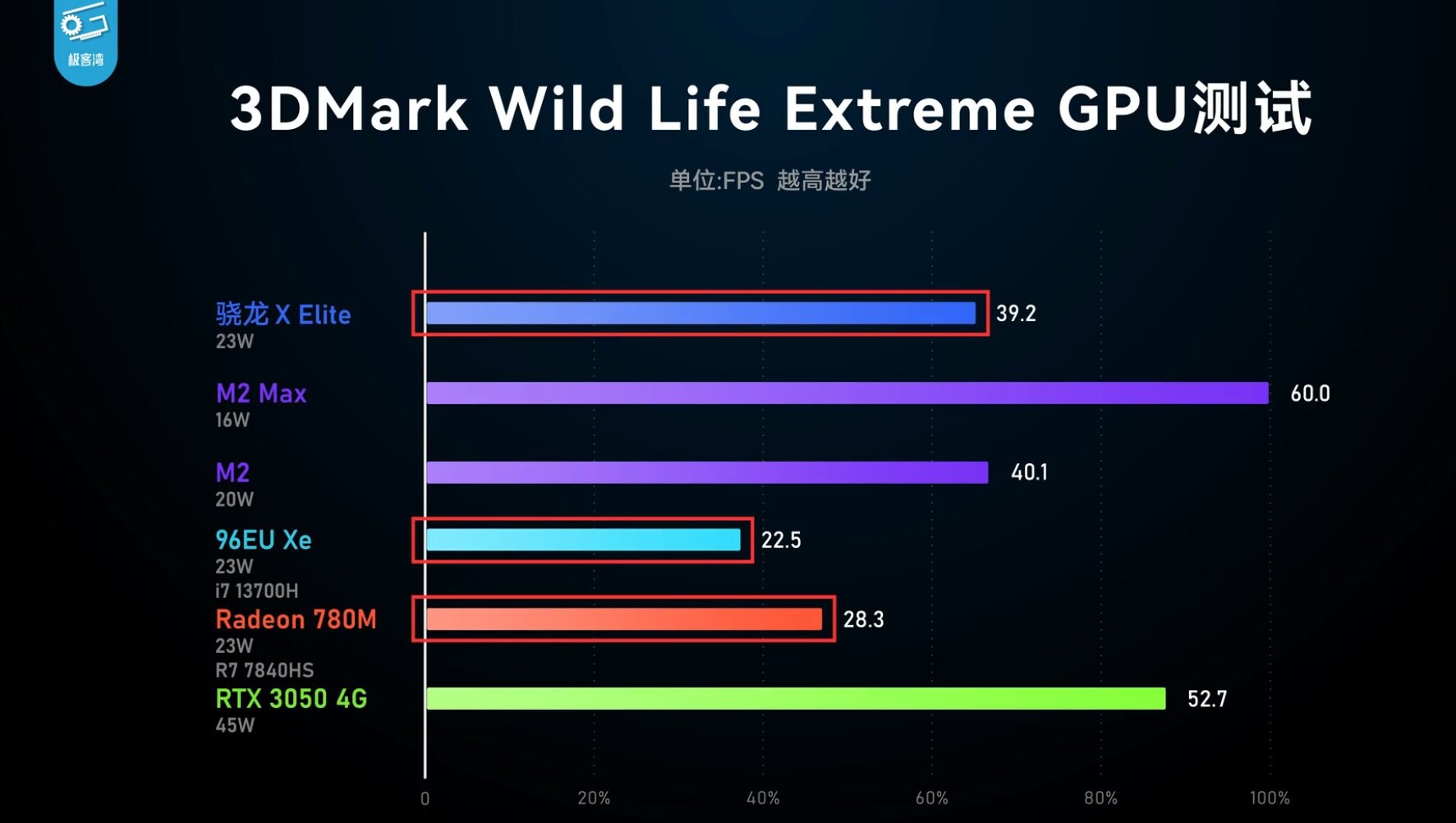
In the 3DMark Wildlife Extreme benchmark, designed for graphics solutions of this class, the Snapdragon X Elite scored 39.2 FPS (average), compared to 60 FPS of the Apple M2 Max, 40 FPS of the Apple M2. The Core i7-13700H "Raptor Lake" is a 45 W mobile processor with an Intel Xe-LP based iGPU that has 96 EU. This chip scored just 22.5 FPS in this test. The surprise here is the Radeon 780M, the iGPU of the AMD Ryzen 7 7840HS, based on the latest RDNA3 architecture, with 12 compute units (768 stream processors). This chip did just 28 FPS, falling behind even the M2. The other benchmark is "Control" at 1080p with its lowest graphics settings, and here the results are fundamentally different. With "Control," we see the Snapdragon X Elite post a respectable 53 FPS, which is almost as fast as the 56 FPS by the Radeon 780M powering the Ryzen 7 7740HS, but ahead of the 43 FPS put by the Apple M2, and a whopping 145 FPS by the M2 Max.

Sources:
Geekerwan (YouTube), HXL (Twitter), VideoCardz
In the 3DMark Wildlife Extreme benchmark, designed for graphics solutions of this class, the Snapdragon X Elite scored 39.2 FPS (average), compared to 60 FPS of the Apple M2 Max, 40 FPS of the Apple M2. The Core i7-13700H "Raptor Lake" is a 45 W mobile processor with an Intel Xe-LP based iGPU that has 96 EU. This chip scored just 22.5 FPS in this test. The surprise here is the Radeon 780M, the iGPU of the AMD Ryzen 7 7840HS, based on the latest RDNA3 architecture, with 12 compute units (768 stream processors). This chip did just 28 FPS, falling behind even the M2. The other benchmark is "Control" at 1080p with its lowest graphics settings, and here the results are fundamentally different. With "Control," we see the Snapdragon X Elite post a respectable 53 FPS, which is almost as fast as the 56 FPS by the Radeon 780M powering the Ryzen 7 7740HS, but ahead of the 43 FPS put by the Apple M2, and a whopping 145 FPS by the M2 Max.

40 Comments on Qualcomm Snapdragon X Elite Put Through Graphics Tests, Beats AMD Radeon 780M iGPU in 3DMark
-HS Phoenix immediately screams early release gaming laptop as opposed to more probability of LPDDR for -U. Some of those gaming laptops not only come with JEDEC DDR5 but also come out of the factory with a single channel config. But the low perf probably still comes more from the power budget.
As long as the node of their choosing is well paired with the clock envelope they want, it doesn't seem surprising that Qualcomm should be able to pull it off. It is a new custom chip after all, look what they already could do in an ultrabook form factor with their low effort Compute Platform rebrands.
You can poo-poo gamers all you want, but they make up a significant portion of remaining PC users. Steam alone has 120 million monthly active users (not total users). That 9% of the global windows population, not just consumer. Consumer only, it's likely far higher. And they spend big money.
The average user who does everything via web browser has already started jumping to chromebooks, mac OS, linux, or most commonly, phones and tablets, which make up an ever growing % of total online devices. The current PC industry is made up of people who need legacy support. You may not value it, but clearly there's 1.4 billion users who do.
If it didnt matter, then windows RT, windows 10 S, and windows on ARM would have become major successes. Instead they have all, so far, failed dramatically. More importantly, if you dont need legacy apps, WHY USE WINDOWS AT ALL? MS is well aware (or at least it used to be) that legacy IS its market, without legacy support windows will die out, that's why they've backed down from any attempt to replace the win32 API.
Qualcomm is using 2 design reference units. Config A is at 80W and config B is at 23W.
What happened here? Why is power scalability so incredibly poor between 23W and nearly 4 times as much power?
If anything, this shows me that the PPW curve is heavily lower scale leaning. Its not that the Config B sample shows particularly poor performance, but I honestly don't know why Qualcomm decided 80W is a good TDP as a secondary, high performance mode one.
To me, from a silicon perspective this proves one thing. Well, two things. One - keep the SD X Elite at where it performs efficiently. Two - maybe above 25W think of a more power efficient core complex instead of pushing the hardware so hard with frequency you gain 30% performance for nearly 4 times the power consumption. How about you shove more X4 cores into it instead, Qualcomm?
I have no doubt they will, and hope this kind of more higher performance tuned chip will rely on multiple X4 cores
1 - chasing a graph leader. We see it every day with GPUs and CPUs pushed well out of the efficiency curve for 1-3% gains. No reason it would be different here.
2- it's a TDP, not measured power draw. Just because the A config is 80w does not mean the CPU itself draws 80w. Remember it has a big iGPU in there too, and that is included in that TDP. We will have to wait and see, but its likely the 80w model isnt pulling 80w under just CPU or GPU load. Just like the apple M2 max, or the ryzen 7800hswhateveritscalled.
Maybe SD X Elite works differently, but either way, this is not a complimenting look efficiency wise. I would hope that a chip design made for such significantly higher TDP would be able to actually use it and convert it into significantly higher performance. From all shown results so far, this is not the case. Not in single core, not in multicore, not in graphics compute.