Friday, March 28th 2025

AMD Radeon RX 9070 XT Reference PCB Design Revealed via Leak, Compared to Similar Sapphire PULSE Board
AMD Radeon RX 9070 XT and RX 9070 "MBA" models have turned up for sale through Chinese black market channels; with local PC hardware enthusiasts quickly snapping up these "reference design" curios—for "scientific" analysis, and in some cases: bragging rights. Officially, Team Red has relied on its board partners to produce an all-custom first wave of RDNA 4 gaming graphics cards. Recent discoveries of authentic-looking "Made by AMD" specimens suggested a very limited distribution of first-party units to trusted partners. According to a fresh ITHome news article, Team Red's Radeon RX 9070 XT reference PCB design was fully revealed via a comprehensive teardown. Kyogre shared heavily watermarked photos with the online publication; showcasing their disassembly of a "leaked" example.
Team Red's proprietary triple-fan cooling solution and backplate were removed; leading to the exposure of gory innards. ITHome provided a quick rundown visual clues—the analyzed unit features: "dual PCIe 8-Pin power supply interfaces, and a black shell with a tough and simple shape. It is about three slots thick and is equipped with a rear open and ventilated cooling backplane with a core back frame...Looking deeper into the internal structure of the graphics card, we can find that this graphics card is equipped with five heat pipes, the corresponding position of the GPU core uses a copper base, and the surrounding memory positions are also in contact with the metal frame through thermal pads. In addition, it is equipped with four video output interfaces."


 VideoCardz noticed that the reference board design—marked with a 109-G295A7-00D_03 ID code—shared layout similarities with Sapphire's PULSE RX 9070 XT PCB. Their article referred to TechPowerUp's recent review of this model; W1zzard's in-depth evaluation included several high-res shots of the sample's internals. A key point of interest was a: "8+3 phase VRM" providing power to the Navi 48 monolithic GPU die. It is managed by a Monolithic Power Systems MP2868A controller."
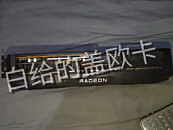
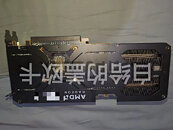
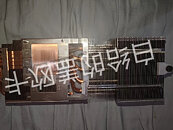 ITHome highlighted the presence of: "TIM (thermal interface material) between the GPU and the copper base in this 'reference design' is not silicone grease, but graphene sheets that are more common in AMD's high-end MBA public version graphics cards. Compared with silicone grease, the thermal conductivity of graphene will not decline over time and has better durability."
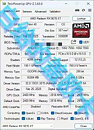
Kyogre managed to get their Radeon RX 9070 XT "MBA" sample up and running with official drivers—a screenshot of TechPowerUp GPU-Z v2.63's diagnostic (see above) shows the card being configured with reference clocks (no big surprise).
Sources:
VideoCardz, ITHome
Team Red's proprietary triple-fan cooling solution and backplate were removed; leading to the exposure of gory innards. ITHome provided a quick rundown visual clues—the analyzed unit features: "dual PCIe 8-Pin power supply interfaces, and a black shell with a tough and simple shape. It is about three slots thick and is equipped with a rear open and ventilated cooling backplane with a core back frame...Looking deeper into the internal structure of the graphics card, we can find that this graphics card is equipped with five heat pipes, the corresponding position of the GPU core uses a copper base, and the surrounding memory positions are also in contact with the metal frame through thermal pads. In addition, it is equipped with four video output interfaces."


9 Comments on AMD Radeon RX 9070 XT Reference PCB Design Revealed via Leak, Compared to Similar Sapphire PULSE Board
The PCB is so compact, just give us a cooler that works within that space!
Edit: TBF the MBA version looks like it's probably about 10.5 inches long, which is not terrible in the grand scheme of things, but it could be even more compact.
Here's a list of previous AMD first party card designs that consumers only saw AIBs release:
"Radeon HD 8970" thermal design prototype:
Radeon R9 285(X) reference design:
Radeon R9 390X thermal and PCB design prototype (similar cooler specifications to 285X reference):
Radeon R9 Fury reference design (XFX would ship this as their own design):
Radeon RX Vega 56 "Nano" PCB reference design:
Chop that third fan off and take my money Powercolor...
I get the idea though. I want SFF video cards too but at 300W+ I think three fans would be OK, considering that the MBA RX 7900 XTX did good for what it was (or at least the updated variant later 2023).
Ultimately I just want more choice. I don't care about noise, I either wear noise cancelling headphones in my office on my main, or I have a nice 5.1 system that can drown out dinky fan noise no problem on my Steambox.
Nvidia tends to do much better in offerings for more niche situations than AMD. I hope AMD's AIBs feel a little invigorated to go with some less traditional designs and give us something a bit more svelte.
To me the above pic of the 9070XT does not any different like a 6700XT or so.