Monday, May 19th 2025

ASUS VGA Innovations at Computex 2025: RTX 50-series Noctua Edition, Flexible BTF
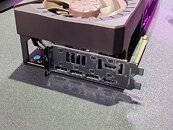
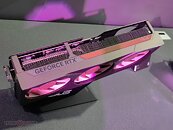
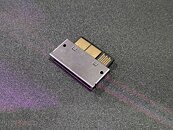
ASUS at the 2025 Computex showed us a few of its latest innovations in custom-design graphics cards. To begin with, the company unveiled a flexible BTF (backside cabling) solution. If you recall from the RTX 40-series BTF cards from ASUS, they all came with second gold-finger for power, which made these cards unfit for regular motherboards, as the power gold-finger would obstruct something on the motherboard, such as a PCH heatsink. With the RTX 50-series BTF cards, ASUS recessed the power gold finger such that the card has the dimensions of a regular card, and can be powered by its 12V2x6 power connector; but on motherboards with BTF capability, a breakaway power gold finger riser can be attached, so it behaves like a BTF card, letting you unplug the 12V2x6—quite genius.
Next up, ASUS unveiled the RTX 50-series Noctua Edition, with the debut of an RTX 5080 Noctua. You see Noctua cooling innovation blend more closely with ASUS design, the card no longer looks like something with an aftermarket air-cooler strapped on. This is still a large 4-slot card, but no longer 5-slot. The heatsink features many of the design innovations Noctua introduced for its CPU air coolers. The heatsink fin-stack has cavities in which the FDB fans are recessed into. The card appears slightly larger and heavier than the ROG Astral air-cooled.


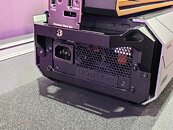
 Next up, is the ROG XG Station, an external GPU dock that comes with its own ATX 3.1-capable power supply that can deliver 675 W of continuous power to the graphics card, and is capable of Flex BTF power cabling. The dock leverages Thunderbolt 5 for 80 Gbps of bandwidth for the GPU, although it doesn't leverage asymmetric laning for something like 120 Gbps for the Tx lane with 40 Gbps for Rx. A GPU is a Tx-heavy device. The XG Station is tested for compatibility with RTX 50-series and RX 9000 series GPUs.
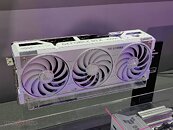
Next up, ASUS unveiled the RTX 50-series Noctua Edition, with the debut of an RTX 5080 Noctua. You see Noctua cooling innovation blend more closely with ASUS design, the card no longer looks like something with an aftermarket air-cooler strapped on. This is still a large 4-slot card, but no longer 5-slot. The heatsink features many of the design innovations Noctua introduced for its CPU air coolers. The heatsink fin-stack has cavities in which the FDB fans are recessed into. The card appears slightly larger and heavier than the ROG Astral air-cooled.


10 Comments on ASUS VGA Innovations at Computex 2025: RTX 50-series Noctua Edition, Flexible BTF
And I like a lot more design to use 2 massive pads for gpu power delivery, than 12v HPWR :), especially if You just need to deliver 12v and ground, not 12 different things to gpu.
I count 4 connections to increase the current resistance. PSU, Motherboard, and two at the GPU side.
Good job making the 5090 even unsafer.2 large pads mean lack of current balancing, it's bad.
With friends we designed the pass-through for the power-tools from one brand to another, and it was working flawlessly, even with multiple points of increased resistance.
Just the safety margin has to be made appropriately :)
This "inovation" does not eliminate the real problem.
They have had every opportunity to make a GPU with triple NF-A9x14 fans and instead they keep trotting out these monstrous abominations.
Oh well. At least it confirms that Noctua NF-A12x25 G2 is releasing soon.
Also looks like a ROG Loki 1000 SFX-L is jammed in there. Should be enough for a 600W GPU with USB-C charging up to 140W (28V 5A). Or perhaps 240W (48V 5A)? Although there is no x86 laptop that follows PD 3.1 at 100+W yet.