Saturday, October 17th 2026

ASUS Makes Its First Intel Arc Card, a 32 GB Arc Pro B70 Under the UGen AI Brand
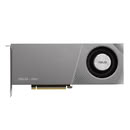
ASUS has listed the UGen Arc Pro B70 32 GB on its website, which makes it the company's first Intel Arc graphics card. ASUS sat out both the Alchemist and Battlemage consumer generations, and its last Intel discrete card was the passively cooled Iris Xe DG1-4G from 2021. Interestingly, ASUS files it under its UGen AI accelerator lineup rather than ProArt, putting it in the same family as the UGen300 USB AI accelerator the company showed at CES 2026. ASUS hasn't announced pricing or a release date yet. Intel launched the Arc Pro B70 at $949 back in March, though US retail listings now seem to sit closer to $1,300.
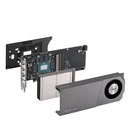
The ASUS card uses the full "Big Battlemage" BMG-G31 die with 32 Xe2 cores, 256 XMX engines, and 32 GB of GDDR6 ECC memory on a 256-bit bus for 608 GB/s of bandwidth. ASUS rates it at a 2,800 MHz boost clock, up to 367 INT8 TOPS, and a 290 W board power, which is the top of Intel's 160 to 290 W range for the B70 (the reference default is 230 W). Cooling comes from a dual-slot blower, and ASUS says four cards can be paired for 128 GB of combined VRAM, enough for models with up to 120 billion parameters according to the company. ASUS also joins ASRock, Sparkle, and Maxsun, which already have their own B70 models, so pricing will likely decide how well the UGen version does.
Update Oct 27th: ASUS has confirmed European pricing for its UGen Arc Pro B70 card. It is available in Germany and Austria at a recommended price of €1,799 including VAT.
Source:
ASUS
The ASUS card uses the full "Big Battlemage" BMG-G31 die with 32 Xe2 cores, 256 XMX engines, and 32 GB of GDDR6 ECC memory on a 256-bit bus for 608 GB/s of bandwidth. ASUS rates it at a 2,800 MHz boost clock, up to 367 INT8 TOPS, and a 290 W board power, which is the top of Intel's 160 to 290 W range for the B70 (the reference default is 230 W). Cooling comes from a dual-slot blower, and ASUS says four cards can be paired for 128 GB of combined VRAM, enough for models with up to 120 billion parameters according to the company. ASUS also joins ASRock, Sparkle, and Maxsun, which already have their own B70 models, so pricing will likely decide how well the UGen version does.
Update Oct 27th: ASUS has confirmed European pricing for its UGen Arc Pro B70 card. It is available in Germany and Austria at a recommended price of €1,799 including VAT.


11 Comments on ASUS Makes Its First Intel Arc Card, a 32 GB Arc Pro B70 Under the UGen AI Brand
A lot of the power budget is allocated in the extra vram on the back of the card.
A proper b770 290w with 20gbps memory could reach the performance of the 5070. While it’s not ideal it would put pressure on the market.
The 256bit chip landscape would be like this:
5080
9070 xt close to the 5070 ti
B770 close to the 5070
Alas, everything goes to ai, both hardware and software development.
The only scenario where we see an actual "Arc B770" is Battlemage becoming radically obsolete for 'AI' and 'Big Data' while the consumer market stagnates on current-gen chips.
Which TBF, might happen come mid-2027.
nVidia isn't planning any new generation consumer releases until 2028, and AMD at-best is releasing a mid-tier RDNA5 (AT2) 5080 24GB competitor, come late 2027. The vast majority of 2027 is going to be current generation offerings further-increasing in price over release MSRP.
In the worst way, this may actually make consumer BMG-G31 cards, a possibility.
I would expect more gpus to follow the 5090. They can be sold with 32gb of memory after all. No more 5080, 5070 ti ,9070 xt and 9070. Only the rtx pro and AI PRO R9700 will remain. Lets add a AI PRO R9700 lite to replace the 9070.
It's ok. In 2-3 years everything will be back to normal* (less expensive than now but actually more expensive than it was, even adjusting for inflation)
Sorry to tell you that, and i wish that i am wrong!
There is an upwards trend over the years but there are some but some improvements notably ampere and blackwell:
On blackwell you have to attach some asterisks though because despite cheaper, it should be a little bit cheaper. In that sense the most notable generation was ampere before the mining boom prices.If you want to be more accurate you need to calculate the average salary etc
Everyone will still demand that high end cards need to cost what the GTX 280 did, thinking the era of 2009 was in any way sustainable. It's much easier to cry about how nvidia and jensen huang are "EvIL" then it is to state that, given wafers have increased by over 2000% in the same time frame, tariffs raise the price of imported goods, the price of all base materials increases, significantly elevated labor costs focused highly on the low end, and with their larger boxes and coolers you can fit fewer GPUs per container (people often forget this one) it was nothing short of a miracle the 5080 was a $1000 product in the first place.
And then the g92 released, before the crash.
*technically 249 but due to demand 349 but dropped to 299 when the gts arrived? something like thatWhy? Or rather imagine the opposite.... the pricing being completely tied to the performance starting with the nv1. The 5090 is 1000000000000000000000x faster so it should cost 1000000000000000000000x more.
Since everything is more expensive, like you said, then they should scale down. For example (yes it's too late for the ps6 but): imagine a ps6 with a tiny zen4c cpu and small rdna4 gpu, barely faster than the ps5 pro but with a reasonable price. It wouldn't bring better graphics but it would still service a lot of people with a more reasonable price.
But that is not the way they design. Even if they knew sooner they wouldn't change course because everything is designed for datacenters and the distance from consumer needs increases more and more. (or it's a storm, it will pass they think)
Seriously though, why was it not sustainable back then? I can assume a few things but do you know anything specific from the inside? They didn't have the capital to invest in the next generation of hardware for example, with those smaller profit margins? I don't remember being an issue at least until 2015.
Yeah, such margins would have destroyed future growth and tech development. Again, see AMD during the 2010s. If you dont remember that being a problem until 2015, all I can say is you were either not online or asleep at the wheel during the great financial crisis. Tesla and Fermi were utterly unsustainable as business practices, their prices were very low because we were in the worst economy since 1929 and not lowering prices would have resulted in bankruptcy. The forums back then had people talking excitedly about the likes of the GTX 580 but not being able to afford it because, you know, economic collapse. First gen Fermi had some serious issues, hence the Thermi meme, that were fixed in the second gen and likely would have been ironed out had they waited, but they couldnt.
Furthermore, people whine and bitch about nvidia being evil with price increases, but looking at the margins tells a very different story. Between Kepler and Ada Lovelace, nvdia's margins increased about ~10%. Yet GPU prices went up almost 50%, sometimes higher on the high end. Clearly it wasnt just nvidia wanting more money, these cards cost progressively more to produce because the world economy cant get cheaper forever. Even with the first year of the AI craze starting, nvidia margins only went up 5-8% depending on what quarter you look at. But that runs counter to the narrative of "nVidia evil, nVidia bad", so it gets buried or gaslit into supporting the narrative instead of people accepting that $500 flagships were never realistic and the only way we are ever getting that is an economic crisis worse then 2008, at which most of those complaining would be homeless.
The "100000000x price increase"; In a bubble where nodes scale linearly with performance, sure, but we dont live in a bubble. Node costs and capability improved dramatically for about 20 years, and since while improvements continue the costs have spiraled out of control. People expect GPUs should have remained as they were in 2009, mostly because they either dont understand economics at all, or have an axe to grind about nvidia specifically.
Saying "they should just scale down" seems sensible, until you ask "who would buy that?". You know who did that? AMD. They "scaled down" and stopped progressing with Polaris. Didnt work out to well for them. Then they did it again with the 9070xt, and they've only continued to lose marketshare. It happened with nvidia too, when they were spinning their wheels with the 9000 and 200 series, AMD was making significant inroads with Evergreen. When they sat around with Kepler AMD pulled out Hawaii and got jensen panicking about losing the high end.
To take your example, why would anyone buy a PS6 if it was no faster then the PS5 pro? Why not just keep making the PS5 pro then? Consumers are not going to take very well to buying what they already have. Any time these corporations stop progressing with tech and try to stagnate without improvements their competitor grabs more of the market and consumers leave. There is some legit thought about reduced die size, but that needs multiGPU to keep pushing things forward and despite multiple attempts it has not caught on.
nvidianews.nvidia.com/news/nvidia-reports-financial-results-for-second-quarter-fiscal-2011
nvidianews.nvidia.com/news/nvidia-reports-financial-results-for-third-quarter-fiscal-2011
Overall I saw that they suffered greatly back then but...
They had the material issues: the bump gate, the solder balls that cracked. It was tsmc's fault mostly :roll: .
Perhaps they had low sales, especially on high margin parts and that affected them more than the "low" margins so much so that even if they raised them they couldn't offset the R&D and other issues of the time.
I don't remember estimations from back then but I meant the profit margins on the cards themselves including the R&D per card and the distribution of course. Do we know those numbers? I don't think so...
Ai, which is not very good yet estimates 45% margins on a 580 that rose slowly over the years to 75% per card with the 5080. Anyway.The point is that it's going to be significantly cheaper. As to who would want that, those that are left behind and right now, many will. But it doesn't matter since 90% of the silicon goes to datacenters.
I just wish gpus were at msrp at least. Indeed, like you said, adjusted for inflation they are not that bad compared to the 8000 series. But we are closing in at msrp X2.
(and the b770, I really want to know what intel can do if they push battlemage)