Monday, November 2nd 2026

ASUS XG Core Radeon RX 9060 XT LP Heavily Downclocked to Meet 75 W Power Limit
According to the latest update on the ASUS page, the official specifications for the PCIe slot-powered 75 W ASUS XG Core Radeon RX 9060 XT LP differ significantly from those of the regular desktop card. As an external graphics solution, the XG Core powers the GPU through the PCIe slot without needing external GPU PCIe power connectors. The XG Core operates at a default game clock of 1,010 MHz and can boost up to 1,600 MHz. In OC mode, these figures increase modestly to 1,030 MHz and 1,620 MHz, respectively, which is not very noticeable. This contrasts sharply with the standard Radeon RX 9060 XT LP edition, which has a base frequency of 1,380 MHz—nearly 37% higher—and a boost frequency of up to 3,040 MHz, which is nearly double.
The differences in frequency also correlate with power consumption. The Navi 44 XTLP in the XG Core solution is rated for just 75 W, while the desktop GPU is designed for a 140 W power draw and requires an external GPU power connector. The entire XG Core unit, including its USB4 controller, is capped at 75 W. This aggressive power limit necessitates lower clock speeds to maintain stability and thermal performance within its compact chassis, which measures roughly 114 × 117 × 39 mm. The device connects to host systems via USB4 and provides limited display outputs, making it a portable graphics dock suitable for mini-PCs, notebooks, and handhelds.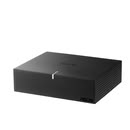
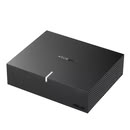
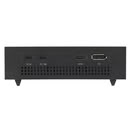
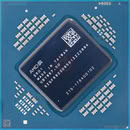 ASUS first showcased the XG Core at Gamescom 2026 as a more compact, less gaming-focused alternative to its ROG XG Mobile eGPU lineup. The product is designed for both gaming and local AI workloads, with the updated listing highlighting 406.3 AI TOPS. The newly published clock data clearly illustrates that there must be a performance trade-off to deliver desktop-class RDNA 4 silicon in a USB4-powered external form factor that consumes only half the power of a typical discrete RX 9060 XT GPU version.
Sources:
ASUS, via Uniko's Hardware
The differences in frequency also correlate with power consumption. The Navi 44 XTLP in the XG Core solution is rated for just 75 W, while the desktop GPU is designed for a 140 W power draw and requires an external GPU power connector. The entire XG Core unit, including its USB4 controller, is capped at 75 W. This aggressive power limit necessitates lower clock speeds to maintain stability and thermal performance within its compact chassis, which measures roughly 114 × 117 × 39 mm. The device connects to host systems via USB4 and provides limited display outputs, making it a portable graphics dock suitable for mini-PCs, notebooks, and handhelds.


20 Comments on ASUS XG Core Radeon RX 9060 XT LP Heavily Downclocked to Meet 75 W Power Limit
Regardless, Navi44 is one of the most efficient GPUs on the market at the moment, I bet this thing performs surprisingly well for how constrained it is.
They'll offer you a Zenbook 14 with a U9 285H but then kneecap it at 45-65w in the bios so it never melts the laptop. Same laptop would have had a U5 the previous year.
- 75W TGP, lower than the LP's 140W
- Only USB4 40Gbps. They could've gone with USB4 80Gbps (but they probably did not want to license TB5 or buy JHL9480 as there still is no ASMedia/VIA solution yet)
- Missing one DisplayPort connector. RX 9060 XT supports DisplayPort and one HDMI output simultaneously
There are a couple of good things about it:
- Seems to runs off USB-C power itself, this is most likely the reason why they had to further limit it to PCIe slot power:
- This may be the most compact eGPU solution outside of boutique OEMs. The dimensions are quite small compared to others: 144 x 117 x 39 mm
If this is more than $500 (proper MSRP, not based off current memory pricing) for what it is, then this may not be a good buy. The GIGABYTE AORUS RTX 5060 Ti AI box was OK for its MSRP (US $699.99) considering it is a dock with extra ports and supported TB5/USB4 80Gbps and it was at least close to the RTX 5060 Ti's base MSRP ($430). This doesn't have any extra ports except the upstream port can charge16GB model only. The specs page is up.
A 6 core Zen 4 CPU isn't the worst baseline. Even with the single channel RAM it's reasonable. A low end 2022 laptop GPU is a terrible baseline for a $1000+ machine that will presumably be sold and used for many years.
I don't care how many software tricks like memory compression and FSR 4.1 Lite Linux can pull off. It's as bad as the Switch 2 using ancient Arm cores and cut down Ampere, on an ancient node.
Thing is the Switch 2 is a $500 device, and comes with controller/screen etc. So there's some excuses.
People were saying "RDNA 4 didn't exist at Steam Machine wattages" well here it is. Proof of that obvious concept.
It was possible. Valve chose not to.
No, of course not. That would be silly.
Same chart 6800XT 183W, 9060XT 63W on same test, so it can't do cp2077 with rt on @65w but very probably 1080p high no rt would go easy in the 65w range, if can do 120fps @160W, on 60fps the energy would be way less than half, if not 65, probably 70w, 6800xt is on 130fps but with that 280w, so it would be no less than 120w @60hz and you could see it in adrenaline control panel, even the energy efficiency chart speaks for itself, 6800xt got 67% of 9060xt efficiency, I would try later with my 9070XT, quite sure without rt it can be under 80w @60fps 1080p.
It is unlikely it will run Cyberpunk with ray tracing below 80 W, but that's fine. Power efficiency is one of the areas I have to really take my hat off to RDNA 4, and this is a particularly demanding type of workload. 80 W is what my laptop's RTX 3050 has to work with, for what it's worth anyway... and it'll vastly outperform it in the same power budget.
3080 Ti, 5070, 5080 (if you ignore current price), RX 9070, the nicest all-around desktop cards in recent gen, IMO.