Thursday, May 22nd 2025

ASMedia Showcases PCIe and USB4 Solutions at COMPUTEX 2025
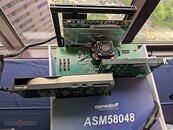
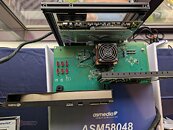
ASMedia Technology is getting ready to unveil its latest PCIe Packet Switch solution (ASM58048) at Computex 2025, with sampling expected in Q3 2025. ASMedia product lineup covers PCIe generations 2 through 6, offering channel configurations that range from 3 to 80 channels. The upcoming PCIe Gen 5 product (ASM68080 series) development is underway, with a fully verified PHY design nearing completion. Following the ASM58048, ASMedia plans for multiple products featuring 24 to 80 channels, while work on PCIe Gen 6 is actively underway.
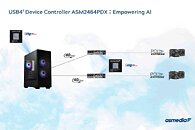
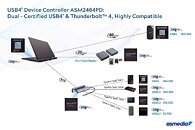
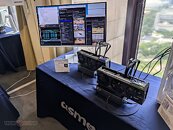
The company's USB4 ASM4242 host controller has found a home in high-end motherboards and laptops from a variety of brands being certified USB4 and Thunderbolt 4. The ASM2464PDX USB4 controller is tailored for edge AI computing, allowing for plug-and-play external GPUs by converting PCIe Gen 4 signals to USB4. This makes it easy to connect graphics cards, NVMe SSDs, and Wi-Fi modules externally, delivering performance that rivals internal setups.


Update May 22nd: Added more pictures
ASMedia's President Che-Wei Lin said, "ASMedia's PCIe solutions not only offer superior performance but also demonstrate unparalleled flexibility and compatibility, enhancing the user experience. From Gen 2 to Gen 6, our product roadmap comprehensively covers the needs of each stage, with a focus on the future demands of AI and edge computing. The PCIe Gen 5 ASM68080 series is poised for launch, and PCIe Gen 6 design is also within our development roadmap. This reflects our commitment to meeting the market's demand for high-speed designs. Furthermore, ASMedia's mass-produced USB4, through single-cable technology, achieves seamless integration of data, video, and power, redefining application possibilities across industries. In the future, ASMedia looks forward to collaborating with global partners to continuously promote and enhance the PCIe and USB4 ecosystems."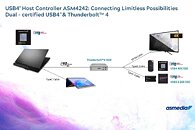
Pictures from TechPowerUp visit to ASMedia demo room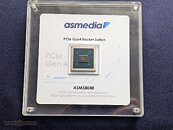
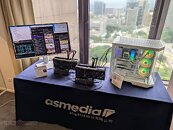
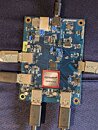
Source:
ASMedia
The company's USB4 ASM4242 host controller has found a home in high-end motherboards and laptops from a variety of brands being certified USB4 and Thunderbolt 4. The ASM2464PDX USB4 controller is tailored for edge AI computing, allowing for plug-and-play external GPUs by converting PCIe Gen 4 signals to USB4. This makes it easy to connect graphics cards, NVMe SSDs, and Wi-Fi modules externally, delivering performance that rivals internal setups.


ASMedia's President Che-Wei Lin said, "ASMedia's PCIe solutions not only offer superior performance but also demonstrate unparalleled flexibility and compatibility, enhancing the user experience. From Gen 2 to Gen 6, our product roadmap comprehensively covers the needs of each stage, with a focus on the future demands of AI and edge computing. The PCIe Gen 5 ASM68080 series is poised for launch, and PCIe Gen 6 design is also within our development roadmap. This reflects our commitment to meeting the market's demand for high-speed designs. Furthermore, ASMedia's mass-produced USB4, through single-cable technology, achieves seamless integration of data, video, and power, redefining application possibilities across industries. In the future, ASMedia looks forward to collaborating with global partners to continuously promote and enhance the PCIe and USB4 ecosystems."


24 Comments on ASMedia Showcases PCIe and USB4 Solutions at COMPUTEX 2025
This news post was based on information from a press release and they didn't show anything new at their stand located at the USB-IF booth in Nangang, as I walked past there today, but they have a suite in a hotel where the pics in the press release are from.
In fact, the only 80 Gbps stuff in the USB-IF booth, was cables.
2018:
---> www.anandtech.com/show/13022/asmedia-preps-asm2824-pcie-30-switch
wonder how much those cost now. i need some actual expansion slots. x670e boards only having 3 pcie slots is kind of insanely sparse.
It's a mix between not having enough engineers, the USB IF not having finalised all the documentation/testing requirements, the company working on AMD's next gen chipset and a bunch of other products at the same time and finally no demand from their customers.
There is apparently not even a whole lot of demand for their device controllers outside of some storage products, although the somewhat recent Thunderbolt 4 certification and Intel's blessing (finally), might change that.
It's something of a chicken/egg effect, plus even most of the readership here doesn't seem all the interested in USB4 or Thunderbolt, at least that's what it feels like based on the comments here when we write about those kind of products.
Finally! I was expecting to see (semi-affordable) Gen4 PCIe switches from ASmedia, years ago.
AFAIK, ASMedia-AMD's PROM21 (B650,B850,X670,X870) already had the basic functionality from day 1. So, I'm not quite sure what's taken them this long?
- a security problem (DMA), being patched again and again, then some devices having default "BIOS" TB switches off, making some devices not work without providing a hint as to why;
- TB devices not being backwards compatible with USB (until late last year IIRC) or compatible (very rare), but with (much) lower performance on both interfaces (see an older TB SSD review on AT);
- compatibility problem, with some older TB devices needing to be "approved" manually (for security reasons, see DMA above), but notebook vendors failing to provide (working!) software (like Intel Thunderbolt Control Center or Thunderbolt Software) for that - I have a TB drive dock that was made to work on some Intel TB controllers and Win10, but not on Win11 ("does not need the Software, it has Settings for that", sadly, false) and not on USB4 (obviously Intel's Software does not recognize the controller, does ASMedia have software for device "approval"?);
- stability problem, some hosts and/or some OS versions (e.g. was OK, bad after OS update) bluescreening often with some TB/USB4 device(s) connected (and some not even once in their history without one);
- feature problem, some hosts and/or some OS versions e.g. repeatedly waking from sleep after a short while with some TB/USB4 device(s) connected;
- most (all?) host TB3/TB4 ports being backwards compatible with USB 3.2 Gen 2x1 only, not 2x2 - apparently ASMedia's USB4 host can do 2x2, is that right?
- TB3/TB4 ports reserving a lot of unused bandwidth, making them only somewhat faster for e.g. external SSDs than Gen 2x2 (USB4 fortunately does not exhibit this behaviour, see 2025 USB4 SSD reviews);
- some hosts using Intel-accepted 2-lane PCIe connection for TB host controller, negating any performance advantage over Gen 2x2 (slower, in fact);
- and that's without talking about prices, that are just recently coming down to somewhat sane levels...
So with quite a few hosts with TB3/TB4/USB4 and quite a few devices, the dock I prefer is a non-USB4 one, just feature complete (Gen 2 downstream, HDMI 2.x, PD65W+, preferably PD100W+).
New, preferably ASMedia-based, USB4 SSDs directly connected to (obviously ASMedia-based) USB4 hosts may change my mind, provided someone finally offers them in 8+ TB sizes.
It will take some time to change the overall stigma.
Yes, USB4 is fully backwards compatible with all speed grades of USB 3.x, as that is a requirement by the USB-IF.
Do keep in mind that until recently, Thunderbolt was also limited to PCIe 3.0 x4, hence why the ASM4242 was faster. Only the latest gen of Thunderbolt 4/5 chips from Intel has a PCIe 4.0 x4 system interface.
The reason for that weird two lane PCIe interface for Thunderbolt was supposedly power saving, it was only meant for some laptops.
Example of deception in advertisement. I bought Z390 ITX from Asrock years ago, with TB3 port, advertised, of course, as "40 Gbps". Little did I know that the controller supported only PCIe3 x2 link. I found out only later, after seeing low transfer speeds, that it was JHL6240... This was never listed on the product page or explained to buyers the speed of different protocols through generic 40 Gbps cable.
They do the same now with Thunderbolt 5. I can see listings "80 Gbps" and "120 Gbps" for external GPU enclosure, for example from Gigabyte at Computex, which is complete nonsense. PCIe data used by GPU to communicate with laptop's CPU/RAM will travel at 64 Gbps only. Nobody is saying this to buyers or listing it on their product pages. It's a massive deception and failure to be informative and honest with customers. Utter failure.
Reported by this website and well commented by a user
www.techpowerup.com/336945/gigabyte-shows-off-aorus-rtx-5090-egpu-box-implementing-120-gbps-thunderbolt-5
It's sad to think that whenever we discover dubious practices and claims, we need to call GamersNexus or HardwareUnboxed to try to expose it.
In the list above I still forgot about add-on TB PCIe cards for desktops, which is another can of worms.
The really sad thing is that while for newer hosts and devices points 1, 2, 7, and 8 from my list above may no longer be a problem, the others are still present, experienced in the last year on Zen 4 / Pheonix (3, 4, and 5) and Zen 5 / Strix Halo (3 and 4).Thanks for confirmation, hoped so.
Because of SSD power requirements I prefer ready-made external SSDs, as external M.2 enclosures were sometimes not respecting power limits, causing the SSD to turn off mid-work.
This should not be an issue with USB4/TB hosts, where power limit is higher, but if used in compatibility mode on, say, USB 3.2 Gen 2 ports (that I need) may still be relevant.
The new Corsair EX400U seems really good, but unfortunately stops at only 4 TB.
This is not a solution, as they cannot predict and dictate the bandwidth of directional traffic between external GPU and laptop's CPU/RAM. By making the traffic asynchronous, they could be bottlenecking either Tx or Rx side during gameplay, as one side would always have more. How the heck they would predict Tx and Rx traffic at any time during gameplay?
They need to implement Gen5 x4 link, minimally.
In a way, this is like the marketing speeds for WiFi routers, although no-one is mandating the numbers there, but everyone knows that bigger numbers sell better.
Educate and inform the public, don't deceive them. This is one of reasons why public trust in Intel has eroded in recent years. They lack integrity and others, like Gigabyte, copy the same nonsense approach.
Since Intel cannot be trusted to provide the public with marketing material on how fast are different protocols within TB5 cable, Gigabyte cannot be trusted too, by extension.
Also, we have tech journalists and youtubers who should push them hard to provide the above mentioned information in marketing material and product specifications, so that buyers are actually aware of what they are buying.
Most people have as much interest in USB and thunderbolt as they have in watching paint dry.
I believe I'm one of one journalist that give a shit and actually talk to the companies about this tech.
I was afaik, the one and only person that did a comparison test between 90% of all USB 3.0 host controllers back in the day. I missed one or two as I couldn't get my hands on them. AMD sucked at the time. I ended up meeting the guy in charge of their USB 3.0 implementation in Taipei at an AMD event and wanted to ask him what went wrong, he told me he was aware of my test, but refused to talk to me about it.
This is often how it is when you give a shit. I'm not afraid to call out BS, I'm old as experienced enough at this point, but if no-one cares, what can I do?
I've started writing out the actual speed of USB interfaces in all my posts here, I'll make sure to do the same for thunderbolt, when relevant, but I can't do much more.
It is true that Intel in their TB5 brief for tech media mentioned 64 Gbps for PCIe data and 'two times more bandwidth for external SSDs and eGFX...', so they are formally on the "good side of the Force". However, at this moment of time, the key problem is marketing of devices that actually are meant to use 64 Gbps link for PCIe data. All we can see is this gigantic "80/120 Gbps" mantra, which melts my brain.
Just like with early TB3 where it was actually 32Gbps PCI-E 3.0 x4 + 8Gbps DP data for a total of 40Gbps. So maybe with TB5 now its 64Gbps PCI-E 4.0 x4 + 16 Gbps DP data?
I'm not sure how the 120 Gbps link up would play out, unless Intel has future plans for upgrading TB5 (just like how newer TB4 chipsets support PCI-E 4.0 x4 for 64Gbps) somehow.
Marketing like this sucks, but the total data bandwidth may more or less be correct.
Mixed data - 80 Gbps
Video data - 120 Gbps modeThis was not questioned. Mixed traffic works, with priority for DP data. If you connect a monitor with 40 Gbps link, there is 40 Gbps left for everything else.New TB4 controllers JHL9440 and JHL9480 do support PCIe 4.0, but within the limit of 40 Gbps of cable bandwidth. So, Gen4 x4 link is established, but the speed is not 64 Gbps. It is up to 40 Gbps.