Wednesday, July 30th 2025

AMD to Rehash Ryzen 8000G Desktop APUs as 9000G Series: Rumor
It looks like AMD is refreshing its Ryzen 8000G desktop APUs as the newer Ryzen 9000G series, these chips will be powered by the older "Zen 4" microarchitecture, and not the latest "Zen 5," suggests a credible rumor on ChipHell. It was anticipated that the Ryzen 9000G series would be based on the 4 nm "Strix Point" monolithic silicon, or its updated variant, "Krackan Point." The chip features a dual-CCX CPU component with one CCX packing four "Zen 5" cores sharing 16 MB of L3 cache, and the second CCX featuring eight "Zen 5c" cores sharing an 8 MB L3 cache. The "Zen 5c" cores operate at lower average clock speeds than "Zen 5," and hence don't need large amounts of last-line cache. "Strix Point" also features a large RDNA 3.5 iGPU with 16 compute units, and most importantly, a powerful NPU with 50 AI TOPS, which meets Microsoft Copilot+ requirements. This is not going to be the case for the Ryzen 9000G, if the rumor is true.
If based on the older 4 nm "Hawk Point" silicon, the 9000G series will feature a single CCX CPU with eight full-size "Zen 4" cores sharing a 16 MB L3 cache; and an RDNA 3 based iGPU with 12 compute units, but unfortunately a much slower NPU with only 16 TOPS of throughput, which doesn't meet Copilot+ requirements. Perhaps the only things differentiating the 9000G series from the 8000G series are minor speed bumps, around 200 MHz increases in CPU clock speeds across the board, and a 100 MHz increase in iGPU engine clocks. All is not lost, as the non-socketed mobile Ryzen AI 300 "Strix Point" processor can be had in plenty of MoD (mobile-on-desktop) mini PCs, and we can see from recent product launches that PC OEMs are all over the Ryzen AI Max "Strix Halo" chip, putting it into prebuilt desktops.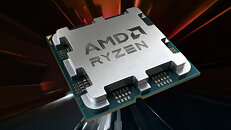
Sources:
VideoCardz, ChipHell Forums, HXL (Twitter)
If based on the older 4 nm "Hawk Point" silicon, the 9000G series will feature a single CCX CPU with eight full-size "Zen 4" cores sharing a 16 MB L3 cache; and an RDNA 3 based iGPU with 12 compute units, but unfortunately a much slower NPU with only 16 TOPS of throughput, which doesn't meet Copilot+ requirements. Perhaps the only things differentiating the 9000G series from the 8000G series are minor speed bumps, around 200 MHz increases in CPU clock speeds across the board, and a 100 MHz increase in iGPU engine clocks. All is not lost, as the non-socketed mobile Ryzen AI 300 "Strix Point" processor can be had in plenty of MoD (mobile-on-desktop) mini PCs, and we can see from recent product launches that PC OEMs are all over the Ryzen AI Max "Strix Halo" chip, putting it into prebuilt desktops.

13 Comments on AMD to Rehash Ryzen 8000G Desktop APUs as 9000G Series: Rumor
What are the PCIE lanes like on these APU's and boards? I'm curious how many PCIE 5.0 CPU wired lanes they have accessible. It's a pity the iGPU part is weaker than you'd like to see for a APU though. I do get it though the stronger APU chips are going to more lucrative market segments plus their probably trying to empty out a bunch of castrated RNDA3 chips still laying around.
Before Ryzen, Intel did the same, releasing "more of the same" CPUs for almost 10 years.
It would be great if Nvidia acquired Intel. Nvidia would then be a formidable competitor to AMD, even in the console and portable SoC market. AMD would also stop releasing "more of the same" CPUs/APUs with new names, low cache memory, and outdated iGPUs.