Friday, August 15th 2025
Biwin Launches Mini SSD: NVMe Speeds in a SIM-Tray Style Card
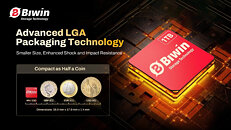
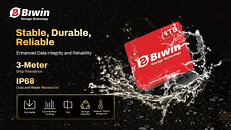
Biwin's new Mini SSD squeezes NVMe-class performance into a SIM-tray style card barely larger than a MicroSD, offering quoted sequential read speeds of up to 3,700 MB/s and write speeds of up to 3,400 MB/s over PCIe 4.0 x2 in 512 GB, 1 TB, and 2 TB options. The 15 × 17 × 1.4 mm module ejects with a pin, similar to a smartphone SIM, allowing for easy swapping without tools. Biwin markets this module as IP68 dust and water-resistant, with three-meter drop protection for rugged mobile use. The format promises a sweet spot between MicroSD convenience and M.2 speed, and early support from handhelds such as GPD's Win 5 and the OneXPlayer Super X means we could soon see whether controllers, firmware, and thermal limits let the tiny drives live up to their claims. Additionally, if the format lives up to the promise, we could see adoption from more handheld device makers.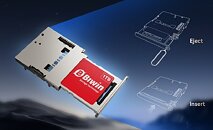

Source:
The Verge


44 Comments on Biwin Launches Mini SSD: NVMe Speeds in a SIM-Tray Style Card
www.theverge.com/news/759624/china-is-about-to-launch-ssds-so-small-you-insert-them-like-a-sim-cardI for one don't want another memory card format, I'm happy with them bringing back SD cards and implementing mSD EX slots, but Android manufacturers are more concerned with how they can copy and rip off Apple than making original devices, the last company that made any phones with soul has a foot and a half in the grave already (Sony).This is not a SIM tray NVMe, I think everyone excited in this article has misunderstood this. It's a proprietary format memory card, it does not have a specification, either, and seems to be accepted only by a few Chinese devices at this point in time (and it is likely these devices are all that will ever support it). From the source article, notice the contact points:
It is much larger than any SIM or micro SD card, and seems to have about the same performance of the highest tier SD Express cards which currently aren't being manufactured and sold by any company.
If these Biwin reader is contained within the SIM slot, that's a lot of space saving for mobile devices
And this is only on the SD Express v 8.0 spec. and currently there's no 2x lanes cards, and they're still limited to 1x PCIe 3.1 lane as well, no PCIe 4.0 yet.
The only thing that might sit this Mini SSD apart is how they're managing the thermal issue, microSD wasn't designed at all for such loads from a physical design perspective, and thermal throttling is a big issue for it, that's why adoption is too limited to this day. But we don't know yet.
Starting from the extremely dull design, boring custom OS, camera app, proprietary apps, PRICE, all are extremely dull, soulless and fade.
Sorry, but they more than deserve to be with both feet in the grave.
Don't see anything bad with new format. Small, good reads/writes compared to microsd. Could be used in handheld gaming, even phones.
The problem is neither size nor performance, we've had fast micro-sd for years, it's just more profitable to push for cloud storage subscriptions :nutkick: - be happy while you can still buy a phone with larger internal memory lol (though I'm perfectly happy with 256gb base storage, it's a good way to force me to backup things from time to time)
JMicron JMS586R + ASM2812 or ASM2824 Gen3 Packet Switch would do (for mSDe).Unfortunately, Gen4 PCIe switches and USB4/TB<->PCIe4.0/NVMe bridges are not coming down in price much.
Gen2 and Gen3 switches and USB3.1/3.2 bridges OtOH, are cheap as chips :laugh:
My feeling is that they are going to open this standard very soon, because this piece of chinese technology is here to compete with us (west).
P.S: The same thing with GPMI cable which is coming in 2026 to compete with all the westerns analogues.
Hardware design: I personally quite appreciate the Sony design, especially the part where the screen doesn't have a hole in it!, It's also balanced absolutely beautifully, unlike many other brands.
OS: I very much appreciate that the OS is skinned very little. Samsung's skin is alright, and even better in some places, but things like XiaoMi's MIUI/HyperOS or ZTE/nubia/RedMagic have issues with forcibly sending apps to sleep despite what I explicitly and manually set in the settings. That results in a broken notifications system where you get the 7 notifications 4s after your put the thing back into your pocket after checking it manually and seeing nothing
Apps: Sony is down to like 3 proprietary apps: camera app(s), music player and game enhancer garbage, which is less than most. They don't even have their own gallery app or dialer anymore ffs!. In fact, Sony is even avoiding infesting their phones with AI and that's a big plus to many of us (though I am not sure how intentional that is). As for preloaded bload... Sony does have a bunch of stuff preloaded as like everyone else (in particular facebook and supporting integration grabage) but eh - just remove/disable those and move on with life.
Price: fair complaint. Though I will say that when you compare to an iPhone Pro or Samsung Ultra the price isn't all that far off (more an indication that everyone's flagship is overpriced, but that's a differnt discussion).
So yeah, where you see dull, soulless, boring and fade design; I see restrained, subtle design that doesn't get in the way of gettings done and everyday livability. Besides, have you ever owned a purple phone? There is nothing subtle or dull about purple anything, especially a purple phone!Eeeh, I don't buy thet line of reasoning. Huawei did the Nano Memory card in 2018 (before getting sanctioned) and the last devices supporting it seem to have been released in 2023, after which Huawei went cardless. If the CCP cared to push it, they would have done so a long time ago. Besides, it's not like China is the only place people cook up perfectly sound, but ultimately pointlessly redundant specs - JEDEC had their own go at an NVMe memory card with XFM instead of just using CFe or SD EX. I can get why they would want to not use SD (SD are the same breed of license trolls as HDMI), but CFe is an open spec with no licensing requirements and CFe Type-A (the roughly SD-sized one) has been around since the original CFe release and very much predates every other NVMe-based card.
As for GPMI.. GPMI Type-C is yet another USB-C altmode with exactly the same power capabilities and only a very slight increase in bandwidth, so I don't expect that to take off any time soon. GPMI Type-B is basically two of those in a custom connector, but I don't see that taking off either given that you can run 8K60/8K75 HDR already using USB4 80G/TB5 and DP2.1 without the asymmetric bandwidth boost mode, with 8K240 HDR doable using DSC. Much like most westerners, the Chinese public is also reticent to change connectors unless there is a good reason to do so.
At this point I don't really understand - how and why Kioxia has scraped it's own mini ssd?
Also: This thing could be used to make any laptop more smaller without loosing any of discrete performance if compared with any conventional full form factor ssd.
But of course!!! we are living in a world where shit always rules, so why wondering? Right?
As for XFM Express, it was DoA thanks to both CFExpress and SD Express - the former because it had been around in real devices for 4 years already by the time XFM was first shown, and the latter because of backwards compatibility with the billions of existing SD devices.